

A hair transplant for a receding hairline works by moving DHT-resistant follicles from the donor area into the thinning frontal and temporal zone, using single-hair grafts placed at 45–55 grafts/cm² to recreate a natural transition line (Vera Clinic Academy, Validation of Baldness Staging Scales, 2026). A receding hairline is not limited to older men: in a Vera Clinic Academy registry of 631 patients treated between January 2024 and May 2026, it was the primary complaint in 84% of men aged 18 to 29 (Vera Clinic Academy, Investigation of Hair Loss Patterns, Prevalence, and Miniaturization Metrics, 2026), often appearing before any visible thinning at the vertex. The condition is most commonly driven by androgenetic alopecia, though its pattern, severity, and treatability vary from one patient to the next, and candidacy for a hair transplant depends heavily on how far that recession has progressed before the frontal design is planned.
Key Points
- A receding hairline is the primary complaint in 84% of men aged 18 to 29, per a Vera Clinic Academy registry of 631 patients tracked between January 2024 and May 2026.
- Frontal and temporal recession is treated with single-hair grafts at 45–55 grafts/cm² to avoid an unnatural, pluggy appearance.
- Graft counts rise with stage, from 1,850 grafts on average for Norwood II to 3,100 for Norwood III-Vertex.
- Not every receding hairline needs surgery: a mature hairline is a normal, one-time shift, while active recession is progressive.
- Vera Clinic does not offer FUT for hairline work because the strip-harvesting method leaves a permanent linear scar at the donor site.
- Unnatural hairline design accounts for 17.2% of documented revision cases (25 of 145), making frontal design experience a key clinic-selection factor.
What Is a Receding Hairline?
A receding hairline is the gradual backward movement of the frontal and temporal hairline, most often caused by androgenetic alopecia, and it is one of the most visible early signs of pattern hair loss because it changes the shape of the face rather than just the density of the scalp. The pattern starts at the two temples rather than the center, and an M or U shape is the first visible change, appearing before any thinning elsewhere on the scalp. In a large-scale U.S. health records analysis of over 266,000 patients, most men presenting with androgenetic alopecia were between 20 and 39 years old, while women presenting with the condition skewed markedly older, 60 to 69 (Gupta et al., 2025), a gap that reflects how much earlier the frontal and temporal zones are affected in men compared to the more diffuse, later-onset pattern seen in women.
What Is the Difference Between a Receding Hairline, a Mature Hairline, and a High Hairline?
A receding hairline, a mature hairline, and a naturally high hairline can look similar at a glance, but each has a different origin and requires a different response.
| Pattern | Origin | Progression | How to Fix |
|---|---|---|---|
| Mature Hairline | Age-related, slight shift | One-time, settles by the mid-twenties | No treatment needed |
| Active Recession | Androgenetic alopecia (AGA) | Progressive, often asymmetric between the two sides | Hair transplant |
| Congenital High Hairline | Present from birth, tied to facial proportions rather than follicle loss | Does not progress with age | Hairline lowering hair transplant |
Patients unsure which of these three patterns they are seeing can review the visual staging guide on widow’s peak or early balding before deciding whether treatment, and which treatment, is warranted.
What Causes a Receding Hairline?
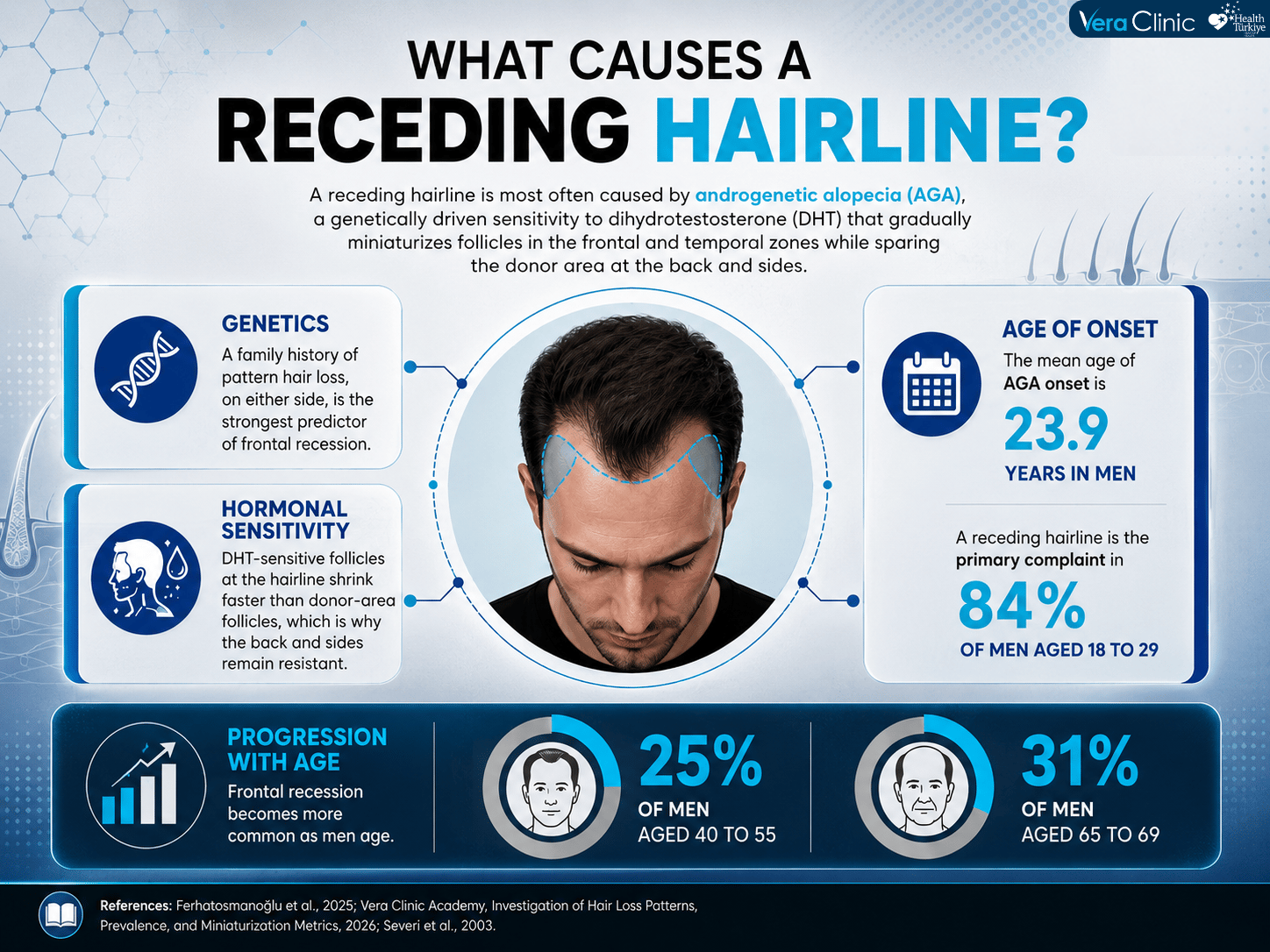
A receding hairline is most often caused by androgenetic alopecia (AGA), a genetically driven sensitivity to dihydrotestosterone (DHT) that gradually miniaturizes follicles in the frontal and temporal zones while sparing the donor area at the back and sides.
- Genetics: A family history of pattern hair loss, on either side, is the strongest predictor of frontal recession.
- Hormonal sensitivity: DHT-sensitive follicles at the hairline shrink faster than donor-area follicles, which is why the back and sides remain resistant.
- Age of onset: The mean age of AGA onset is 23.9 years in men (Ferhatosmanoğlu et al., 2025), which explains why frontal recession so often shows up as a young man’s complaint rather than something confined to middle age.
- Progression with age: Frontal recession is present in 25% of men aged 40 to 55 and 31% of men aged 65 to 69 (Severi et al., 2003).
Taken together, genetics and DHT sensitivity explain why androgenetic alopecia causes the hairline to recede at all, while age of onset and progression data explain why the timing and pace differ so much from one patient to another.
What Are the Early Signs of a Receding Hairline?
In consultations, patients often notice a receding hairline first in photographs rather than in the mirror, since the gradual, asymmetric pace between the two temples is easier to catch in a side-by-side comparison than day to day. The earliest sign of a receding hairline is thinning at the temples, followed by a slow flattening of the frontal corners into an M, U, or V shape. Digital trichoscopy can detect this before it is visible to the eye: in early-stage cases, the miniaturization index already reaches 24.2% ± 3.1%, meaning a meaningful share of frontal hairs have already narrowed in diameter while the total hair count still looks normal (Vera Clinic Academy, Investigation of Hair Loss Patterns, Prevalence, and Miniaturization Metrics, 2026), a distinction between hair loss vs hair thinning that determines whether medication alone is still enough or whether the recession has crossed into a stage that needs surgical correction.
How Is a Receding Hairline Treated?
A receding hairline is treated along a ladder of options ranging from supportive home care to a permanent hair transplant, and most patients only reach the surgical end of that ladder once the earlier steps have stopped keeping pace with the recession.
- Home Remedies: Scalp massage, reduced heat or chemical styling at the hairline, and gentle handling during washing can support existing follicles but have no evidence of reversing recession that has already occurred.
- Supplementary Treatments: Biotin, saw palmetto, and other over-the-counter supplements are commonly used alongside medical treatment, though clinical evidence for their effect on frontal recession specifically remains limited.
- Minoxidil: A topical vasodilator applied directly to the frontal and temporal scalp, where DHT sensitivity is highest, and it prolongs the growth phase of still-active follicles, though the effects of minoxidil for hair loss reverse within months of stopping use.
- Finasteride: An oral 5-alpha-reductase inhibitor that blocks the conversion of testosterone into DHT, and the effectiveness of finasteride for hair loss depends heavily on starting treatment while recession is still early rather than after the frontal zone has gone bald.
- Microneedling: Fine needles create controlled micro-injuries across the frontal scalp to stimulate a wound-healing response, and microneedling for hair loss is usually paired with topical minoxidil rather than used alone.
- LLLT (low-level laser therapy): A light-based therapy that stimulates follicles still in the growth phase, and clinical evidence for LLLT Therapy supports maintaining existing density more than regrowing a fully receded frontal zone.
- Mesotherapy: Scalp micro-injections of vitamins and growth-supporting compounds, and mesotherapy for hair is combined with minoxidil or finasteride rather than used as a stand-alone treatment.
- Hair Transplant: The only option that rebuilds a hairline that has already receded, and the step patients move to once the options above have stopped being enough to hold the line where it is.
None of the options above except a hair transplant can rebuild a hairline that has already receded past the point of active follicles, so patients with visible frontal recession are evaluated for non-surgical options and surgery together rather than trying each option in sequence.
Which Hair Transplant Techniques Are Used for a Receding Hairline?
A hair transplant treats a receding hairline by relocating DHT-resistant donor follicles into the frontal and temporal zone using single-hair grafts placed at 45–55 grafts/cm² along the front row, with the specific technique chosen based on how far the recession has progressed and how much native hair remains at the temples (Vera Clinic Academy, Validation of Baldness Staging Scales, 2026).
- Vector-10 (CVD lab-grown diamond blade): Used for recipient-site creation at the leading edge of the hairline, chosen for the fine cutting angle it allows in the part of the scalp scrutinized most closely.
- Sapphire FUE: Recipient sites at the hairline are opened first using sapphire-tipped blades, which create narrower incisions than standard steel punches and reduce scarring along the front row.
- DHI (Direct Hair Implantation): Grafts are loaded into a pen-style implanter and placed one at a time without pre-opening the site, giving tighter angle control exactly where the hairline is most visible.
- FUT: Capable of restoring a receding hairline and often preferred for advanced cases needing very high graft counts in a single session, but Vera Clinic does not offer it for hairline work because the strip-harvesting method leaves a permanent linear scar at the donor site, a tradeoff that matters most in exactly the area patients are trying to fix.
Because the frontal hairline is judged more closely than any other part of the scalp, graft angle and direction are adjusted hair by hair rather than following a single fixed line, which is what allows a transplanted hairline to move naturally with facial expression instead of sitting as a flat band.
Is FUE or DHI Better for a Receding Hairline?
Both FUE and DHI can rebuild a receding hairline; the difference at the frontal zone comes down to angle control during placement, since the hairline is the area where a wrong angle is most visible.
| Aspect | FUE | DHI |
| Graft handling at the hairline | Recipient sites are opened first, grafts placed after | Grafts are loaded and implanted directly, one at a time |
| Angle precision on the front row | Depends on blade/punch angle set in advance | Adjusted per graft during implantation |
| Use case | Larger sessions covering hairline plus mid-scalp | Dense, single-row work concentrated on the hairline |
Neither technique is universally better for a receding hairline, and the surgeon’s experience with frontal design matters more than the technique label itself, though the broader DHI vs FUE Hair Transplant tradeoffs around recovery time, cost, and session length extend well beyond just the hairline.
Who Is a Candidate for a Receding Hairline Transplant?
A candidate for a receding hairline transplant is a patient whose hair loss has stabilized, who has enough donor density to supply the frontal zone, whose recession pattern is treatable, and who is being evaluated as male or female, since male and female pattern hair loss are staged and planned differently.
- Patients whose hair loss has stabilized: Surgeons want to see the hairline position stay unchanged across multiple follow-up visits before committing grafts to the frontal zone, regardless of age, since operating on active recession risks stranding transplanted follicles ahead of hair that keeps receding behind them and increases the odds of needing a second procedure later.
- Patients with strong donor density: Candidates need enough donor reserve to supply single-hair grafts at 45–55 grafts/cm² along the front row without dropping below the density a future session would need if recession later spreads toward the mid-scalp.
- Patients with a treatable recession pattern: M-shaped, U-shaped, and asymmetric recession can all be treated, though the graft distribution across the temples and center point changes with the pattern, and matching a pattern against the Hamilton-Norwood Scale before consultation helps set expectations for graft count.
- Male and female patients, staged differently: Women are less commonly candidates for a hairline-specific transplant because female pattern hair loss thins the mid-scalp while sparing the frontal band under the Ludwig Scale, and in a Vera Clinic Academy cohort, Ludwig Stage I patients retained an intact frontal hairline band despite early mid-scalp thinning (Vera Clinic Academy, Validation of Baldness Staging Scales, 2026); women with true frontal or temporal recession, rather than diffuse thinning, remain candidates and can be treated without shaving surrounding hair.
Meeting these criteria does not guarantee a specific outcome, but it narrows the decision to whether the priority is treating the current recession now or waiting to combine it with a later session as the pattern continues to evolve.
Who Is Not a Good Candidate for a Receding Hairline Transplant?
Vera Clinic declines to operate on patients with severe donor depletion, patients with uncontrolled medical conditions, patients with unrealistic expectations, patients whose hair loss is too advanced for the donor area to supply, and patients under 20 whose pattern has not yet stabilized.
- Patients with severe donor depletion: if a prior procedure or naturally low donor density has already reduced the reserve close to the safety threshold, there may not be enough healthy follicles left to supply the frontal zone without compromising future coverage.
- Patients with uncontrolled medical conditions: conditions such as unmanaged diabetes, active scalp infections, or bleeding disorders that have not been stabilized with a physician increase surgical risk and are addressed before any transplant is scheduled.
- Patients with unrealistic expectations: those expecting a hairline identical to their pre-recession appearance, or expecting a single session to permanently outpace ongoing hair loss, are counseled on realistic outcomes before proceeding, since setting the wrong expectation upfront is a common source of post-operative dissatisfaction.
- Patients whose hair loss is too advanced for the donor area to supply: once recession has progressed to the point where the donor area cannot cover both the frontal zone and a realistic future session, the priority shifts to preserving what donor reserve remains rather than committing it entirely to the hairline.
- Patients under 20 whose pattern has not stabilized: designing a hairline around a pattern that is still changing risks a line that no longer matches the surrounding hair a year or two later, so these patients are asked to wait.
None of these criteria are permanent exclusions; donor reserves can improve with time, medical conditions can be stabilized, and an unstable pattern in the late teens often settles within a couple of years, so patients who don’t currently qualify are re-evaluated at a later date rather than turned away for good.
How Many Grafts Are Needed for a Receding Hairline?
A receding hairline confined to the frontal and temporal zone requires 1,850 to 3,100 grafts, depending on whether vertex thinning has also begun, with single-hair grafts placed at 45–55 grafts/cm² along the front row to keep the transition natural, based on a Vera Clinic Academy cohort of 412 male patients (Vera Clinic Academy, Validation of Baldness Staging Scales, 2026). The jump between stages is not linear: moving from a symmetrical frontotemporal recession to one with early vertex involvement adds roughly 800 additional grafts on average, reflecting the extra surface area and the geometric demands of covering a whorl pattern rather than a flat zone. Graft planning at this stage is less about a single fixed number and more about matching density to how far the recession has actually spread.
| Norwood Stage | Presentation | Mean Graft Count | Range |
|---|---|---|---|
| Stage II | Minor frontotemporal recession, no vertex thinning | 1,850 ± 250 | 1,600–2,100 |
| Stage III | Deep, symmetrical frontotemporal recession | 2,300 ± 300 | 2,000–2,600 |
| Stage III-Vertex | Frontotemporal recession with early vertex thinning | 3,100 ± 350 | 2,750–3,450 |
This graft range covers recession confined to the frontal and temporal zone; once vertex thinning becomes the dominant feature, graft planning shifts toward a broader scalp strategy, and patients can compare their own pattern against the Hamilton-Norwood Scale before finalizing expectations for total grafts needed beyond the hairline alone.
What Are the Risks of a Receding Hairline Transplant?
The main risks of a receding hairline transplant are depleting the donor area, creating an island hairline effect, running out of future donor reserve, and designing an unnatural hairline, each of which affects how the frontal zone holds up years after surgery rather than just in the first year.
- Depleting the donor area: Harvesting too many grafts for a small frontal zone reduces the reserve available if recession later spreads further back.
- Creating an island hairline effect: Because transplanted follicles are DHT-resistant and permanent, a receding hairline can leave the new frontal line isolated if the native hair immediately behind it keeps thinning, creating a visible gap between the two.
- Running out of future donor reserve: The donor area has a finite supply, so grafts used on the hairline today reduce what is available for the mid-scalp or crown in a future session.
- Designing an unnatural hairline: In a Vera Clinic Academy review of 145 revision cases, unnatural hairline design accounted for 17.2% of documented prior-procedure errors (25 of 145), most of them avoidable with careful preoperative planning rather than being an inherent limitation of the surgery (Vera Clinic Academy, Prior-Procedure Error Type and Graft Survival in Revision Hair Transplantation, 2026).
None of these risks are unique to the hairline, but they show up faster and more visibly there than anywhere else on the scalp, which is why donor planning and hairline design deserve as much attention during consultation as the graft count itself.
How Is a Hairline Corrected After a Previous Hair Transplant?
A hairline from a previous transplant is corrected through a revision procedure that adjusts graft angle, density, or shape, and outcomes depend heavily on what went wrong the first time: in a Vera Clinic Academy cohort of 145 revision patients treated between January 2022 and December 2024, cases where the original error was an unnatural hairline design had the highest 12-month graft survival of any error category (90.1%) and needed additional grafting less often than any other group (12.0%), since repositioning an already-present but poorly shaped line is a more contained problem than replacing tissue lost to donor over-harvesting (79.3% survival, 57.9% needing more grafts) (Vera Clinic Academy, Prior-Procedure Error Type and Graft Survival in Revision Hair Transplantation, 2026). Most of these cases (71.7%) arrive having had their original procedure performed at a different clinic, which is why a second hair transplant at Vera Clinic often starts with a full review of exactly what went wrong the first time before any new graft is placed.
How Much Does a Receding Hairline Transplant Cost in Turkey?
The cost of a receding hairline transplant in Turkey scales with graft count rather than being a flat fee, since a frontal-only procedure requires fewer grafts than a full-scalp session.
| Graft Range | Norwood Stage | Price Range (Turkey, market average) |
|---|---|---|
| 1,600–2,100 grafts | Stage II | €1,550–€2,100 |
| 2,000–2,600 grafts | Stage III | €1,750–€2,450 |
| 2,750–3,450 grafts | Stage III-Vertex | €2,100–€3,050 |
Package inclusions such as accommodation, transfers, and aftercare consultations affect the total price more than the surgical fee itself, and the broader hair transplant Turkey cost picture across techniques and graft counts shows the same pattern holding true regardless of which zone of the scalp is being treated.
What Is the Recovery Timeline After a Receding Hairline Transplant?
Recovery at the hairline follows the same broad phases as the rest of the scalp, but shedding and regrowth are easier to track at the front because the line sits in plain view every time the patient looks in the mirror.
- Weeks 2–4: transplanted hairs enter a temporary shedding phase, which is expected and does not affect final graft survival, though it often causes more visible anxiety at the hairline than elsewhere since the front row briefly looks emptier than the day after surgery.
- Months 3–4: fine, new hair begins to emerge from the transplanted follicles, starting at the center of the new line before spreading toward the temples.
- Months 6–8: the new hairline thickens enough to reshape how the face looks in photos, which is when patients first feel the frontal zone looks intentional rather than “in progress.”
- Months 9–12: the frontal hairline reaches its final density and shape, and any remaining asymmetry between the two temples resolves by this point.
These milestones are averages rather than fixed dates, and individual pace depends on graft density, skin type, and how closely aftercare instructions were followed in the first month. Individual pace still fits within the broader hair transplant recovery timeline that applies across techniques, just concentrated at the front of the scalp instead of spread evenly across the whole head.
What Is the Aftercare for a Receding Hairline Transplant?
Aftercare for a receding hairline transplant centers on wearing protective headwear, washing gently, avoiding friction, and sleeping in the right position, since the new frontal grafts sit closer to the surface and are more exposed than grafts placed further back on the scalp.
- Wearing protective headwear: A loose cap or hat is recommended when outdoors during the first ten days to shield the front row from sun exposure and accidental knocks, since sunburn on fresh grafts can affect healing.
- Washing gently: Washing follows the clinic’s specific schedule, avoiding direct pressure or rubbing on the hairline until scabs have fully shed on their own, by day ten to fourteen.
- Avoiding friction: Hats, helmets, and pillows that rub against the front hairline should be avoided until the area has settled, since repeated friction in the first two weeks is one of the more common causes of graft displacement at the hairline specifically.
- Sleeping in the right position: Sleeping with the head slightly elevated for the first few nights reduces swelling that can otherwise migrate toward the forehead and press against the new grafts.
Missing these steps in the first ten days is one of the more avoidable causes of graft loss at the hairline, and the hair transplant aftercare schedule most clinics follow applies the same logic to every other region of the scalp.
Why Choose Vera Clinic for a Receding Hairline Transplant?
Vera Clinic is recognized by the European Awards in Medicine, and treats a receding hairline as a design problem first, not just a graft-count target: the new hairline is drawn irregular rather than straight, with single-hair grafts placed at the leading edge to avoid the flat, artificial line that gives older transplants away. This approach is shaped by Vera Clinic Academy’s own registry of frontal and temporal recession outcomes, so the transition zone is planned against how the hairline is likely to continue changing, not just where it sits today.
Vector-10™ (CVD Lab-Grown Diamond Instrument), Sapphire FUE, and DHI are each selected based on how far the recession has progressed and how much native hair remains at the temples, and every case is planned around donor preservation as well as the immediate result. Patients receive an all-inclusive package covering the procedure, accommodation, transfers, medications, and aftercare, with every step supervised by Vera Clinic‘s surgical team.
Frequently Asked Questions
No, hair lost to androgenetic alopecia does not grow back on its own, because the follicles have miniaturized rather than simply gone dormant. Early diagnosis keeps more treatment options open before frontal density drops further.
Yes, a hairline lowering hair transplant is a purely aesthetic option, not just a treatment for hair loss: donor follicles are redistributed into the frontal zone to bring the hairline forward, using the same hair transplant approach applied to a receding hairline. A separate, more invasive technique called surgical scalp advancement achieves a similar forward shift by physically advancing the scalp itself rather than adding follicles, but it is a distinct surgical procedure outside the scope of hair transplantation and is rarely combined with it.
The most predictable results come from patients in their late twenties to early thirties whose hair loss has already stabilized, though the frontal zone still requires planning for future loss at younger ages.
Yes, when single-hair grafts are placed at the correct density and angle along the front row, the temples blend into the existing hairline without a visible line or plug-like pattern.
Visible growth at the hairline begins around three to four months after surgery, with the frontal line reaching its final shape and density between months nine and twelve.
- Ferhatosmanoğlu, A., Karaca Ural, Z., Baykal Selçuk, L., Arıca, İ. E., & Aksu Arıca, D. (2025). Comprehensive evaluation of androgenetic alopecia: Demographic characteristics, psychosocial impact, and the role of social media in treatment choices. Journal of Cosmetic Dermatology.
- Gupta, A. K., Wang, T., & Economopoulos, V. (2025). Epidemiological landscape of androgenetic alopecia in the US: An All of Us cross-sectional study. PLoS ONE, 20(2), e0319040.
- Severi, G., Sinclair, R., Hopper, J. L., English, D. R., McCredie, M. R. E., & Boyle, P. (2003). Androgenetic alopecia in men aged 40–69 years: Prevalence and risk factors. British Journal of Dermatology, 149(6), 1207–1213.
- Vera Clinic Academy. (2026). Investigation of hair loss patterns, prevalence, and miniaturization metrics using artificial intelligence-assisted digital trichoscopy: A retrospective registry analysis of 631 patients. https://www.veraclinic.net/wp-content/uploads/2026/06/Investigation-of-Hair-Loss-Patterns-Prevalence-and-Miniaturization-Metrics-Using-Artificial-IntelligenceAssisted-Digital-Trichoscopy-A-Retrospective-Registry-Analysis-of-631-Patients.pdf
- Vera Clinic Academy. (2026). Prior-procedure error type and graft survival in revision hair transplantation: A retrospective cohort study at Vera Clinic, Istanbul, Turkey. https://www.veraclinic.net/wp-content/uploads/2026/07/Prior-Procedure-Error-Type-and-Graft-Survival-in-Revision-Hair-Transplantation-A-Retrospective-Cohort-Study-at-Vera-Clinic-Istanbul-Turkey.pdf
- Vera Clinic Academy. (2026). Validation of baldness staging scales: Retrospective cohort analysis of Norwood & Ludwig classifications with operative graft requirements. https://www.veraclinic.net/wp-content/uploads/2026/06/Validation-of-Baldness-Staging-Scales-Retrospective-Cohort-Analysis-of-Norwood-Ludwig-Classifications-with-Operative-Graft-Requirements.pdf