


There is no single best age for a hair transplant. The right time is determined by hair loss stabilization, not by a specific birthday, which is why most surgeons look for a settled pattern before recommending surgery. Patients in their 20s often face unpredictable future loss that can undermine a transplant’s long-term result, though most who are screened for stability are still cleared to proceed, while patients between 30 and 50 tend to have a more established pattern and adequate donor supply. Age past 50 does not exclude a patient either, as donor hair quality and general health carry more weight than the number on a birth certificate, and candidacy data bears this out. Understanding how stabilization, donor density, and technique choice interact with age helps clarify whether now is the right moment for surgery or whether waiting serves the outcome better.
Key Points
- Hair loss stabilization, not age, is the primary factor surgeons use to time a hair transplant.
- Baldness prevalence rises with age, from 31% among men aged 40 to 55 to 53% among men aged 65 to 69 (Cranwell & Sinclair, 2016).
- Among younger patients screened for stability, 65.0% are cleared for surgery and 35.0% are deferred until their pattern settles further (Vera Clinic Academy, 2026).
- Patients under 30 are advised to complete at least six months of medical therapy before surgery to confirm their hair loss has stabilized (Vañó-Galván et al., 2023).
- Among patients evaluated specifically for advanced age and general health, 87.5% are accepted, with declines tied to health status rather than age itself (Vera Clinic Academy, 2026).
- Donor hair quality and scalp elasticity carry more weight in candidacy than age alone.
- Technique selection can shift with age, with FUE more often suited to larger, more mature areas of loss and DHI favored for precision work in younger patients.
What Is the Best Age for a Hair Transplant?
The best age for a hair transplant is the point at which a patient’s hair loss pattern has stabilized, which for most men with androgenetic alopecia falls after age 30, though the process can begin earlier or later depending on genetics. Age itself is not the criterion surgeons rely on. What matters is whether the balding pattern has stopped shifting enough that a surgeon can design a hairline and density plan that will still look proportionate years later. Baldness prevalence increases steadily with age, rising from 31% among men aged 40 to 55 to 53% among men aged 65 to 69 in a large Australian cohort (Cranwell & Sinclair, 2016), which illustrates why hair loss is better understood as an ongoing process than a fixed condition tied to one age bracket. A hair transplant performed before that process settles risks a mismatch between the transplanted area and the hair that continues to thin around it.
Why Does Hair Loss Stabilization Determine the Right Age?
Hair loss stabilization determines the right age because a surgeon cannot safely plan graft placement around a pattern that is still actively changing. Androgenetic alopecia progresses in stages, and operating while the surrounding native hair continues to fall out can leave transplanted grafts isolated against hair that keeps receding behind them. This is the clinical basis for the international expert consensus recommending that patients under 30 with androgenetic alopecia complete at least six months of medical therapy with finasteride, dutasteride, or minoxidil before a transplant is considered, specifically to confirm that the alopecia has stabilized before grafts are committed (Vañó-Galván et al., 2023). Stability is assessed by comparing the Hamilton-Norwood scale classification across multiple visits rather than by a single consultation, since a pattern that looks settled at one appointment can still be advancing.
What Other Factors Matter More Than Age in Hair Transplant Timing?
Hair loss stabilization, donor hair quality, scalp health, and patient expectations matter more than age when a surgeon evaluates candidacy for a hair transplant.
- Hair Loss Stabilization: Surgeons look for a pattern that has held steady across several visits, since a design built on a moving target rarely ages well, whatever the patient’s exact birth year.
- Donor Area Quality: Coverage potential comes down to what is available in the hair transplant donor area, where density, hair thickness, and follicle health set the ceiling on results far more than the patient’s age does.
- Healthy Scalp Condition: Laxity and skin health at the extraction and recipient sites shape how cleanly grafts come out and go in, a variable that has more to do with individual physiology than with the number of birthdays.
- Realistic Expectations: What a patient wants from density and hairline shape, and whether they will stick with any medication plan afterward, does more to define a satisfying outcome than age does on its own.
Age remains a useful starting point for a candidacy conversation, but these four factors are what a surgeon actually measures before confirming a patient is ready for surgery.
What Age Range Gives the Best Hair Transplant Results?
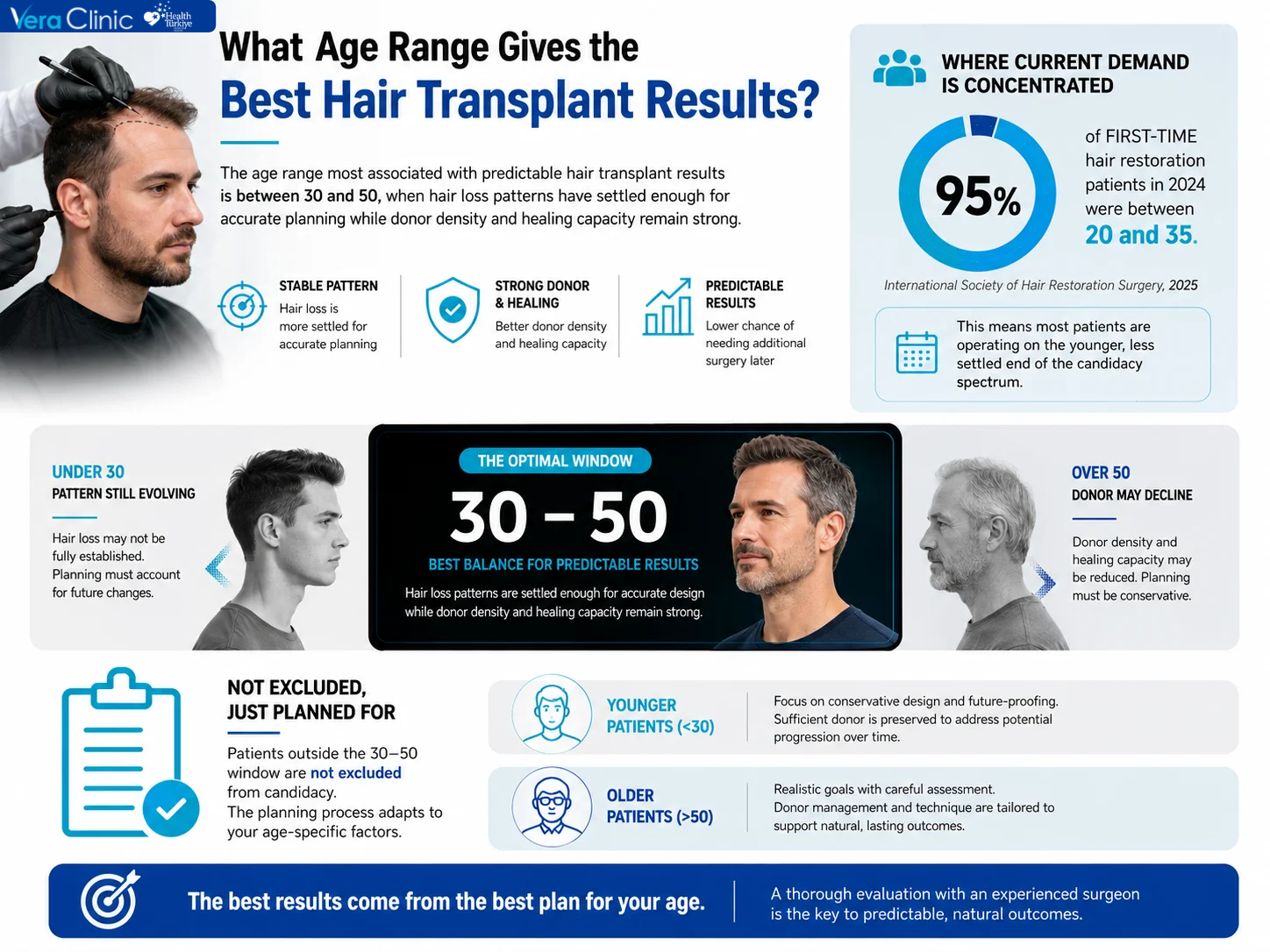
The age range most associated with predictable hair transplant results is between 30 and 50, when hair loss patterns have settled enough for accurate planning while donor density and healing capacity remain strong. This window does not match where current demand is concentrated: 95% of first-time hair restoration patients in 2024 were between 20 and 35 (International Society of Hair Restoration Surgery, 2025), meaning a large share of patients are operating on the younger, less settled end of the candidacy spectrum rather than the range surgeons associate with the most predictable outcomes. Within the 30 to 50 window, a surgeon can map out a design based on a pattern that is unlikely to shift substantially, which lowers the chance that correcting continued loss around the original graft placement will require additional surgery later. Patients outside this range are not excluded from candidacy, but the planning process accounts for either an unfinished pattern in younger patients or reduced donor density in older ones.
How Do Hair Transplant Outcomes Compare by Age Ranges?
Hair transplant outcomes differ across age brackets mainly through pattern stability and donor reserve, which together shape recovery speed and the likelihood of needing further surgery.
| Age Range | Pattern Stability | Donor Density | Recovery | Technique Fit | Revision Likelihood |
|---|---|---|---|---|---|
| Under 25 | Often still progressing | Adequate | Fast | DHI favored for conservative, precision-first design | Higher, due to ongoing loss |
| 30–50 | Usually settled | Strong in most candidates | Standard | FUE or DHI, depending on area size | Lower |
| 50+ | Settled | Varies by individual health and prior loss | Slower, depends on general health | FUE favored for broader coverage | Depends on donor reserve |
Reading pattern stability alongside technique fit matters more than reading either column alone, since the same age bracket can call for a different approach depending on how much of the donor area remains untouched by prior loss.
Is a Hair Transplant Safe in Your 20s?
Yes, a hair transplant can be performed in your 20s, but it carries specific risks tied to unfinished hair loss progression that older patients do not face to the same degree. Surgeons manage this by screening for pattern stability rather than relying on age as a cutoff, and most younger candidates who go through this screening are cleared to proceed: among 140 younger patients evaluated specifically for pattern stability over a 12-month period (April 2024–March 2025), 65.0% were confirmed stable enough for surgery, while the remaining 35.0% were deferred until their pattern settled further, according to a Vera Clinic Academy Hair Transplant Candidacy Outcomes by Risk Category Study.
- Unpredictable Future Loss: A patient’s Norwood stage at 22 does not reliably predict their stage at 35, which makes it difficult to design a hairline that stays proportionate as loss continues.
- Donor Depletion Risk: Using donor grafts to fill an area that has not finished balding can leave insufficient donor supply for the additional coverage a patient may need later.
- Hairline Mismatch: A hairline designed around a 20s-era pattern can end up positioned too low or too dense relative to the surrounding hair once loss advances further, compromising the natural appearance the procedure was meant to achieve.
- Compressed Decision Window: Because teenage hair loss and early-onset loss in the early 20s often continue to progress for years, surgery at this stage frequently precedes, rather than follows, the stabilization surgeons look for.
- Higher Revision Likelihood: A design built around an unstable 20s-era pattern is more likely to need correction later, and undoing or adjusting a mismatch through a second hair transplant is a more complex undertaking than getting the design right the first time.
None of these risks rule out surgery in your 20s outright. They are the reason surgeons weigh a longer observation period before committing grafts to a pattern that may still be changing.
Can You Get a Hair Transplant After 50?
Yes, patients over 50 can be strong candidates for a hair transplant, and excellent outcomes are the norm rather than the exception in this group once donor quality and general health are accounted for (International Society of Hair Restoration Surgery, 2024). What changes with age is the evaluation process and the goal itself: surgeons weigh cardiovascular health, medication use, and healing capacity more closely, and donor density assessment carries added importance since natural thinning in the donor zone can also affect older patients. General health is the deciding factor when a patient in this group is not cleared for surgery, not age on its own, consistent with the Vera Clinic Academy Hair Transplant Candidacy Outcomes by Risk Category Study, in which 87.5% of 40 patients evaluated over a 12-month period (April 2024–March 2025) for advanced age and general-health factors were accepted, with declines tied to health status rather than age. Rather than aiming to fully reverse decades of loss, the goal for an older patient is to restore a frontal hairline and place a limited number of grafts strategically behind it, a “less is more” approach that works because the human eye cannot reliably distinguish 50% density from 100% density on the scalp (International Society of Hair Restoration Surgery, 2024). In cases where donor supply is genuinely too limited to support a good outcome, a surgeon may recommend against surgery altogether rather than proceed with an unrealistic plan. Gray or white donor hair does not prevent a transplant either, though it is assessed separately through a white hair transplant evaluation, since pigment loss affects visibility and graft handling rather than survival.
What Do Hair Transplant Results Look Like at Different Ages?
Hair transplant results look different across age groups because the goal shifts from maximizing density in younger patients to preserving a natural, age-appropriate frame in older patients. A patient in their 30s is often working toward a fuller hairline and higher density, while a patient in their 50s or later frequently prioritizes a natural-looking frame over recreating the density of a much younger hairline, a contrast that shows up clearly when comparing hair transplant before and after cases across age brackets.
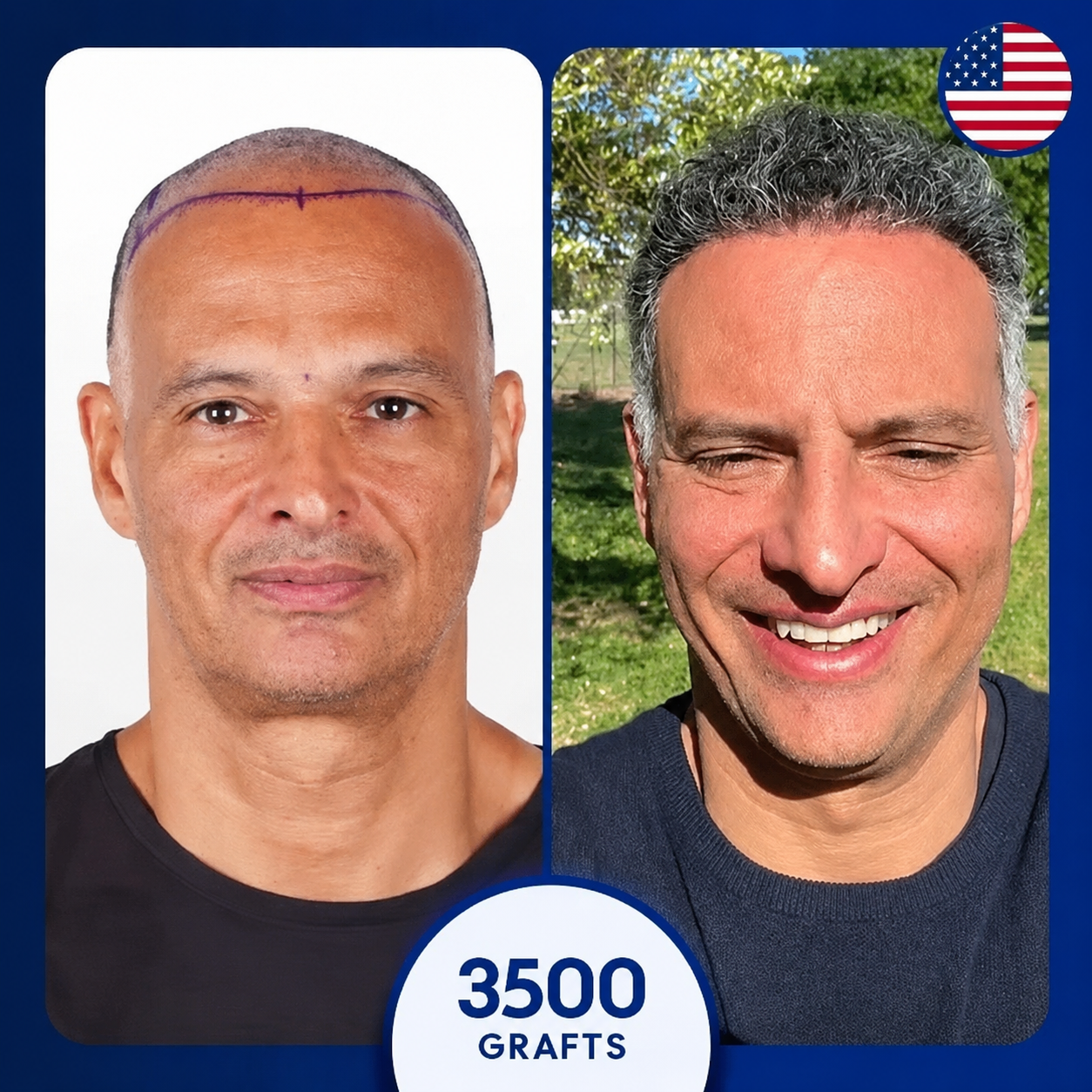

Reviewed side by side, these cases set expectations that match what is achievable for a given starting pattern and donor supply, rather than a single standard outcome applied across every age group.
Which Hair Transplant Techniques Work Best at Different Ages?
The technique that suits a patient best shifts with age mainly because each method fits a different combination of area size, precision need, and donor difficulty.
- DHI: Favored for patients with finer, more hairline-focused loss, common in younger candidates, since its incision-free placement allows tighter precision on smaller, more delicate zones and reduces the time grafts spend outside the body between extraction and implantation.
- Sapphire FUE: An option for patients seeking denser packing regardless of age, when donor difficulty is low and higher graft density is the priority, since the sapphire blade’s cleaner incision supports tighter graft spacing without added trauma to the recipient area.
- Vector-10™ (CVD Lab-Grown Diamond): A blade option available regardless of age, built from CVD lab-grown diamond that sustains sharpness across roughly 15 times more incisions than sapphire before showing comparable degradation, which matters most for patients needing higher incision volumes, such as older candidates with larger coverage areas or younger candidates planning for future sessions.
- FUE: Better suited to patients with larger or more mature areas of loss, since it efficiently covers broad zones once hair loss has extended beyond the hairline, and achieves graft survival rates generally reported between 90% and 95% in accredited clinical settings (Parsley & Perez-Meza, 2010).
- FUT: A strip-harvesting technique that removes a linear section of scalp tissue to extract grafts before closing the donor area with sutures. Vera Clinic does not offer FUT regardless of age, since the method leaves a permanent linear scar across the donor area, a tradeoff the clinic considers unnecessary given that FUE and DHI achieve comparable coverage without it.
Age narrows the starting point for this decision, but the final choice is confirmed against the full range of hair transplant techniques available and how each fits a patient’s specific donor profile.
Which Hair Transplant Technique Is Better by Age, FUE or DHI?
FUE and DHI suit different age profiles mainly because of how each places grafts, not because one technique is universally stronger than the other.
| FUE | DHI | |
|---|---|---|
| Placement Method | Pre-made recipient incisions, grafts inserted after | Single-step extraction and implantation via implanter pen |
| Best Age Fit | Patients past 50 or with larger, more mature zones of loss | Patients under 30 with smaller, hairline-focused areas |
| Coverage Efficiency | Higher, suited to wide areas | Lower per session, suited to precision zones |
| Session Length | Standard | Longer, due to the single-step process |
Age points toward one technique or the other, but the final decision still comes down to matching a patient’s donor characteristics and area of loss against the specific DHI vs FUE hair transplant comparison.
How Does Age Affect Graft Survival?
Age affects graft survival mainly through its relationship with donor density, not through age itself as a biological limit on healing. Patient selection and hair characteristics carry more weight in determining survival than a patient’s age alone (Parsley & Perez-Meza, 2010). A patient with strong donor density and good scalp health can achieve comparable graft retention whether they are 30 or 55, while a patient with reduced donor supply, more common as natural thinning accumulates over decades, faces a tighter margin for error in extraction and placement. This is why an assessment of the donor area weighs donor quality alongside a patient’s overall health, and why published hair graft survival rate figures are read against donor characteristics rather than against age alone.
Does the Best Age Differ for Women?
Yes, the best age for a hair transplant is later for women than for men, since female pattern hair loss develops on a slower, more cumulative timeline rather than settling early. Clinically detectable female pattern hair loss appears in 12% of women by age 29, rising to 25% by age 49 and 41% by age 69 (Fabbrocini et al., 2018), which places the candidacy window for most women closer to the 40s and 50s than the 30-to-50 range associated with the strongest male outcomes. This later timeline reflects when stabilization for a meaningful share of women is confirmed, not a fixed cutoff, since individual onset still varies widely. Diffuse thinning across the crown rather than a receding hairline is the dominant pattern, and because the frontal hairline is frequently preserved even as density drops elsewhere, ruling out non-androgenetic causes of thinning, such as thyroid conditions or iron deficiency, is a more central step in candidacy evaluation than it is for men. These differences in pattern and diagnostic workup are why age-based timing guidance for hair transplant for women is assessed on its own terms rather than mapped directly from male timelines.
Frequently Asked Questions
Most clinics set a minimum age between 21 and 25, since hair loss patterns before this range are considered too unsettled to plan a durable graft design, and consensus guidance places additional emphasis on confirming stabilization before proceeding in patients under 30 (Vañó-Galván et al., 2023).
Older patients do not automatically need more grafts than younger patients, since graft count depends on the area and density of loss rather than age itself, though decades of untreated progressive loss can result in a larger area requiring coverage by the time surgery is considered.
No, there is no maximum age for a hair transplant, provided the patient has adequate donor density and no health condition that would compromise healing. Candidacy at any age is determined by donor supply and general health rather than a birthday cutoff.
A hair transplant performed at a younger age lasts as long as one performed later in life, since transplanted follicles are resistant to the hormone that causes pattern baldness and do not fall out once they take. What changes with younger age is not durability but the risk that surrounding native hair continues to thin, which can make an early result look less proportionate over time even though the transplanted grafts themselves remain permanent.
Surgeons generally advise against a hair transplant while hair loss is still actively progressing, since operating on an unstable pattern risks a design that no longer matches the surrounding hair within a few years. Medical therapy is used to slow or confirm the stabilization of active loss before a transplant is scheduled.
- Cranwell, W., & Sinclair, R. (2016). Male androgenetic alopecia. In Endotext. MDText.com, Inc.
- Fabbrocini, G., Cantelli, M., Masarà, A., Annunziata, M. C., Marasca, C., & Cacciapuoti, S. (2018). Female pattern hair loss: A clinical, pathophysiologic, and therapeutic review. International Journal of Women’s Dermatology, 4(4), 203–211.
- International Society of Hair Restoration Surgery. (2024, January 14). A guide to hair transplantation after age 50: Excellent results are the rule in older patients.
- International Society of Hair Restoration Surgery. (2025, May 13). New survey finds younger adults, more women seeking treatment for hair loss [Press release].
- Parsley, W. M., & Perez-Meza, D. (2010). Review of factors affecting the growth and survival of follicular grafts. Journal of Cutaneous and Aesthetic Surgery, 3(2), 69–75.
- Vañó-Galván, S., Bisanga, C. N., Bouhanna, P., Farjo, B., Gambino, V., Meyer-González, T., Silyuk, T., & Hair Transplant Surgery Expert Group. (2023). An international expert consensus statement focusing on pre and post hair transplantation care. Journal of Dermatological Treatment, 34(1), 2232065.
- Vera Clinic Academy. (2026). Hair transplant candidacy outcomes by risk category: A retrospective audit of age, medication, comorbidity, and HIV-related eligibility decisions at Vera Clinic [Research report].