
Exosome hair loss treatment is a regenerative treatment that uses nanovesicles (tiny extracellular messengers measuring about 30–150 nanometers) to restore scalp communication at the cellular level. These exosomes are released naturally by stem cells and carry microRNAs, proteins, and growth factors that instruct damaged or dormant hair follicles to repair, divide, and regrow. In cases of androgenetic alopecia, where follicles shrink under the influence of DHT and chronic microinflammation, these regenerative vesicles support communication between cells in the affected tissue.
The vesicles deliver miRNAs (for example miR-181a-5p, miR-122-5p, miR-218-5p), growth mediators like VEGF and IGF-1, and Wnt/β-catenin cues associated with the hair-cycle. A 2025 review of exosome use in human subjects covering 125 patients across 9 alopecia studies found rare local side effects and concluded that larger controlled trials are still needed to prove efficacy (Queen and Avram, Dermatologic Surgery, 2025).Patients who still have thinning, vellus-leaning hairs respond best; the scaffold exists, the signals were missing.
Exosome therapy for hair loss is non-surgical and clinic-based. A session targets affected zones with micro-injections placed at consistent depths over the thinning field. The aim is diffusion, not bulk. Practitioners map the safe donor ridge and the high-risk frontal third differently because vascular density and sebum flow change absorption. Technique matters. So does oxygen.
At Vera Clinic, we include exosome hair therapy as a post-transplant regenerative protocol within the “New Generation Exosome Package” priced at €5,990 and pair exosomes with OxyCure Therapy to improve local oxygen tension and diffusion. Oxygen supports vesicle stability and uptake across the extracellular matrix, especially in sebum-heavy or fibrotic scalp. More oxygen means better gradient, better spread, better chance the vesicles reach the dermal papilla niche.
PRP delivers platelet-derived signals, mesotherapy delivers vitamin-based compounds, and exosomes deliver stem-cell-derived signaling molecules. The result patients want is visible density. The mechanism we pursue is precise signaling.
What Is Exosome Hair Therapy?
Exosome hair therapy is a non-surgical regenerative treatment that uses nanovesicles (tiny extracellular messengers derived from stem cells) to restore scalp health and promote hair regrowth.
Procedure type: Non-surgical
Treatment duration: 30–45 minutes
Downtime: None
Results visible: 8–12 weeks
Longevity: 12–24 months
Each exosome carries microRNAs, proteins, and growth factors that repair damaged hair follicles and reactivate dormant ones. Unlike PRP or mesotherapy, which depend on the patient’s own biological material, exosome therapy delivers pre-programmed regenerative signals that optimize follicle recovery even in areas with low vascularity.
How Does Exosome Therapy Work for Hair Loss?
Exosome therapy reactivates dormant follicles by transferring regenerative RNA and proteins that restore lost communication between cells in the scalp. The vesicles bind to damaged dermal papilla cells, triggering the release of Wnt/β-catenin, VEGF, and IGF-1, key pathways for hair-cycle activation and angiogenesis.
By repairing the microinflammatory environment caused by DHT and oxidative stress, exosome hair treatment helps reverse miniaturization, stabilize shedding, and improve follicle vitality. Patients with androgenetic alopecia notice reduced hair loss within the first two months, followed by visible thickening between weeks 8–12.
How Does Exosome Therapy Stimulate Hair Regrowth?
Exosome therapy stimulates hair regrowth by restoring scalp signaling at the molecular level.
The vesicles deliver miR-181a-5p, miR-122-5p, and miR-218-5p; microRNAs that activate dermal papilla cells and extend the anagen (growth) phase.
These vesicles increase vascular endothelial growth factor (VEGF) and insulin-like growth factor (IGF-1), which improve oxygen and nutrient delivery to follicles. This combination strengthens the follicular matrix and promotes new keratin production
How do exosomes reactivate dormant follicles?
Exosomes reactivate dormant follicles by transferring regenerative RNA, proteins, and growth factors that restart the communication between dermal papilla cells and surrounding tissues. This restores the follicle’s ability to enter the anagen (growth) phase and produce new hair strands.
Is Exosome Hair Therapy Effective?
Yes, exosome hair therapy is effective and clinically shown to improve hair density and thickness by restoring follicular signaling.
- Hair density increased from 121.7 to 146.6 hairs per cm² in a study of 39 patients (Park et al., 2022)
- Shaft thickness increased from 52.6 to 61.4 micrometers in the same study (Park et al., 2022)
- Visible improvement reported at 8 to 12 weeks
Hyperbaric oxygen (such as OxyCure Therapy) and exosome therapy are mechanistically linked through their shared role in tissue repair, with oxygen supporting the regenerative processes exosomes rely on (Zhang et al., 2025).
What Does Vera Clinic Academy’s Own Data Show for Exosome Therapy?
While the studies above rely on external research, Vera Clinic Academy has also tracked its own patients undergoing exosome therapy to see how these results hold up in real-world practice. In a 12-month prospective observational cohort, 40 patients received exosome therapy across 3 sessions spaced roughly three weeks apart. By the 12-month endpoint, follicular density had increased by 28.4% and hair shaft diameter by 22.8%, with the first documented clinical response recorded at month 1.5, following just the first session, according to Vera Clinic Academy’s Regenerative Hair Therapies and Hair Transplantation Outcomes Study (2026). Patients also reported high satisfaction, reflected in a PROM score of 8.6 out of 10.
| Vera Clinic Academy — Exosome Cohort (n=40) | 12-Month Result |
|---|---|
| Follicular Density Increase | 28.4% |
| Hair Shaft Diameter Increase | 22.8% |
| First Documented Clinical Response | Month 1.5 (post-session 1) |
| Patient-Reported Outcome (PROM) Score | 8.6 / 10 |
Within this same cohort, exosome therapy showed a numerically higher density increase (28.4%) than PRP (18.2%) or mesotherapy (12.5%) over the identical 12-month period. This pattern is consistent with the underlying mechanism: exosomes deliver concentrated, cell-derived signaling molecules directly, rather than relying on the patient’s own platelet or nutrient supply, which may explain the faster and more pronounced response observed here. As the three modalities differ in mechanism and are typically indicated for different patient profiles and severity levels, this reflects the specific cohort studied rather than a universal ranking of effectiveness.
How Many Exosome Sessions Are Needed for Hair Regrowth?
The typical protocol for an exosome hair session is 1–2 sessions spaced 30–45 days apart; visible results begin at 8–12 weeks. Maintenance is optional yearly booster.
- Primary sessions: 1–2 treatments
- Interval: 30–45 days between sessions
- Visible result window: 8–12 weeks
- Maintenance: optional 1 session/year
Using multiple exosome hair loss treatment sessions within the defined interval improves signal saturation and extends the anagen phase. Maintenance yearly helps sustain benefit beyond the initial 12–24 months of effect.
How soon will I see results from exosome therapy?
Most patients begin noticing reduced shedding within 6–8 weeks after exosome therapy, with visible hair density and thickness improvements appearing between 8–12 weeks as new follicles enter the active growth phase.
What Happens in an Exosome Session?
An exosome hair therapy session delivers concentrated extracellular vesicles derived from mesenchymal stem cells directly into the scalp to restore follicular communication and accelerate tissue regeneration.
The session lasts less than an hour. Oxygen is applied first to support tissue oxygenation before injection. Then, exosomes are delivered into the scalp, each carrying microRNAs that support cell signaling.
This is a non-surgical therapy: follicles are not forced to grow, but supported in their existing growth cycle.
For seven to ten days, these vesicles migrate through the extracellular matrix, merging with cells, releasing regenerative signals, and supporting vascular activity in the treated area.
Duration: 30–45 minutes
Target depth: 1.2–1.5 mm in the dermal papilla zone
Concentration: 10⁹ vesicles/mL enriched with miR-181a-5p, miR-122-5p, miR-218-5p, VEGF, and IGF-1
Injection mapping: 100–120 micro-points guided by UHL Scanner scalp-thickness assessment for depth-calibrated, uniform diffusion
Integration window: 7–10 days for vesicle fusion and regenerative signaling activation
Purpose: Cellular reactivation, angiogenesis, and reversal of follicular miniaturization
1. The Bioelectric Reset (0–5 minutes)
Before injection, the scalp is prepared to optimize its electrical conductivity and oxygen tension. At Vera Clinic, OxyCure Therapy is used before the session to saturate tissues with oxygen at 2 ATA, supporting tissue oxygenation and the oxygen-dependent processes involved in vesicle uptake.
Why this matters: exosomes don’t diffuse through airless tissue. They follow oxygen gradients. Higher oxygen means deeper diffusion and more vesicle uptake by dermal papilla cells.
Hair regeneration in this context is not purely chemical, but signaling-based. Oxygen and electrical conductivity influence the strength of this cellular signaling.
2. The Vesicle Mapping Phase (5–25 minutes)
The clinician uses a high-frequency injector or microneedle gun with 1.25 mm penetration depth calibrated to the scalp’s thickness and density profile. Unlike PRP, where plasma distribution is broad, exosome extracellular vesicle therapy delivery is micro-targeted to regions with higher follicular dropout density.
Each injection site receives roughly 0.02 mL of vesicle concentrate containing up to 10⁹ particles/mL, standardized for miR-181a-5p, miR-122-5p, and miR-218-5p expression (Vera Clinic Academy Database, 2026). These microRNAs activate the Wnt/β-catenin and IGF-1 pathways within 48 hours, the same genes dormant follicles need to re-enter the growth cycle.
In a retrospective clinical analysis of 39 androgenetic alopecia patients, adipose-derived stem cell exosomes applied to the scalp increased hair density from 121.7 to 146.6 hairs per cm² with no notable adverse reactions (Park et al., J Cosmet Dermatol, 2022).
3. The Integration Window (Day 1–Day 10)
After injection, vesicles migrate through the extracellular matrix and fuse with follicular stem cells. Here’s the hidden mechanism: exosome injection for hair uses lipid bilayer mimicry to merge with recipient membranes, releasing their genetic cargo into the cytoplasm. This process is energy-dependent and oxygen-sensitive, which is why OxyCure hyperbaric oxygen support is used alongside the treatment.
During this phase, early “micro-pruritus” or light tingling may appear, signaling active nerve and fibroblast regeneration. This is a good sign, not irritation. By Day 5, angiogenesis is supported by elevated VEGF and IGF-1 expression, reported in preclinical dermal papilla cell (Rajendran et al., 2017; Oh et al., 2024).
4. The Recovery Intelligence Layer (Weeks 1–4)
Patient-reported sensitivity, local pH, and transepidermal water loss (TEWL) are used to measure how effectively exosomes are integrated into scalp metabolism. If absorption lag is detected, an hyperbaric oxygen micro-boost session can be added to rebalance oxygen gradients and improve vesicle uptake.
What Are Exosomes Made Of?
Exosomes used in stem cell therapy for hair are extracellular vesicles, not living cells. They are microscopic lipid-bound spheres that carry RNA, proteins, and lipids; the molecular signals that living cells use to communicate and repair. Unlike stem cells, they cannot divide or alter DNA; they only transfer information.
These vesicles are derived from adipose-derived stem cells (ADSC exosomes), bone marrow mesenchymal stem cells (BMSC exosomes), or dermal papilla cells (DPC exosomes), all known for strong regenerative signaling. In clinical production, exosomes are isolated using ultracentrifugation (to separate by density), size-exclusion chromatography (to remove impurities), and sterile filtration (to ensure clinical-grade purity). Each 30–150 nm vesicle is verified under electron microscopy for shape, integrity, and concentration consistency.
Exosome therapy is considered safer than stem cell transplantation because it delivers cell-free regenerative communication, no nuclei, no replication, only bioactive messengers like VEGF, IGF-1, and miR-series RNAs that restart the scalp’s self-repair cycle.
How Are Exosome Ingredients Collected?
Exosome ingredients are collected from stem cell culture media, not from inside the cells themselves. Once the donor stem cells (ADSCs or BMSCs) secrete vesicles into their surrounding medium, the fluid is harvested and purified through ultracentrifugation and tangential flow filtration. What remains is a cell-free solution of extracellular vesicles ready for clinical application.
All batches are processed in GMP-certified labs, following FDA biologics and ISO 20399 standards, ensuring sterility, safety, and consistent vesicle concentration before use in patients.
Are exosomes considered a drug or a biologic?
No, exosomes are classified as biologic-derived therapeutics, not drugs, because they originate from living stem cells but contain no living components; only the regenerative signals those cells release.
What Do Exosomes Deliver to Hair Follicles?
Exosome therapy for hair loss delivers a biologically active injectable formula; a cell-free, regenerative “communication system” that restores balance in the follicular microenvironment. Inside the exosome solution, hundreds of molecules act in synergy, similar to a mesotherapy cocktail, but at a nanoscale where real genetic signaling occurs.
| Molecule | Function |
| VEGF | Increases vascularization and nutrient delivery to follicles, improving oxygen flow and graft survival. |
| IGF-1, HGF, KGF | Stimulate dermal papilla cell proliferation and accelerate anagen phase re-entry. |
| miR-218-5p | Suppresses SFRP2 expression, thereby activating the Wnt/β-catenin pathway essential for hair follicle regeneration. |
| miR-181a-5p | Reduces follicular apoptosis and protects against oxidative stress. |
| miR-122-5p | Counters DHT-induced suppression on dermal papilla cells, preserving their metabolic activity. |
| Annexins, CD63, CD81 | Surface identifiers that define exosomal purity and ensure precise cell targeting. |
| β-catenin, Shh (Sonic hedgehog) | Core intracellular signals responsible for follicle renewal and stem cell activation. |
This molecular network works as a biological relay: one signal reactivates another, forming a regenerative cascade that restores scalp homeostasis.
How Long Do Exosome Results Last?
Results from exosome therapy last 12–24 months, depending on genetic predisposition, hormonal balance, stress levels, and scalp care. The longevity comes from miRNA persistence within dermal papilla cells. These microRNAs continue to regulate gene expression long after the session, sustaining the follicle’s regenerative state. At Vera Clinic, OxyCure Therapy enhances oxygen diffusion, which increases miRNA stability.
How long does exosome therapy last?
Most patients retain visible density for up to two years, with optional booster sessions maintaining signal strength beyond that period.
How Much Does Exosome Hair Therapy Cost in 2026?
The cost of exosome hair therapy in 2026 varies by country and clinic infrastructure. In Turkey, the treatment averages €1,500–€2,500 per session, depending on concentration, combination with OxyCure or PRP, and aftercare protocols with the country-by-country breakdown set out in the exosome therapy statistics.
| Country | Average Cost (€) |
| Turkey | 1,500–2,500 |
| UK | 3,500–4,200 |
| USA | 4,800–5,500 |
This makes Turkey, especially Istanbul, a leading destination for exosome stem cell therapy for hair, offering hospital-grade infrastructure and integrated oxygen-assisted protocols at a fraction of Western pricing.
Exosome Package at Vera Clinic
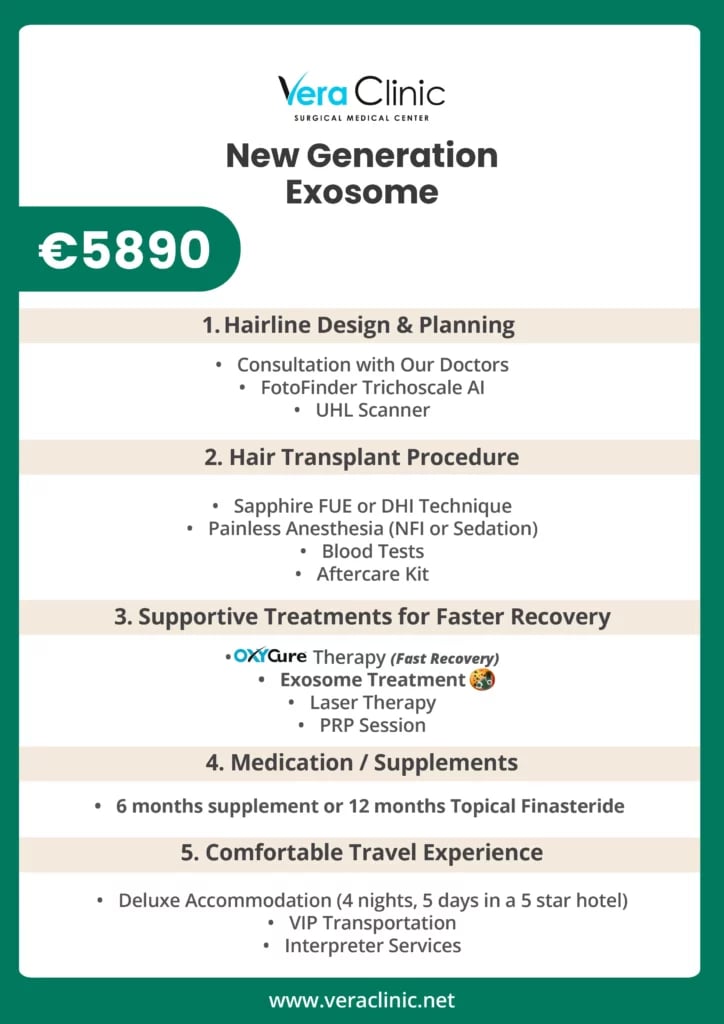
The Exosome Package at Vera Clinic combines Sapphire FUE or DHI hair transplantation with a post-procedure exosome therapy session designed to support faster healing. It includes OxyCure Therapy, PRP, and Laser Therapy for enhanced recovery, along with medications, and VIP accommodation and transfers, creating a complete, medical-tourism-ready regeneration program for €5,990.
Consult Vera Clinic specialists for a personalized protocol and exosome concentration tailored to your scalp condition and recovery timeline.
What Are the Benefits of Exosome Hair Therapy?
Exosome hair therapy offers multi-layered regeneration, it thickens hair and reprograms the scalp’s communication system.
The vesicles restore dermal papilla cell vitality, improve oxygen diffusion, and reverse miniaturization without surgery. Because exosomes contain growth mediators like VEGF, IGF-1, and miR-series RNAs, they trigger new microvessel formation and prolong the anagen (growth) phase for long-lasting density.
At Vera Clinic, combining exosome therapy with OxyCure oxygen support to aid signal penetration and post-transplant recovery, ensuring deeper signal penetration and faster post-transplant recovery. Patients report less shedding and visible improvement in texture within three months.
What Are the Side Effects of Exosome Hair Therapy?
Exosome therapy is a cell-free treatment with minimal risks, as it contains no live cells or hormones. Mild redness, tenderness, or pinpoint swelling may occur for 24–48 hours following injections, normal responses to tissue activation. There are no hormonal disruptions and no immune rejection, making it equally safe for both women and men.
Is exosome therapy safe for women and men?
Yes, since exosomes don’t contain DNA or donor cells, they are universally biocompatible and gender-neutral in application.
Contraindications:
- Pregnancy or breastfeeding
- Active scalp infections
- Autoimmune or inflammatory disorders (e.g., lupus, psoriasis)
- Uncontrolled diabetes or bleeding conditions
- Recent chemotherapy or radiation
What Does Exosome Hair Therapy Aftercare Require?
Exosome therapy requires minimal downtime, but precision aftercare ensures maximum signal retention. For 48–72 hours, your scalp is in a communication phase where exosomes are still fusing with follicle cells. That’s why rest, hydration, and oxygen flow matter more than products or routines.
Avoid washing your hair for the first day and skip gym sessions, saunas, or tight hats for three days. These small habits protect the delicate vesicle layer now working beneath your skin. Think of it as giving your follicles quiet space to “read” the genetic instructions they just received.
What Are the Alternatives to Exosome Hair Therapy?
While exosomes represent the newest generation of regenerative treatment, other options remain effective depending on hair loss severity and scalp condition:
- Mesotherapy for hair: Vitamin-based injectable formula that nourishes hair follicles superficially.
- Stem Cell Hair Transplant: Regenerates follicles through living stem cells extracted from adipose tissue.
- PRP Treatment (Platelet-Rich Plasma): Uses the patient’s platelets to release growth factors.
- PP405 Hair Loss Treatment: Small-molecule therapy under clinical review for DHT resistance.
- Low-Level Laser Therapy (LLTL): Non-invasive photobiomodulation to improve blood circulation.
- NAD+ Therapy: A metabolic restoration treatment that enhances mitochondrial energy, supports oxygen utilization, and strengthens follicle longevity when paired with OxyCure or exosome hair regeneration sessions.
What Are the Differences Between Exosome vs PRP vs Stem Cell Therapy?
PRP stimulates existing cells with platelet-derived growth factors, stem cells introduce living regenerative cells, and exosomes deliver cell-free signaling molecules without introducing any new cells.Check exosome vs PRP for hair and exosome vs stem cell therapy below.
| Therapy | Mechanism | Longevity | Ideal For |
| PRP | Platelet-derived growth factors | 6–9 months | Early thinning |
| Stem Cell | Cellular regeneration using living stem cells | 12–18 months | Advanced androgenetic alopecia |
| Exosome | Cell-free gene signaling via RNA and protein messengers | 12–24 months | Diffuse or treatment-resistant hair loss |
Can Exosome Therapy Replace a Hair Transplant?
Exosome therapy cannot replace a hair transplant, it complements it. While exosomes restore cellular communication and improve scalp vitality, they don’t create new follicles in completely bald areas. Instead, they act as a regenerative enhancer that supports recovery.
At Vera Clinic, combining Exosome + OxyCure + Stem Cell Therapy is intended to support graft oxygenation and aid post-surgery recovery. Exosomes help transplanted follicles adapt faster to their new environment by stimulating dermal papilla activity and angiogenesis within the first two weeks.
This combination is positioned as a supportive addition to the hair transplant procedure, intended to aid the graft’s adaptation to its new environment.
Can exosome therapy be done before or after a hair transplant?
Exosome therapy can be done both ways: before, to prepare the scalp and boost circulation; and after, to support healing.
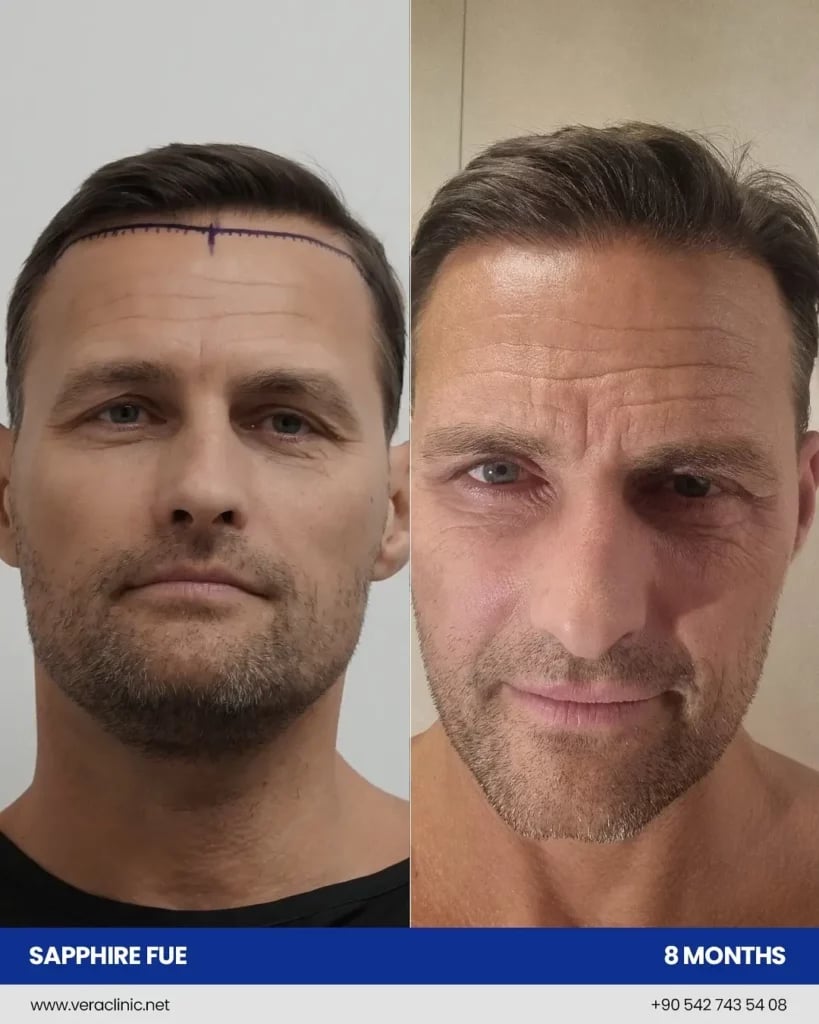
How Do Exosome Hair Therapy Before and After Results Look Like?
At Vera Clinic, hair transplant before and after analyses show visible density gains and improved scalp vitality within 8–12 weeks post-treatment. Patients report softer texture, fewer shedding episodes, and stronger follicle anchoring following OxyCure-assisted exosome hair growth therapy sessions.
What Do Patients Say About Exosome Hair Therapy in Turkey?
Patients describe exosome therapy at Vera Clinic as comfortable, quick, and noticeably effective. Most highlight the absence of pain, reduced post-transplant redness, and faster return to daily life. Reviews mention visible thickening around the third month and appreciation for the clinic’s aftercare monitoring, which tracks recovery.
Patient quotes
Selected highlights from users and verified patients.
“The exosome booster made my transplanted area heal twice as fast.”— John D.
“Felt no pain, just mild warmth after oxycure, density improved by the second month.”— Boris K.
Not all ratings are from the same source. Aggregate scores show source next to the rating.
Why Choose Vera Clinic for Regenerative Hair Therapy?
Vera Clinic is a leading clinic in regenerative hair science in Turkey, built around an ecosystem of oxygen, data, and precision. Its certified doctors, accredited by the Turkish Ministry of Health, have performed over 40,000 successful procedures worldwide since 2013. Recognized among the leading hair transplant clinics in Europe with European Awards in Medicine for Medical Excellence in the Hair Transplant Surgery category, and serving as an official medical partner of the Houston Rockets, Vera Clinic reflects a continued focus on innovation and safety in modern hair restoration, with protocols and training resources maintained through the Vera Clinic Academy.