
Il trattamento della caduta dei capelli con esosomi è una terapia rigenerativa che impiega nanovesicole (minuscoli messaggeri extracellulari di dimensioni comprese tra circa 30 e 150 nanometri) per ripristinare la comunicazione a livello cellulare nel cuoio capelluto. Questi esosomi vengono rilasciati naturalmente dalle cellule staminali e trasportano microRNA, proteine e fattori di crescita che inducono i follicoli piliferi danneggiati o dormienti a ripararsi, dividersi e ricrescere. Nei casi di alopecia androgenetica, in cui i follicoli si restringono sotto l’influenza del DHT e di una microinfiammazione cronica, queste vescicole rigenerative favoriscono la comunicazione tra le cellule del tessuto colpito.
Le vescicole trasportano miRNA (ad esempio miR-181a-5p, miR-122-5p, miR-218-5p), mediatori della crescita quali VEGF e IGF-1 e segnali Wnt/β-catenina associati al ciclo pilifero. Una revisione del 2025 sull’impiego di esosomi in soggetti umani, che ha coinvolto 125 pazienti in 9 studi sull’alopecia, ha evidenziato rari effetti collaterali locali e ha concluso che sono ancora necessari studi clinici controllati su larga scala per confermarne l’efficacia (Queen e Avram, Dermatologic Surgery, 2025). I pazienti che presentano ancora capelli diradati e di tipo vello rispondono meglio; la struttura di supporto esiste, mancavano solo i segnali.
La terapia concaduta dei capelli esosomi è non chirurgica e viene eseguita in clinica. Una seduta agisce sulle zone interessate tramite microiniezioni effettuate a profondità costanti nell’area di diradamento. L’obiettivo è la diffusione, non il volume. Gli operatori mappano in modo differenziato la cresta donatrice sicura e il terzo frontale ad alto rischio, poiché la densità vascolare e il flusso sebaceo modificano l’assorbimento. La tecnica è fondamentale. Così come l’ossigeno.
Alla Vera Clinic includiamo la terapia capillare con esosomi come protocollo rigenerativo post-trapianto all’interno del “Pacchetto Esosomi di Nuova Generazione”, al prezzo di 5.990 €, e abbiniamo gli esosomi alla terapia OxyCure per migliorare la tensione e la diffusione locale dell’ossigeno. L’ossigeno favorisce la stabilità delle vescicole e il loro assorbimento attraverso la matrice extracellulare, in particolare in un cuoio capelluto con elevata produzione di sebo o fibrotico. Più ossigeno significa un gradiente migliore, una diffusione migliore e maggiori possibilità che le vescicole raggiungano la nicchia della papilla dermica.
Il PRP veicola segnali derivati dalle piastrine, la mesoterapia veicola composti a base di vitamine e gli esosomi veicolano molecole di segnalazione derivate dalle cellule staminali. Il risultato che i pazienti desiderano è una densità visibile. Il meccanismo che perseguiamo è una segnalazione precisa.
Che cos’è la terapia capillare con esosomi?
La terapia capillare con esosomi è un trattamento rigenerativo non chirurgico che utilizza nanovesicole (minuscoli messaggeri extracellulari derivati dalle cellule staminali) per ripristinare la salute del cuoio capelluto e favorire la ricrescita dei capelli.
Tipo di procedura: non chirurgica
Durata del trattamento: 30–45 minuti
Tempo di recupero: assente
Risultati visibili: 8–12 settimane
Durata degli effetti: 12–24 mesi
Ogni esosoma trasporta microRNA, proteine e fattori di crescita che riparano i follicoli piliferi danneggiati e riattivano quelli in fase di quiescenza. A differenza del PRP o della mesoterapia, che utilizzano il materiale biologico autologo del paziente, la terapia con esosomi fornisce segnali rigenerativi preprogrammati capaci di ottimizzare il recupero dei follicoli anche in aree con scarsa vascolarizzazione.
Come funziona la terapia con esosomi contro la caduta dei capelli?
La terapia con esosomi riattiva i follicoli dormienti trasferendo RNA e proteine rigenerative che ripristinano la comunicazione perduta tra le cellule del cuoio capelluto. Le vescicole si legano alle cellule danneggiate della papilla dermica, innescando il rilascio di Wnt/β-catenina, VEGF e IGF-1, vie chiave per l’attivazione del ciclo capillare e l’angiogenesi.
Riparando l’ambiente microinfiammatorio causato dal DHT e dallo stress ossidativo, il trattamento capillare con esosomi aiuta a invertire la miniaturizzazione, a stabilizzare la caduta dei capelli e a migliorare la vitalità dei follicoli. I pazienti affetti da alopecia androgenetica notano una riduzione della caduta dei capelli entro i primi due mesi, seguita da un visibile infoltimento tra l’ottava e la dodicesima settimana.
In che modo la terapia con esosomi stimola la ricrescita dei capelli?
La terapia con esosomi stimola la ricrescita dei capelli ripristinando la segnalazione del cuoio capelluto a livello molecolare.
Le vescicole rilasciano miR-181a-5p, miR-122-5p e miR-218-5p, microRNA che attivano le cellule della papilla dermica e prolungano la fase anagen (di crescita).
Queste vescicole aumentano il fattore di crescita endoteliale vascolare (VEGF) e il fattore di crescita insulino-simile (IGF-1), che migliorano l’apporto di ossigeno e sostanze nutritive ai follicoli. Questa combinazione rafforza la matrice follicolare e favorisce la produzione di nuova cheratina
In che modo gli esosomi riattivano i follicoli dormienti?
Gli esosomi riattivano i follicoli dormienti trasferendo RNA rigenerativo, proteine e fattori di crescita che riavviano la comunicazione tra le cellule della papilla dermica e i tessuti circostanti. Ciò ripristina la capacità del follicolo di entrare nella fase anagen (di crescita) e di produrre nuovi capelli.
La terapia capillare con esosomi è efficace?
Sì, la terapia capillare con esosomi è efficace e ha dimostrato clinicamente di migliorare la densità e lo spessore dei capelli ripristinando la segnalazione follicolare.
- In uno studio su 39 pazienti (Park et al., 2022), la densità dei capelli è aumentata da 121,7 a 146,6 capelli/cm².
- Nello stesso studio, il diametro del fusto del capello è aumentato da 52,6 a 61,4 micrometri (Park et al., 2022)
- Un miglioramento clinicamente evidente è stato riportato dopo 8-12 settimane.
L’ossigeno iperbarico (come la terapia OxyCure) e la terapia con esosomi sono collegati dal punto di vista meccanicistico attraverso il loro ruolo comune nella riparazione dei tessuti, con l’ossigeno che supporta i processi rigenerativi su cui fanno affidamento gli esosomi (Zhang et al., 2025).
Quante sedute con esosomi sono necessarie per la ricrescita dei capelli?
Il protocollo tipico prevede 1–2 sedute a distanza di 30–45 giorni l’una dall’altra; i risultati visibili iniziano a manifestarsi dopo 8–12 settimane. Il mantenimento consiste in un trattamento di richiamo annuale facoltativo.
- Sessioni iniziali: 1–2 trattamenti
- Intervallo: 30–45 giorni tra una seduta e l’altra
- Finestra temporale per l’osservazione dei primi risultati: 8–12 settimane
- Mantenimento: 1 seduta all’anno (facoltativa)
Sottoporsi a più sedute di trattamento con esosomi contro la caduta dei capelli entro l’intervallo definito migliora la saturazione del segnale e prolunga la fase anagen. Il trattamento di mantenimento annuale aiuta a preservare i benefici oltre i primi 12–24 mesi di efficacia.
Dopo quanto tempo vedrò i risultati della terapia con esosomi?
La maggior parte dei pazienti inizia a osservare una riduzione della caduta dei capelli entro 6–8 settimane dal trattamento con esosomi, mentre i miglioramenti nella densità e nel diametro dei capelli diventano evidenti tra 8 e 12 settimane, man mano che i nuovi follicoli entrano nella fase anagen.
Cosa accade durante una seduta con esosomi?
Una seduta di terapia capillare con esosomi prevede la somministrazione di vescicole extracellulari concentrate, derivate da cellule staminali mesenchimali, direttamente nel cuoio capelluto per ripristinare la comunicazione follicolare e accelerare la rigenerazione dei tessuti.
La seduta dura meno di un’ora. Prima dell’iniezione viene somministrato ossigeno per favorire l’ossigenazione dei tessuti. Successivamente, gli esosomi vengono iniettati nel cuoio capelluto; ciascuno di essi trasporta microRNA che favoriscono la segnalazione cellulare.
Si tratta di una terapia non chirurgica: i follicoli non vengono costretti a crescere, ma vengono sostenuti nel loro ciclo di crescita esistente.
Per un periodo compreso tra sette e dieci giorni, queste vescicole migrano attraverso la matrice extracellulare, fondendosi con le cellule, rilasciando segnali rigenerativi e favorendo l’attività vascolare nell’area trattata.
Durata: 30–45 minuti
Profondità target: 1,2–1,5 mm nella zona
della papilla dermica Concentrazione: 10⁹ vescicole/mL arricchite con miR-181a-5p, miR-122-5p, miR-218-5p, VEGF e IGF-1
Mappatura dell’iniezione: 100–120 micropunti guidati dall’imaging vascolare UHL per una diffusione
uniforme Finestra di integrazione: 7–10 giorni per la fusione delle vescicole e l’attivazione
della segnalazione rigenerativa Scopo: riattivazione cellulare, angiogenesi e inversione della miniaturizzazione follicolare
1. Il Bioelectric Reset (0–5 minuti)
Prima dell’iniezione, il cuoio capelluto viene preparato per ottimizzarne la conduttività elettrica e la tensione di ossigeno. Presso la Vera Clinic, prima della seduta viene utilizzata la terapia OxyCure per saturare i tessuti con ossigeno a 2 ATA, favorendo l’ossigenazione dei tessuti e i processi ossigeno-dipendenti coinvolti nell’assorbimento delle vescicole.
Perché è importante: gli esosomi non si diffondono nei tessuti ipossici. Seguono i gradienti di ossigeno. Un livello più elevato di ossigeno comporta una diffusione più profonda e un maggiore assorbimento delle vescicole da parte delle cellule della papilla dermica.
In questo contesto, la rigenerazione dei capelli non è puramente chimica, ma basata sulla segnalazione. L’ossigeno e la conduttività elettrica influenzano l’intensità di questa segnalazione cellulare.
2. La fase di mappatura delle vescicole (5–25 minuti)
Il medico impiega un iniettore ad alta frequenza oppure una pistola a microaghi con profondità di penetrazione di 1,25 mm, calibrata sulla mappa vascolare del cuoio capelluto. A differenza del PRP, in cui la distribuzione del plasma è ampia, la somministrazione della terapia a base di vescicole extracellulari esosomiali è micro-mirata alle regioni con maggiore densità di perdita follicolare.
Ciascun sito di iniezione riceve circa 0,02 mL di concentrato di vescicole contenente fino a 10⁹ particelle/mL, standardizzato per l’espressione di miR-181a-5p, miR-122-5p e miR-218-5p (Database della Vera Clinic Academy, 2026). Questi microRNA attivano le vie di segnalazione Wnt/β-catenina e IGF-1 entro 48 ore, le stesse vie di cui i follicoli dormienti necessitano per rientrare nel ciclo di crescita.
In un’analisi clinica retrospettiva su 39 pazienti affetti da alopecia androgenetica, gli esosomi derivati da cellule staminali adipose applicati sul cuoio capelluto hanno aumentato la densità capillare da 121,7 a 146,6 capelli per cm² senza reazioni avverse degne di nota (Park et al., J Cosmet Dermatol, 2022).
3. La finestra di integrazione (dal giorno 1 al giorno 10)
Dopo l’iniezione, le vescicole migrano attraverso la matrice extracellulare e si fondono con le cellule staminali follicolari. Il meccanismo nascosto è il seguente: l’iniezione di esosomi per i capelli sfrutta la mimica del doppio strato lipidico per fondersi con le membrane del recettore, rilasciando il proprio carico genetico nel citoplasma. Questo processo è energia-dipendente e ossigeno-sensibile, motivo per cui il supporto con ossigeno iperbarico OxyCure viene utilizzato in concomitanza al trattamento.
Durante questa fase, è possibile osservare un iniziale “micro-prurito” o una lieve parestesia, segni clinici di una rigenerazione attiva di nervi e fibroblasti. Si tratta di un buon segno, non di irritazione. Entro il 5° giorno, l’angiogenesi è sostenuta da un’elevata espressione di VEGF e IGF-1, come riportato in studi preclinici sulle cellule della papilla dermica (Rajendran et al., 2017; Oh et al., 2024).
4. La fase di recupero intelligente (settimane 1–4)
La sensibilità riferita dal paziente, il pH locale e la perdita d’acqua transepidermica (TEWL) vengono utilizzati per misurare l’efficacia con cui gli esosomi si integrano nel metabolismo del cuoio capelluto. In caso di ritardo nell’assorbimento, è possibile aggiungere una sessione di micro-boost con ossigeno iperbarico per riequilibrare i gradienti di ossigeno e migliorare l’uptake delle vescicole.
Di cosa sono composti gli esosomi?
Gli esosomi impiegati nella terapia con cellule staminali per i capelli sono vescicole extracellulari, non cellule viventi. Si tratta di sfere microscopiche ricche di lipidi che trasportano RNA, proteine e lipidi: i segnali molecolari che le cellule viventi utilizzano per comunicare e ripararsi. A differenza delle cellule staminali, non possono dividersi né alterare il DNA; si limitano a trasferire informazioni.
Queste vescicole derivano da cellule staminali adipose (esosomi ADSC), da cellule staminali mesenchimali del midollo osseo (esosomi BMSC) o da cellule della papilla dermica (esosomi DPC), tutte note per la loro potente capacità di segnalazione rigenerativa. Nella produzione clinica gli esosomi vengono isolati mediante ultracentrifugazione (per separarli in base alla densità), cromatografia a esclusione dimensionale (per rimuovere le impurità) e filtrazione sterile (per garantire la purezza di grado clinico). Ogni vescicola di 30–150 nm viene verificata al microscopio elettronico per accertarne forma, integrità e uniformità della concentrazione.
La terapia con esosomi è considerata più sicura del trapianto di cellule staminali perché fornisce una comunicazione rigenerativa priva di cellule: nessun nucleo, nessuna replicazione, solo messaggeri bioattivi come VEGF, IGF-1 e RNA della serie miR che riavviano il ciclo di autoriparazione del cuoio capelluto.
Come vengono raccolti gli ingredienti degli esosomi?
Gli ingredienti esosomici vengono prelevati dai terreni di coltura delle cellule staminali, non dall’interno delle cellule stesse. Una volta che le cellule staminali del donatore (ADSC o BMSC) secernono le vescicole nel terreno circostante, il fluido viene raccolto e purificato tramite ultracentrifugazione e filtrazione a flusso tangenziale. Ciò che rimane è una soluzione priva di cellule di vescicole extracellulari pronta per l’applicazione clinica.
Tutti i lotti vengono trattati in laboratori certificati GMP, nel rispetto delle norme della FDA sui prodotti biologici e della norma ISO 20399, garantendo sterilità, sicurezza e una concentrazione costante di vescicole prima dell’uso sui pazienti.
Gli esosomi sono considerati un farmaco o un prodotto biologico?
No, gli esosomi sono classificati come prodotti terapeutici di origine biologica, non come farmaci, poiché derivano da cellule staminali vive ma non contengono componenti viventi; contengono esclusivamente i segnali rigenerativi rilasciati da tali cellule.
Cosa apportano gli esosomi ai follicoli piliferi?
La terapia con esosomi per la caduta dei capelli prevede la somministrazione di una formula iniettabile biologicamente attiva: un “sistema di comunicazione” rigenerativo e privo di cellule che ripristina l’equilibrio nel microambiente follicolare. All’interno della soluzione di esosomi, centinaia di molecole agiscono in sinergia, in modo simile a un cocktail mesoterapico, ma su scala nanometrica, dove avviene la vera segnalazione genetica.
| Molecola | Funzione |
| VEGF | Aumenta la vascolarizzazione e l’apporto di nutrienti ai follicoli, migliorando il flusso di ossigeno e la sopravvivenza degli innesti. |
| IGF-1, HGF, KGF | Stimolano la proliferazione delle cellule della papilla dermica e accelerano il rientro nella fase anagen. |
| miR-218-5p | Sopprime l’espressione di SFRP2, attivando così la via Wnt/β-catenina, essenziale per la rigenerazione del follicolo pilifero. |
| miR-181a-5p | Riduce l’apoptosi follicolare e protegge dallo stress ossidativo. |
| miR-122-5p | Contrasta la soppressione indotta dal DHT sulle cellule della papilla dermica, preservandone l’attività metabolica. |
| Annexine, CD63, CD81 | Marcatori di superficie che definiscono la purezza degli esosomi e garantiscono un targeting cellulare preciso. |
| β-catenina, Shh (Sonic hedgehog) | Segnali intracellulari chiave responsabili del rinnovamento follicolare e dell’attivazione delle cellule staminali. |
Questa rete molecolare opera come un vero e proprio relè biologico: ciascun segnale riattiva il successivo, innescando una cascata rigenerativa che favorisce il ripristino dell’omeostasi del cuoio capelluto.
Quanto durano i risultati della terapia con esosomi?
I risultati della terapia con esosomi durano in genere da 12 a 24 mesi, in funzione della predisposizione genetica, dell’equilibrio ormonale, dei livelli di stress e delle cure dedicate al cuoio capelluto. Questa persistenza deriva dalla stabilità dei miRNA all’interno delle cellule della papilla dermica, i quali continuano a modulare l’espressione genica a lungo dopo la seduta, mantenendo il follicolo in uno stato di rigenerazione. Presso Vera Clinic, la terapia OxyCure ottimizza la diffusione dell’ossigeno, incrementando la stabilità dei miRNA.
Quanto dura la terapia con esosomi? La
maggior parte dei pazienti mantiene una densità visibile fino a due anni, con sedute di richiamo opzionali che mantengono l’intensità del segnale oltre tale periodo.
Quanto costerà la terapia esosomiale per i capelli nel 2026?
Il costo della terapia capillare con esosomi nel 2026 varia in funzione del Paese e delle infrastrutture della clinica. In Turchia, il trattamento ha un costo medio compreso tra 1.500 e 2.500 euro a seduta, in relazione alla concentrazione di esosomi, alla eventuale associazione con OxyCure o PRP e ai protocolli di assistenza post-trattamento, con la ripartizione per Paese riportata nel Statistiche sulla terapia con esosomi.
| Paese | Costo medio (€) |
| Turchia | 1.500–2.500 |
| Regno Unito | 3.500–4.200 |
| Stati Uniti | 4.800–5.500 |
Tale contesto rende la Turchia, in particolare Istanbul, una destinazione di elezione per la terapia con cellule staminali esosomiali finalizzata al rinforzo dei capelli, garantendo infrastrutture di livello ospedaliero e protocolli integrati assistiti da ossigeno a una frazione dei costi occidentali.
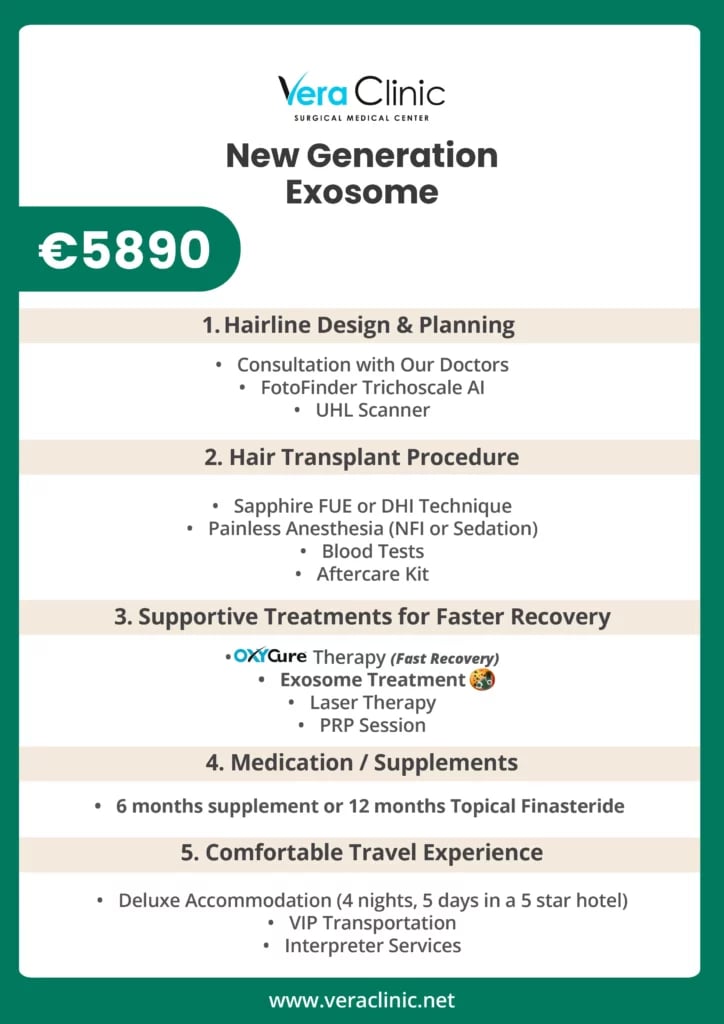
Pacchetto Esosomi presso Vera Clinic
Il Pacchetto Esosomi di Vera Clinic combina il trapianto di capelli con tecnica Sapphire FUE o DHI con una sessione di terapia con esosomi post-operatoria studiata per favorire una guarigione più rapida. Include la terapia OxyCure, il PRP e la terapia laser per un recupero ottimizzato, oltre a farmaci, sistemazione VIP e trasferimenti, creando un programma di rigenerazione completo e pronto per il turismo medico al prezzo di 5.990 €.
Consulta gli specialisti di Vera Clinic per definire un protocollo personalizzato e una concentrazione di esosomi calibrata alle condizioni del tuo cuoio capelluto e ai tuoi tempi di recupero.
Quali sono i benefici della terapia capillare con esosomi?
La terapia capillare con esosomi garantisce una rigenerazione multistrato, aumenta la densità dei capelli e riprogramma il sistema di comunicazione del cuoio capelluto.
Le vescicole ripristinano la vitalità delle cellule della papilla dermica, migliorano la diffusione dell’ossigeno e invertono il processo di miniaturizzazione senza ricorrere alla chirurgia. Poiché gli esosomi contengono mediatori della crescita come VEGF, IGF-1 e RNA della serie miR, stimolano la formazione di nuovi microvasi e prolungano la fase anagen (di crescita) per una densità duratura.
Presso Vera Clinic la terapia con esosomi viene associata al supporto ossigenante OxyCure per potenziare la penetrazione dei segnali e accelerare il recupero post-trapianto, garantendo una penetrazione più profonda e una convalescenza più rapida. I pazienti riferiscono una minore caduta dei capelli e un miglioramento visibile della consistenza entro tre mesi.
Quali sono gli effetti collaterali della terapia capillare con esosomi?
La terapia con esosomi è un trattamento privo di cellule, con rischi minimi, in quanto non contiene cellule vive né ormoni. Nelle 24-48 ore successive alle iniezioni possono comparire lieve eritema, indolenzimento o tumefazione puntiforme, reazioni fisiologiche all’attivazione dei tessuti. Non si osservano alterazioni ormonali né rigetto immunitario, il che la rende ugualmente sicura sia per le donne sia per gli uomini.
La terapia con esosomi è sicura sia per le donne che per gli uomini?
Sì, poiché gli esosomi non contengono DNA né cellule del donatore, sono universalmente biocompatibili e di applicazione neutra rispetto al genere.
Controindicazioni:
- Gravidanza o allattamento
- Infezioni attive del cuoio capelluto
- Disturbi autoimmuni o infiammatori (es. lupus, psoriasi)
- Diabete non controllato o disturbi emorragici
- Chemioterapia o radioterapia recenti
Cosa comporta la cura post-trattamento della terapia capillare con esosomi?
La terapia con esosomi richiede un tempo di recupero minimo, ma un’assistenza post-trattamento accurata garantisce la massima ritenzione del segnale. Per 48–72 ore, il cuoio capelluto si trova in una fase di comunicazione in cui gli esosomi si stanno ancora fondendo con le cellule dei follicoli. Ecco perché il riposo, l’idratazione e l’apporto di ossigeno sono più importanti dei prodotti o delle routine.
Evita di lavarti i capelli nelle prime 24 ore e astieniti da palestra, saune o cappelli stretti per i successivi tre giorni. Queste semplici precauzioni preservano l’integrità dello strato di vescicole che sta operando sotto la tua pelle. Immagina questa fase come un momento di quiete in cui i follicoli possono “leggere” con precisione le istruzioni genetiche appena ricevute.
Quali sono le alternative alla terapia capillare con esosomi?
Sebbene gli esosomi rappresentino l’ultima generazione di trattamenti rigenerativi, altre opzioni rimangono efficaci a seconda della gravità della caduta dei capelli e delle condizioni del cuoio capelluto:
- Mesoterapia per i capelli: formula iniettabile a base di vitamine che nutre superficialmente i follicoli piliferi.
- Trapianto di capelli con cellule staminali: Rigenera i follicoli attraverso cellule staminali vive estratte dal tessuto adiposo.
- Trattamento PRP (Plasma ricco di piastrine): sfrutta le piastrine del paziente per rilasciare fattori di crescita.
- PP405 Trattamento contro la caduta dei capelli: Terapia a base di piccole molecole attualmente in fase di valutazione clinica per la resistenza al DHT.
- Terapia laser a bassa intensità (LLTL): fotobiomodulazione non invasiva per migliorare la circolazione sanguigna.
- Terapia con NAD+.: Trattamento di ripristino metabolico che potenzia l’energia mitocondriale, favorisce l’utilizzo dell’ossigeno e rafforza la longevità dei follicoli se abbinato a sessioni di OxyCure o di rigenerazione capillare con esosomi.
Quali sono le differenze tra la terapia con esosomi, il PRP e la terapia con cellule staminali?
Il PRP stimola le cellule esistenti mediante fattori di crescita derivati dalle piastrine; le cellule staminali introducono cellule viventi dotate di proprietà rigenerative; gli esosomi, invece, rilasciano molecole di segnalazione acellulari senza introdurre nuove cellule. Di seguito è possibile consultare un confronto tra la terapia con esosomi e il PRP per i capelli, nonché tra la terapia con esosomi e quella con cellule staminali.
| Terapia | Meccanismo | Durata | Ideale per |
| PRP | Fattori di crescita derivati dalle piastrine | 6–9 mesi | Diradamento precoce |
| Cellule staminali | Rigenerazione cellulare mediante cellule staminali vive | 12–18 mesi | Alopecia androgenetica avanzata |
| Esosomi | Segnalazione genica extracellulare mediata da RNA e proteine messaggere | 12–24 mesi | Diradamento diffuso o alopecia resistente ai trattamenti |
La terapia con esosomi può sostituire un trapianto di capelli?
La terapia con esosomi non può sostituire il trapianto di capelli, ma lo integra. Sebbene gli esosomi ripristinino la comunicazione cellulare e migliorino la vitalità del cuoio capelluto, non generano nuovi follicoli nelle aree completamente calve. Agiscono piuttosto come potenti promotori della rigenerazione, favorendo il recupero.
Alla Vera Clinic, l’associazione esosomi + OxyCure + terapia con cellule staminali è finalizzata a ottimizzare l’ossigenazione degli innesti e a facilitare il recupero post-operatorio. Gli esosomi favoriscono l’adattamento dei follicoli trapiantati al nuovo sito, stimolando l’attività della papilla dermica e l’angiogenesi entro le prime due settimane.
Questa sinergia è pensata come supporto aggiuntivo allatrapianto di capelliprocedura, finalizzato a facilitare l’adattamento dell’innesto al nuovo ambiente.
La terapia con esosomi può essere effettuata prima o dopo un trapianto di capelli? La
terapia con esosomi può essere effettuata in entrambi i modi: prima, per preparare il cuoio capelluto e stimolare la circolazione; e dopo, per favorire la guarigione.
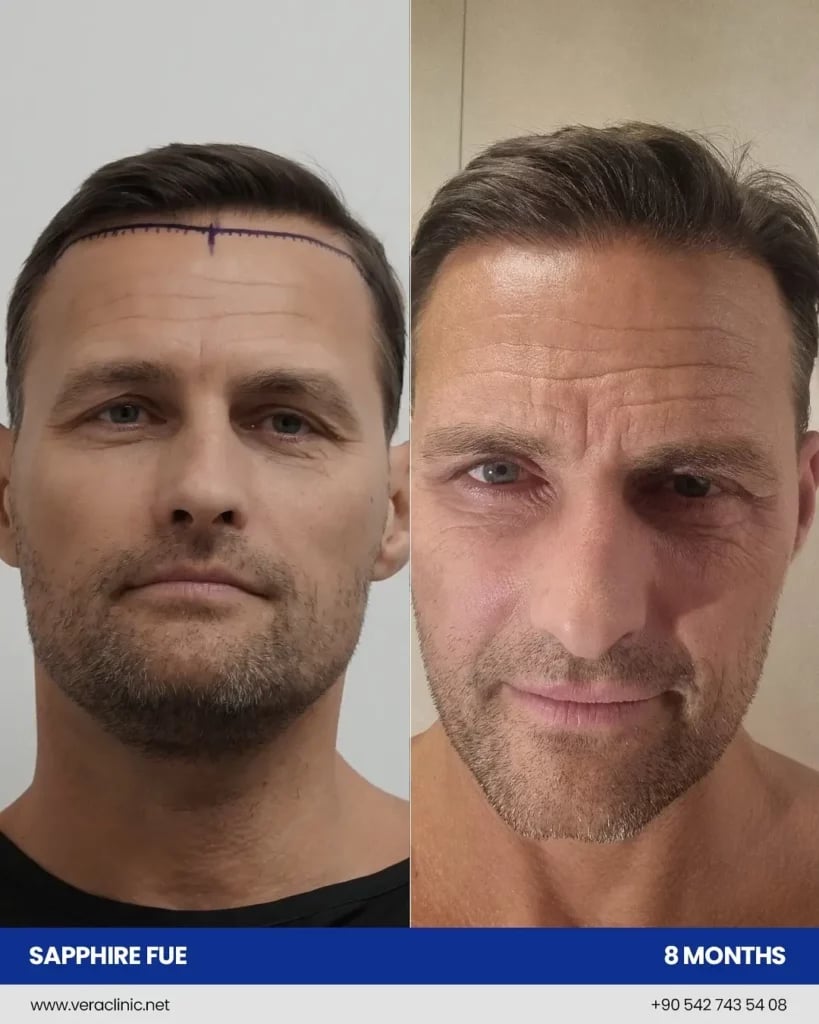
Quali sono i risultati della terapia capillare con esosomi prima e dopo il trattamento?
Alla Vera Clinic,trapianto di capelli: prima e dopole analisi mostrano un aumento visibile della densità e una maggiore vitalità del cuoio capelluto entro 8–12 settimane dal trattamento. I pazienti riferiscono una consistenza più morbida, una minore caduta dei capelli e un ancoraggio più saldo dei follicoli a seguito delle sedute di terapia per la crescita dei capelli con esosomi assistita da OxyCure.
Cosa dicono i pazienti della terapia capillare con esosomi in Turchia?
I pazienti descrivono la terapia con esosomi presso Vera Clinic come confortevole, rapida e visibilmente efficace. La maggior parte sottolinea l’assenza di dolore, la riduzione dell’arrossamento post-trapianto e un più rapido ritorno alle attività quotidiane. Le recensioni menzionano un visibile infoltimento intorno al terzo mese e apprezzano il monitoraggio post-trattamento offerto dalla clinica, che segue da vicino il recupero.
Testimonianze dei pazienti
Punti salienti selezionati da utenti e pazienti verificati.
“Il booster a base di esosomi ha permesso alla zona trapiantata di guarire due volte più rapidamente.”— Giovanni D.
“Non ho avvertito alcun dolore, solo un lieve calore dopo il trattamento con Oxycure; la densità è migliorata già dal secondo mese.”— Boris K.
Non tutte le valutazioni provengono dalla stessa fonte. I punteggi complessivi indicano la fonte accanto alla valutazione.
Perché scegliere Vera Clinic per la terapia rigenerativa per i capelli?
Vera Clinic è un punto di riferimento in Turchia per la terapia rigenerativa dei capelli, basata su un ecosistema integrato di ossigeno, dati e precisione. I suoi medici certificati, accreditati dal Ministero della Salute turco, hanno eseguito con successo oltre 40.000 procedure in tutto il mondo dal 2013. Riconosciuta tra le migliori cliniche di trapianto di capelli in Europa con gli European Awards in Medicine per l’eccellenza medica nella categoria “Chirurgia del trapianto di capelli” e in qualità di partner medico ufficiale degli Houston Rockets,Vera Clinicla clinica riflette una costante attenzione all’innovazione e alla sicurezza nel campo del moderno ripristino capillare, con protocolli e risorse formative costantemente aggiornati attraverso il Vera Clinic Academy.