
NAD therapy after hair transplant involves replenishing NAD+, a vital coenzyme present in every cell that drives energy production, DNA repair, and mitochondrial function. During a hair transplant, follicles undergo temporary stress, inflammation, and reduced oxygen supply; this depletes intracellular NAD+, weakening cellular recovery.
By restoring NAD+ (Nicotinamide Adenine Dinucleotide) through IV infusions or oral supplementation, the therapy helps transplanted follicles recover faster, promoting ATP synthesis and DNA repair in dermal papilla and follicular stem cells. This mitochondrial boost supports angiogenesis, reduces oxidative stress, and enhances overall graft survival.
Researchers are now exploring NAD+ for hair growth as a metabolic enhancer for post-surgical healing and follicular regeneration. Early mechanistic data link NAD⁺-induced mitochondrial biogenesis and VEGF expression to improved scalp oxygenation: key processes that aid recovery after transplantation (“Nicotinamide Adenine Dinucleotide (NAD⁺) Metabolism and the Control of Energy Homeostasis: A Balancing Act Between Mitochondria and the Nucleus.”, Cell Metabolism.)
Unlike DHT blockers that target hormonal pathways, NAD+ hair loss therapy works at the cellular energy level, potentially complementing treatments like Oxycure, PRP, and stem cell therapy to optimize post-transplant regrowth outcomes.
Is NAD the same as NMN?
No, NAD+ and NMN are not the same. NMN (nicotinamide mononucleotide) is a precursor that the body converts into NAD+, the active coenzyme responsible for cellular energy production and DNA repair.
What Is NAD Therapy Used For?
NAD therapy after hair transplant is an intravenous or oral supplementation protocol designed to restore declining NAD+ (nicotinamide adenine dinucleotide) levels that drop with age, stress, and illness. NAD+ acts as a coenzyme in over 400 cellular reactions, including those tied to energy production, DNA repair, and oxidative balance.
Core Use Cases:
- Anti-Aging: Supports DNA repair and mitochondrial renewal, slowing the pace of cellular aging.
- Energy Metabolism: Enhances ATP production through improved mitochondrial efficiency.
- Brain and Liver Health: Aids detoxification and neuronal recovery in chronic fatigue, neurodegeneration, and oxidative stress.
- Post-Surgery Recovery: Replenishes NAD+ depleted by anesthesia, inflammation, and tissue trauma, improving cellular regeneration.
These same mechanisms that rejuvenate neuronal, hepatic, and muscular cells also influence follicular health. By restoring mitochondrial energy and reducing oxidative damage in dermal papilla and stem cells, NAD+ therapy after hair transplant helps transplanted follicles recover faster and maintain stronger growth cycles after surgery.
Can NAD+ reverse aging?
Not entirely, but restoring NAD+ levels can slow several aging-related cellular declines. Boosting NAD+ in older mammals improved mitochondrial function, DNA repair, and stem cell activity, effectively reversing some age-related damage at the cellular level according to “Long-Term Administration of Nicotinamide Mononucleotide Mitigates Age-Associated Physiological Decline in Mice.” published in Cell Metabolism. In humans, it supports energy metabolism and tissue regeneration, which indirectly promote healthier skin, organs, and scalp tissue.
How NAD⁺ Can Support Hair Regrowth?
NAD⁺ (nicotinamide adenine dinucleotide) supports hair regrowth by restoring mitochondrial energy production, repairing DNA damage, and enhancing antioxidant defenses in dermal papilla and follicular stem cells. Evidence from regenerative biology studies shows that NAD⁺ supplementation increases ATP, VEGF, and β-catenin expression, core signals for follicle survival and angiogenesis after hair transplantation.
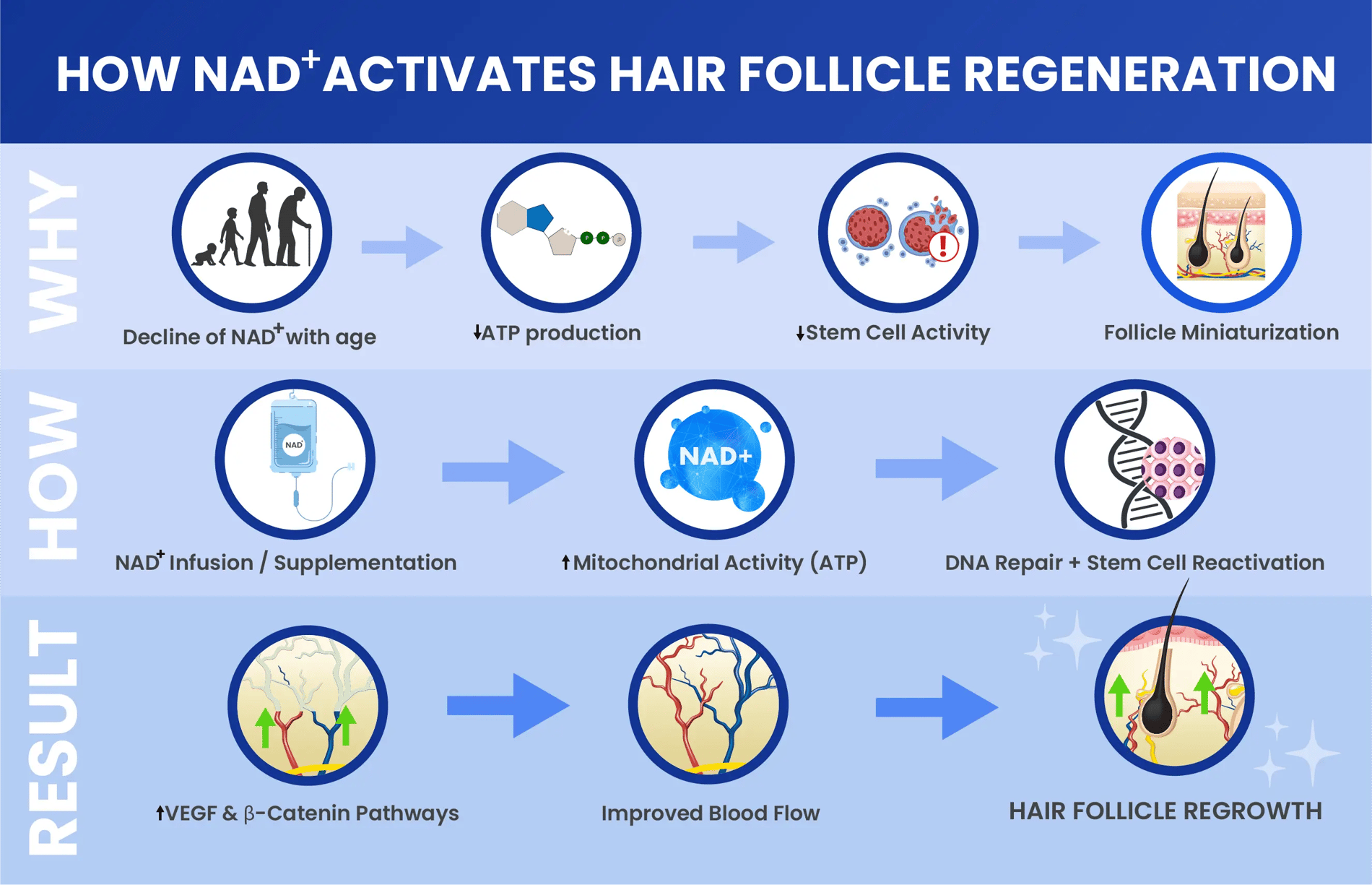
Restoring NAD⁺ levels activates mitochondrial biogenesis and stem cell renewal, both of which are essential for post-transplant follicular recovery and long-term growth cycle stability according to Yoshino & Imai, Cell Metabolism (2018) and Rajman et al., Cell Metabolism (2018).
- Cellular Energy & DNA Repair: ↑ ATP → improved dermal papilla metabolism → faster graft recovery.
- Anti-Aging and Stem Cell Reactivation: Reverses senescence → reawakens follicular stem cells.
- Reduced Oxidative Stress and Inflammation: NAD⁺ activates SIRT1 → lowers ROS in follicular tissue.
- Increased Growth Factor Expression: Boosts VEGF and β-catenin → enhances microvascular supply.
1. Cellular Energy & DNA Repair
Hair follicles are among the most energy-demanding tissues in the body. During transplantation, ischemic stress and inflammation can damage their mitochondria. NAD⁺ replenishment restores ATP synthesis and activates PARP1 and SIRT1, enzymes that drive DNA repair and cell survival.
Raising intracellular NAD⁺ directly enhances mitochondrial oxidative phosphorylation and energy metabolism according to “NAD⁺ repletion improves mitochondrial and stem cell function and enhances life span in mice.” published in Science; key for sustaining active follicular cells post-transplant.
2. Anti-Aging and Stem Cell Reactivation
With age, NAD⁺ levels naturally decline, leading to follicular stem cell exhaustion and slower hair regeneration. NAD⁺ restoration through NMN supplementation reversed age-related physiological decline by reactivating muscle and epidermal stem cells according to “Long-term administration of nicotinamide mononucleotide mitigates age-associated physiological decline in mice.” Cell Metabolism.
Similarly, in follicular tissue, this metabolic rejuvenation may reawaken quiescent stem cells in the bulge region, prolonging the hair growth (anagen) phase and reducing miniaturization.
3. Reduced Oxidative Stress and Inflammation
Transplanted follicles face oxidative stress due to temporary ischemia. NAD⁺ serves as a substrate for SIRT3 and SIRT6, which neutralize reactive oxygen species (ROS) and stabilize mitochondrial membranes.
Boosting NAD⁺ reduced oxidative stress markers in dermal papilla cells, leading to increased cell survival and healthier follicle structure according to “β-Nicotinamide Mononucleotide Promotes Cell Proliferation and Hair Growth by Reducing Oxidative Stress.” Molecules.
4. Increased Growth Factor Expression (VEGF, β-Catenin Pathways)
VEGF promotes vascular growth around follicles, while β-catenin regulates follicle regeneration. NAD⁺ signaling through SIRT1–PGC-1α pathways upregulates both.
In Cell Death & Disease (2019), NAD⁺ elevation was shown to increase VEGF expression and enhance β-catenin translocation to the nucleus, triggering new hair follicle formation in preclinical models.
This angiogenic and mitogenic response strengthens scalp oxygenation and nutrient delivery, making NAD⁺ therapy an effective adjunct to stem cell, PRP, or Oxycure treatments after transplantation.
Do NAD Infusions Really Work?
Clinical data confirms that NAD+ infusions improve mitochondrial energy metabolism, cognitive performance, and fatigue recovery, especially in patients with neurodegenerative or metabolic conditions. A 2019 pilot study by Grant et al., Frontiers in Aging Neuroscience showed that IV NAD+ therapy significantly increased plasma NAD+ levels and enhanced mitochondrial function and oxidative balance.
For hair regrowth, evidence remains primarily mechanistic rather than clinical. The biochemical link is strong: NAD+ drives ATP synthesis, DNA repair, and stem cell vitality; all essential for transplanted follicle survival. However, human scalp-level randomized trials are still lacking. Thus, NAD therapy should be viewed as a supportive metabolic enhancer, not a standalone cure.
Vera Clinic Academy has also tracked IV NAD+ supplementation as part of its 12-month regenerative therapies cohort, administering it alongside FUE transplantation in a subset of 40 patients to support cellular energy metabolism during graft healing. Because NAD+ acts through metabolic rather than cellular or paracrine signaling pathways, its effects were tracked separately from the density and thickness outcomes measured for the other regenerative arms in that cohort, and formal efficacy quantification for this subset was outside the scope of the study, according to Vera Clinic Academy’s Regenerative Hair Therapies and Hair Transplantation Outcomes Study (2026). This is consistent with the broader evidence base: NAD+’s role in hair regrowth remains primarily supportive and mechanistic rather than clinically quantified.
How to increase NAD+ levels naturally?
You can naturally raise NAD+ by exercise, intermittent fasting, sunlight exposure, and consuming precursors like niacin (vitamin B3), nicotinamide riboside (NR), or NMN. These methods enhance mitochondrial efficiency and sustain steady NAD+ levels without IV infusions.
Does NAD Increase DHT?
No direct clinical or biochemical evidence shows that NAD⁺ increases dihydrotestosterone (DHT) levels. Instead, NAD⁺ operates as a metabolic coenzyme, it drives redox reactions and mitochondrial energy cycles, not androgen synthesis.
Mechanistically, NAD⁺ and its dependent enzymes such as SIRT1 and PARP1 regulate inflammatory and oxidative stress pathways within the follicle. Raising intracellular NAD⁺ downregulated NF-κB and COX-2, two pro-inflammatory mediators linked to DHT-induced follicle miniaturization according to NAD⁺ supplementation attenuates oxidative stress and inflammatory signaling through SIRT1-mediated pathways in dermal cells. Redox Biology. This implies an indirect protective effect rather than hormonal stimulation.
In androgen-sensitive follicles, restored NAD⁺ homeostasis can improve mitochondrial resilience, limit lipid peroxidation, and enhance dermal papilla viability; all factors that buffer follicles against DHT-related micro-inflammation.
While DHT blockers like finasteride act hormonally, NAD⁺ works bioenergetically, targeting the mitochondrial health of follicles rather than endocrine feedback loops. This distinction makes it a promising adjunct therapy for patients sensitive to hormonal treatments.
Who Should Avoid NAD⁺ Therapy?
While NAD⁺ therapy is widely regarded as safe, certain individuals should proceed with caution or avoid treatment entirely due to its metabolic acceleration effects.
- Individuals with Active or Recent Cancer: NAD⁺ supports mitochondrial respiration and DNA repair, beneficial in healthy cells but potentially fueling proliferation in malignant ones. Tumor cells exploit elevated NAD⁺ pools to sustain rapid growth through PARP- and SIRT-driven repair mechanisms. This makes NAD⁺ therapy contraindicated unless cleared by an oncologist.
- Pregnant or Breastfeeding Patients: There’s no controlled safety data on NAD⁺ infusions in pregnancy. Because NAD⁺ modulates epigenetic methylation and fetal growth signaling, experts recommend postponing therapy until postnatal recovery.
- Patients with Uncontrolled Diabetes or Liver Disease: Since NAD⁺ boosts glucose metabolism and fatty acid oxidation, IV NAD⁺ transiently alters insulin sensitivity and hepatic enzyme levels. Individuals with metabolic instability or elevated liver transaminases require medical supervision.
- Patients with Known Sensitivity to NAD⁺ or IV Additives: Reactions such as vein irritation, flushing, nausea, or chest tightness can occur during rapid infusion. These effects are due to osmolarity changes, not the NAD⁺ itself, and resolve when administered slowly (over 2–3 hours).
Few realize that NAD⁺ isn’t universally beneficial: its same regenerative power that enhances recovery reactivating dormant or damaged cell lines if misused. This “double-edged” bioenergetic potential is why advanced clinics use precision dosing and metabolic screening before introducing NAD⁺ into post-surgical recovery protocols.
How Much Does a NAD⁺ Infusion Cost?
The average cost of NAD⁺ therapy in 2026 ranges from €100 to €800 per session globally, depending on region, dosage (250–1000 mg), and whether the infusion includes vitamin or antioxidant boosters.
A single NAD⁺ infusion session includes a slow intravenous drip lasting 1.5–3 hours, often combined with vitamin or antioxidant boosters
| Country | Cost per Session | Notes / Context |
| Turkey | €100 – €200 | Popular for post-surgery recovery; often combined with Oxycure or stem cell therapy. |
| Europe (Germany, UK, Spain) | €250 – €450 | Premium clinics use full-dose infusions (500–750 mg). |
| USA | $400 – $800 | Includes full mitochondrial restoration protocols; common in longevity centers. |
| Thailand | ฿9,200 – ฿34,500 (~$270 – $1,000) | Widely offered in wellness and medical tourism hubs like Bangkok. |
| India | ₹12,000 – ₹30,000 (~$145 – $370) | Growing availability in dermatology and integrative medicine clinics. |
| South Korea | ₩350,000 – ₩800,000 (~$260 – $600) | Used alongside regenerative scalp therapies in Seoul clinics. |
| Mexico | $180 – $400 | Offered in metabolic and anti-aging clinics; often bundled with vitamin drips. |
Clinics offering NAD infusion cost prices lower, often use shortened drip times or subtherapeutic dosages (<250 mg). Full cellular benefits (including mitochondrial biogenesis and ATP restoration) are generally achieved with 500–1000 mg IV infusions, the range used in clinical studies such as Grant et al., Frontiers in Aging Neuroscience (2019).
Can I Take NAD⁺ After Surgery or Hair Transplant?
Yes, NAD⁺ therapy is safely introduced after a hair transplant, but only under medical supervision. Post-operative NAD⁺ IV infusions are designed to accelerate wound healing, improve graft survival, and restore cellular energy by enhancing mitochondrial output and reducing oxidative stress in transplanted follicles.
“In post-operative recovery, timing is everything. NAD+ shouldn’t be introduced before the scalp has fully closed and the initial inflammatory phase has settled, around 7 to 10 days after surgery. Starting too early can interfere with the body’s natural healing response, so timing matters as much as the treatment itself.”
—Dr. Emin Gül, Vera Clinic Surgeon
At this stage, NAD therapy after hair transplant helps reactivate dermal papilla cells, support angiogenesis, and strengthen DNA repair within the recovering tissue. In practice, this timing adjustment matters most for patients with a history of slow post-operative healing or higher inflammation markers, where the team may delay the first infusion slightly to avoid overlapping with the acute recovery window.
Can NAD Replace a Hair Transplant?
No, NAD⁺ cannot replace a hair transplant, as it does not create new follicles. Instead, it supports the metabolic recovery of existing or transplanted follicles, making it an ideal adjunct to surgical restoration rather than a hair transplant alternative.
How Does NAD⁺ Therapy Compare to Stem Cell Therapy, PRP, and Exosomes?
NAD⁺ therapy acts as a metabolic catalyst, it enhances mitochondrial energy, DNA repair, and redox balance inside follicular and dermal papilla cells. Unlike stem cell therapy, PRP, or exosomes, it doesn’t introduce new growth factors or cells but amplifies their biological performance.
| Treatment | Primary Mechanism | Session Frequency | Best For | Limitations |
| NAD⁺ Therapy | Increases ATP, activates sirtuins (SIRT1/SIRT3), enhances mitochondrial repair, reduces oxidative stress | 1–2 IV infusions/week for 4–6 weeks | Post-transplant recovery, scalp inflammation, metabolic fatigue | No direct follicle creation; adjunct therapy |
| Stem Cell Therapy | Delivers mesenchymal or follicular-derived stem cells to reactivate dormant follicles | 1–2 procedures annually | Severe thinning, regenerative restoration | High cost, procedural variability |
| PRP Therapy | Uses patient’s platelet-derived growth factors (VEGF, PDGF, IGF-1) to stimulate follicles | 3–4 sessions every 4–6 weeks | Early androgenetic alopecia, post-transplant support | Effect duration limited (~6–12 months) |
| Exosome Therapy | Cell-free vesicles carrying miRNAs and cytokines that reduce inflammation and promote regrowth | 1 session monthly for 3 months | Inflammatory hair loss, post-surgical recovery | Regulatory oversight; purity consistency |
In the context of NAD vs stem cell hair transplant therapy, the former is not a replacement but a synergistic metabolic enhancer. It improves the cellular environment; ensuring that transplanted or regenerated follicles have the energy and antioxidant protection needed for long-term survival and visible density gains.