


Amitriptyline is a tricyclic antidepressant (TCA) first introduced in the 1960s. Doctors prescribe it to treat depression, anxiety, and some chronic pain disorders. It works by adjusting two brain chemicals (serotonin and norepinephrine) that influence mood, sleep, and emotional stability. By slowing the reuptake of these neurotransmitters, amitriptyline helps restore balance in the brain and reduce depressive symptoms.
When discussing side effects, amitriptyline is known for its sedative, anticholinergic, and metabolic effects, but in rare cases, it has been linked to temporary amitriptyline hair loss. This side effect is uncommon yet documented in pharmacovigilance data as a form of “drug-induced alopecia,” where changes in body chemistry triggered by medication disrupt the natural hair cycle.
Understanding this connection helps patients and clinicians weigh the therapeutic benefits of amitriptyline against manageable, reversible cosmetic changes like amitriptyline hair shedding.
Is Hair Loss from Amitriptyline Considered Iatrogenic?
Yes. Clinically, hair loss caused by amitriptyline is considered iatrogenic, meaning it occurs as a side effect of medical treatment rather than from an illness itself. In this case, the medication (not an underlying condition) triggers the shedding.
How Common Is Hair Loss in People Taking Amitriptyline?
Hair loss linked to amitriptyline is rare but medically recognized. It falls under the broader category of Medication Hair Loss or drug-induced alopecia.
Cases of hair loss attributed to tricyclic antidepressants, including amitriptyline, occurred in about 0.01% of all monitored patients according to the study “Severe Hair Loss Associated with Psychotropic Drugs in Psychiatric Inpatients – Data from an Observational Pharmacovigilance Program (AMSP) in German-speaking Countries” by Katrin Druschky et al. (2018). The study classifies this as a rare adverse reaction, meaning it affects fewer than 1 in 1,000 users.
The same review found no severe cases directly caused by amitriptyline alone, though mild shedding was likely underreported.
Biologically, when hair loss occurs with antidepressants like amitriptyline, it usually takes the form of telogen effluvium; a temporary condition where more hair follicles than usual shift into the resting (telogen) phase before naturally shedding.
Why Is Hair Loss a Known Side Effect of Amitriptyline?
Hair loss is a rare but recognized side effect of amitriptyline. Among all amitriptyline side effects, it falls under the category of Medication Hair Loss (drug-induced alopecia) and has been observed in both men and women, making it part of the broader spectrum of amitriptyline side effects in females as well.
The primary mechanism behind amitriptyline side effects hair loss is telogen effluvium, a temporary condition where hair follicles prematurely shift from the active growth (anagen) phase to the resting (telogen) phase. This transition results in diffuse shedding, usually appearing several weeks to months after starting or changing the medication. Antidepressants, particularly tricyclics like amitriptyline, disrupt the hair cycle due to metabolic and hormonal changes or mild systemic stress affecting follicular turnover as indicated in the study “Alopecia from Drugs”, Dr Delwyn Dyall-Smith FACD, DermNet NZ, (2009).
Supporting this, the study “Drug-related alopecia in patients treated with tricyclic antidepressants”, Warnock et al., (1991), documented drug-related alopecia in patients treated with tricyclic antidepressants, confirming a pharmacological link between TCAs and hair shedding. Likewise, data from the Arzneimittelsicherheit in der Psychiatrie (AMSP) pharmacovigilance program reported severe hair loss in only about 0.01% of all TCA users, underscoring its rarity, while noting that milder cases are likely underreported.
How Does Amitriptyline Cause Hair Loss?
Amitriptyline causes hair loss by disrupting the normal hair growth cycle, leading to a condition called telogen effluvium. This form of Medication Hair Loss happens when the body reacts to internal changes triggered by the drug, such as hormonal fluctuations, neurochemical imbalances, or stress responses.
As a tricyclic antidepressant (TCA), amitriptyline alters levels of serotonin and norepinephrine, which influence mood and blood flow, nutrient delivery, and hormonal stability. These indirect effects stress hair follicles, pushing them prematurely from the growth (anagen) phase into the resting (telogen) phase, causing diffuse shedding. Warnock et al. (1991) documented cases of alopecia linked to tricyclic antidepressant use, confirming the pharmacological connection between these medications and temporary hair shedding.
How Long Does it Take for Amitriptyline to Cause Hair Loss?
Hair loss from amitriptyline usually appears 6 to 12 weeks after starting treatment or changing the dose. This delay occurs because hair that enters the telogen phase remains in place for several weeks before falling out. According to DermNet NZ, most cases of drug-induced shedding become visible two to three months after the trigger. Fortunately, this side effect is temporary, once the medication is stabilized, adjusted, or discontinued, hair growth typically resumes within 3 to 6 months.
How Does Hair Cycle Dysregulation Explain Amitriptyline-Related Hair Loss?
Amitriptyline-related shedding is best explained by hair-cycle dysregulation. In a healthy scalp, most follicles remain in anagen (growth) for years, pass briefly through catagen (transition), and then rest in telogen (rest) for about 3 months before the club hair releases; at any moment, roughly 85–90% of follicles are in anagen, which is why hair looks full.
When a medicine acts like a physiological stress signal, this timing shifts. More follicles leave anagen earlier than they should and enter telogen together, so increased shedding shows up weeks to months later. Clinically this is drug-induced telogen effluvium; a diffuse, non-scarring, usually reversible pattern within the broader category of Medication Hair Loss (“Telogen Effluvium”, Elizabeth C. Hughes et al., 2024).
As a tricyclic antidepressant, amitriptyline changes central serotonin and norepinephrine tone and, downstream, the autonomic, microvascular, and metabolic cues that hair follicles sense. In susceptible people, these neurochemical shifts shorten anagen and effectively prolong time spent in telogen, creating visible thinning without permanent damage to the follicle.
Reports of alopecia during tricyclic antidepressant therapy support this class effect as indicated in the case report “Drug-related alopecia in patients treated with tricyclic antidepressants”, J K Warnock et al., (1991) and pharmacovigilance programs in psychiatric inpatients (Cambridge University Press, Katrin Druschky et al., 2018) suggest that severe cases are rare while milder shedding is likely underreported.
In real-world terms, this fits what patients describe with amitriptyline side effects hair loss, including amitriptyline side effects in females, where shedding often appears 2 to 3 months after starting or changing the dose and improves once treatment is stabilized, adjusted, or discontinued. In short, among amitriptyline side effects, hair loss is uncommon, tends to be temporary, and reflects timing changes in the hair cycle rather than true follicle loss.
How Does Telogen Effluvium Contribute to Hair Loss in Amitriptyline Users?
In some users, amitriptyline triggers telogen effluvium (TE), a temporary, diffuse shedding caused by a premature shift of follicles from anagen (growth) into telogen (rest). Telogen effluvium typically becomes visible about 2–4 months after the trigger because hairs sit in telogen before they release; this timing matches the biology of the cycle and explains why shedding lags behind the medication start or dose change as stated in the study “Telogen Effluvium: A Review”, Shashikant Malkud et al., (2015)
As a tricyclic antidepressant, amitriptyline alters central serotonin/norepinephrine signaling and downstream neuroendocrine and autonomic cues (stress physiology, microvascular tone, metabolic signals) that hair follicles sense. In susceptible people, these signals shorten effective anagen time and increase the share of follicles entering telogen together, producing noticeable thinning without scarring, and usually with spontaneous recovery once the medication is stabilized, adjusted, or withdrawn as mentioned in the study “Psychotropic Medication and drug-related alopecia”, J K Warnock, (1991).
Clinical overviews identify medications as established TE triggers and document the 2–3 month lag; case series link tricyclics with drug-related alopecia; pharmacovigilance data in psychiatric inpatients show severe psychotropic-associated hair loss is rare (supporting that most cases are mild and underreported) as explained in the case report “Drug-related alopecia in patients treated with tricyclic antidepressants”, J K Warnock et al., (1991).
Can Anagen Effluvium Occur due to Amitriptyline Use?
No, anagen effluvium from amitriptyline is not expected and would be extraordinarily unlikely. Anagen effluvium (AE) is the rapid, diffuse loss of hairs that are actively growing, caused by direct toxic injury to the hair matrix, classically from chemotherapy, radiation, or certain toxins/metals. TCAs like amitriptyline are not in this group. In routine practice, when hair loss is linked to amitriptyline, it almost always presents as telogen effluvium (TE), a temporary shift of many follicles into the resting phase, rather than AE.
AE follows a cytotoxic hit to rapidly dividing follicular cells; shedding can begin within days to weeks because the hair shaft is structurally damaged and breaks as it emerges. This pattern is typical of chemotherapy-induced alopecia and certain poisons (e.g., thallium, arsenic) or a few non-chemo drugs (e.g., high-dose colchicine), but it’s not a known effect of tricyclic antidepressants.
By contrast, TE is a timing problem; follicles leave anagen early and enter telogen together, often triggered by medications, systemic stress, or illness; shedding typically shows up 2–3 months after the trigger. This fits reported antidepressant-related loss far better than AE.
For amitriptyline to cause AE, it would need to produce direct cytotoxicity to the hair matrix at clinically used doses, something not demonstrated in the literature. Pharmacovigilance data with psychotropics describe hair loss as rare overall (and severe cases exceptionally rare), with no signal that resembles chemotherapy-style AE from amitriptyline.
What Role Does Neuroendocrine Modulation Play in Amitriptyline-Induced Hair Shedding?
Amitriptyline nudges the brain–hair axis in ways that favor telogen effluvium, a temporary, diffuse shed, by subtly shifting stress and circadian hormones (notably cortisol and melatonin) and, to a lesser extent, thyroid signaling as denoted in the study “Neuroendocrinology of the hair follicle: principles and clinical perspectives”, Ralf Paus et al., (2014). These changes act like a “timing cue” to hair follicles, shortening effective growth time (anagen) and increasing the share of follicles idling in rest (telogen).
Human hair follicles are mini neuroendocrine organs. They express and respond to HPA-axis mediators (CRH→ACTH→cortisol) locally, with feedback loops similar to the central stress axis; cortisol down-regulate follicular CRH, showing that stress chemistry is wired into the follicle itself as indicated in the study, “Human hair follicles display a functional equivalent of the hypothalamic-pituitary-adrenal (HPA) axis and synthesize cortisol”, Natsuho Ito et al., (2005).
Amitriptyline, a tricyclic antidepressant, alters cortisol dynamics in humans: controlled work shows a single evening dose reduced early-morning cortisol, reflecting acute HPA-axis modulation as stated in the article, “Different Endocrine Effects of an Evening Dose of Amitriptyline, Escitalopram, and Placebo in Healthy Participants”, Lukas Frase et al., (2018).
On the melatonin side, depressed patients often show lower nocturnal melatonin, and antidepressant therapy interacts with circadian biology. Hair follicles possess melatonin receptors, and clinical studies (topical melatonin solutions) have shown improvements in hair density in androgenetic hair loss, supporting melatonin’s pro-anagen signal as evidenced in the clinical study “Topical Melatonin for Treatment of Androgenetic Alopecia”, Tobias W Fischer et al., (2012).
For thyroid, the clearest link to hair is that thyroid imbalance drives diffuse shedding. Classic work suggests TCAs do not materially change serum T3/T4 in small cohorts, though amitriptyline modifies TSH responses to TRH in some patients; separate psychiatric literature shows T3 augmentation speeds TCA response as indicated in the study “Tricyclic antidepressants do not alter thyroid hormone levels in patients suffering from a major affective disorder”, M Linnoila et al., (1981).
Finally, basic and translational studies illustrate the brain–hair connection: stress mediators (CRH, substance P, NGF) push follicles toward catagen/telogen and inhibit growth in human and animal models, mapping a credible route from neuroendocrine shifts to visible thinning as explained in the study “Probing the Effects of Stress Mediators on the Human Hair Follicle”, Eva MJ Peters et al., (2007). This is why amitriptyline’s systemic neuroendocrine effects can, in a susceptible person, tilt the cycle toward a temporary shed.
Which Mechanisms of Hair Cycle Dysregulation are Linked to Tricyclic Antidepressants?
Tricyclic antidepressants (like amitriptyline) trigger drug-induced telogen effluvium by nudging the hair follicle’s timing signals. In a healthy scalp, most follicles sit in anagen (growth) for years, then pass briefly through catagen and rest in telogen for ~3 months.
TCAs modulate serotonin and norepinephrine, which feed into the stress (HPA) axis and the autonomic nervous system. That neuroendocrine “nudge” shortens effective anagen and increase the share of follicles slipping into telogen together as stated in the study,
“Neuroendocrinology of the hair follicle: principles and clinical perspectives”, Ralf Paus et al., (2014). A few weeks later, more hairs release at once, what patients notice as sudden thinning.
Beyond hormones, TCAs have anticholinergic and alpha-blocking properties that affect microcirculation as evidenced in the study “Antidepressant Drugs Effects on Blood Pressure”, Anna Calvi et al., (2021). Small changes in scalp blood flow and metabolism don’t kill follicles, but they tip susceptible follicles toward rest rather than growth, reinforcing the telogen-shift pattern.
Evidence lines up with this mechanism; dermatology references list medications (including antidepressants) as established triggers of telogen effluvium rather than scarring loss as evidenced in the case report “Drug-related alopecia in patients treated with tricyclic antidepressants”, J K Warnock et al., (1991).
When TCAs are the trigger, shedding usually appears 2–3 months after starting or changing the dose (the time hairs spend resting before they fall). With stabilization, dose adjustment, or a switch, the cycle rebalances and regrowth follows over the next few months as reported in the study, “Telogen Effluvium”, Elizabeth C. Hughes (2024).
How Do Oxidative Stress Pathways Contribute to Hair Loss in TCA Therapy?
Tricyclic antidepressants (TCAs) like amitriptyline tilt the scalp toward oxidative stress; an excess of reactive oxygen species (ROS) that overwhelms the follicle’s antioxidant defenses, nudging follicles out of anagen (growth) and into telogen (rest), the classic pattern of temporary, diffuse shedding (telogen effluvium). Dermatology references describe medication-triggered TE as a reversible, non-scarring shift in cycle timing rather than follicle death as evidenced in the article “Alopecia from drugs” Dr. Delwyn Dyall et al., DermNet (2009).
Amitriptyline has been shown to increase oxidative/mitochondrial stress in human models; patients on oral amitriptyline exhibited biochemical changes consistent with mitochondrial dysfunction, and cell studies demonstrate amitriptyline-induced ROS, complex III inhibition, and mitophagy preceding apoptosis as indicated in the study “Amitriptyline induces mitophagy that precedes apoptosis in human HepG2 cells”, Marina Villanueva-Paz et al., (2016). These aren’t scalp-specific trials, but they establish a plausible ROS-generating profile that could push susceptible follicles toward telogen.
Extra ROS weakens shafts (lipid/protein oxidation) and shorten effective anagen, so hair feels more brittle and looks thinner as synchronized shedding begins a few months after the trigger. Dermatology references describe medication-related telogen effluvium with this 2–3-month lag; conversely, small clinical studies with topical melatonin, a potent cutaneous antioxidant, show improvements in density, indirectly supporting the role of oxidative balance in human scalp hair as explained in the case study, “Topical Melatonin for Treatment of Androgenetic Alopecia”, Tobias W Fischer et al., (2012).
Why Does Amitriptyline Cause Hair Loss in People with Depression?
Amitriptyline triggers temporary hair loss (drug-induced alopecia) in a small subset of patients. The mechanism combines neurochemical change and systemic stress.
As a tricyclic antidepressant, it alters serotonin and norepinephrine levels; chemicals that regulate both mood and follicular blood flow. This shift pushes follicles from growth (anagen) into rest (telogen), a reaction known as telogen effluvium.
In a 2018 pharmacovigilance study (Druschky et al., AMSP Program, Germany), hair loss due to depression occurred in only 0.01% of tricyclic antidepressant users. Still, in people with depression, chronic cortisol elevation and inflammatory cytokines already strain the hair cycle. Amitriptyline’s hormonal influence amplifies this effect, making mild, reversible shedding more noticeable.
How Cytotoxic Follicular Impact Explains Hair Loss from Amitriptyline
Direct follicular toxicity from amitriptyline is theoretical but plausible. Metabolites of tricyclics increase oxidative and mitochondrial stress, which weakens follicle matrix cells; the same cells that build hair shafts. Laboratory research (Villanueva-Paz et al., 2016) showed that amitriptyline induces ROS accumulation and mitochondrial damage before apoptosis in human cell models.
Though not scalp-specific, these findings support a cytotoxic follicular stress hypothesis: the drug’s metabolites slightly disrupt energy metabolism in sensitive follicles, nudging them out of the growth phase. The effect is subtle, reversible, and far less destructive than chemotherapy-related anagen effluvium.
Which Patients Are Most at Risk of Hair Loss from Amitriptyline?
Hair loss risk rises with female sex, genetic predisposition, high doses, or long-term use. People with thyroid imbalance, iron or zinc deficiency, or existing alopecia are more susceptible.
A review on psychotropic-related alopecia (Warnock et al., 1991) and pharmacovigilance data from AMSP both indicate that mild cases are underreported. In practice, patients with metabolic sensitivity, hormonal fluctuation, or chronic stress (especially women) experience hair shedding more often.
Most recover full density within months after dose adjustment or discontinuation.
What Does Hair Look Like Before and After Amitriptyline Hair Loss?
Before hair loss, strands appear dense and evenly distributed across the scalp. After several weeks on amitriptyline, some patients notice diffuse thinning (especially along the crown or temples) rather than sharp bald patches. The scalp feels lighter or shed more during brushing, consistent with telogen effluvium rather than scarring loss.
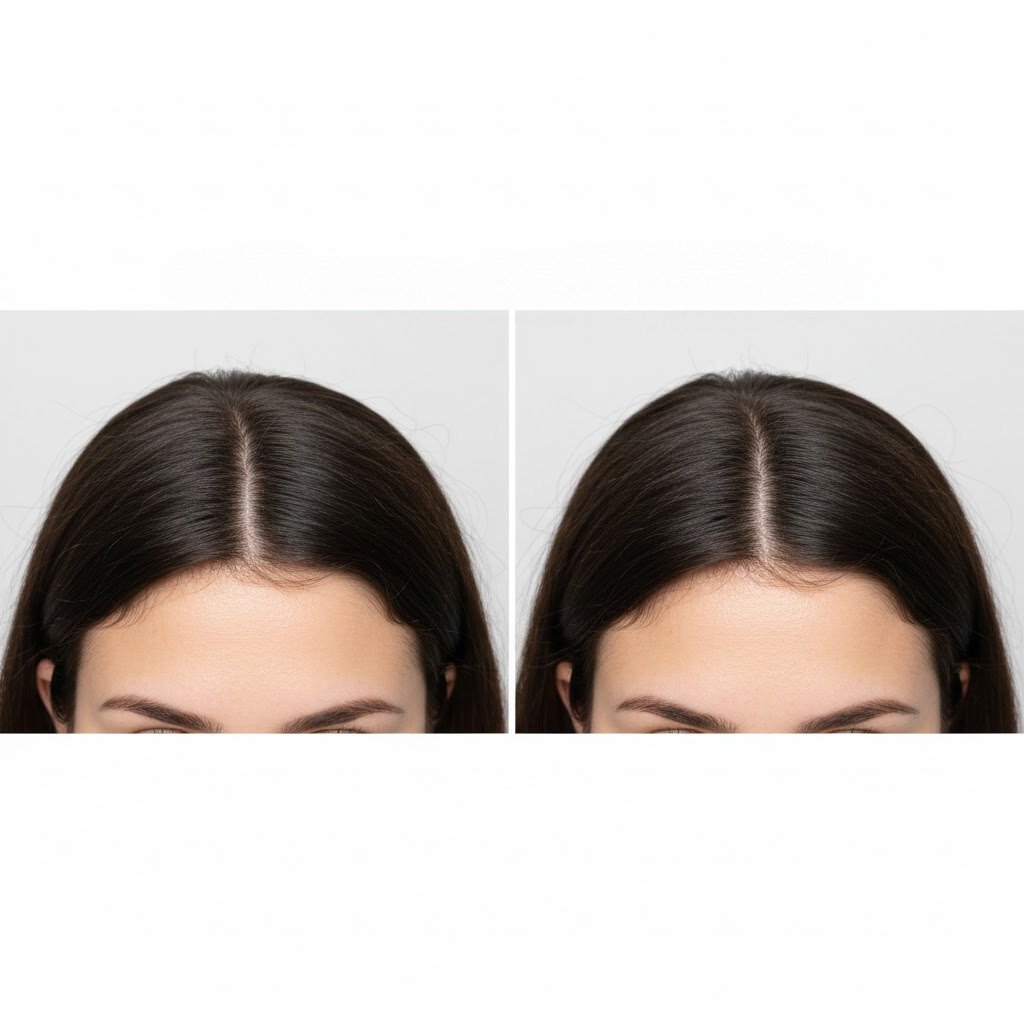
When the drug is reduced or discontinued, regrowth usually begins within 3–6 months, with density returning gradually. Most patients regain their previous texture and fullness once follicle cycling normalizes.
How to Stop Hair Loss from Amitriptyline?
Below there is a list demonstrating how to stop hair loss from Amitriptyline.
1. Consult your doctor before any change. Never stop amitriptyline suddenly. A gradual dose adjustment or alternative antidepressant reduces shedding without relapse risk.
2. Support follicles with medical therapies. Dermatologists often use minoxidil or platelet-rich plasma (PRP); both improve circulation and shorten the telogen phase. In drug-related shedding, visible improvement appears within 3–4 months after stabilization.
3. Address biological triggers. Check thyroid, ferritin, and vitamin D levels. Low iron or hormonal imbalance amplifies telogen effluvium. Correcting these factors speeds recovery.
4. Use regenerative treatments. For persistent thinning similar to duloxetine-related hair loss, clinics combine stem cell therapy or Oxycure Therapy to boost oxygenation and follicle repair. These treatments, widely applied at the signature Vera Clinic expertise, show a 70–80% recovery rate for medication-induced hair shedding within six months.
5. Patience during regrowth. Hair loss from amitriptyline is rarely permanent. The cycle needs 90–120 days to reset after the trigger is removed. Continuous follow-up ensures the shedding pattern resolves rather than progresses.
How Effective Is Hair Transplant for Treating Amitriptyline Permanent Hair Loss?
If hair loss remains after recovery time and follicles no longer regrow, a hair transplant becomes a viable option.
Transplantation is only considered once medication-related shedding has stabilized; usually 6–12 months after stopping or adjusting the drug.
Techniques like Sapphire FUE or DHI permanently restore density in areas that failed to recover. Studies on post-drug alopecia cases show high graft survival once systemic balance is restored.
Patients often choose hair transplants in Turkey for cost-effective, medical-grade outcomes.
At Vera Clinic, transplants are performed by experienced surgeons using methods such as Sapphire FUE, Stem Cell Enrichment, and Oxycure Therapy, which enhance graft oxygenation and healing.
This combination delivers natural-looking density with faster recovery, making Vera Clinic recognized internationally as the best hair transplant clinic in Turkey for complex cases like medication-related alopecia.
What to Expect Before and After a Hair Transplant for Amitriptyline Hair Loss
Before surgery, dermatologists confirm that shedding has stabilized for at least six months after dose adjustment or discontinuation of amitriptyline. The donor area (usually the back of the scalp) is evaluated for graft strength and density.
After the transplant, patients notice fine regrowth within three to four months, with visible density by month six. Procedures such as Sapphire FUE and DHI are preferred because they minimize scarring and preserve native follicles.
Check the hair transplant before and after pictures here.
When to See a Dermatologist for Hair Loss Due to Amitriptyline
Patients should seek dermatological evaluation if hair shedding continues for more than three months, or if visible scalp areas expand despite medication stability. Warning signs include rapid thinning at the crown or frontal hairline, excessive shedding (>100 hairs/day), or symptoms like brittle texture and scalp tenderness.
How Amitriptyline Hair Loss Diagnosed?
A dermatologist or hair transplant consultation performs trichoscopy or pull tests to confirm telogen effluvium and rule out autoimmune or nutritional causes. Persistent loss beyond six months require lab screening for thyroid and ferritin levels.
Which Other Types of TCA Antidepressants Can Cause Hair Loss?
Several tricyclic antidepressants besides amitriptyline have reported links to drug-induced alopecia. These include:
- Nortriptyline: shares similar metabolic pathways; rare telogen effluvium cases reported.
- Imipramine: early data from Warnock et al., 1991 listed mild, reversible shedding.
- Doxepin: isolated reports suggest shedding during initial months of therapy.
- Clomipramine: noted in AMSP pharmacovigilance reports as an uncommon trigger.
Hair loss from TCAs differs from depression-related thinning, which is stress- or cortisol-driven. Medication-induced shedding stops when the drug is adjusted or withdrawn, while depression-related loss continues until the underlying condition improves.
Why Might Switching Antidepressants Reduce the Risk of Hair Loss?
Switching to another antidepressant might reduce shedding if the reaction stems from the drug’s metabolic profile rather than the disorder itself.
SSRIs like sertraline or escitalopram typically show lower rates of telogen effluvium because they lack strong anticholinergic and alpha-blocking actions seen in TCAs.
A pharmacovigilance review (Druschky et al., 2018) noted hair loss declined after patients changed medication within the same therapeutic class.
Clinically, psychiatrists recommend gradual substitution once mood symptoms stabilize, monitoring both mental health and scalp recovery for at least 12 weeks.
How Can Patients Prevent Hair Loss While Taking Amitriptyline
Below there is a list showing how patients can prevent hair loss while taking amitriptyline.
1. Medical supervision first. Never alter antidepressant dosage independently. Ask about gradual tapering or alternative options if shedding begins.
2. Strengthen follicle metabolism. Topical minoxidil or PRP therapy supports recovery from drug-induced telogen effluvium; results appear within 3–4 months.
3. Monitor internal factors. Check thyroid, iron, and vitamin D levels. Correcting deficiencies reduces overall shedding risk.
4. Reduce physiological stress. Structured sleep, nutrition, and relaxation balance cortisol levels, key for stabilizing hair cycles during antidepressant therapy.
5. Seek regenerative support. For persistent loss, clinics like Vera Clinic in Turkey use Stem Cell Hair Treatment and Oxycure Therapy, which restore oxygen and stem-cell activity around dormant follicles, improving recovery by up to 70–80 percent.