

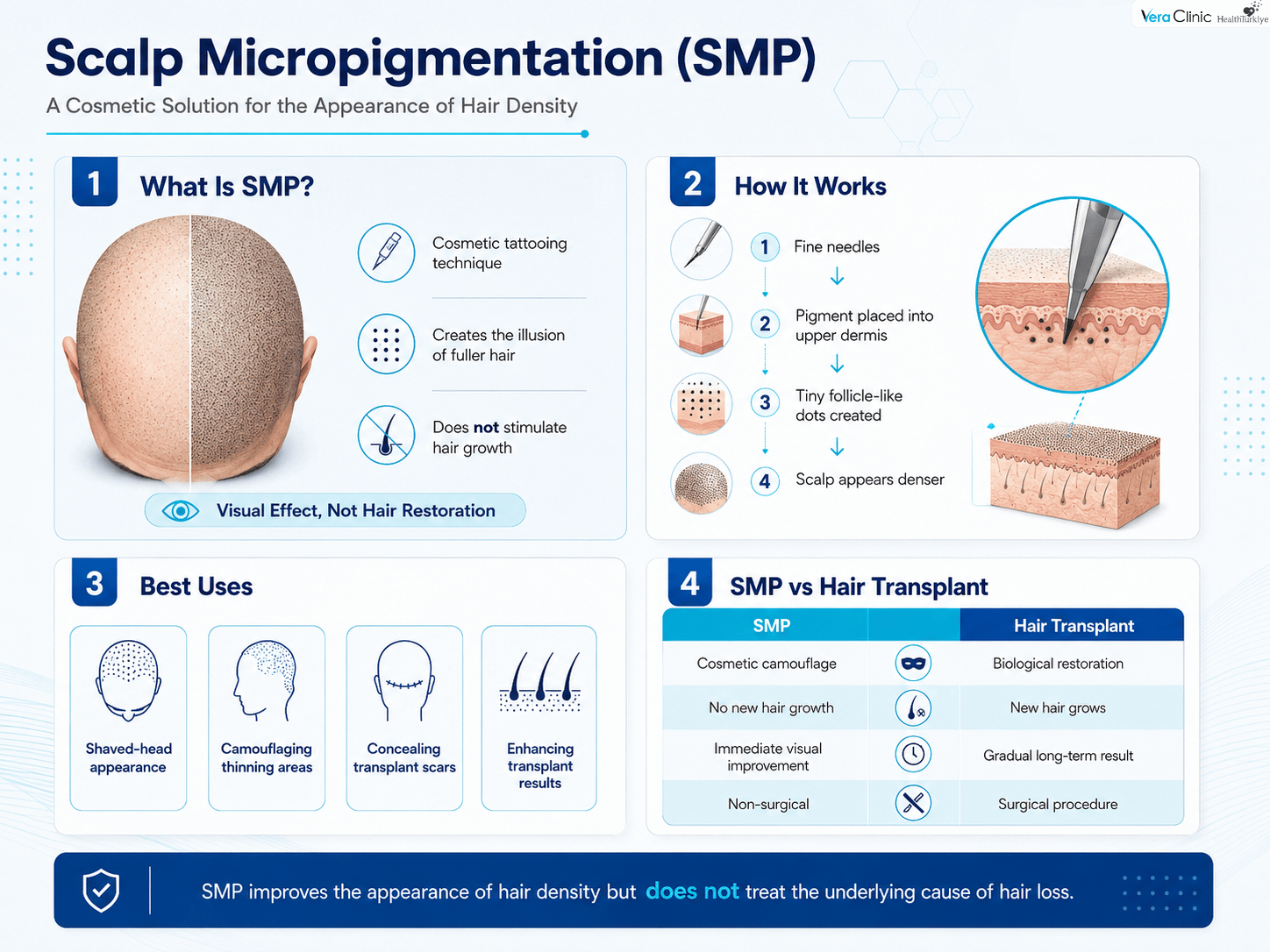
Scalp micropigmentation (SMP) is a cosmetic tattooing technique that deposits pigment into the scalp to create the visual appearance of denser hair or a closely shaved look. It does not stimulate hair growth and is not a treatment for the underlying cause of hair loss; it is a camouflage technique that changes how the scalp looks, not how it functions. SMP is used both as a standalone option for patients unsuited to or uninterested in surgery, and as a complement to a hair transplant, filling density gaps or concealing scars.
Key Points
- SMP deposits cosmetic-grade pigment into the upper dermis in a stippling pattern to mimic the look of hair follicles; it does not regrow hair or treat the biological cause of hair loss (Rassman et al., 2015).
- SMP’s main advantages are cosmetic and practical rather than medical, immediate visible results, scar concealment, and suitability even when donor hair is insufficient for a transplant (Rassman et al., 2015; Park et al., 2024).
- Treatment is built gradually across 2 to 4 sessions, with pigment density increased incrementally rather than completed in one pass, and pigment fading afterward is accelerated by UV exposure and sweating without proper aftercare (Liu et al., 2025; Dhurat et al., 2017).
- SMP suits patients with advanced hair loss and limited donor supply, those unsuited to surgery, women with diffuse thinning, and post-transplant patients seeking scar concealment, while patients with keloid-prone skin, active skin conditions, or very light skin paired with very light or white hair are poor candidates.
- A standardized three-session protocol produced a visual density score of 8.7 out of 10 immediately after treatment, holding at 7.7 out of 10 at 6 months, though pigment in scarring alopecia faded faster than in androgenetic alopecia, meaning results are not permanent (Liu et al., 2025).
- Documented risks range from pigment migration and unnatural results to rare infection or keloid scarring, and most corrective SMP cases trace back to non-medical settings rather than clinical ones.
- A full course costs significantly less in Turkey than in the United States or United Kingdom, even though session counts are similar across all three.
- SMP and a hair transplant address different problems, visual coverage versus biological regrowth, and are frequently combined, though ISHRS recommends waiting 10 to 12 months after a transplant before starting SMP.
What Is Scalp Micropigmentation?
Scalp micropigmentation is a non-surgical cosmetic procedure that uses fine needles to deposit specialized pigment into the upper dermis layer of the scalp, roughly 0.5 to 1 millimeter deep, in a stippling pattern of small dots. The result replicates the visual appearance of closely cropped hair follicles or adds the impression of density between existing hair (Rassman et al., 2015). SMP differs from conventional tattooing in both technique and material: it uses shallower needle depth, a pointillist dot pattern rather than line-work, and pigments formulated to resist the blue or green color shift that traditional tattoo ink can develop on the scalp over years. The most important clinical distinction is that SMP does not stimulate hair growth, does not affect existing follicles, and does not treat the underlying cause of hair loss. It changes the visual appearance of the scalp, not its biology. A common but misleading framing describes SMP as a hair loss solution or hair restoration treatment; SMP is more accurately described as a camouflage technique, since it addresses how hair loss looks rather than the hair loss itself. It sits alongside surgical and other non-surgical options among the range of effective hair loss treatments patients consider.
What Are the Benefits of Scalp Micropigmentation?
SMP’s benefits are cosmetic and practical rather than medical. Unlike treatments that work gradually on the follicle itself, SMP changes what the scalp looks like immediately, which is why it appeals to patients who want a visible result without waiting months to see whether a biological treatment takes effect.
- No surgery or downtime: The procedure is needle-based rather than surgical, and most patients resume normal activity within a day or two.
- Immediate visible results: Unlike treatments that require months to show an effect, the visual density change from SMP is apparent as soon as a session is complete.
- Scar and deformity concealment: SMP can visually blend FUE dot scars, FUT linear scars, and other scalp irregularities into the surrounding tone, the original clinical use case the technique was developed for (Rassman et al., 2015).
- An option when donor hair is insufficient: For patients with advanced hair loss whose donor area cannot support a full transplant, SMP can achieve a complete-coverage look that surgery alone cannot, since it does not depend on donor zone integrity the way a transplant does (Park et al., 2024). It is one of several corrective options for donor area damage specifically, alongside PRP and certain laser treatments.
- Low ongoing maintenance: Compared to daily topical treatments, SMP requires only periodic touch-up sessions rather than continuous use.
These advantages explain why SMP appeals both as a standalone option and as a finishing touch after a transplant, though they are cosmetic advantages, not medical ones.
What Does the Scalp Micropigmentation Procedure Involve?
The procedure begins with a consultation, where the practitioner assesses the hair loss pattern, scalp condition, and skin tone, then plans a hairline or density pattern suited to the patient’s facial structure. A pigment shade is selected and tested against the patient’s natural hair color, since an incorrect match is one of the most common causes of an unnatural result. For patients combining SMP with scar concealment, the practitioner also evaluates scar type and maturity, since FUT linear scars, FUE dot scars, and hypertrophic scars each respond differently to pigment.
Treatment itself is built gradually rather than completed in one pass: a standardized protocol builds pigment density across three sessions, moving from roughly 30% to 70% to 100% of natural follicular spacing (Liu et al., 2025; Dhurat et al., 2017). This incremental approach lets the practitioner adjust density and placement based on how the pigment settles after each session, rather than committing to a final result on the first visit. Each session commonly lasts one to several hours depending on the treatment area, with sessions spaced roughly one to three weeks apart to allow initial healing between passes. Most published protocols describe 2 to 4 total sessions, with the exact number depending on the size of the area treated and how much contrast needs to be built.
Aftercare in the days following each session matters for how well the pigment settles: patients are advised to avoid washing the treated area for the first 3 to 5 days and to avoid sun exposure, since UV exposure is one of the main causes of premature pigment fading. Sweating and swimming are restricted for about a week to protect pigment retention, and once the initial healing period has passed, light moisturizing supports the skin without disturbing the result.
Who Is a Good Candidate for Scalp Micropigmentation?
Candidacy depends on the pattern and stage of hair loss, medical history, and whether the goal is a standalone result or a complement to a transplant.
- Patients with advanced hair loss and limited donor supply: Where a transplant cannot achieve full coverage, SMP alone can create a closely shaved, complete-coverage appearance. On the Hamilton-Norwood Scale, this applies most directly to Stage 6, where the bald crown connects fully to the front, and Stage 7, where only a thin horseshoe-shaped band of hair remains and donor availability is too limited for full surgical restoration. This pattern appears in exploratory research on cellular hair therapies: a Vera Clinic Academy cohort study, part of a 220-patient, 12-month prospective cohort, noted SMP being used by patients with comprehensive donor area depletion to create a non-surgical illusion of density, though this observation was not formally quantified (Clinical Efficacy of Regenerative Hair Therapies and Combined Hair Transplantation Outcomes, Vera Clinic Academy, 2026).
- Patients who are not surgical candidates: Including those on blood thinners or with health factors that raise surgical risk, for whom non-surgical hair transplant alternatives are preferable.
- Women with diffuse thinning: Female SMP uses a different technique, softer gradients that darken the scalp between existing hair rather than replicating a shaved-head look, since female pattern baldness often produces diffuse thinning that also affects the donor zone and limits transplant candidacy (Park et al., 2024).
- Post-transplant patients: Those seeking to conceal FUE or FUT scars or fill visible density gaps between grafts.
- Patients with certain non-scarring or stable scarring alopecias: Including frontal fibrosing alopecia and traction alopecia, which tend to respond better to SMP than more fibrotic scarring conditions (Shubham et al., 2026).
Vera Clinic’s medical team frames this limitation clearly with patients:
“If the donor area can’t realistically support the coverage a patient wants, we won’t perform a transplant just to deliver a partial result. That’s a donor supply problem, not something surgery can fix by trying harder. In those cases, patients are usually better served looking at options built for exactly that limitation, like scalp micropigmentation, rather than a procedure that was never going to reach the density they had in mind.”
— Dr. Emin Gül, Vera Clinic Surgeon
These profiles are not exhaustive, and a consultation remains the only way to confirm which category a patient falls into, using the Hamilton-Norwood Scale for men or the Ludwig Scale for women to assess stage precisely.
Who Should Not Get Scalp Micropigmentation?
Certain skin conditions and medical factors rule out SMP, at least temporarily.
- Patients with keloid-prone skin: Needle trauma carries a higher risk of hypertrophic or keloid scarring in these patients.
- Patients with active psoriasis or eczema in the treatment area: Compromised skin integrity affects both healing and pigment retention.
- Patients currently using isotretinoin: This medication impairs normal skin healing.
- Patients on blood thinners: These increase bleeding risk during the procedure and can affect how the pigment settles.
- Patients with scars under 12 months old: Scar tissue is still remodeling and has not stabilized enough for predictable pigment retention.
- Patients with very light skin and very light or white remaining hair: This combination fails the contrast requirement that makes SMP look natural.
A consultation is necessary to confirm candidacy, since several of these factors require a visual skin assessment rather than a self-check.
Is Scalp Micropigmentation Permanent?
No, scalp micropigmentation is not permanent. Unlike traditional tattoo ink, which is designed to stay unchanged indefinitely, SMP pigment is formulated to break down gradually, which is why results fade rather than shift color the way a regular tattoo might. Results last several years before a touch-up is needed, though durability depends on the underlying condition being treated. A study using a standardized three-session protocol recorded a visual density score of 8.7 out of 10 immediately after treatment, holding at 7.7 out of 10 at 6-month follow-up. Pigment in scarring alopecia faded more than in androgenetic alopecia over the same period, a difference of 1.6 versus 0.9 points on the density scale, a statistically significant gap (Liu et al., 2025). Fading over the following years is accelerated by UV exposure, oily skin, and normal skin cell turnover, which is why most patients need a touch-up periodically rather than getting a single permanent result.
Are There Risks or Side Effects of Scalp Micropigmentation?
Most complications associated with SMP relate to technique and provider skill rather than the pigment itself, though a few risks are relevant regardless of who performs the procedure.
- Pigment migration and color shift: Incorrect needle depth can cause pigment to spread under the skin or shift toward blue or green over time. Correctly placed pigment stays confined to a distinct, evenly spaced dot pattern that remains visually different from natural follicles under close inspection, a distinction confirmed in histopathological studies (Nguyen et al., 2022).
- Infection: As with any needle-based procedure, inadequate sterilization carries an infection risk.
- Allergic reaction: Uncommon, since SMP pigments are formulated to be hypoallergenic, but patients with known ink or dye sensitivities should disclose this beforehand.
- Keloid or hypertrophic scarring: In predisposed patients, repeated needle trauma can trigger raised scarring at the treatment site, which is why keloid-prone skin is also a disqualifying factor for candidacy.
- Uneven or unnatural results: Incorrect pigment color matching or an overly uniform dot pattern is a common cosmetic complication, more a technique failure than a medical risk.
Provider training affects these risks directly: corrective SMP cases are frequently linked to procedures originally performed in non-medical settings rather than clinical ones.
How Much Does Scalp Micropigmentation Cost?
SMP is priced per course of sessions rather than per single visit, since one session is rarely sufficient for a complete result.
| Region | Sessions | Estimated Full Course |
|---|---|---|
| Turkey | 2 – 4 | $800 – $2,000 |
| United States | 2 – 4 | $2,000 – $5,000 |
| United Kingdom | 2 – 4 | $2,300 – $4,400 |
The total depends on three factors: the size of the area treated, whether the goal is full density coverage or targeted scar concealment, and the number of sessions required to build density gradually. Scar concealment work requires more sessions than density-only work, since scar tissue takes pigment less predictably than normal skin. The session count is similar across regions, but per-session pricing varies significantly by country, which is the main driver of Turkey’s cost advantage. When SMP is combined with a hair transplant, it is priced and booked as a separate course of sessions rather than bundled into the transplant package.
How Does Scalp Micropigmentation Compare to a Hair Transplant?
SMP and a hair transplant are not equally matched solutions to the same problem. A hair transplant relocates living follicles that continue growing hair permanently, addressing hair loss at its source, while SMP only recreates the visual impression of density through pigment, without changing the scalp’s biology or growing a single new strand. For patients whose donor area can support the coverage they want, a hair transplant is the more complete, permanent solution.
| Aspect | Scalp Micropigmentation | Hair Transplant |
|---|---|---|
| Mechanism | Cosmetic pigment deposited in the upper dermis | Living follicles surgically relocated |
| Permanence | Fades over years; needs periodic touch-ups | Transplanted follicles grow permanently |
| Recovery | Minimal; days | Surgical; weeks to months |
| Donor hair required | No | Yes |
| Suitability for advanced hair loss | Effective regardless of donor supply | Limited by donor area density |
A retrospective study on treatment selection in women with female pattern hair loss found that SMP and hair transplantation are often selected for different clinical profiles, largely based on donor zone integrity (Park et al., 2024). SMP remains the more practical option specifically when donor supply cannot support a transplant, or when a patient is not a surgical candidate; in every other case, a hair transplant addresses the underlying cause directly rather than covering its appearance.
Can Scalp Micropigmentation Be Combined With a Hair Transplant?
Yes, SMP is commonly used alongside a hair transplant rather than as a substitute for it, most often to conceal FUE or FUT scars or to fill visible density gaps between grafts. Some approaches build this in from the start: a hybrid FUE technique can incorporate SMP directly into the surgical plan to enhance visual density between transplanted follicles, rather than adding it as a separate step afterward. Timing matters for the more common sequential approach: the International Society of Hair Restoration Surgery recommends waiting 10 to 12 months after a hair transplant before starting SMP, since transplanted hair takes this long to reach its final density and pattern. Starting earlier risks placing pigment based on a result that has not yet fully developed.
Why Choose Vera Clinic for a Hair Transplant?
Vera Clinic is a leading hair transplant center in Istanbul, Turkey, offering FUE, DHI, and Sapphire FUE techniques tailored to each patient’s donor supply and hair loss pattern. A hair transplant delivers a permanent, biological result that SMP cannot replicate. The surgical team assesses donor zone integrity during consultation to confirm candidacy, and pairs the procedure with supportive therapies such as PRP, stem cell treatment, and OxyCure to strengthen graft survival and recovery, an approach shaped by Vera Clinic Academy‘s clinical research.
Patients receive all-inclusive packages covering surgery, accommodation, transfers, and aftercare support, with procedures supervised by Vera Clinic’s surgical team. For patients whose case calls for a cosmetic option instead, whether due to limited donor supply or a preference to avoid surgery, SMP remains available as a complementary or standalone alternative for patients exploring their options across Vera Clinic‘s hair restoration treatments.
Frequently Asked Questions
No, scalp micropigmentation does not regrow hair or affect existing follicles. It is a cosmetic technique that changes the visual appearance of the scalp, not a treatment for the biological cause of hair loss (Rassman et al., 2015).
Yes, though removal requires multiple laser sessions and is less predictable than the original application, similar to removing other cosmetic tattoos. Because SMP pigment sits shallower than traditional tattoo ink, results from removal can vary.
Most patients describe the sensation as mild discomfort rather than significant pain, comparable to a fine-needle tattoo. Topical numbing is commonly used, and any soreness resolves within a day or two.
Sources
- Dhurat, R. S., Shanshanwal, S. J. S., & Dandale, A. L. (2017). Standardization of SMP procedure and its impact on outcome. Journal of Cutaneous and Aesthetic Surgery, 10(3), 145–149.
- International Society of Hair Restoration Surgery (ISHRS). Scalp micropigmentation (SMP): All you need to know. https://ishrs.org/micropigmentation-of-scalp/
- Liu et al. (2025). Scalp micropigmentation is an effective treatment for localized alopecia: Technical analysis and a series of ten case reports. Journal of Cosmetic Dermatology, 24(9), e70375.
- Nguyen, B., Mervis, J. S., Romanelli, P., & Tosti, A. (2022). Scalp micropigmentation: A clinicopathologic correlation. Skin Appendage Disorders, 8(5), 412–414.
- Park, J. H., Kim, N., & You, S. H. (2024). Hair transplantation versus scalp micropigmentation: A retrospective study of treatment selection in persons with female pattern hair loss. Journal of Cosmetic Dermatology, 23(10), 3347–3355.
- Rassman, W. R., Pak, J. P., Kim, J., & Estrin, N. F. (2015). Scalp micropigmentation: A concealer for hair and scalp deformities. Journal of Clinical and Aesthetic Dermatology, 8(3), 35–42.
- Shubham, S., Kaur, J., Bains, P., Sharma, S., & Kapoor, P. (2026). Efficacy, safety, and patient-reported outcomes of scalp micropigmentation in scarring alopecia. Journal of Cutaneous and Aesthetic Surgery, 19, 158–164.
- Vera Clinic Academy. (2026). Clinical Efficacy of Regenerative Hair Therapies and Combined Hair Transplantation Outcomes: A 12-Month Prospective Comparative Cohort Study. https://www.veraclinic.net/wp-content/uploads/2026/06/Clinical-Efficacy-of-Regenerative-Hair-Therapies-and-Combined-Hair-Transplantation-Outcomes-A-12-Month-Prospective-Comparative-Cohort-Study.pdf