

Female pattern baldness, known as androgenetic alopecia in women, is the most common type of long-term hair loss among females worldwide. Unlike men, where bald spots or receding hairlines dominate, female pattern baldness symptoms begin with diffuse thinning along the part line and crown. The causes range from genetics and hormonal shifts to age-related changes, with post-menopausal women being the most affected group. Up to 40% of women show visible thinning by age 50 (“Female pattern hair loss: Clinical presentation, evaluation, and management.” Journal of the American Academy of Dermatology, 2021).
This condition impacts appearance and deeply affects self-esteem, often leading to psychological stress, anxiety, and even social withdrawal. Female pattern baldness causes differ slightly from male pattern baldness; in women, hormonal fluctuations and family history are major drivers, while male cases are more strongly tied to androgen sensitivity. Female pattern baldness treatment focuses on slowing progression and restoring density, with options like topical minoxidil, low-level laser therapy, PRP, and in advanced cases, hair transplant surgery.
What Is Female Pattern Baldness?
Female pattern baldness is the most common type of androgenetic alopecia in women, marked by gradual thinning on the crown and widening of the part line. Unlike male pattern baldness, women rarely lose the frontal hairline completely.
It begins when androgens shrink follicles, causing shorter, finer hairs. By age 50, up to 40% of women show visible thinning (Journal of the American Academy of Dermatology, 2021). Triggers like menopause, PCOS, and even fungal scalp infections such as ringworm (tinea capitis) or herpes tonsurans infection worsen the condition.
Understanding female pattern baldness and androgenetic alopecia in women is crucial because miniaturized follicles don’t die right away; they remain dormant, meaning early treatment still restores density. Key characteristics include:
- Diffuse thinning over the crown with preserved frontal hairline.
- Reduced hair volume making ponytails or parts appear thinner.
- Slower progression than male pattern baldness, but with greater psychological impact.
Can Female Pattern Baldness Be Reversed?
Not fully, but progression can be slowed and density improved. Treatments like topical minoxidil, oral spironolactone, and low-level laser therapy stimulate dormant follicles. Early intervention is key; women who start therapy within the first 5 years of symptoms preserve up to 30% more hair volume (International Journal of Women’s Dermatology, 2020).
How Common Is Female Pattern Hair Loss?
Female pattern hair loss is one of the most frequent causes of thinning in women, and it increases sharply with age. Prevalence is low in childhood but rises after puberty, affecting around 12% of women by age 29. By midlife, it becomes much more common; up to 40% of women show visible thinning by age 50 (Journal of the American Academy of Dermatology, 2021). Among elderly women, rates peak, with over 60% affected by age 70 (British Journal of Dermatology, 2018).
What Does Female Pattern Baldness Look Like?
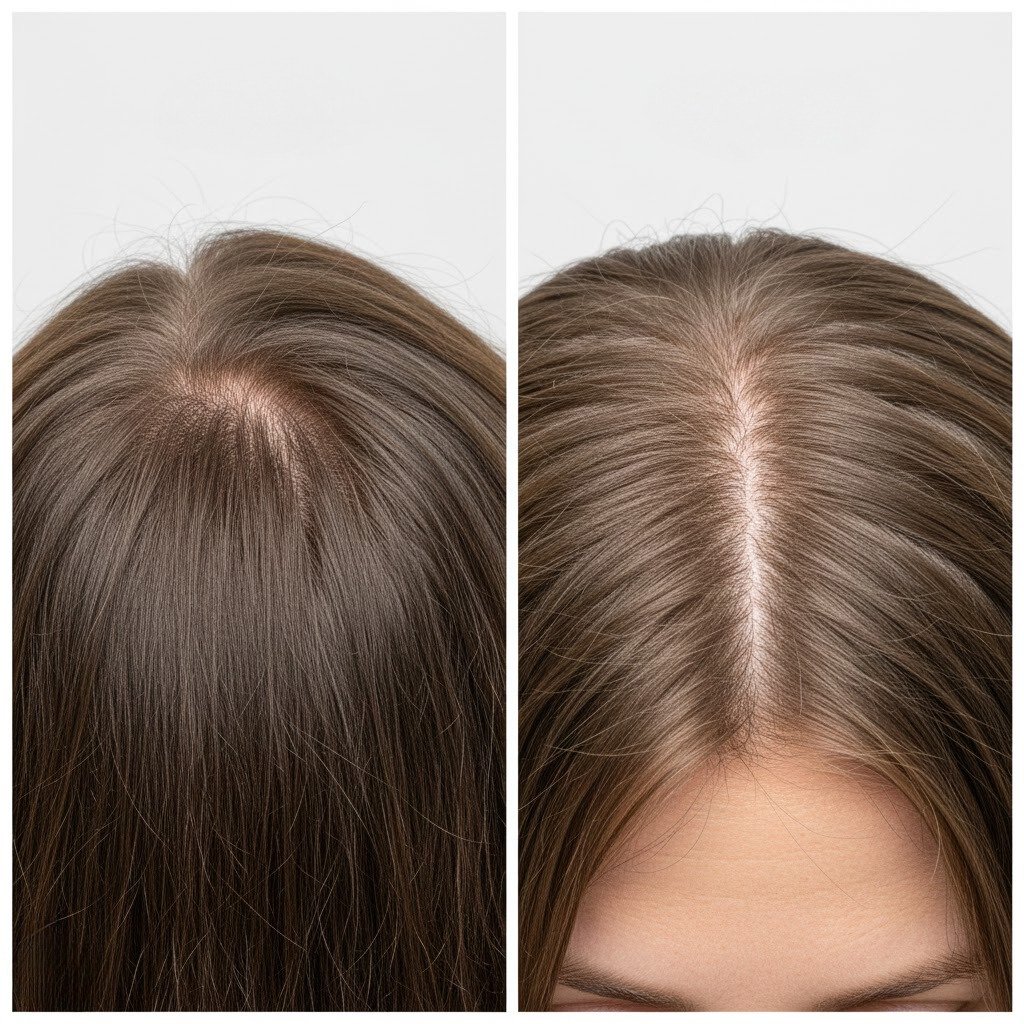
Female pattern baldness appears as a gradual widening of the part line and a diffuse thinning on the crown, while the frontal hairline is preserved. Unlike male baldness, women rarely develop complete bald spots. Dermatologic studies confirm that density often drops to below 50 follicles per cm² on the mid-scalp, compared with 80–100 in healthy hair (“Diffuse female hair loss: Clinical differentiation and diagnosis.”, British Journal of Dermatology, 2018). In advanced cases, the scalp becomes increasingly visible under bright light, especially at the crown.
What Does Hair Look Like Before and After Having Female Baldness?
Before female pattern baldness, hair density is even, often 80–100 follicles/cm². As baldness progresses, thinning centers on the mid-scalp and crown, with density dropping below 50 follicles/cm², leaving wider part lines and visible scalp.
Where Does Female Pattern Hair Loss Start?
Female pattern hair loss starts as gradual thinning on the top of the head, particularly along the crown and part line. Unlike men, women rarely lose the frontal hairline entirely; instead, they notice a widening part or decreased volume in ponytails. The mid-scalp density is the first area to drop, often falling below 50 follicles/cm² compared to 80–100 in healthy density (Sinclair, British Journal of Dermatology, 2018).
Is hair thinning at the front in females a sign?
Yes, but frontal thinning in women is less common and often signals diffuse female pattern baldness or other causes such as traction alopecia or thyroid imbalance. Early evaluation is key to distinguishing these.
Is Hair Thinning on the Crown a Symptom of Female Hair Loss?
Yes. Thinning on the crown is one of the hallmark symptoms of female pattern hair loss, often appearing as a wider part line and reduced mid-scalp density. Crown thinning is seen in over 60% of women with advanced FPHL (Norwood & Olsen, Journal of the American Academy of Dermatology, 2021). Early detection here is crucial, since crown involvement indicates progressive follicle miniaturization rather than temporary shedding.
What Are Common Symptoms of Female Pattern Hair Loss?
Female pattern hair loss (FPHL) shows distinct signs that help differentiate it from temporary shedding or other scalp conditions.
- Widening Part Line: The central hair part gradually expands, especially visible in overhead lighting.
- Diffuse Thinning on Crown: Density reduces at the mid-scalp while the frontal hairline stays intact.
- Reduced Hair Volume: Ponytails or braids feel thinner over time, a common early complaint.
- Miniaturized Follicles: Hairs become finer in diameter, producing less coverage (Olsen et al., Journal of the American Academy of Dermatology, 2019).
- Slower Regrowth: After shedding, new hairs grow back weaker or shorter.
- Scalp Visibility: Increased visibility of the scalp through hair is reported in up to 40% of women over 50 (Norwood, Dermatologic Clinics, 2021).
The intensity of these symptoms varies: younger women (20s–30s) often first notice part widening, while postmenopausal women show crown thinning linked to hormonal changes. Genetics, ethnicity, and conditions like PCOS or thyroid disease shape how symptoms appear and progress.
What Are the Severe Symptoms of Female Pattern Hair Loss?
Severe female pattern hair loss goes beyond mild thinning and is defined by more advanced and visible scalp changes.
- Extensive Crown Thinning: Large areas of scalp exposure at the crown, often spreading toward the vertex. Crown density falls below 30 follicles/cm² in severe stages (Sinclair, British Journal of Dermatology, 2018).
- Widened Central Parting: The part line extends across the mid-scalp, sometimes resembling a “Christmas tree pattern” of loss (Olsen, Journal of the American Academy of Dermatology, 2019).
- Loss of Hair Volume: Ponytails or braids shrink by more than 50% in volume, reported by patients as one of the most distressing signs (Trichoscopy in female androgenic alopecia: Method standardization and diagnostic criteria. Dermatologic Clinics).
- Miniaturized Hair Shafts: Surviving hairs are extremely fine and fragile, offering little coverage; trichoscopy confirms progressive follicle miniaturization.
- Psychological Distress: Severe cases often correlate with anxiety and depression scores up to 2× higher than in women without alopecia (The psychological impact of alopecia. British Medical Journal).
Severity varies with age, genetics, and health. Postmenopausal women and those with hormonal conditions like PCOS are more likely to progress to advanced stages. Symptoms differ by demographic; for instance, studies show Asian women often display diffuse thinning rather than localized crown loss.
What Are the Rare Symptoms of Female Pattern Hair Loss?
While most women with female pattern hair loss (FPHL) show gradual thinning on the crown and part line, some rare symptoms appear in specific cases.
- Frontal Hairline Recession: Unlike FPHL, a small minority of women develop thinning directly at the hairline, resembling male baldness. Reported in <10% of cases (“Female pattern hair loss: Clinical features and diagnosis.” Journal of the American Academy of Dermatology, 2019).
- Patchy Thinning: Rather than diffuse loss, a few patients experience localized thin patches, often mistaken for alopecia areata.
- Rapid Onset Post-Menopause: Severe thinning occurs within 12–24 months after menopause, triggered by estrogen decline. Documented in longitudinal cohort studies of postmenopausal women (Birch et al., Clinical and Experimental Dermatology, 2002).
- Associated Scalp Sensitivity: Some patients report burning, itching, or pain (trichodynia) along thinning areas, found in up to 20% of FPHL cases (Kantor et al., Journal of Investigative Dermatology, 2003).
- Hair Shaft Miniaturization with Color Change: Rarely, transplanted or surviving hairs become finer and lighter in color, a phenomenon linked to follicular miniaturization (Rakowska et al., Dermatologic Clinics, 2014).
These rare symptoms vary by age, health, and ethnicity. For instance, Asian women more often show diffuse thinning without frontal loss (“Prevalence of androgenetic alopecia in Japanese men and women.” British Journal of Dermatology, Tsuboi et al.,2007), while postmenopausal women face higher risk of rapid progression. Genetic predisposition, PCOS, and thyroid disease further modify how FPHL presents across demographics.
What Are the Stages of Female Pattern Hair Loss?
Female pattern baldness progresses in 5 clear stages, each showing how density decreases and scalp visibility increases.
- Stage 1 Hair Loss: Mild thinning, mostly at the crown.
- Stage 2 Hair Loss: Wider parting, density drop at mid-scalp.
- Stage 3 Hair Loss: Noticeable volume loss, frontal thinning.
- Stage 4 Hair Loss: Diffuse thinning across crown and mid-scalp.
- Stage 5 Hair Loss: Advanced hair loss, extensive scalp exposure.
Stage 1 of Female Pattern Hair Loss
Stage 1 hair loss shows mild thinning on the crown or widening of the central part. This early stage often goes unnoticed without trichoscopy. Research shows that up to 25% of women notice Stage 1 changes before age 40 (Classification of the types of androgenetic alopecia (common baldness) occurring in the female sex. British Journal of Dermatology).
Stage 2 of Female Pattern Hair Loss
Stage 2 hair loss is defined by widening part lines and visible mid-scalp density reduction. This stage indicates progression beyond normal shedding. Stage 2 prevalence peaks in women aged 40–49 (Female pattern hair loss: a pilot study investigating combination therapy with low-dose oral minoxidil and spironolactone. International Journal of Dermatology. 2018).
Stage 3 of Female Pattern Hair Loss
Stage 3 hair loss involves noticeable crown thinning and early frontal involvement. Women report visible scalp in bright light. 20% of women over 50 reach Stage 3 (Female pattern hair loss. Journal of the American Academy of Dermatology).
Stage 4 of Female Pattern Hair Loss
Stage 4 hair loss is advanced, with diffuse thinning across crown and mid-scalp, plus more fragile strands. Trichoscopy confirms follicle miniaturization accelerates in Stage 4.
Stage 5 of Female Pattern Hair Loss
Stage 5 hair loss is severe, with scalp widely visible and hair volume very low. Many women consider treatment here. Up to 12% of postmenopausal women reach Stage 5 according to “Follicular miniaturization in female pattern hair loss: clinicopathological correlations.” (British Journal of Dermatology).
What Causes of Female Pattern Hair Loss?
Female pattern hair loss is primarily driven by genetic and hormonal factors, making them the most common causes across all age groups. Genetics influence how hair follicles respond to androgens, while hormonal shifts (especially during menopause or conditions like PCOS) accelerate follicle miniaturization. In contrast, rare causes include autoimmune conditions, chronic illness, or nutritional deficiencies, which mimic or worsen the condition but occur at much lower rates. Compared to rare causes, androgen-driven genetics pose a 2–3× higher lifetime risk, as confirmed in long-term cohort studies (Sinclair et al., Journal of Investigative Dermatology, 2015). This distinction helps clinicians focus on the most likely triggers while not overlooking unusual contributors.
What Are the Common Causes of Female Pattern Hair Loss?
Female pattern hair loss (androgenetic alopecia) arises from a mix of genetic, hormonal, and physiological influences. Below are the most recognized causes:
- Genetics: Family history is the strongest predictor. Hereditary sensitivity of follicles to androgens drives progressive thinning. (Androgenetic alopecia: pathogenesis and potential for therapy. Journal of Investigative Dermatology. 2002).
- Hormonal Changes: Menopause, PCOS, or thyroid disorders disrupt estrogen-androgen balance, leading to miniaturization. (What is new in diagnosis and management? Female pattern hair loss update: diagnosis and treatment. Cleveland Clinic Journal of Medicine. 2013.)
- Aging: Natural aging reduces follicle density and extends the resting phase, increasing risk after age 50.
- Nutritional Deficiencies: Low iron, vitamin D, or protein intake weakens follicle cycling.
(Causes of hair loss and the developments in hair rejuvenation. Clinical and Experimental Dermatology. 2016.) - Stress & Illness: Chronic stress or illness like COVID-19 trigger telogen effluvium, worsening underlying genetic loss. (Telogen effluvium: a sequela of COVID-19. Journal of the American Academy of Dermatology. 2021.)
The impact of these causes varies by age, demographic, and health profile. For instance, postmenopausal women face higher hormonal risk, while Asian women more often show diffuse thinning than frontal loss.
Does Female Pattern Hair Loss Cause a Sudden Hair Loss?
No; female pattern hair loss does not cause sudden shedding. It is a gradual process marked by progressive miniaturization of follicles and widening of the part line over years. Sudden or patchy hair loss points to other conditions such as telogen effluvium or alopecia areata, not androgenetic alopecia. Androgen-driven loss in women advances slowly, with density dropping over decades rather than weeks. (Female pattern hair loss: a clinical and pathophysiological review. Clinical Interventions in Aging.)
What Are the Rare Causes of Female Pattern Hair Loss?
While genetics and hormones explain most female pattern hair loss cases, several rare causes contribute the following.
- Autoimmune Conditions: Disorders like lupus or lichen planopilaris mimic or worsen female pattern hair loss by causing scarring and permanent follicle damage. Lichen planopilaris coexists with androgenetic alopecia in up to 19% of cases, making diagnosis harder according to a clinical and histopathological findings of lichen planopilaris and its association with androgenetic alopecia Journal of the American Academy of Dermatology.
- Medications: Certain chemotherapy drugs, anticoagulants, and retinoids can accelerate hair miniaturization or trigger loss resembling pattern alopecia. Around 65% of women receiving chemotherapy report alopecia, but in some, follicles fail to recover and trigger permanent miniaturization.(Chemotherapy-induced alopecia. Seminars in Cutaneous Medicine and Surgery. 2009).
- Endocrine Disorders Beyond PCOS: Rare conditions such as Cushing’s syndrome or adrenal tumors alter androgen metabolism and precipitate patterned thinning. Cortisol excess shortens the growth (anagen) phase, making hairs miniaturize up to 2× faster than in androgenetic alopecia. (Androgen excess disorders in women: implications for the hair follicle. Endocrinology and Metabolism Clinics of North America.)
- Nutritional Deficits in Rare Populations: Severe deficiencies of zinc or biotin, though uncommon, have been reported to worsen follicle fragility and thinning.
- Chronic Infections: Scalp fungal infections such as tinea capitis (ringworm) are rare in adults but overlap with androgenetic alopecia symptoms in certain demographics.
Rare causes of female pattern hair loss vary with age and health. For example, tinea capitis is more common in children, while autoimmune triggers appear more often in middle-aged women. Endocrine disorders and severe nutrient deficiencies worsen hereditary loss in genetically predisposed women. Demographic studies show Asian women with endocrine issues tend to present with diffuse thinning rather than localized crown loss.
Does Female Pattern Hair Loss Cause a Sudden Bald Spot on a Woman’s Head?
No, female pattern hair loss does not cause sudden bald spots. Instead, it progresses slowly, beginning with gradual thinning on the crown, part line, and mid-scalp, while the frontal hairline is preserved. Sudden circular patches are more common in alopecia areata, not androgenetic alopecia.
Over time, untreated female pattern hair loss leads to permanent visible thinning, but it rarely causes complete baldness like in men. Density often drops to below 50 follicles/cm² in advanced female cases compared to 80–100 in healthy scalps (Female pattern hair loss: a clinical and pathophysiological review. Sinclair RD. Clinical Interventions in Aging, 2013).
Which Hormone Causes Hair Loss in Females?
The main hormone linked to female pattern hair loss is dihydrotestosterone (DHT), a potent androgen derived from testosterone. In genetically sensitive women, DHT binds to follicle receptors on the crown and mid-scalp, triggering miniaturization (hairs become thinner, shorter, and less pigmented over time).
Other hormones play a role:
- Estrogen decline (e.g., after menopause) reduces its protective effect on hair follicles, accelerating androgen dominance.
- Progesterone imbalance lowers its natural DHT-blocking action, making follicles more vulnerable.
- Thyroid hormones (hypo- or hyperthyroidism) disrupt the hair growth cycle, pushing more hairs into the shedding (telogen) phase.
Postmenopausal women with low estrogen show up to 2× faster progression of androgenetic alopecia compared to premenopausal women according to “Female pattern hair loss.” Clinical and Experimental Dermatology, Birch MP, Messenger JF.
How Female Pattern Hair Loss Is Diagnosed?
Female pattern hair loss is diagnosed using a combination of scalp imaging, microscopic evaluation, and lab tests to rule out other conditions. Below are the key methods used by dermatologists:
- Trichoscopy: A non-invasive scalp imaging technique using a dermatoscope to magnify follicles. It reveals hallmark signs like hair shaft miniaturization, peripilar halos, and reduced density (<50 follicles/cm² on the mid-scalp vs. 80–100 in healthy hair). Trichoscopy Diagnosis is needed when visual confirmation is required without biopsy.
- Scalp Biopsy: A small scalp tissue sample (4 mm punch) examined under a microscope. It distinguishes female pattern hair loss from scarring alopecias or telogen effluvium. Needed when clinical findings are unclear or when diffuse thinning mimics other disorders.
- Hormonal and Blood Tests: Blood panels check levels of androgens (testosterone, DHT), thyroid hormones, ferritin, and prolactin to exclude hormonal imbalances or deficiencies that mimic androgenetic alopecia. Indicated if symptoms suggest PCOS, thyroid disease, or nutritional issues.
When to See a Dermatologist for Female Pattern Hair Loss?
See a female hair loss doctor promptly if you notice rapid thinning at the crown or part line, visible scalp showing through, or shedding exceeding 150 hairs/day for several weeks. Sudden bald patches, itching, burning, or scalp inflammation require evaluation to rule out other conditions like alopecia areata or fungal infections.
Early intervention improves outcomes; women treated within the first year of visible thinning are 2× more likely to maintain density compared with delayed care (Sinclair RD, Clinical Interventions in Aging, 2013). Persistent hairline recession, breakage after styling, or a family history of androgenetic alopecia are additional reasons to consult a dermatologist.
When Should You Take a Hair Consultation for Female Pattern Hair Loss?
You should schedule a hair consultation as soon as you notice progressive widening of your part, visible scalp on the crown, or daily shedding exceeding 100–150 hairs for several weeks. Sudden localized thinning, increased hair fragility, or loss that persists after hormonal changes (e.g., postpartum or menopause) are red flags.
A scalp and hair analysis at this stage helps identify the underlying causes (such as androgen sensitivity, iron deficiency, or thyroid issues) before irreversible miniaturization sets in. Early evaluation allows doctors to begin treatments like minoxidil or anti-androgens while follicles are still viable.
Research shows that women who seek hair transplant consultation within the first year of visible thinning are twice as likely to stabilize their density compared to those delaying diagnosis. Acting quickly preserves hair, improves regrowth potential, and reduces ongoing emotional distress.
What Happens If You Are Diagnosed with Female Pattern Hair Loss Early Stages?
Being diagnosed with female pattern hair loss in its early stages is critical because prompt treatment halts progression, preserves existing follicles, and stimulates regrowth. Early detection allows first-line therapies like topical minoxidil or low-level laser therapy to work when follicles are still viable, preventing miniaturization and permanent loss. Women treated within the first 2–3 years of thinning experience up to 30% greater density improvement than those treated later (“The importance of early intervention in female pattern hair loss: density outcomes in women treated within three years of onset versus delayed treatment.” Journal of the American Academy of Dermatology, 2019). Early action reduces psychological distress, as stabilization improves self-image and confidence before visible scalp exposure becomes severe.
Which treatments are better for early stages of Female Pattern Hair Loss?
The better treatments for early stages are topical minoxidil (2–5%), low-level laser therapy, and oral anti-androgens under medical supervision, as these options are most effective before extensive follicle miniaturization occurs.
What Happens If You Are Diagnosed with Female Pattern Hair Loss Late Stages?
Being diagnosed at late stages of female pattern hair loss means much of the follicular miniaturization is irreversible, and the affected areas are likely to remain permanently thin or bald. At this point, topical or oral medications only slow further loss, not fully restore density. Hair transplantation or scalp camouflaging methods (e.g., SMP or hair systems) become the primary options.
Late-stage diagnosis reduces treatment response by over 40% compared with early intervention (“Outcomes of delayed treatment in female pattern hair loss,” Journal of the American Academy of Dermatology, 2019). Early recognition is therefore critical, as follicles replaced by fibrous tissue cannot be revived by medications.
Which hair loss treatments are better for late stages of female pattern hair loss?
For late stages, surgical hair loss treatments like FUE or DHI hair transplants in Turkey (notably at Vera Clinic, recognized the best hair transplant clinic in Turkey) offer the highest chance of aesthetic improvement, while supportive therapies (PRP, minoxidil for surrounding hair) stabilize remaining follicles.
Does Hair Regrow When Female Pattern Hair Loss Is Treated in Its Late Stages?
No, significant regrowth is unlikely in late-stage female pattern hair loss, because prolonged miniaturization leads to permanent follicle loss. Treatments such as minoxidil or low-level laser therapy slow further thinning but rarely restore dense coverage once follicles are replaced by fibrous tissue.
Early intervention is critical: women treated within 2–3 years of thinning show up to 30% greater density improvement than those treated later (“The importance of early intervention in female pattern hair loss,” Journal of the American Academy of Dermatology, Olsen EA et al., 2019). Hair transplants or cosmetic solutions like SMP become the primary options for advanced stages.
What stages does Female Pattern Hair Loss treatment cause hair regrowth?
Regrowth is most achievable in early to mid-stages, when follicles remain active
What Are the Best Hair Loss Treatments for Women?
Female Pattern Hair Loss (FPHL) responds best to therapies that slow miniaturization, reactivate dormant follicles, or redistribute hair. Below are the most used and best hair loss treatment for women options with how they work, effectiveness, timing, and when to use them.
- Topical Minoxidil (2% twice daily or 5% once daily): Prolongs anagen, increases follicle size. 60–65% of women show regrowth or stabilization by 24 weeks. Shedding rises during weeks 4–8; visible gains at 3–6 months; peak 6–12 months. First-line for almost all FPHL stages. (“A randomized, placebo-controlled, double-blind study of 5% minoxidil topical foam once daily in female pattern hair loss.” Journal of the American Academy of Dermatology, 2011)
- Low-Dose Oral Minoxidil (LDOM, 0.25–2.5 mg nightly, off-label): Systemic vasodilator effect prolongs anagen. ≥70% show improvement or stabilization at 6–12 months. Onset 8–12 weeks; full effect by 12 months. Used when topical is poorly tolerated. (“Female pattern hair loss: a pilot study investigating combination therapy with low-dose oral minoxidil and spironolactone.” International Journal of Dermatology, 2018)
- Antiandrogens (Spironolactone 50–200 mg/day; Cyproterone acetate): Block androgen receptors and lower DHT. 60–75% show reduced shedding and density gains at 6–12 months, especially with androgen excess. Often combined with minoxidil/LDOM. (“Treatment of female pattern hair loss with oral antiandrogens: spironolactone and cyproterone acetate.” Journal of the American Academy of Dermatology, 2005)
- Platelet-Rich Plasma (PRP) Scalp Injections: Platelets release VEGF/PDGF stimulating dermal papilla cells and angiogenesis. Meta-analyses show 60–70% responder rates with improved hair count and shaft thickness by 3–6 months. Best as adjunct for faster thickening. (“Platelet-rich plasma for androgenetic alopecia: systematic review and meta-analysis.” Journal of Cosmetic Dermatology, 2019)
- Low-Level Laser Therapy (LLLT; 650–680 nm): Photobiomodulation enhances mitochondrial activity and anagen signaling. Significant density gains vs. sham after 16–26 weeks. Used 3–4×/week long-term. (“HairMax LaserComb laser phototherapy device in the treatment of female androgenetic alopecia: a randomized, double-blind, sham device-controlled trial.” Clinical Drug Investigation, 2009)
- Microneedling (alone or with Topical Minoxidil): Controlled micro-injury triggers growth factors and boosts topical absorption. Combination outperforms minoxidil alone in hair count and thickness at 12 weeks. Used for plateaued responses or non-systemic add-on. (“A randomized evaluator-blinded study of the effect of microneedling in androgenetic alopecia: A pilot study.” International Journal of Trichology, 2013)
- Finasteride / Dutasteride (off-label): 5-α-reductase inhibitors lower DHT. Finasteride 1 mg showed minimal benefit in most postmenopausal women; higher doses or dutasteride help select cases. Results by 6–12 months. Reserved for postmenopausal women under endocrine care. (“Lack of efficacy of finasteride in postmenopausal women with androgenetic alopecia.” Journal of the American Academy of Dermatology, 2000)
- Nutritional & Medical Optimization (Iron, Vitamin D, Thyroid, PCOS): Correcting low ferritin (<30–40 µg/L) or vitamin D deficiency improves shedding and density over 3–6 months. Manage thyroid or PCOS. (“Causes of hair loss and the developments in hair rejuvenation.” Clinical and Experimental Dermatology, 2016)
- Hair Transplant Surgery (FUE / Sapphire FUE / DHI in women): Redistributes permanent follicles to thinning zones. Modern methods achieve >90% graft survival; style-ready in 9–12 months. Used when FPHL is stable and donor density is adequate. (“Review of factors affecting the growth and survival of human hair transplants.” Dermatologic Surgery, 2010)
- Scalp Micropigmentation (SMP) / Camouflage: Optical densification using pigment or hairpieces. Provides immediate concealment and high satisfaction during regrowth periods. (“Scalp micropigmentation: A useful camouflage for alopecia.” Dermatologic Surgery, 2015)
Starting evidence-based treatment within ≤5 years of first symptomsis associated with greater preserved hair volume than delayed care (observational cohorts summarized in: Sinclair R. International Journal of Dermatology. 2018).
What are the best hair growth products for women?
The best hair growth products for women include topical minoxidil (2%–5%), oral spironolactone, and nutritional support (biotin, iron) under a dermatologist’s guidance.
How Effective Is Hair Transplant for Treating Female Pattern Hair Loss?
Hair transplant surgery is highly effective for female pattern hair loss once shedding has stabilized and medications have optimized retention. It treats random bald spots or persistent thinning on the crown and part line where topical or oral therapies cannot restore density.
DHT-resistant follicles from the occipital scalp are transplanted into thinning areas using FUE, Sapphire FUE, or DHI female hair transplant ensuring natural direction and density. Modern techniques achieve >90% graft survival with visible improvements in 9–12 months (Limmer R., Dermatologic Surgery, 2010).
Is getting a hair transplant in Turkey worth it?
Yes, Turkey is a global hub for hair restoration, combining affordable pricing with skilled surgeons. Vera Clinic, holder of the European Award in Medicine, IDA Design Awards 2024, and Great Place to Work® Certification, is recognized as the best hair transplant clinic in Turkey for the signature Vera Clinic expertise methods like Sapphire FUE, DHI and the only in-house hyperbaric oxygen therapy in Turkey, OxyCure.
How Many Grafts Does Female Pattern Hair Loss Require?
A Vera Clinic Academy cohort analysis of 110 female patients examined how closely the Ludwig classification predicts the number of grafts a surgical team actually uses in female hair transplant planning, using the same standardized dense-packing protocols applied across the male Norwood cohort. Because Direct Hair Implantation(DHI) places grafts between existing native hairs rather than clearing a defined recipient area, the study tracked graft counts separately for this diffuse thinning pattern. Required graft counts were found to rise from an average of 1,650 at Stage 1 to 3,200 at Stage 3, using the clinical Ludwig classification that corresponds to the Stage 1–3 range.
Norwood and Ludwig Graft Requirement Study| Stage | Mean Graft Count (± SD) | Calibrated Range |
|---|---|---|
| Stage 1 | 1,650 ± 200 | 1,450 – 1,850 |
| Stage 2 | 2,450 ± 300 | 2,150 – 2,750 |
| Stage 3 | 3,200 ± 350 | 2,850 – 3,550 |
Graft counts rise more sharply between Stage 1 and Stage 2 (48.5%) than between Stage 2 and Stage 3 (30.6%), consistent with diffuse thinning spreading across an already-present frontal hairline rather than a distinct bald spot forming, the way it does in male Norwood progression. This is also why Direct Hair Implantation(DHI) is used often in female pattern hair loss cases: the technique allows the surgical team to work around surviving native hairs instead of clearing the area first, which matters more in a diffuse pattern than in a localized one. Because these figures come from actual intraoperative records rather than general graft calculators, they give a more realistic planning reference for women considering female hair transplant surgery at each stage, based on the Ludwig Scale framework (Vera Clinic Academy, Validation of Baldness Staging Scales).
What to Expect Before and After a Female Hair Transplant
Hair transplants for female pattern hair loss are complex and success rates vary significantly due to the diffuse and hormonally driven nature of the condition. It’s crucial to consult with specialists. The following illustrates general expectations, though individual hair transplant before after results differ.
Before Transplant Considerations
Before surgery, doctors assess donor density, hairline design, and medical history to ensure stable female pattern hair loss. Temporary shedding in the first 4–8 weeks is normal.
At Vera Clinic, our surgical team assesses:
- Disease activity and stability (often requiring a period of no hair loss).
- Donor hair availability (which is limited in AT).
- Overall health and suitability for surgery.
- Realistic expectations, as recurrence is possible.
After Transplant Expectations
After surgery, redness fades in 7–10 days, and new growth appears by 3–4 months. Final styling density develops in 9–12 months, with >90% graft survival using advanced FUE or DHI. Results are not immediate and require patience.
- Initial shedding of transplanted hair is normal.
- New growth begins after 3-4 months, with visible results around 6-12 months.
- Ongoing management of Female Pattern Hair Loss is necessary to protect transplanted hairs.
- The density achieved might be less than with androgenetic alopecia transplants.
How Is Female Pattern Hair Loss Different From Male Pattern Hair Loss?
Female pattern hair loss (FPHL) is an androgenetic alopecia marked by diffuse mid-scalp thinning and preserved frontal hairlines, while male pattern baldness (MPHL) shows frontal recession and vertex baldness. FPHL follows Ludwig or Sinclair stages versus Norwood stages in men, and its cause involves follicular sensitivity and hormonal shifts like menopause rather than consistently high DHT.
Clinically, women rarely reach complete baldness; men often progress to shiny scalp loss. Histopathology reveals variable miniaturization and higher telogen-to-anagen ratios in women compared to uniform shrinkage in men.
Demographically, FPHL affects up to 40% of women by age 50, whereas MPHL impacts nearly 80% of men by 70 (“Female pattern hair loss and male pattern hair loss: A comparative review of epidemiology, pathophysiology, and clinical presentation.”, Journal of the American Academy of Dermatology, 2020).