

Traditional hair transplants use needle-based local anesthesia, which is effective but causes brief pain and anxiety. Pain-free (needle-free) anesthesia hair transplant introduces needle-free jet injectors, which use high-pressure air to deliver anesthesia through the skin without puncturing it.
The innovation of needle-free anesthesia for hair transplants is not the drug (lidocaine) but the delivery system, as the research titled “The feasibility of needleless jet injection versus conventional local anesthetic needle: systematic review of clinical evidence” published in PMC shows.
Control of pain through delivery mechanics, not patient endurance.
At Vera Clinic, pain-free (needle-free) anesthesia and needle-free anesthesia are designed as part of the procedure, not added as an afterthought. Sapphire FUE hair transplant procedures last 6–8 hours. Local anesthesia takes about 15 minutes. After anesthesia takes effect, patients do not feel pain.
Pain-free anesthesia for hair transplant focuses on how anesthesia enters the scalp. Needle-free anesthesia reduces pain during the most sensitive minutes. After numbing, the procedure feels like pressure, not an actual hair transplant pain.
What Is Pain-Free (Needle-Free) Anesthesia?
Pain-free (needle-free) anesthesia is a group of medical techniques designed to reduce pain perception during local anesthesia delivery. These methods focus on how anesthetic enters the tissue rather than increasing drug strength. It is not a single device or a promise of zero sensation.
The approach was first developed in dentistry. Computer-controlled anesthesia systems were created to deliver anesthetic slowly and evenly. Clinical research in dental anesthesia shows that controlled flow lowers tissue pressure and reduces pain signal activation. The same physiological principle now applies to scalp anesthesia.
In hair transplant procedures, pain-free anesthesia combines local anesthesia with needle-free delivery during the initial numbing phase. The objective is direct. The scalp becomes numb before pain signals fully activate.
Key technologies include computer-controlled anesthesia systems, needle-free jet injectors, and high-pressure anesthetic mist delivery. These tools support local anesthesia by regulating speed, depth, and distribution with greater precision.
How Pain-Free (Needle-Free) Anesthesia Works on the Scalp
Needle-free local anesthesia scalp techniques rely on jet injectors that deliver anesthetic via pressure, not puncture, creating a fine high-speed stream that penetrates the skin without a needle stick. This high-pressure delivery produces a microshockwave that briefly opens microscopic pathways in the epidermis, allowing the anesthetic to spread widely and evenly across the scalp. Because the scalp is one of the most vascularized and nerve-dense areas of the body, this method enables the anesthetic to reach superficial nerve endings first, producing rapid and uniform numbing across the treated zone.
Patients consistently describe the sensation as pressure or vibration, not a sharp sting, which aligns with the Gate Control Theory of Pain. The jet’s mechanical pressure stimulates fast-conducting A-β fibers that transmit vibration sensations, effectively closing the neural “gate” before slower pain fibers can activate. This creates a brief but powerful block of pain signaling: a neurophysiological effect rather than merely a psychological one.
Initial numbing happens before any deeper anesthesia, which is the key to the method’s success. This “first numbing phase lasts minutes” but significantly reduces pain perception during deeper anesthesia later. By pre-numbing the scalp’s upper sensory network, the patient’s nerves are partially desensitized before any secondary injection or surgical manipulation. The scalp’s fibrous galea layer helps disperse the anesthetic horizontally, creating a uniform field of analgesia that enhances comfort and efficiency during hair transplantation procedures.
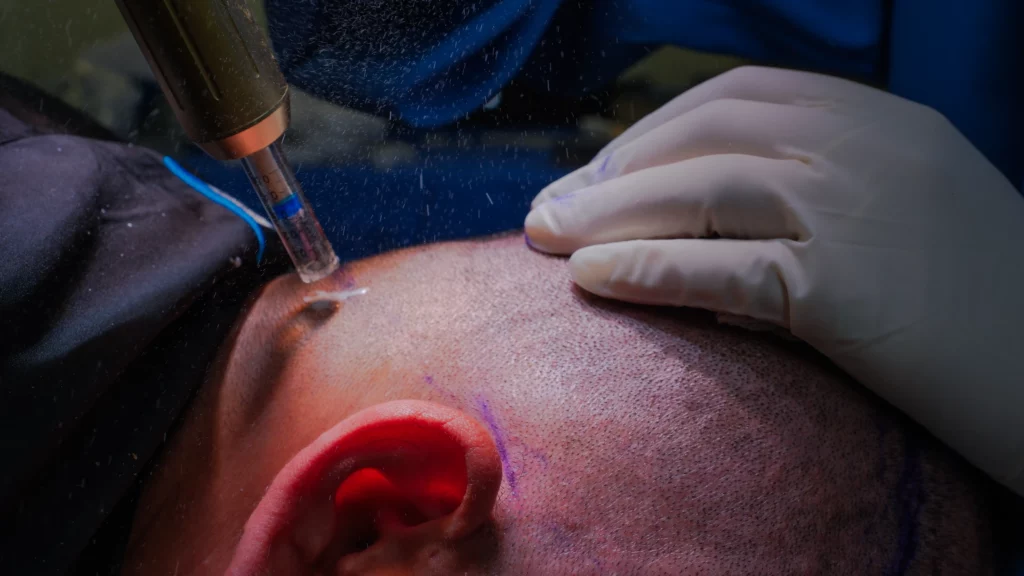
Needle-free jet injection provides anesthesia with equal or lower pain perception than conventional needle methods, validating its safety and effectiveness in superficial and vascular tissue zones according to the research titled “Assessment of anesthetic properties and pain during needleless jet injection anesthesia: a randomized clinical trial“ published in the Journal of Applied Oral Science.
Needle-free anesthesia uses high-pressure delivery to numb the scalp without a needle stick.
Why the First Minutes Matter Most in Hair Transplant Anesthesia
Most pain memory forms during the first injections. Neurology research shows that early pain shapes how the brain interprets the rest of a procedure. (The subjective experience of pain: Where expectations shape perceptual experience, T. Koyama, et al., 2005)
Once superficial nerves are blocked, pain drops sharply. The scalp becomes resistant to further pain signals. Needle-free anesthesia targets that window.
Traditional anesthesia often starts with needle penetration into fully sensitive skin. Pain-free anesthesia reverses that order. The surface numbs first. Deeper anesthesia follows calmly.
This approach is not marketing language. It is pain physiology. Studies on procedural pain confirm that early nerve blockade lowers overall pain perception and anxiety.
Most hair transplant pain occurs during the first minutes of anesthesia, not during surgery.
Does a Hair Transplant Hurt After Anesthesia Takes Effect?
No, a hair transplant does not hurt after anesthesia takes effect, Vera Clinic patients report that they feel only a moment of pressure or vibration. Needle-free local anesthesia blocks superficial nerves first, cutting off the brain’s early pain signals. This layered numbing creates a neurological “pain lockout” that lasts the full 6–8 hours of a Sapphire FUE procedure at Vera Clinic.
Is anesthesia painful during a hair transplant?
Anesthesia during a hair transplant is virtually painless, as modern needle-free jet systems numb the scalp through pressure instead of needles, blocking pain before it can register.
Is Needle-Free Anesthesia Enough on Its Own for Pain?
Needle-free anesthesia handles the first numbing stage. Tiny needles may still be used later for tumescent anesthesia. The difference is timing. The scalp is already numb. Pain remains minimal.
This layered approach is honest and safe. It aligns with clinical anesthesia standards used in dermatologic surgery.
What do they give you to calm you down before surgery?
Local anesthesia does most of the work. A calm environment and controlled pacing support comfort.
Can You Do a Hair Transplant without Anesthesia?
No. A hair transplant cannot be done without anesthesia. Pain-free does not mean anesthesia-free. It means controlled, well-timed anesthesia that minimizes discomfort.
What Does Clinical Data Show About Hair Transplant Anesthesia Pain?
Patients consistently overestimate procedural pain before FUE hair transplantation. A retrospective cohort study conducted at Vera Academy analyzed 19,586 patients undergoing FUE hair transplantation between 2021 and 2025, making it one of the largest real-world datasets on procedural pain in hair restoration.
Before anesthesia, patients in both groups rated their expected pain above 7 out of 10 on a Visual Analog Scale (VAS). After anesthesia was completed, actual pain scores dropped sharply in both groups, and significantly more in the needle-free group.
| Metric | Traditional Needle (TLA) | Needle-Free (NFA) |
|---|---|---|
| Expected pain (VAS 0–10) | 7.47 | 7.36 |
| Actual pain (VAS 0–10) | 3.82 | 1.70 |
| Pain reduction | 3.65 points | 5.66 points |
| Between-group difference | — | 2.12 points lower |
| Effect size (Cohen's d) | — | ≈ 2.2 (large) |
The 2.12-point difference between groups was statistically significant (95% CI: 2.04–2.20; p < 0.001). Needle-free anesthesia remained independently associated with lower pain scores after adjustment for age, sex, graft count, and hair loss stage.
The gap between expected and actual pain suggests that fear of anesthesia is a bigger barrier than the procedure itself. Evidence-based counseling and needle-free delivery together address both the psychological and physical components of procedural discomfort.
What Is the Pain Level of Hair Transplant Anesthesia?
Hair transplant anesthesia pain is low with needle-free protocols. Clinical data from Vera Academy referenced in our hair transplant pain data recorded a mean actual pain score of 1.70 out of 10 for needle-free anesthesia patients, compared to 3.82 for conventional needle injection.
For reference, patient-reported scores by phase:
- Initial needle-free numbing: 1–2 on VAS, based on post-procedure clinical records.
- Deeper tumescent anesthesia (scalp already numb): 0–1. Extraction and implantation phase: 0.
These numbers reflect measured outcomes, not estimates. The same cohort reported pre-procedure expectations averaging 7.36 out of 10, meaning patients experienced less than one-quarter of the pain they anticipated.
How Does Needle-Free Anesthesia Compare to Traditional Injection in Practice?
Needle-free anesthesia produces significantly lower pain scores than conventional 30-gauge needle injection during the anesthesia phase of FUE hair transplantation. The Vera Academy study provides direct comparative data across both methods under standardized clinical conditions.
| Factor | Traditional Needle (TLA) | Needle-Free (NFA) |
|---|---|---|
| Delivery method | 30-gauge needle injection | High-pressure jet injector |
| Mean actual pain (VAS) | 3.82 ± 1.19 | 1.70 ± 0.65 |
| Needle penetration | Yes | No |
| Bruising / pinpoint bleeding | Occasionally documented | Not applicable |
| Transient erythema | Rare | Small proportion of patients |
| Severe adverse events | None | None |
Both methods used the same anesthetic formulation (lidocaine with epinephrine) and the same coverage areas. The difference in outcome was attributable to delivery mechanics, not drug strength.
Who Benefits Most From Needle-Free Anesthesia?
Needle-free anesthesia is most useful in specific patient groups.
- Patients with needle phobia (trypanophobia): Anesthesia for needle phobia hair transplant cases reduces fear during the first minutes.
- Anxiety-prone patients: Lower early pain reduces stress response and muscle tension.
- First-time hair transplant patients: No previous pain memory improves overall experience.
At Vera Clinic, patient comfort is a design goal. The scientific approach behind pain-free anesthesia supports that goal without exaggeration.