
Hair transplantation produces measurable improvements in psychological well-being, but the path there is rarely linear. Vera Clinic Academy, the clinical research unit of Vera Clinic, conducted a longitudinal study tracking 40 male patients across twelve months. Self-esteem scores increased by 47.3%, sexual dissatisfaction dropped by 45%, and relationship satisfaction improved significantly, all with strong statistical reliability (p < 0.001). The reported p < 0.001 finding suggests that hair transplantation should not be viewed solely as a cosmetic change in appearance, but as a clinically significant intervention with measurable psychological effects that warrant deeper evaluation within the field of hair transplant psychology.
The reported p < 0.001 finding suggests that hair transplantation should not be viewed solely as a cosmetic change in appearance, but as a clinically significant intervention with measurable psychological effects that warrant deeper evaluation within the field of hair transplant psychology.
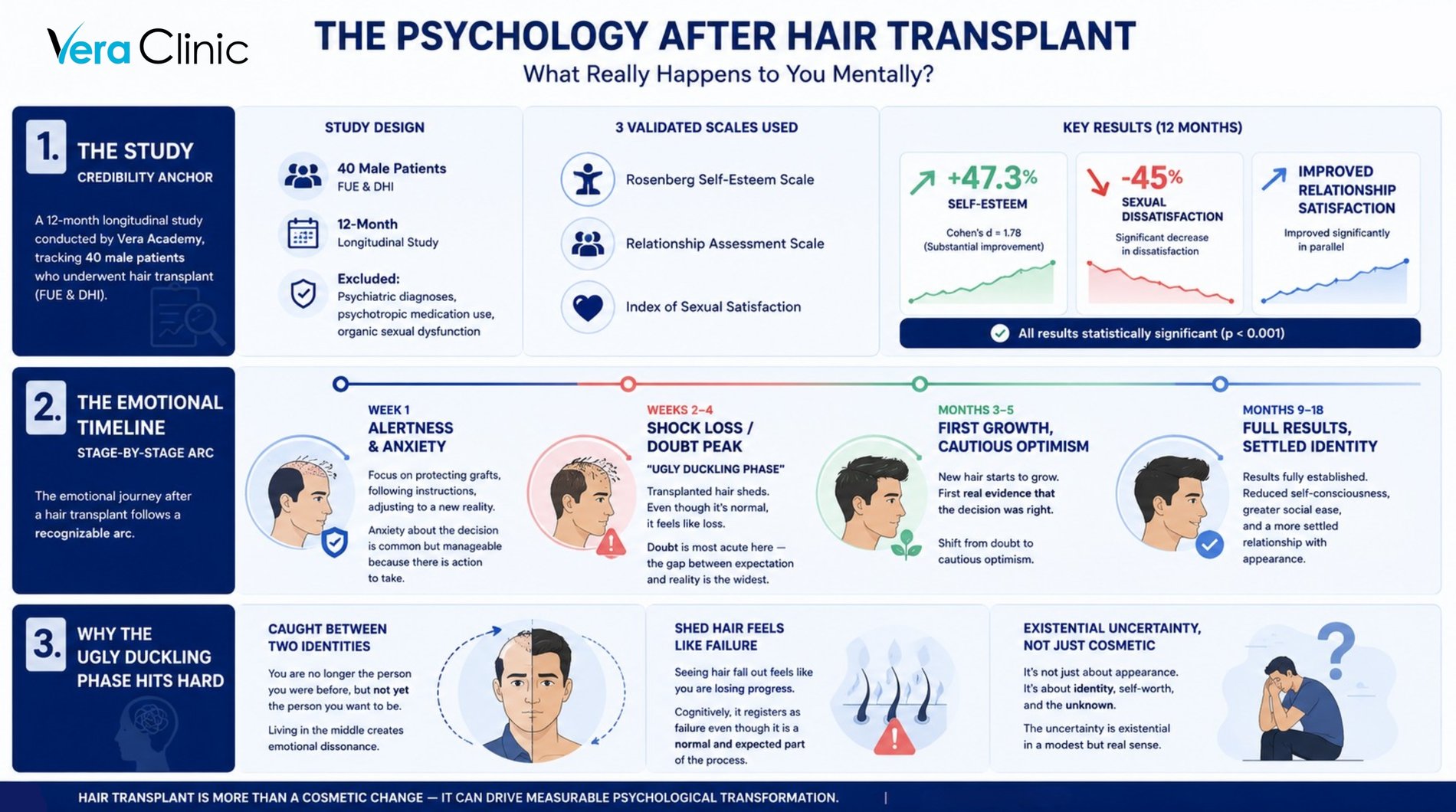
The emotional journey after a hair transplant follows a recognizable arc starting with alertness, continuous with cautiousness, and ends with relief. Most patients experience significant self-esteem benefits, but a meaningful subset, particularly those with Body Dysmorphic Disorder (BDD) or unrealistic baseline expectations, do not.
The research also shows that self-esteem, relationship satisfaction, and sexual functioning do not improve independently after surgery. Instead, they move together. This suggests that hair transplant initiates a broader psychological shift, not simply a change in how someone looks in the mirror.
Vera Clinic Academy conducted hair transplant psychology study from data analysis from patients, not from observations.
What Are the Emotional Stages After a Hair Transplant?
The psychological journey after a hair transplant follows a recognizable arc with layers.
In the first week, the dominant psychological state is not excitement but alertness. Patients focus intensely on protecting their grafts, following post-op instructions correctly, and managing the unfamiliar appearance of a recently operated scalp. Anxiety about whether they made the right decision is common but manageable, because there is still action to take.
Between weeks two and four, the picture changes. Transplanted hair begins to shed. Even though this is a normal and expected part of the process, cognitively it registers as loss. This is the phase where doubt is most acute and where the gap between expectation and visible reality is at its widest.
Between months three and five, the first new growth appears. For many patients, this is the first concrete evidence that the decision they made was correct. The shift from doubt to cautious optimism during this period is well-documented in patient accounts.
By months nine to eighteen, hair transplant results are fully established. Patients consistently report reduced self-consciousness, greater social ease, and a more settled relationship with their own appearance.
Why Is the Ugly Duckling Phase the Hardest Part Emotionally?
What makes ugly duckling phase genuinely difficult is not just the appearance of the scalp. It is the psychological position it creates. When someone has spent years building behavioral strategies around their hair loss, the post-operative period does not offer immediate relief. It suspends the patient between two identities: the one they have been living with, and the one they cannot yet inhabit. The uncertainty is not simply cosmetic, it is existential in a modest but real sense.
The two-to-four month window after a hair transplant has acquired a name among patients, which is ugly duckling phase. During this phase, the hair follicles enter the resting phase and shed which is called shock loss. This means, even though the follicles remain in the scalp, hair loss continues for a single hair growth cycle.
What Does Clinical Research Say About Psychological Outcomes After Hair Transplant?
Most claims about the psychological benefits of hair transplantation are observational and anecdotal. A clinical study conducted at Vera Clinic by Vera Clinic Academy provides something more rigorous.
The study followed 40 male patients (FUE and DHI patients) across three time points: baseline (one week before surgery), six months post-operation, and twelve months post-operation. Three validated scales were used: the Rosenberg Self-Esteem Scale, the Relationship Assessment Scale, and the Index of Sexual Satisfaction. Participants with psychiatric diagnoses, psychotropic medication use, or organic sexual dysfunction were excluded to strengthen internal validity.
Results were statistically significant across all domains (p < 0.001). Self-esteem increased by 47.3% over twelve months, with a Cohen’s d of 1.78, indicating a substantial restructuring of self-perception rather than a modest improvement. Sexual dissatisfaction dropped by 45%, and relationship satisfaction improved in parallel.
Critically, these three variables did not move independently. Self-esteem and sexual dissatisfaction correlated at r = -0.71. Self-esteem and relationship satisfaction at r = 0.64. The data suggests a reciprocal system. Improved appearance raises self-esteem, which improves relational engagement, which generates positive social feedback, which reinforces self-concept. Over twelve months, this loop becomes self-sustaining.
Does a Hair Transplant Also Affect Your Relationships and Sex Life?
Yes, according to the study that Vera Clinic Academy conducted.
Over twelve months, relationship satisfaction and sexual functioning improved significantly alongside self-esteem, with all three domains moving in the same direction rather than independently. The 45% reduction in sexual dissatisfaction scores, combined with strong correlations between self-esteem and relational outcomes, indicates that the psychological benefits of hair transplantation extend into intimate life in measurable ways.
The mechanism appears to involve a reduction in what sex researchers call spectatoring. It is the tendency to self-observe and self-evaluate during intimate situations rather than remaining present in them. This cognitive pattern is closely tied to body image concerns. When body image improves, the attentional resources that were directed inward become available for connection instead.
Patients who experienced the greatest self-esteem gains in the study also showed the most significant improvements in both relationship satisfaction and sexual functioning, which is why the sex after hair transplant literature treats these outcomes as interdependent rather than separate.
Does a Hair Transplant Improve Self-Esteem for Everyone?
No, hair transplant does not improve self-esteem for everyone. A meaningful amount of patients continue experiencing dissatisfaction. The most clinical significant factor is Body Dysmorphic Disorder (BDD).
For individuals with BDD, the source of distress is never hair loss or baldness. The stress lies in the cognitive framework. Patients with unaddressed BDD are at elevated risk of dissatisfaction after any cosmetic procedure, even when results meet objective clinical standards.
A separate challenge involves expectations anchored to an idealized past rather than a realistic post-operative outcome. A patient benchmarking his results against photos from age nineteen is working with a target no procedure can reach.
How Does a Hair Transplant Change the Way You Present Yourself?
At Vera Clinic, a pattern in patient communications has repeated itself consistently enough to be worth examining through a psychological lens.
Before surgery, patients send photographs that isolate the scalp. They crop out their faces, frame from above, angle the camera to capture recession. The framing is clinical and deliberately partial. After surgery, once results are established, the same patients often send photographs that look nothing like those initial images: full face, full body, expansive posture.
In the psychology of self-presentation, this shift maps onto approach versus avoidance behavior. Hair loss is reliably associated with avoidance strategies, not because patients are vain, but because the condition generates anticipatory self-consciousness. People avoid cameras, certain lighting, social situations where their scalp might be noticed. These are functional adaptations to a source of distress.
When the source of avoidance is resolved, the behavioral inhibition often lifts. This is consistent with what the Vera Clinic Academy study measured, which is improvements in self-esteem correlated with improvements in relationship satisfaction and social engagement. What the photographs capture is not confidence in the colloquial sense, it’s the behavioral expression of reduced avoidance, which is a clinically meaningful change in how a person occupies social space.
What Can You Do to Protect Your Mental Health During the Recovery Process?
The research and clinical observation converge on a small number of strategies that meaningfully reduce psychological distress during recovery.
- Know the phases before you enter them: Shock loss in weeks two through four is a normal physiological event, not a sign of failure. Patients who understand this before surgery are significantly better equipped to tolerate the anxiety it generates.
- Calibrate your timeline to biological reality: Final results emerge between nine and eighteen months. Evaluating outcomes at month three means assessing an incomplete process.
- Manage appearance during recovery practically: During the shock-loss phase, wearing a hat is a reasonable tool for reducing the daily cognitive load of managing an appearance that has not yet resolved.
- Consider whether the emotional weight predates the surgery: Hair loss can accumulate years of associated distress (social avoidance, identity disruption, chronic self-monitoring). Surgery removes the condition; it does not automatically dissolve the patterns that formed around it.
Psychological support during or after recovery can be needed for some patients, especially for patients who are struggling with anxiety and BDD.
Why Does Hair Loss Affect Mental Health in the First Place?
Hair loss carries psychological weight that is disproportionate to its medical significance, and the reasons for this are well-established in the research literature.
For most men, hair is bound up in constructs of age, social status, and physical appeal. Androgenetic alopecia does not simply change how a person looks, it changes how a person believes they are perceived. Self-perception and perceived social evaluation are not the same thing, but hair loss tends to distort both simultaneously.
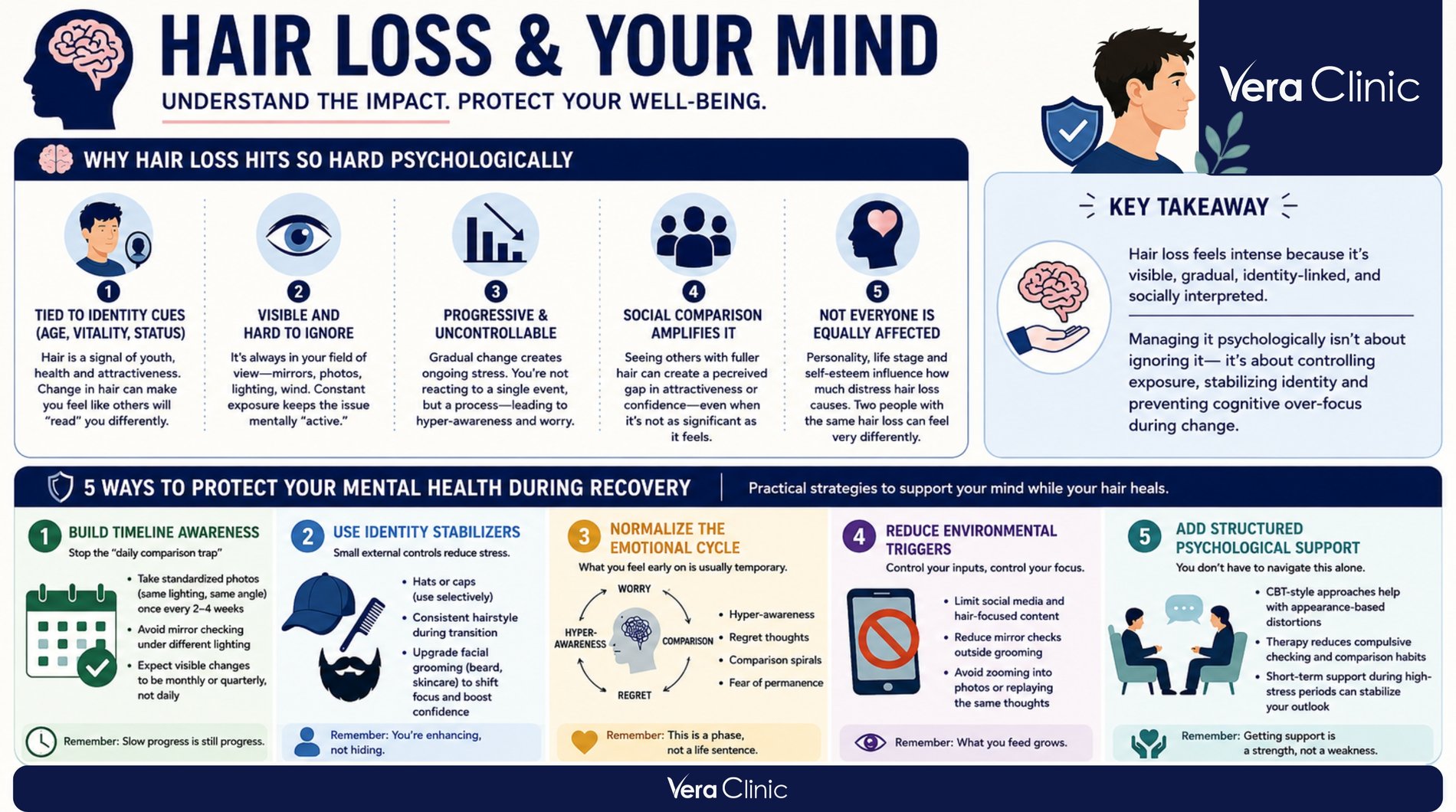
The consequences documented in the literature include reduced self-esteem, increased social anxiety, withdrawal from social situations, and disrupted body image. Because the change is progressive and visible, it generates a sustained state of self-consciousness rather than a discrete, resolvable event.
A separate, cross-sectional Vera Clinic Academy survey of 460 patients puts numbers to part of this picture, and shows it is not uniform across patients. Women scored higher on average than men on the Perceptions of Beauty Standards Scale (PBSS-8), a validated measure of how strongly a person feels exposed to societal appearance expectations: 64.3 versus 52.7. The score also rose with the severity of hair loss in both genders, from 59.8 among women with early-stage thinning to 71.4 among those with advanced loss, and similarly from 48.9 to 58.9 across stages in men, a pattern that the Hair Transplant Motivation and Beauty Standards Study describes. This does not mean women are more preoccupied with appearance than men; it means the same visible hair loss interacts with societal beauty expectations differently by gender, and more severe loss interacts more strongly with that pressure in both. This is an association measured at a single point before surgery, not a before-and-after outcome, so it describes how patients perceive their situation going in, rather than how surgery changes it.
Does Hair Loss Cause Depression in Everyone?
No, hair loss doesn’t cause clinical depression in everyone even though it might increase the risk of psychological distress.
Many men experience hair loss with minimal psychological disruption. Others experience significant distress that falls short of clinical threshold. A smaller subset develop symptoms that meet criteria for clinical conditions including depression, social anxiety disorder, or BDD.
BDD warrants specific attention because the distress it causes is often disconnected from the actual degree of hair loss. People with BDD may become intensely preoccupied with perceived flaws in their appearance, even when the objective change is minimal. Reassurance or cosmetic correction alone rarely resolves this distress because the underlying issue is psychological rather than purely aesthetic.
References:
- Research Gate Psychological Well-Being and Sexual Functioning Before and After Hair Transplantation: A Longitudinal Clinical Study of 40 Patients at Vera Clinic DOI:10.36948/ijfmr.2026.v08i02.72723
- Rosenberg, M. (1965) Society and the Adolescent Self-Image. Princeton University Press, Princeton, NJ. https://doi.org/10.1515/9781400876136
- Adamczyk, K., Kleka, P., & Frydrychowicz, M. (2022). Psychometric functioning, measurement invariance, and external associations of the Relationship Assessment Scale in a sample of Polish Adults. Scientific reports, 12(1), 22157. https://doi.org/10.1038/s41598-022-26653-6
- Hudson, W. W., Harrison, D. F., & Crosscup, P. C. (1981). A short-form scale to measure sexual discord in dyadic relationships. The Journal of Sex Research, 17, 157–174.