

Phalacrophobia is a reason for a hair transplant only when it is tied to real, diagnosable hair loss; when the fear exists without any visible hair loss, a hair transplant is not the answer. Phalacrophobia itself is an intense, persistent fear of going bald or losing hair, distinct from the ordinary worry most people feel when they notice thinning. It can affect people with no visible hair loss at all, and it does not resolve simply by looking in the mirror and seeing a full head of hair. The fear falls under the broader category of specific phobias (American Psychiatric Association [APA], 2013) rather than having its own separate diagnostic listing. It is driven by a mix of genetics, past experiences such as childhood teasing, and cultural pressure (Rachman, 1977) around appearance. The condition can be managed through cognitive behavioral therapy, exposure therapy, and in some cases medication for an underlying anxiety disorder. For people whose fear is tied to real, visible hair loss, a hair transplant may reduce the specific anxiety linked to that change (Yalcin et al., 2026), though it does not treat a phobia occurring independently of actual hair loss.
Key Points
- Phalacrophobia is a specific phobia, not a separate DSM-5 diagnosis (APA, 2013), closely related to but distinct from peladophobia, and can occur with no visible hair loss.
- It is shaped by genetics, past experiences, and cultural pressure around appearance (Rachman, 1977), not by a single cause.
- Cognitive behavioral therapy, exposure therapy, and medication (when an anxiety disorder is present) are the main treatment routes.
- A hair transplant can ease anxiety tied to real, visible hair loss, but it does not treat a phobia that exists independently of actual hair loss, and candidacy depends on which of the two is present.
- At Vera Clinic, this distinction is screened for as a standard part of every consultation, not handled only after a problem becomes visible.
What Is Phalacrophobia?
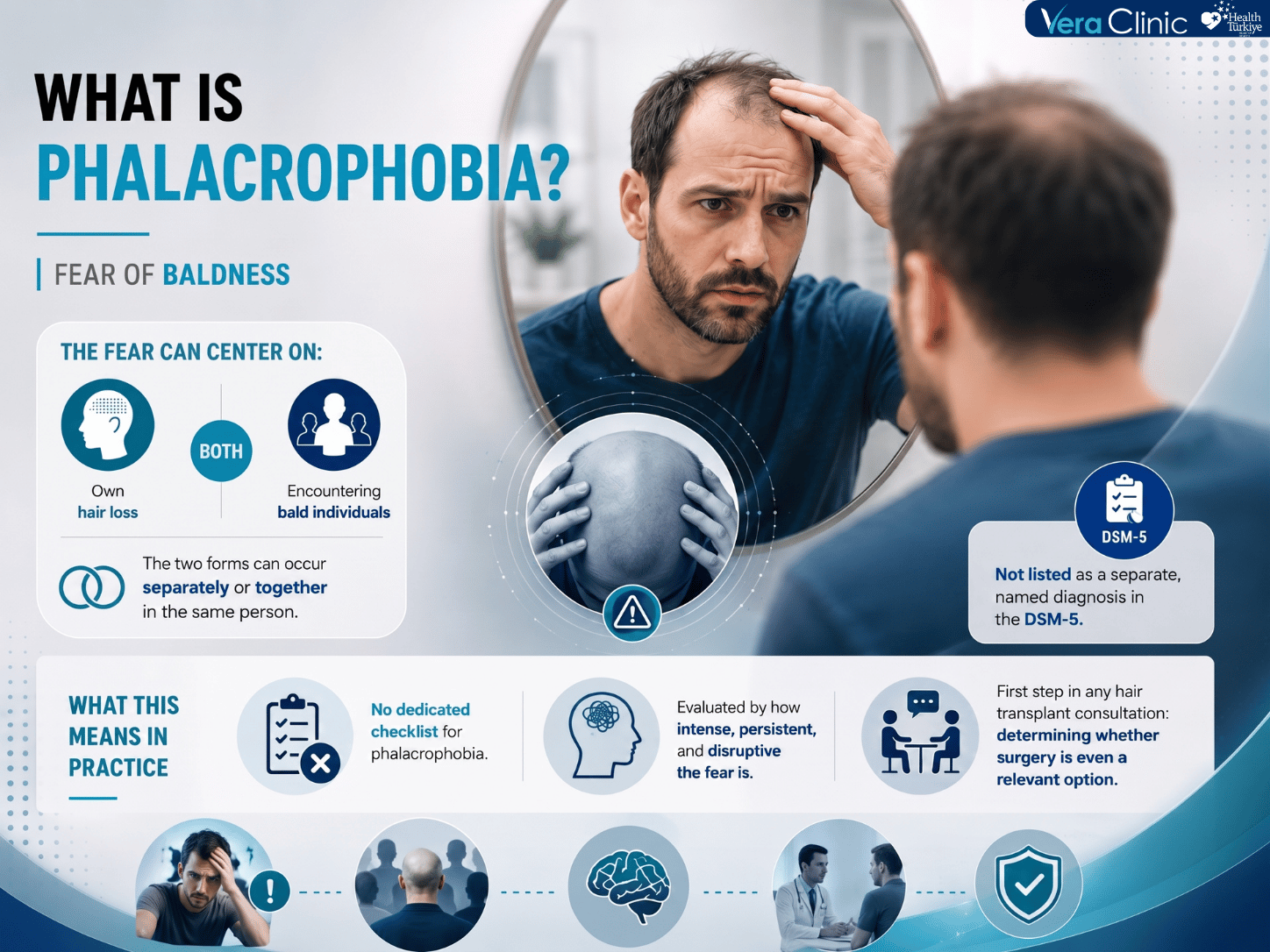
Phalacrophobia is fear of baldness, derived from the Greek words phalakros (bald) and phobos (fear). Phalacrophobia is not listed as a separate, named diagnosis in the DSM-5. Instead, a mental health professional would evaluate it under the general criteria for specific phobia (APA, 2013), since the diagnostic manual defines specific phobias by their pattern, a marked fear of a particular object or situation, rather than by a list of named triggers. This matters in practice: there is no dedicated checklist for phalacrophobia, so a clinician relies on how intense, persistent, and disruptive the fear is, not on the fact that its object happens to be baldness. This distinction is also the first thing a hair transplant consultation needs to establish, since it determines whether surgery is even a relevant option.
What Is the Difference Between Phalacrophobia and Peladophobia?
Phalacrophobia and peladophobia are closely related but not identical. Phalacrophobia is the fear of going bald oneself, centered on one’s own hair and its future. Peladophobia is the fear of bald people, centered on encountering or being near someone who is already bald. In practice, the two terms are often used interchangeably, and many people experience both forms together, but the distinction matters for treatment: exposure therapy for phalacrophobia focuses on the person’s own hair and hairline, while exposure therapy for peladophobia focuses on contact with bald individuals.
| Aspect | Phalacrophobia | Peladophobia |
|---|---|---|
| Object of fear | One’s own hair and the possibility of losing it | Bald people, encountered in person or in images |
| Typical trigger | Seeing loose hair, checking the hairline, or noticing thinning | Being near or interacting with someone who is already bald |
| Exposure therapy focus | The person’s own hair and hairline | Contact with bald individuals |
This distinction is why some patients relate more to descriptions of avoiding bald individuals, while others relate more to descriptions of fearing their own hairline, even though most information on the subject uses the two terms interchangeably.
What Causes Phalacrophobia?
Phalacrophobia is caused by a combination of genetic, experiential, and cultural factors rather than a single trigger. Fear researchers describe three main pathways by which specific phobias form: direct conditioning through a distressing personal experience, vicarious learning through observing someone else’s fear or misfortune, and information passed on through family or culture (Rachman, 1977). Phalacrophobia tends to fit this same pattern.
- Family history: Watching a parent or close relative go bald can create an early, anticipatory fear of the same outcome, a pattern consistent with the vicarious learning route by which specific phobias are known to develop (Rachman, 1977).
- Childhood teasing or bullying: Negative comments about hair or early hair thinning during childhood or adolescence can attach lasting anxiety to the topic, functioning as the kind of direct, distressing experience that fear-conditioning models identify as a common root of specific phobias (Rachman, 1977).
- Media and cultural pressure: Hair is widely associated with youth and attractiveness, which can make its loss feel like a loss of status or desirability, a concern documented in the broader literature on the psychological impact of androgenetic alopecia (Aukerman & Jafferany, 2023).
- Underlying anxiety disorders: Generalized anxiety disorder, obsessive-compulsive tendencies, or body dysmorphic patterns can make a person more likely to develop an intense, focused fear like this one, since specific phobias frequently co-occur with other anxiety conditions rather than appearing in isolation (APA, 2013).
None of these factors act alone; most patients describe a combination, such as a family history of baldness compounded by a specific negative comment or experience during adolescence.
What Are the Symptoms of Phalacrophobia?
The symptoms of phalacrophobia fall into two groups: psychological symptoms, such as compulsive checking and avoidance, and physical symptoms, such as a racing heartbeat or panic response.
- Psychological symptoms: Checking the hairline or pillow for shed hair on a regular basis, avoiding mirrors or photographs, or feeling unable to dismiss the fear even when there is no visible change. This pattern of disproportionate fear followed by active avoidance is the defining behavioral marker of any specific phobia, not just this one (StatPearls, 2024).
- Physical symptoms: A racing heartbeat, sweating, trembling, or a panic response triggered by exposure to a cue such as seeing loose hair or a bald person. This autonomic surge, sometimes accompanied by an urge to escape the situation, is the same fear response documented across anxiety and phobia-related conditions generally (Craske et al., 2009).
Recognizing these symptoms matters before any hair transplant consultation, since a patient driven primarily by this kind of fear needs a different conversation than one responding to observable, progressive hair loss, and the two are not always easy to tell apart from the patient’s stated concern alone.
How Is Phalacrophobia Different From Normal Concern About Hair Loss?
Phalacrophobia differs from ordinary concern about hair loss in intensity, duration, and how much it interferes with daily life, the same three markers clinicians use to distinguish any specific phobia from ordinary fear (APA, 2013). Most people notice thinning hair and feel some worry, then move on once they get more information or see that nothing has changed. Phalacrophobia does not follow that pattern.
| Factor | Normal Concern About Hair Loss | Phalacrophobia |
| Intensity | Mild to moderate worry, proportional to visible hair changes | Intense, disproportionate anxiety or panic, often without visible hair loss |
| Duration | Comes and goes, often tied to specific events (a haircut, a photo) | Persistent, present for six months or longer (APA, 2013) |
| Response to reassurance | Worry eases once a person is reassured or sees no real change | Reassurance provides little or no lasting relief |
| Functional impact | Does not interfere with daily life or social activity | Leads to avoidance behavior, such as skipping haircuts, photos, or social events |
| Link to actual hair loss | Follows a real, observable change in hair density | Can occur with no clinical evidence of hair loss at all |
| Effect on hair transplant decision | Leads to a consultation only once real, visible thinning has occurred | Can push a person toward a consultation before any real hair loss exists, or, in some cases, delay a needed consultation through avoidance |
The clearest signal that a fear has crossed from normal concern into a phobia is functional impairment: when the worry starts to change what a person does day to day, rather than simply being an unpleasant thought. This same distinction is what a hair transplant clinic needs to identify before recommending a surgical plan for hair loss.
Can Phalacrophobia Actually Cause Hair Loss?
Yes, fear of baldness can plausibly contribute to real hair shedding, though this exact cycle has not been directly studied in phalacrophobia itself. Chronic stress and anxiety are associated with telogen effluvium, a form of temporary hair shedding (Hadshiew et al., 2004), so an intense, ongoing fear of baldness could feed into a pattern where anxiety and shedding reinforce each other. This connection is based on the general relationship between stress and telogen effluvium rather than on a study of phalacrophobia specifically, and it should be read as a plausible mechanism rather than an established, direct causal finding. For someone considering a hair transplant, this means the fear itself is worth addressing directly, rather than assuming that surgery alone will break the cycle.
How Is Phalacrophobia Treated?
Phalacrophobia is treated through a combination of professional psychological approaches and self-help strategies, with the right mix depending on how severe the fear is and whether it occurs alongside another anxiety condition. Meta-analytic evidence across specific phobias shows that structured psychological treatment produces meaningful, lasting improvement in most patients (Wolitzky-Taylor et al., 2008), and there is no reason to expect fear of baldness to respond differently, since it follows the same underlying pattern as other specific phobias. Professional care addresses the fear directly, while self-help strategies work alongside it to reduce how much the fear intrudes on daily life between sessions.
What Are the Professional Psychological Treatment Options for Phalacrophobia?
A mental health professional treats phalacrophobia with the same three approaches used for other specific phobias: cognitive behavioral therapy, exposure therapy, and, when needed, medication.
- Cognitive behavioral therapy: helps a person identify and restructure the irrational beliefs driving the fear, such as assuming that any hair loss will be severe, permanent, and socially damaging (Wolitzky-Taylor et al., 2008).
- Exposure therapy: involves gradual, controlled exposure to triggering situations or images, reducing the intensity of the fear response over repeated sessions (Wolitzky-Taylor et al., 2008).
- Medication: a clinician may recommend an SSRI or a short-term anti-anxiety medication when the fear occurs alongside a broader anxiety disorder.
These approaches are combined rather than used in isolation, with the specific mix depending on how severe the fear is and whether another anxiety disorder is present. Addressing the fear through these channels before a hair transplant consultation gives a clearer picture of the patient’s psychology after hair transplant and whether a hair transplant is likely to help or beside the point.
What Are the Self-Help Coping Strategies for Phalacrophobia?
Alongside professional treatment, limiting checking behavior, learning what normal shedding looks like, and reducing exposure to triggering content can all reduce how much the fear intrudes on daily life.
- Limiting checking behavior: reducing how often the hairline or shed hair is inspected can lower the fear’s day-to-day grip, since frequent checking is a reinforcing behavior common across anxiety-related conditions.
- Learning what normal shedding looks like: losing 50 to 100 hairs a day is a normal part of the hair growth cycle, not a sign of oncoming baldness.
- Reducing exposure to triggering content: limiting time spent on hair loss forums or before-and-after images can reduce the frequency of anxiety spikes.
None of these strategies replace professional care when the fear is severe or persistent; they work best as a support alongside therapy rather than instead of it, and alongside any decision about hair transplant surgery rather than as a substitute for that decision.
Can You Get a Hair Transplant If You Have Phalacrophobia?
If a person has documented androgenetic alopecia and their fear centers on that specific, visible change, a hair transplant, whether performed with Sapphire FUE or DHI, addresses the underlying physical cause, and the anxiety often eases as the visible signs of hair loss are corrected. The distinction matters because phalacrophobia is a psychological diagnosis and androgenetic alopecia is a physical one; a patient can have either without the other, and a hair transplant is only a direct answer to the second.
| Patient Scenario | Recommended Path |
|---|---|
| Documented hair loss, fear centers on that visible change | Hair transplant consultation is a reasonable next step |
| No visible hair loss, fear persists regardless | Mental health evaluation before any surgical discussion |
| Documented hair loss, but also panic attacks or diagnosed anxiety disorder | Mental health evaluation alongside surgical consultation |
| Post-surgery, focus has shifted to graft density or donor health rather than easing | Continued psychological support, not a second procedure |
These paths are not mutually exclusive, and a single consultation may move a patient from one row to another as more information becomes available, especially once a scalp examination confirms or rules out documented androgenetic alopecia. Each path is a starting point for that conversation, not a substitute for it.
When Should You Seek Additional Evaluation for Phalacrophobia Before Hair Transplant Surgery?
Extra caution and a broader evaluation are appropriate in the following cases.
- When no visible hair loss is present: If a consultation and scalp examination find no clinical evidence of thinning, a hair transplant will not resolve a fear that exists independently of actual hair status.
- When panic responses or comorbid anxiety are present: Patients with a history of panic attacks or diagnosed anxiety disorders benefit from a mental health evaluation alongside any surgical consultation (APA, 2013).
- When expectations are unrealistic: A clinic should confirm the patient understands what a transplant can and cannot change, including hair transplant side effects, before proceeding.
- When focus risks shifting after surgery: If the fear is rooted in a deeper anxiety or body dysmorphic pattern rather than the hair loss itself, resolving the visible baldness does not always resolve the underlying anxiety, and the focus can shift to graft survival, density, or fear of losing remaining native hair. This is a signal for continued mental health support rather than a second procedure.
Working through these points during consultation, rather than after a hair transplant, is what determines whether a transplant resolves the fear or simply relocates it.
Does a Hair Transplant Help With Phalacrophobia?
Yes, when the fear is tied to real, visible hair loss, treating that hair loss is associated with meaningful psychological improvement, and this pattern is not specific to any single clinic. A two-center prospective study of 48 patients with androgenetic alopecia found significant improvement in quality of life and reduced anxiety and stress following hair transplantation, though depression scores did not change significantly (Maletic et al., 2024). Vera Clinic Academy‘s own longitudinal research, led by Emre Yalçın and Dr. Onur Okan Demirci, tracked 40 patients aged 25 to 50 from just before surgery to 12 months afterward and found statistically significant gains in self-esteem, relationship satisfaction, and sexual functioning as shown in the Psychology and Sex After Hair Transplant Research (Yalcin et al., 2026). What neither of these studies shows is that surgery resolves a fear of baldness that exists without real hair loss behind it. That distinction is exactly what separates a hair-loss-driven anxiety, which a transplant can meaningfully ease, from phalacrophobia occurring on its own, which calls for psychological treatment instead.
Some patients who pursue treatment for hair loss encounter a related but distinct reaction to the healing scalp’s appearance during recovery, known as trypophobia.
How Can Hair Transplant Clinics Support Patients with Phalacrophobia?
Clinics support patients with phalacrophobia through transparent consultation, realistic expectation-setting, and continued follow-up rather than through the surgery alone. At Vera Clinic, psychological readiness is treated as part of surgical candidacy from the start, not as an afterthought handled only if a problem becomes visible.
- Through transparent pre-operative communication: Consultants explain what a transplant can and cannot change, including realistic timelines for growth and density, so the decision is based on accurate information rather than the fear itself.
- Through screening for the source of the fear: A consultation should distinguish between anxiety tied to documented hair loss and a fear that persists regardless of the patient’s actual hair status, since only the former is addressed by surgery.
- Through referral when appropriate: Patients with signs of a broader anxiety disorder or body dysmorphic pattern are referred to a mental health professional alongside, or instead of, a surgical plan.
- Through post-operative follow-up: Continued contact through standard hair transplant aftercare helps confirm whether the anxiety has eased or shifted toward a new focus, such as graft density or donor area health, which signals a need for continued psychological support.
This kind of structured support does not replace therapy for patients whose fear is primarily psychological, but it does ensure the surgical decision itself is made with accurate information rather than fear alone. At Vera Clinic, this screening step is a standard part of every consultation, not an exception applied case by case.
Frequently Asked Questions
Phalacrophobia is not listed as a separate, named diagnosis in the DSM-5. A mental health professional would assess it under the general criteria for specific phobia, based on the intensity, duration, and functional impact of the fear rather than the specific object it targets.
Yes. While androgenetic alopecia is more common and more visible in men, phalacrophobia itself is not limited by sex, and general population data on specific phobias shows a higher prevalence in women than in men.
Covering the scalp may reduce short-term discomfort, but it does not address the underlying fear and can reinforce avoidance behavior over time. Cognitive behavioral therapy and exposure therapy target the fear directly rather than the visible trigger.
No. Phalacrophobia centers on an anticipated future event, going bald, while body dysmorphic disorder involves a fixation on a perceived flaw in current appearance. The two can overlap or occur together, but they are separate patterns with separate diagnostic criteria.
- American Psychiatric Association. (2013). Diagnostic and statistical manual of mental disorders (5th ed.).
- Aukerman, E. L., & Jafferany, M. (2023). The psychological consequences of androgenetic alopecia: A systematic review. Journal of Cosmetic Dermatology, 22, 89–95.
- Craske, M. G., Rauch, S. L., Ursano, R., Prenoveau, J., Pine, D. S., & Zinbarg, R. E. (2009). What is an anxiety disorder? Focus, 9(3), 369–379.
- Hadshiew, I. M., Foitzik, K., Arck, P. C., & Paus, R. (2004). Burden of hair loss: Stress and the underestimated psychosocial impact of telogen effluvium and androgenetic alopecia. Journal of Investigative Dermatology, 123(3), 455–457.
- Maletic, A., Dumic-Cule, I., Zic, R., & Milosevic, M. (2024). Impact of hair transplantation on quality of life. Aesthetic Plastic Surgery, 48(9), 1825–1830.
- Rachman, S. (1977). The conditioning theory of fear-acquisition: A critical examination. Behaviour Research and Therapy, 15(5), 375–387.
- Specific Phobia. (2024). StatPearls. StatPearls Publishing.
- Wolitzky-Taylor, K. B., Horowitz, J. D., Powers, M. B., & Telch, M. J. (2008). Psychological approaches in the treatment of specific phobias: A meta-analysis. Clinical Psychology Review, 28(6), 1021–1037.
- Yalcin, E., Demirci, O. O., Okonoyi, S., & Kamili, A. A. (2026). Psychological well-being and sexual functioning before and after hair transplantation: A longitudinal clinical study of 40 patients at Vera Clinic. International Journal for Multidisciplinary Research, 8(2).