

An eyelash transplant is a delicate hair restoration procedure where individual hair follicles, taken from the scalp, are relocated one by one along the eyelid margin to restore thin, sparse, or missing eyelashes. Because the eyelash line is so fine and close to the eye, this procedure demands more precision than almost any other type of hair transplant.
The eyelash transplant procedure, cost, and recovery vary by clinic, but the principle stays the same: single-hair grafts are extracted, via FUE, and implanted at a very shallow angle to follow the natural curve and direction of the eyelashes. A systematic review of 354 patients across 18 countries found that burns were the most common reason patients sought eyebrow or eyelash transplantation, accounting for 57.6% of cases, with follicular unit techniques used in the large majority of procedures (Klingbeil & Fertig, 2018). Recovery after a hair transplant is quick, with most redness settling within a week, while full results take several months to mature as the grafted hairs cycle through natural growth phases.
Key Points
- An eyelash transplant relocates single-hair grafts, harvested via FUE, one at a time along the eyelid margin.
- A systematic review of 354 patients across 18 countries found that burns caused 57.6% of eyebrow and eyelash transplant cases (Klingbeil & Fertig, 2018).
- In a modified single-hair grafting study of 34 patients, average graft survival reached 87.2% at 12 months, with 46.5 grafts placed per upper eyelid (Tang et al., 2022).
- Full results mature between 6 and 12 months, in line with other facial hair transplants.
- Cost ranges from $1,500 to $5,000, varying by country and surgeon experience.
- Transplanted lashes grow like scalp hair, meaning they grow faster and coarser than natural lashes and require ongoing trimming.
What Is an Eyelash Transplant?
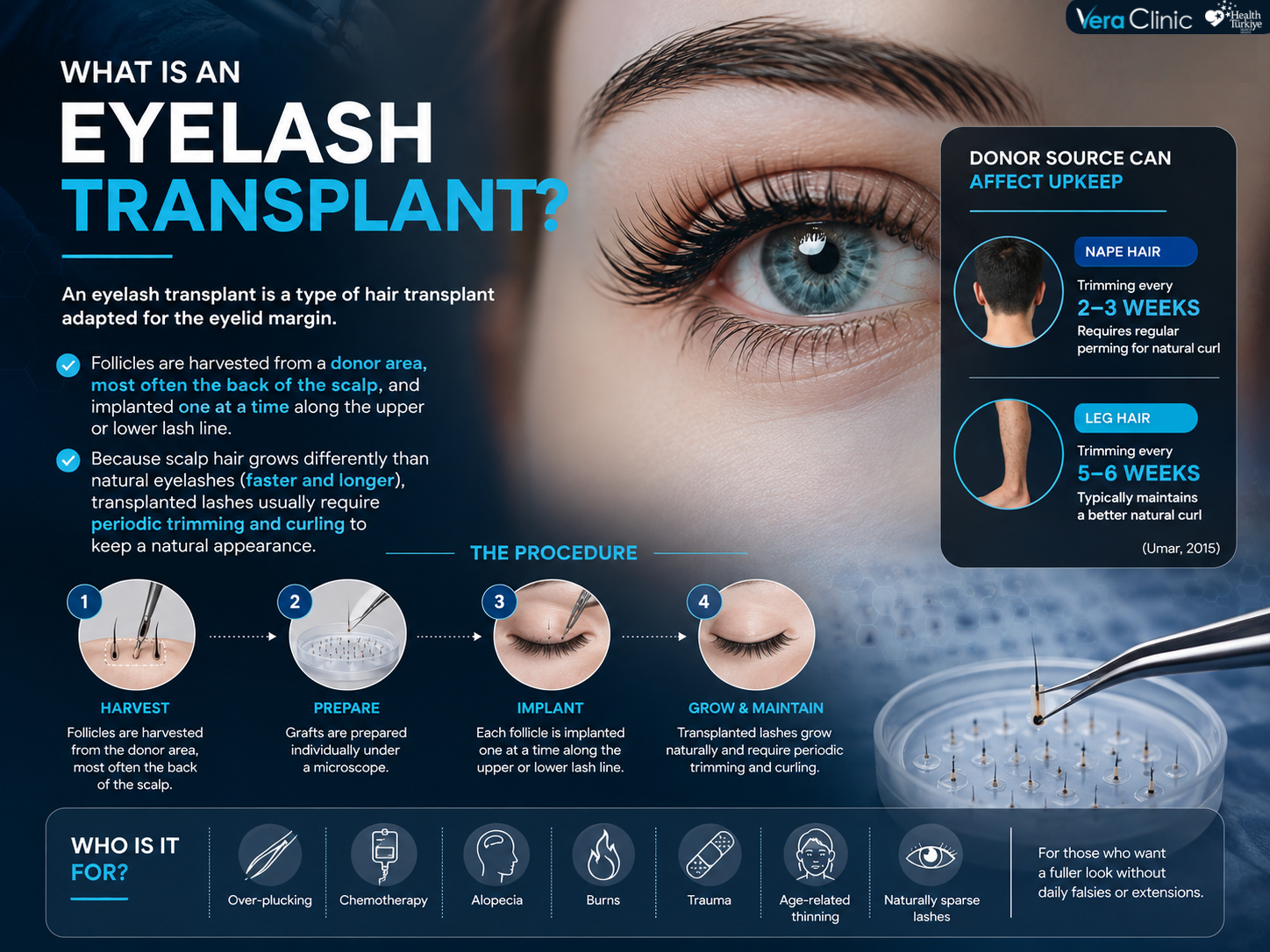
An eyelash transplant is a type of hair transplant adapted for the eyelid margin. Follicles are harvested from a donor area, most often the back of the scalp, and implanted one at a time along the upper or lower lash line. Because scalp hair grows differently than natural eyelashes (faster and longer), transplanted lashes require periodic trimming and curling to keep a natural appearance. The donor source itself can affect how much upkeep is needed: one case comparison found that eyelashes grown from leg hair needed trimming only every 5 to 6 weeks, compared with every 2 to 3 weeks for lashes grown from nape hair, which also required regular perming to hold a natural curl (Umar, 2015).
The procedure is most often chosen by people who have lost lashes due to over-plucking, chemotherapy, alopecia, burns, trauma, or age-related thinning, and by those born with naturally sparse lashes who want a fuller look without daily falsies or extensions.
Why Are Eyelash Transplants Gaining Popularity?
Eyelash transplants are gaining popularity because they provide a permanent alternative to lash extensions, serums, and false lashes, all of which require ongoing maintenance and reapplication. Extensions and strip lashes can also weaken natural lashes over time through repeated adhesive use, which pushes some patients toward a one-time surgical solution instead.
Interest has also grown alongside broader demand for facial hair transplants (eyebrows, beard, sideburns), as patients increasingly view eyelash restoration as part of the same category of precision hair transplantation rather than a purely cosmetic procedure.
When Is an Eyelash Transplant Necessary?
An eyelash transplant becomes a reasonable option when natural lash growth has been permanently reduced or lost and non-surgical options have not produced a lasting result. Common triggers include:
- Chronic over-plucking or lash-pulling habits (trichotillomania) that have damaged the follicles long-term
- Hair loss following chemotherapy or radiation
- Alopecia areata affecting the eyelash area
- Burns, trauma, or scarring near the eyelid
- Naturally sparse or short lashes with no underlying medical cause
Among documented cases, burns account for the largest share of patients seeking this procedure, making up over half of reported cases in published surgical reviews (Klingbeil & Fertig, 2018).
Whatever the underlying cause, the goal remains the same: restoring a natural lash line without relying on daily upkeep.
Who Is a Good Candidate for an Eyelash Transplant?
A good candidate has a healthy donor area (back of the scalp), realistic expectations about density and maintenance, and no active eye conditions such as blepharitis or untreated eyelid infections. Because the eyelid skin is thin and close to the eye, surgeons are more conservative with graft numbers here than in eyebrow or beard procedures, prioritizing safety and a natural look over maximum density.
Patients with active autoimmune eye conditions, uncontrolled bleeding disorders, or unrealistic expectations about achieving extension-level thickness are not suitable candidates.
In consultations, candidacy is assessed primarily through donor hair quality and the patient’s realistic expectations about density, since the eyelid area cannot support the same graft numbers as an eyebrow or beard procedure.
“The eyelid is one of the least forgiving places to work on the body. There’s very little room for error in angle or depth, and the difference between a natural-looking lash line and an unnatural one often comes down to a fraction of a millimeter. It’s also one of the few procedures where patient expectations need the most calibration upfront, since a full set of extension-level lashes simply isn’t what donor hair can safely deliver here.”
– Dr. Emin Gül, Vera Clinic Surgeon
How Much Does an Eyelash Transplant Cost?
The cost of an eyelash transplant depends on the clinic’s location, the surgeon’s experience with this specific procedure, and the number of grafts required.
- Price Range: An eyelash transplant costs between $1,500 and $5,000.
- Country Variation: Costs vary significantly by country, with clinics in the US and Western Europe charging more than clinics in Turkey or parts of Asia.
- Technique Impact: Because the procedure requires meticulous single-hair grafting, cost is driven more by surgeon skill and time than by the technique name itself.
- Session Length: Given the precision required, sessions tend to be priced per hour of surgical time rather than strictly per graft.
| Country | Estimated Cost (USD) |
|---|---|
| Turkey | $1,500 – $2,800 |
| India | $1,200 – $2,200 |
| Mexico | $1,600 – $2,600 |
| Thailand | $1,700 – $2,800 |
| USA | $3,000 – $5,000 |
| UK | $3,200 – $5,000 |
Pricing for a procedure this specialized tends to track surgeon experience more closely than country alone, a pattern consistent with the broader hair transplant Turkey cost landscape across facial hair procedures.
How Does an Eyelash Transplant Process Work?
The process follows the same core principles as other facial hair transplants, adapted for the eye area:
- Consultation and design: The surgeon assesses existing lash density and donor hair quality, and maps a natural-looking lash line.
- Donor extraction: Single-hair grafts are harvested, via FUE, from the back or sides of the scalp.
- Graft sorting: Only the finest single-hair follicles are used, since anything thicker looks unnatural on the lash line. In one modified single-hair grafting study of 34 patients, an average of 46.5 grafts were placed per upper eyelid (Tang et al., 2022).
- Implantation: Grafts are placed one by one at a shallow angle along the lash margin, following the natural curve of the eye.
- Aftercare: Patients are given specific instructions to protect the eye area during the first days of healing.
Each of these steps matters more here than in most facial transplants, since even small errors in angle or density are highly visible on the eyelid, a precision requirement that mirrors the broader hair transplant process surgeons follow across facial regions.
What Are the Different Hair Transplant Techniques Used for Eyelash Transplants?
Eyelash transplants rely on the same underlying hair transplant methods used elsewhere on the face, but adapted for the smallest and most delicate area of all. The choice of technique here affects graft preparation and precision more than overall speed or graft volume.
- FUE (Follicular Unit Extraction): The standard approach for eyelash restoration today. Individual follicles are harvested one by one, which avoids a linear scar and allows the surgeon to hand-select only the finest single-hair grafts for the lash line. FUE hair transplant is well suited to eyelash work precisely because so few grafts are needed.
- Micro FUE: A refined version of FUE using ultra-fine punches, 0.6–0.9mm, the smallest sizes used in hair transplantation. Because eyelash grafts must be single-hair and minimally traumatized to survive along the lash margin, this level of precision is particularly well suited to the procedure. Micro FUE hair transplant is often the preferred choice when working in such a small, visible area.
- Sapphire FUE: Uses sapphire-tipped blades to create smaller, cleaner incisions at the recipient site. Combined with fine punches, this adds an extra layer of precision when implanting along the eyelid margin. Sapphire FUE is reserved for cases where maximum precision is the priority.
- FUT (Follicular Unit Transplantation): Historically documented as the most common technique for eyelash transplantation in published surgical literature (Klingbeil & Fertig, 2018), though modern clinics increasingly favor FUE-based approaches for their precision and lack of linear scarring. Vera Clinic does not perform FUT hair transplant for this or any facial hair procedure, given the permanent linear donor scar it leaves.
No single technique has been established as a clear gold standard for eyelash transplantation, and choice largely comes down to surgeon preference and graft availability, a pattern consistent with the broader range of hair transplant techniques used across facial regions.
How Do These Hair Transplant Techniques Compare?
Punch size and graft handling are what separate these three approaches in practice, even though all three rely on the same underlying FUE principle.
| Technique | Punch Size | Typical Grafts (per eyelid) | Recovery Focus |
|---|---|---|---|
| FUE | 0.8–1.0mm | 46–80 grafts | Standard precision, no linear scar |
| Micro FUE | 0.6–0.9mm | 46–80 grafts | Highest precision for single-hair grafts, minimal trauma |
| Sapphire FUE | Sapphire-tipped blade | 46–80 grafts | Cleanest incision, reserved for maximum-precision cases |
Micro FUE and Sapphire FUE are favored for eyelash work specifically, given how much precision the eyelid margin demands compared to other facial hair regions.
How Long Does Recovery After an Eyelash Transplant Take?
Initial healing is the quickest part of the process. Mild redness and swelling around the eyelid settle within about a week, and most patients can return to normal daily activities shortly after, provided they avoid rubbing or touching the eye area. Aftercare here is more about protecting the eye itself than managing pain, since discomfort is minimal compared to other facial hair transplants.
Full recovery of the surgical site is straightforward, but it is the hair growth cycle that takes considerably longer to complete, a timeline broadly in line with the hair transplant recovery timeline seen across other facial regions.
How Long Does It Take for Eyelashes to Grow Back After an Eyelash Transplant?
Natural eyelash regrowth, such as after occasional shedding or minor thinning, follows a fast cycle of just a few weeks, since eyelashes have one of the shortest hair growth cycles on the body. This natural process only applies when the follicles themselves are still healthy and active.
After a transplant, the timeline is very different: transplanted hairs shed within 2 to 3 weeks (a normal part of the process), begin regrowing around month 2 to 3, and reach noticeable density by month 6, with results considered fully mature between 6 and 12 months (Tang et al., 2022; Umar, 2015). Unlike natural lash regrowth, which relies on the original follicles cycling back into growth, transplanted lashes come from relocated scalp follicles that follow scalp hair’s growth pattern rather than the eyelash’s naturally short cycle. This is also why transplanted lashes continue to grow longer and coarser than natural lashes over time, requiring ongoing trimming as part of long-term maintenance.
In one modified single-hair grafting study of 34 patients, an average graft survival rate of 87.2% was recorded at the one-year mark, with all patients reporting satisfaction with their results (Tang et al., 2022).
Is an Eyelash Transplant Permanent?
Yes. Transplanted follicles keep their original growth characteristics and continue producing hair for life once they take root along the lash line. Unlike extensions or serums, which stop working the moment they are removed or discontinued, the results here do not fade over time, consistent with the broader permanency of hair transplant results seen across facial regions. The main ongoing requirement is trimming, since the transplanted hairs keep growing like scalp hair rather than shedding naturally at eyelash length.
What to Expect Before and After an Eyelash Transplant?
Like most facial hair transplants, an eyelash transplant follows a clear, predictable timeline from the initial procedure through to mature results. Knowing what happens at each stage helps set realistic expectations along the way.
- Before surgery: Design mapping is completed and the donor and recipient areas are prepared under local anesthesia.
- First week: Mild redness and swelling settle, and patients are advised to avoid touching or rubbing the eye area.
- First few weeks: Transplanted hairs shed, a normal part of the growth cycle.
- 6 to 12 months: Full results become visible as the lashes reach their final length and density, at which point periodic trimming becomes part of ongoing maintenance.
Understanding this sequence helps patients recognize each stage as normal rather than a sign that the procedure has failed, consistent with the high satisfaction rates reported in published case series (Tang et al., 2022), and a pattern also visible across hair transplant before and after comparisons.
What Are the Potential Risks and Side Effects of an Eyelash Transplant?
Because the procedure is performed so close to the eye, it carries some risks that are specific to this area:
- Irritation and swelling: Mild swelling around the eyelid is common in the first few days.
- Ingrown or misdirected hairs: Since transplanted hairs follow scalp-hair growth patterns, some may grow at an angle that irritates the eye and needs correction or trimming.
- Infection: Rare, but more concerning near the eye; proper aftercare and hygiene are essential.
- Overgrowth: Transplanted lashes tend to grow like scalp hair, meaning regular trimming is needed to prevent them from becoming too long or curling into the eye.
Across published surgical reviews covering hundreds of eyebrow and eyelash transplant cases, complications were consistently reported as uncommon and manageable when procedures used follicular unit techniques with proper technique (Klingbeil & Fertig, 2018).
Most of these effects are manageable with careful surgical technique and close attention to eye hygiene during healing, consistent with the broader side effects of hair transplant profile seen across facial regions.
What Are the Alternatives to an Eyelash Transplant?
Before considering surgery, many patients try non-surgical options first. Each comes with its own balance of cost, upkeep, and permanence:
- Lash Extensions: Individual synthetic or silk fibers glued to natural lashes for a fuller look. Requires reapplication every 2 to 4 weeks and regular upkeep.
- Strip Lashes (Falsies): A temporary strip applied for a single day or event, removed afterward. No lasting effect on the natural lash line.
- Lash Serums: Topical treatments that may support the growth of existing lashes over several weeks of consistent use, but stop working once discontinued.
- Mascara and Cosmetic Enhancers: The simplest and most temporary option, offering a fuller look with daily application only.
Unlike a transplant, none of these options are permanent, and most require ongoing cost and effort to maintain results, a tradeoff that mirrors the broader landscape of hair transplant alternatives available across facial hair restoration.
What Is the Difference Between Eyelash Transplants and Eyelash Extensions or Falsies?
The core difference is permanence. An eyelash transplant uses the patient’s own living follicles, which continue to grow for life, while extensions, strip lashes, and lash serums are temporary and require ongoing upkeep. Extensions need reapplication every few weeks and can, over time, weaken the natural lash line through repeated adhesive stress, whereas a transplant integrates with the eyelid and grows as part of the patient’s own hair.
The tradeoff is maintenance style rather than permanence: transplanted lashes need occasional trimming and shaping since they grow like scalp hair, while extensions require no trimming but constant reapplication.
- Klingbeil, K. D., & Fertig, R. (2018). Eyebrow and eyelash hair transplantation: A systematic review. The Journal of Clinical and Aesthetic Dermatology, 11(6), 21–30.
- Tang, S., Wu, X., Liu, P., Li, J., Han, C., & Zhang, J. (2022). Modified single-hair follicular unit grafting to esthetically restore eyelashes in Asians. Journal of Cosmetic Dermatology, 21(3), 1106–1110.
- Umar, S. (2015). Eyelash transplantation using leg hair by follicular unit extraction. Plastic and Reconstructive Surgery Global Open, 3(4), e381.