
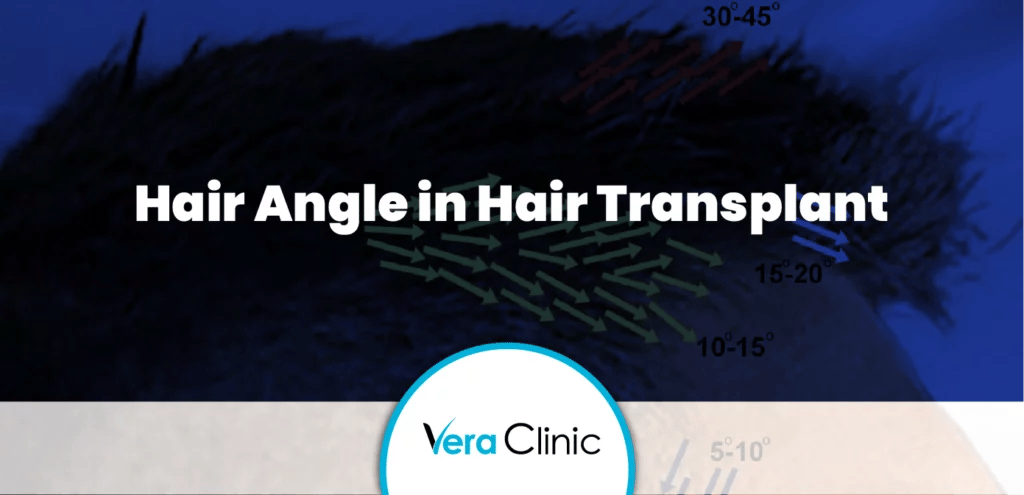

Hair angle is the degree at which a follicle exits the scalp, and it is one of the strongest determinants of whether the result reads as natural or surgical. Native hair does not grow straight up: it exits at zone-specific angles that range from a near-flat 5 to 10 degrees at the temples to a steeper 30 to 40 degrees across the mid-scalp, and matching these angles creates the layered “shingling” effect that makes density look fuller. Surgeons control angle differently depending on technique: FUE sets the incision angle before graft placement, while DHI adjusts angle per graft during direct implantation, and getting it wrong produces recognizable failure patterns such as a spiked temporal hairline or a pinwheel crown. A blinded evaluation by Vera Clinic Academy found that even a 5° gap between the planned and achieved angle lowered the odds of a natural rating by roughly 75%, and an incorrect angle can be revised, though only after a hair transplant has fully healed.
Key Points
- Native hair exits the scalp at zone-specific angles, from 5–10° at the temples to 30–40° across the mid-scalp.
- Matching these angles creates a layered “shingling” effect that makes transplanted density look fuller.
- FUE sets incision angle before graft placement; DHI adjusts angle per graft during direct implantation.
- A blinded evaluation by Vera Clinic Academy found a 5° gap between planned and achieved angle lowered the odds of a natural rating by roughly 75%.
- An incorrect angle can be revised, but revision is generally not assessed until 10 to 12 months after the original procedure.
What Is Hair Angle in a Hair Transplant?
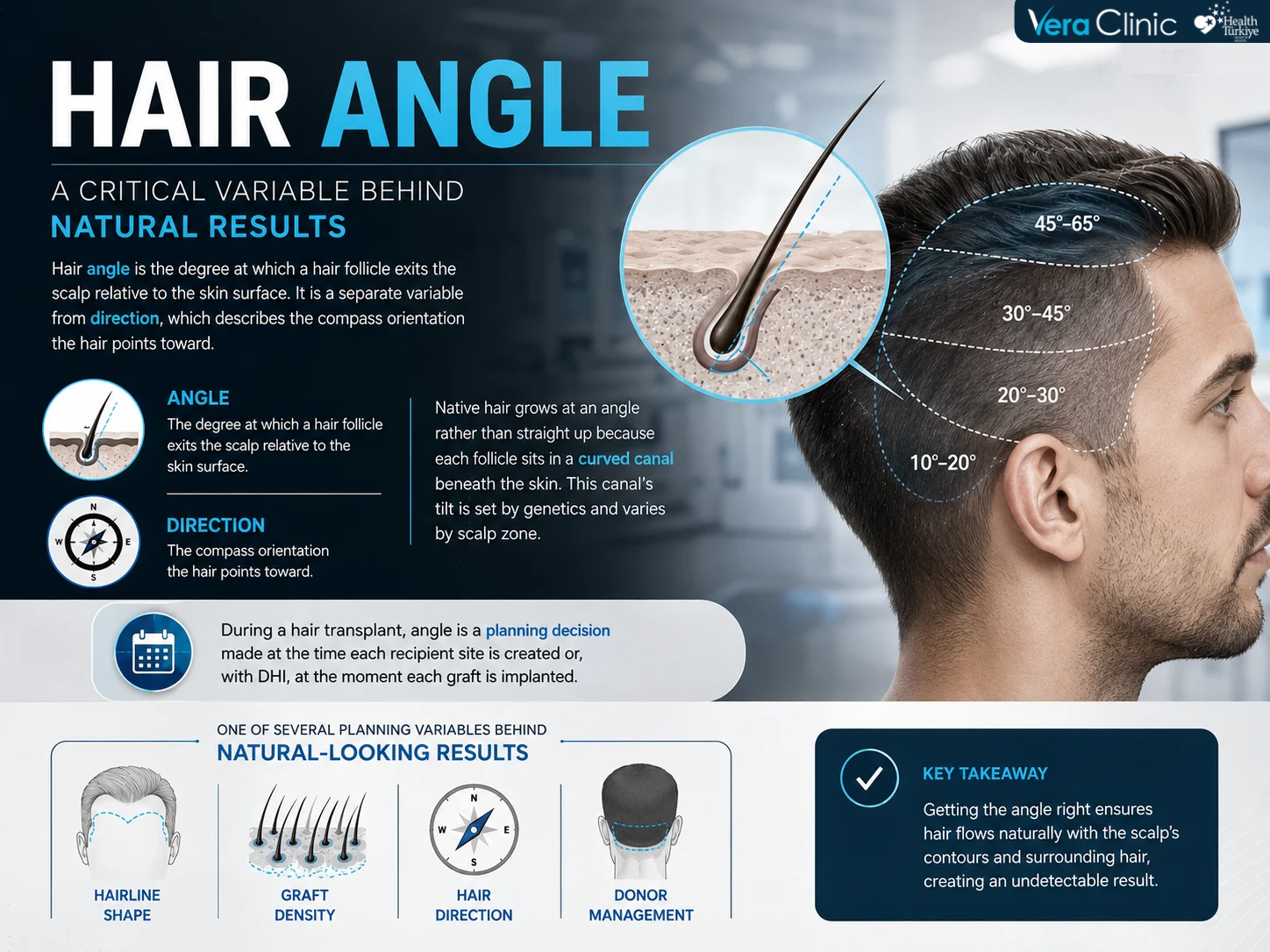
Hair angle is the degree at which a hair follicle exits the scalp relative to the skin surface, a separate variable from direction, which describes the compass orientation the hair points toward. Native hair grows at an angle rather than straight up because each follicle sits in a curved canal beneath the skin, and this canal’s tilt is set by genetics and varies by scalp zone. During a hair transplant, angle is a planning decision made at the time each recipient site is created or, with DHI, at the moment each graft is implanted. Getting the angle right is one of several planning variables behind a natural-looking hair transplant result, alongside direction, depth, and density: a graft placed at the correct angle but too shallow a depth can still lift out of the scalp before it heals, and correct angle paired with an inconsistent density gradient still leaves a visible line between transplanted and native hair.
Why Does Hair Angle Affect How Natural a Result Looks?
Hair angle affects naturalness because acute angles create a layered “shingling” effect that maximizes how much scalp each hair covers, while obtuse angles let more scalp show through between hairs. When a graft exits at a shallow angle close to the surface, each hair shaft lies partially over the scalp behind it, similar to roof shingles, which blocks light and creates an illusion of higher density even at a modest graft count. An obtuse angle, closer to 90 degrees, exposes more scalp surface between hairs and reduces this effect, which is why obtuse exit angles are more likely to reveal visible thinning. A more acute insertion angle also reduces tissue trauma at the recipient site, since wound injury has been shown to increase as the insertion angle increases (Ahmad & Ismail, 2021), which is why angle functions as both a density multiplier and a healing variable rather than a cosmetic detail alone.
What Is the Correct Hair Angle by Scalp Zone?
The correct hair angle changes by scalp zone, ranging from a near-flat 5 to 10 degrees at the temples to a steeper 30 to 40 degrees across the mid-scalp and crown.
| Scalp Zone | Exit Angle Range | Direction | Why |
| Frontal hairline | 10–20° | Forward | A low angle avoids a spiked, “planted” look at the leading edge |
| Temporal points | 5–10° | Lateral, slightly downward | The flattest zone on the scalp; hair lies almost against the skin |
| Mid-scalp | 30–40° | Follows the surrounding flow | A steeper angle supports coverage and volume rather than a soft edge |
| Crown / vertex | Increases toward the center | Radial, outward from a central point | Direction changes in a circular pattern around a central point |
These ranges are reference points rather than fixed rules, and an experienced surgeon adjusts each one slightly based on the patient’s native hair pattern and facial proportions.
Why Is the Crown the Hardest Zone for Angle Precision?
The crown is the hardest zone for angle precision because native hair grows outward from a central point in a whorl pattern rather than in one consistent direction, and grafts must be angled radially to match it. A single degree of error at the crown is more visible than the same error elsewhere, since the eye reads circular patterns more easily than straight ones, and a poorly angled crown produces a pinwheel effect that is difficult to correct without additional grafts. Patients researching a crown hair transplant or checking whether their own growth pattern is a hair whorl rather than early balding can review how this zone is planned before comparing it to frontal or mid-scalp work.
What Is the Difference Between Hair Angle and Hair Direction?
Hair angle describes how steeply a follicle exits the scalp, while hair direction describes the compass orientation it points toward, and a hair transplant needs both to match the surrounding native hair to look natural. Two grafts can share the same angle but point in opposite directions, and either variable being wrong on its own is enough to create a visible red flag, even when the other is correct. Even when angle and direction are both matched precisely to the surrounding native hair, a transplanted follicle can still mature into a visibly different growth direction, an outcome attributed in the clinical literature to gravity and hair shaft thickness acting on the follicle after implantation (Park, 2018).
| Hair Angle | Hair Direction | |
|---|---|---|
| Definition | The degree at which a follicle exits the scalp | The compass orientation the follicle points toward |
| Controls | How flat or upright a hair sits | Which way a hair leans (forward, back, left, right) |
| Visible error if wrong | Spiking, pluggy look, or reduced apparent density | Hair pointing against the natural flow of surrounding hair |
| Zone example | 5–10° at the temples vs. 30–40° at the mid-scalp | Forward at the frontal hairline, radial at the crown |
Both columns have to check out at once: a graft that gets the angle right but the direction wrong still reads as artificial, which is why the two are planned and verified together rather than as separate steps.
Which Hair Transplant Techniques Control Angle During Implantation?
Surgeons rely on a few core techniques to control angle during implantation: some fix the angle with a blade or punch before the graft is placed, while others let the surgeon adjust it graft by graft during placement itself.
- FUE (Follicular Unit Extraction): The recipient incision angle is set with a blade or punch before the graft is placed, so the angle is fixed once the FUE hair transplant recipient site is opened.
- Sapphire FUE: A blade-technology variant of FUE recipient-site creation uses a sapphire-tipped blade instead of a standard steel punch for a finer, more consistent incision angle, an approach known as Sapphire FUE and documented across different blade shapes and angles (Ahmad & Ismail, 2021).
- Vector-10™ (CVD Lab-Grown Diamond): Another blade-technology variant of FUE recipient-site creation uses a lab-grown diamond edge rather than sapphire or steel. The same principle applies: a finer, more consistent incision edge supports more accurate angle placement with reduced trauma to the surrounding tissue, the same principle behind Vera Clinic’s Vector-10™ instrument.
- DHI (Direct Hair Implantation): Grafts are loaded into a pen-style implanter and placed one at a time without a pre-made incision, letting the surgeon adjust angle graft by graft during the DHI hair transplant procedure itself. A randomized split-scalp trial found that angling the implanter at 45 degrees with the bevel facing the skin improved follicular entry and produced more favorable hair angulation than the conventional perpendicular technique (Agarwal et al., 2026).
- FUT (Follicular Unit Transplantation): Recipient-site angle control is mechanically comparable to FUE, since only the donor-harvesting method differs. Strip harvesting leaves a permanent linear scar at the donor site, which is why Vera Clinic does not perform FUT hair transplant procedures for hairline or angle-sensitive work.
None of these methods are inherently more accurate; the practical DHI vs FUE hair transplant tradeoffs around session length, cost, and recovery extend well beyond angle control alone. FUE, DHI, Sapphire FUE, Vector-10™, and FUT cover most angle-relevant hair transplant techniques, though robotic and stem cell-assisted methods follow the same underlying angle principles with their own tradeoffs.
What Happens When the Angle Is Wrong?
An incorrect hair angle produces a small number of recognizable failure patterns, depending on where on the scalp it occurs.
- Spike effect: Grafts placed too upright at the temples stand away from the scalp instead of lying flat, creating a visible spiking pattern at the flattest part of the head.
- Pluggy appearance: Grafts placed too steep at the frontal hairline lose the soft, forward-lying transition and look like individual tufts rather than a continuous line.
- Pinwheel pattern: Grafts angled in one fixed direction at the crown instead of radiating outward from the whorl create a visible circular or fan-shaped artifact.
Each of these patterns points to the same underlying issue: a mismatch between the planned angle and the angle the graft was actually given, rather than a problem with graft survival itself. Recent clinical reviews treat consistent control of graft angle and direction, together with a gradual, irregular hairline design, as essential requirements for a natural outcome (Romera de Blas et al., 2026).
What Determines Whether an Incorrect Hair Angle Can Be Revised?
Three factors determine whether an incorrect hair angle can be revised, and how much of the original result revision can improve: how much time has passed since the original procedure, how far off the original angle was, and how much donor reserve remains. The procedure itself is generally described as an aesthetic revision rather than a repeat transplant (Romera de Blas et al., 2026).
- Time since the original procedure: Revision generally cannot be assessed until the scalp completes a full healing cycle, usually 10 to 12 months, since attempting a fix earlier risks damaging follicles still establishing blood supply and makes it harder to tell which grafts are truly misangled versus still settling into their final position.
- Extent of the original angle error: A case where only the front row was misangled corrects more predictably than one where the entire hairline needs to be redone, since a small, isolated fix disturbs less surrounding tissue than a full redesign.
- Remaining donor reserve: A patient with fewer grafts available for revision due to a depleted hair transplant donor area is more likely to be narrowed toward camouflage rather than full removal and replacement.
These same constraints, particularly limited donor supply, shape how surgeons approach a second hair transplant more broadly.
“A graft’s final resting angle isn’t something you can judge at month two or three. The follicle is still going through its full growth cycle, and the angle you see early on can shift slightly before it settles. That’s part of why we ask patients to wait for a full cycle before we assess whether anything actually needs revising.”
– Dr. Emin Gül, Vera Clinic Surgeon
What Does a Hair Angle Revision Involve?
A revision involves one of three approaches, depending on the severity of the original error.
- Camouflage and blending: Additional single-hair grafts are placed around the misangled area to soften the line without removing existing hair.
- Graft removal and re-implantation: Individual misangled grafts are removed and replaced at the correct angle, used when the error is isolated to a small area.
- Targeted follicle removal: Grafts that cannot be reoriented without damaging surrounding tissue are removed outright, used only when blending or re-implantation is not viable.
The choice between these three depends mainly on how many grafts are affected and how much visible revision the patient is seeking.
How Much Does Angle Precision Actually Affect Naturalness?
Angle precision has a large, measurable effect on naturalness, not a marginal one. Angle is treated in the clinical literature as one of the most consequential technical variables behind a natural result, not a secondary detail: structured reviews of transplant complications attribute unnatural outcomes largely to errors in graft angulation and direction (Romera de Blas et al., 2026), and controlled testing has shown that even small increases in insertion angle raise tissue trauma at the recipient site (Ahmad & Ismail, 2021). Until recently, however, this relationship was described qualitatively rather than measured directly against a naturalness outcome.
A blinded evaluation of 140 patients following DHI hairline restoration between January 2024 and August 2025 put a number to it: a 5° gap between the planned and achieved exit angle left a patient roughly four times less likely to receive a fully natural rating. Naturalness was judged by two independent, blinded raters who assessed standardized photographs without knowing each patient’s planned angle, rather than relying on the patient’s own impression or the treating surgeon’s assessment, and the central hairline showed the greatest sensitivity to angle deviation of any zone, more than the temporal points, according to Vera Clinic Academy’s Hairline Angle and Naturalness Study. The primary analysis quantified this zone difference directly:
| Hairline Zone | Odds of a Fully Natural Rating (vs. Temporal Points) |
|---|---|
| Temporal points | Reference |
| Frontal hairline (transition zone) | 25% lower (not statistically significant) |
| Central hairline | 60% lower |
Only the central hairline reached statistical significance, which is why it is treated as the zone requiring the most precise angle control. This result lines up with what the broader literature already suggested about angle and direction being central to a natural outcome; it simply replaces a general clinical impression with a specific, testable figure, and reinforces why hairline shape, density, and angle continue to be planned as a single natural-looking hair transplant outcome rather than three separate decisions.
What Makes Achieving the Correct Angle Harder?
Three factors make achieving the correct angle harder than simply following a zone chart: tumescent fluid, the natural settling process during healing, and hair curl.
- Tumescent fluid: Fluid injected to lift the scalp before extraction and implantation temporarily distorts the skin’s surface, so the angle a surgeon sees during surgery is not identical to the angle the follicle will settle into once the fluid is absorbed.
- Healing-phase shift: The scalp slightly elevates the implanted angle during the weeks after surgery, so surgeons plan each incision marginally more acute than the intended final angle to compensate.
- Curl and texture: Hair that curves beneath the skin makes the visible exit angle a poor proxy for the true subsurface angle, increasing the risk of a mismatch between plan and result.
These factors are why angle precision is considered a skill that develops with experience rather than a measurement any punch or pen can set automatically.
Why Curl Type Changes the Subsurface Trajectory?
Curl type changes the subsurface trajectory of a follicle because curly and coiled hair follows a curved path beneath the skin rather than a straight one, so the angle visible at the surface is not the same as the angle the follicle actually holds underneath. This is why extraction and implantation technique is adjusted rather than relying on the same punch and pen settings used for straight hair, since matching only the surface angle without accounting for the curve underneath increases the risk of transection and an uneven result. How much this risk varies depends heavily on the specific types of curly hair involved, which is also why curl-adapted tools are used during an Afro hair transplant.
Frequently Asked Questions
Revision uses additional donor hair only for camouflage and blending or full graft removal and re-implantation. A revision limited to re-angling existing grafts does not require new donor extraction.
Yes, revising direction is generally more difficult than the original procedure. The surgeon has to work around already-healed tissue and existing grafts instead of a clear recipient area, which limits how new grafts can be angled without disturbing the surrounding hair.
The angle becomes clearly visible around 4 to 6 months after surgery, once new growth reaches a usable length. Final judgment is usually reserved until the hairline reaches full density closer to the 12-month mark.
Yes, hairline angle planning generally accounts for differences in hair shaft thickness between men and women. Because women’s frontal grafts tend to be thinner than the donor hair used to replace them, surgeons often place them at a slightly more acute angle than the surrounding native hair to compensate for how gravity and shaft thickness affect the final growth direction (Park, 2018).
No, a flatter angle is not universally better. It depends on the zone: a flat angle is correct at the temples, but the same angle would look unnaturally thin at the mid-scalp, where a steeper 30 to 40 degree angle is needed to support volume.
Yes, angle and direction are equally important for eyebrow, beard, and mustache transplants. Each area has its own natural growth pattern, such as an eyebrow’s fan-like divergence or a mustache’s downward-forward flow, that a graft must match just as precisely as a scalp hairline.
- Agarwal, S., Bhaskaran, R., Krishnan, M., & Saketheraman, P. (2026). Use of 45-degree implanter angulation with bevel-to-skin orientation to enhance follicular entry. Aesthetic Medicine, 12(2).
- Ahmad, M., & Ismail, M. (2021). Effect of different shapes of recipient site creation micro-blades at varying angles and wound injury. Journal of Cosmetic Dermatology, 20(11), 3610–3615.
- Park, J. H. (2018). A novel concept for determining the direction of implanted hair in hairline correction surgery in East Asian women. Archives of Plastic Surgery, 45(3), 292–294.
- Romera de Blas, C., Vega Díez, D., Ricart Vayá, J. M., & Gómez Zubiaur, A. (2026). Complications in follicular unit excision hair transplantation: Current evidence and practical approaches. Frontiers in Medicine, 13, 1750989.
- Vera Clinic Academy. (2026). Angle design aesthetics and hairline naturalness outcomes following DHI hair restoration: A prospective, dual-rater observational study at Vera Clinic, Istanbul, Turkey. https://www.veraclinic.net/wp-content/uploads/2026/08/Angle-Design-Aesthetics-and-Hairline-Naturalness-Outcomes-Following-DHI-Hair-Restoration.docx.pdf