


Curly hair is most often broken down into subtypes 4A, 4B, and 4C, ranging from loose, well-defined coils to a tightly packed zigzag pattern with the most shrinkage. That range is only the tightest end of a much larger spectrum, though: curly hair falls into a full spectrum of curl grades, from slightly wavy to tightly coiled, and this spectrum has a direct, measurable effect on how a hair transplant is planned and performed. Cosmetic classification systems (2A to 4C) describe hair by appearance, but for surgical planning, what matters more is a clinically defined curl grade combined with donor skin thickness and hair pigment. Recent Vera Clinic Academy data show that graft survival stays within a clinically acceptable range across all curl types, while follicular transection rate rises from 0.5% in straight or slightly wavy hair to 6.5% in tightly coiled, gray or white hair (Vera Clinic Academy, 2026).
Key Points
- Curl pattern exists on a continuous spectrum, not fixed ethnic categories, based on measurable curve diameter and curl index (Loussouarn et al., 2007).
- Central centrifugal cicatricial alopecia (CCCA), a standard screening factor before a curly hair transplant, affects an estimated 2.7 to 5.7% of women of African descent (Dlova et al., 2017).
- 12-month graft survival ranges from 93.5% to 89.0% across curl and pigment categories, and transection rate ranges from 0.5% to 6.5% (Vera Clinic Academy, 2026).
- A blunt-edge punch combined with a bidirectional, surgeon-calibrated rotary motor lowers transection in tightly coiled hair from 9.5% to 4.0% compared to a standard sharp punch (Vera Clinic Academy, 2026).
- Gray or white hair carries a further, independent rise in transection risk beyond curl grade alone, from 0.9% up to 6.5% depending on curl grade (Vera Clinic Academy, 2026).
- People of African descent face a 7-fold higher risk of keloid scarring after head and neck surgery compared to Caucasian patients (Henry Ford Health System, 2012).
What Are the Different Types of Curly Hair?
Curly hair is classified into a spectrum running from straight to tightly coiled, most commonly described using the Andre Walker Hair Typing System, a numbered scale from 1 to 4 with A, B, and C subtypes that hairstylist Andre Walker coined in 1997 and which has since become the most widely referenced hair-typing framework. It has drawn criticism for not accounting for scalp density or the fact that curl pattern can vary across different areas of the same head.
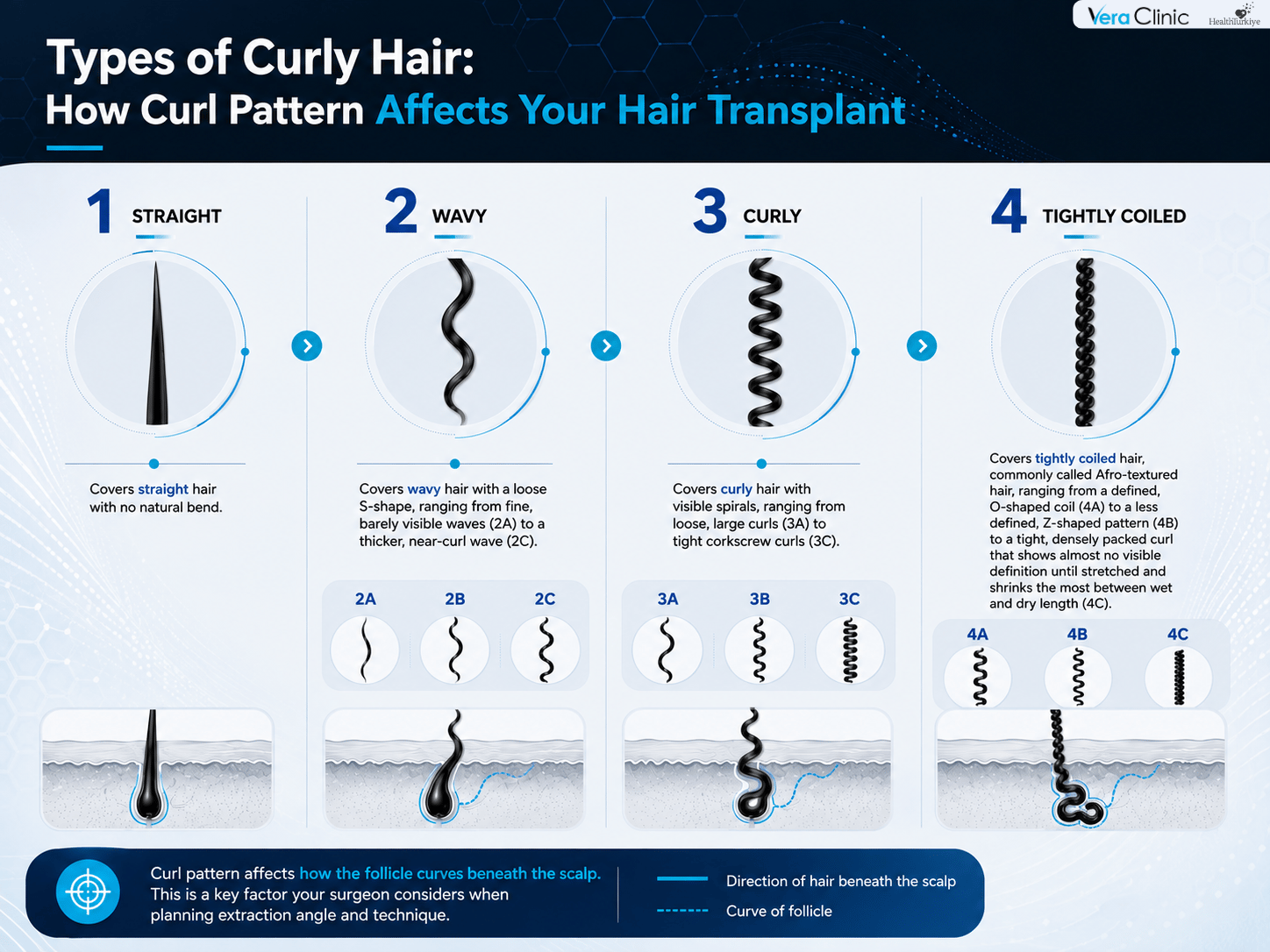
Type 1 covers straight hair with no natural bend. Type 2 covers wavy hair with a loose S-shape, ranging from fine, barely visible waves (2A) to a thicker, near-curl wave (2C). Type 3 covers curly hair with visible spirals, ranging from loose, large curls (3A) to tight corkscrew curls (3C). Type 4 covers tightly coiled hair, commonly called Afro-textured hair, ranging from a defined, O-shaped coil (4A) to a less defined, Z-shaped pattern (4B) to a tight, densely packed curl that shows almost no visible definition until stretched and shrinks the most between wet and dry length (4C).
For hair transplant planning, hair restoration specialists often group this spectrum into four practical curl grades, derived from curve-diameter and curl-index research that measures hair by physical properties rather than by visual category alone (Loussouarn et al., 2007): Straight or Slightly Wavy, Pronounced Wavy, Curly, and Tightly Coiled (Coily). This is not a formal clinical standard; it is a practical framework that surgical planning relies on because what changes extraction technique is how sharply the follicle curves beneath the scalp, not the styling-relevant subtype detail that matters for hair care.
| Clinical Curl Grade | Cosmetic Equivalent | Defining Trait |
|---|---|---|
| Straight / Slightly Wavy | Type 1–2A | Minimal bend, no meaningful subsurface curve |
| Pronounced Wavy | Type 2B–2C | Visible S-shape, slight subsurface curve |
| Curly | Type 3A–3C | Defined spiral, requires angle adjustment during extraction |
| Tightly Coiled (Coily) | Type 4A–4C | Z-shaped, closed subsurface curve, commonly called Afro-textured hair |
These four grades map loosely onto the earlier numbered types, but sorting your own hair into one takes a closer look at its actual shape and behavior.
How Do You Decide Your Curl Type?
You can determine your curl type by examining clean, product-free hair once it has fully air-dried, since curl pattern is most visible and least distorted in this state. Start with hair that has air-dried without brushing, gel, or heat styling, since these can flatten or exaggerate the natural pattern.
- Check the shape of a single strand: Loose S-waves point to slightly wavy hair, tighter spirals point to curly hair, and a Z-shaped zigzag with significant shrinkage points to tightly coiled hair.
- Compare curl diameter to a familiar object: Curls roughly the width of a pencil suggest a looser curl grade, while curls closer to the width of a crochet hook or drinking straw suggest a tighter, more coiled grade.
- Compare shrinkage when wet versus dry: Tightly coiled hair shrinks the most between wet and dry length, sometimes by more than half.
- Note that mixed patterns are common: Many people have looser curls at the crown and tighter curls at the nape, which matters for donor area assessment before a transplant.
These are practical, at-home checks; researchers measure curl grade more precisely using curve diameter and curl index rather than visual comparison alone (Loussouarn et al., 2007). For surgical planning, a consultation-based assessment remains the most reliable method, since it accounts for curl pattern, donor density, and scalp characteristics together.
How Does Curl Type Affect a Hair Transplant?
Curl type affects a hair transplant mainly through follicular transection risk during extraction, not through graft survival, which stays within a clinically acceptable range across all curl grades. Independent studies on tightly coiled, Afro-textured hair report transection rates as low as 3 to 6% with curl-adapted extraction tools, compared to sharply higher rates with unadapted, sharp rotary punches (Umar et al., 2023; Umar, 2016), and a structured clinical classification of follicle curvature describes this difficulty rising progressively across the curl spectrum rather than at a single fixed point (Reyes, 2021).
A Vera Clinic Academy retrospective cohort of 320 patients treated between January and December 2023, with 12-month follow-up through December 2024, extends these findings across the full curl spectrum rather than a single curl category: graft survival ranged from 93.5% in straight or slightly wavy hair to 89.0% in tightly coiled, gray or white hair, while transection rate rose from 0.5% to 6.5% across the same range (Vera Clinic Academy, 2026). Curl grade was the strongest driver of transection risk, with donor skin thickness and hair pigment contributing smaller, independent effects.
| Curl Grade | 12-Month Graft Survival | Transection Rate |
|---|---|---|
| Straight / Slightly Wavy | 93.5% | 0.5% |
| Pronounced Wavy | 92.5% | 0.8% |
| Curly | 91.0% | 2.2% |
| Tightly Coiled (Coily) | 90.5% | 5.0% |
These figures reflect pigmented hair, and the rise in transection risk traces back to a specific, physical change beneath the scalp, while surgeon-calibrated extraction technique and hair pigment each shift the numbers independently in their own way. Curl grade also factors into hairline design and graft placement angle during planning, not only into extraction, a relationship examined in the Hair Curl and Pigment Graft Survival Study.
Why Does Follicle Curvature Beneath the Scalp Increase Transection Risk?
Follicle curvature increases transection risk because a rigid, straight punch cannot reliably follow a follicle that bends or spirals beneath the skin surface, unlike straight hair, which grows in a nearly vertical line. A clinical classification of follicle curvature describes this subsurface shape ranging from a gentle bend in wavy hair to a closed C or Z shape in tightly coiled hair, and notes that extraction depth often has to be limited to roughly 1 to 1.5mm in the most closed shapes, compared with up to 3 to 3.5mm in straight hair (Reyes, 2021). The tighter the curl grade, the more this subsurface curvature departs from a straight line, which is why transection risk rises step by step rather than jumping suddenly at one point on the spectrum.
Why Does Extraction Technique Need to Change for Tighter Curl Types?
Extraction technique needs to change for tighter curl types because a standard, sharp-edge punch at a fixed rotation speed cannot adapt to a curving follicle path beneath the skin. A comparative study on tightly curled hair found that switching from a conventional sharp rotary punch to a curved, blunt-edge punch reduced transection to under 5%, after conventional punches had produced far higher rates in the same patients (Umar, 2016).
Vera Clinic uses a blunt-edge punch combined with a bidirectional rotary motor, with rotation angle and speed manually adjusted by the surgeon for each patient’s curl pattern. In the tightly coiled group, this lowered transection rate from 9.5% with a standard punch to 4.0% with the blunt, surgeon-calibrated technique, and in the curly group it lowered transection from 3.5% to 1.2% (Vera Clinic Academy, 2026), the same curl-adapted protocol used in an Afro hair transplant.
Does Gray or White Hair Change Transection Risk Independently of Curl Type?
Gray or white hair carries its own, independent rise in transection risk on top of whatever curl grade predicts, a factor that published research has largely overlooked in favor of curl and skin thickness alone. Reduced visual contrast between gray or white hair and the scalp is the most likely explanation, since it can make the punch’s alignment with each follicle harder to track during extraction, a mechanism distinct from the subsurface curvature that drives curl-related risk.
A Vera Clinic Academy cohort found this pattern held across every curl grade: gray or white hair showed a higher transection rate than pigmented hair at the same curl grade, for example 6.5% versus 5.0% in tightly coiled hair (Vera Clinic Academy, 2026). This contrast-driven difficulty is a central planning factor in a white hair transplant, where scalp-to-hair contrast, rather than curl grade alone, often determines how closely a surgeon must track each follicle during extraction.
Which Hair Transplant Technique Is Best for Curly Hair?
FUE (Follicular Unit Extraction) with curl-adapted tools is the preferred technique for most curly and tightly coiled hair, though the right choice still depends on donor density, scalp laxity, and keloid risk assessed at consultation.
- Standard FUE with curl-adapted punches: The extracting punch is matched to the follicle’s curve, and rotation angle is adjusted graft by graft rather than following a single fixed line, which matters most when curl varies across the donor area. At Vera Clinic, this takes the form of a blunt-edged, slightly concave punch combined with a bidirectional motorized handpiece, where the surgeon sets rotation speed, direction, and angle to match each follicle’s own curl path. The blunt, concave tip separates tissue by blunt dissection rather than cutting through it, following the follicle’s curve instead of forcing a straight line through it.
- Sapphire FUE: Uses a sapphire-tipped blade for the recipient-site incisions, creating a smaller, more precise wound independent of curl grade.
- Vector-10™ (CVD Lab-Grown Diamond): A further refinement using a lab-grown diamond blade for incision precision, most relevant to dense grafting in the recipient area rather than curl-specific extraction.
- FUT (strip harvesting): Used by some clinics for curly and tightly coiled hair, since dissecting the strip under a microscope outside the body avoids tracking each follicle’s curve blindly during extraction. Vera Clinic does not offer FUT, since the permanent linear scar it leaves, combined with the elevated keloid risk already present in this population, outweighs that advantage.
Curl grade influences which of these tools a surgeon reaches for, but donor density and scalp characteristics still decide the final plan at consultation.
“With curly and coily hair, the punch itself has to behave differently. We angle it to create a small ellipse that follows the hair’s natural exit angle, rather than cutting it as a straight circle, and we adjust the punch diameter based on how firm the surrounding skin is, not just the curl itself. Get either of those wrong, and the graft doesn’t survive the extraction.”
Dr. Emin Gül, Medical Doctor, Vera Clinic
Who Is a Good Candidate for a Curly Hair Transplant?
A good candidate for a curly hair transplant has a stable hair loss pattern, sufficient donor density, and no active scalp disease affecting the donor or recipient area. Age, general health, and realistic expectations about coverage matter for every curl type, but two additional checks apply specifically to curly and coily hair.
- Patients with stable, non-scarring hair loss: Androgenetic alopecia or a similarly stable pattern, rather than active inflammatory hair loss, makes for a predictable surgical plan.
- Patients without active central centrifugal cicatricial alopecia (CCCA): This scarring alopecia must be inactive before surgery is considered, since transplanting into actively inflamed tissue reduces graft survival.
- Patients with no personal or family history of keloid scarring: Keloid risk is elevated in patients with tightly coiled hair, so this history is checked at the pre-operative screening, and a personal history of keloid scarring is a reason for rejection in most cases; patients later identified as at-risk can be prescribed a corticosteroid cream after surgery as a precaution.
- Patients with realistic curl-specific expectations: Understanding that transection risk, not graft survival, is the main technical variable tied to their curl grade sets the right expectations going in.
These criteria guide the initial assessment, but a surgeon still confirms each one in person or through photos before setting the final surgical plan, since curl pattern and scalp condition can shift that plan in ways a general checklist cannot fully capture.
Is a Curly Hair Transplant Suitable for Women?
A curly hair transplant is suitable for women, though CCCA screening carries extra weight in this group because the condition affects an estimated 2.7 to 5.7% of women of African descent, compared to a much lower rate in men (Dlova et al., 2017). Because CCCA is a standard exclusion criterion until it becomes inactive, women with tightly coiled hair who are considering a transplant should have this condition ruled out or stabilized first. Beyond this screening step, candidacy follows the same pattern-stability and donor-density criteria used for a female hair transplant.
What Are the Benefits of a Curly Hair Transplant?
The main benefit of a curly hair transplant is that curl pattern itself increases visual coverage, since curved and coiled hair shafts create more perceived density per graft than straight hair at the same graft count, a principle documented in hair restoration literature using curled donor hair specifically to enhance visual density (Garg & Garg, 2020).
- Fuller visual coverage per graft: Curved hair shafts occupy more surface area than straight ones, so the same graft count looks denser.
- Lower color contrast in some cases: Hair with less contrast against the scalp can appear fuller, since the scalp shows through less between strands.
- Natural texture retention: Grafts keep their original curl pattern permanently, since curl is a property of the follicle rather than the transplant procedure.
- Effective coverage for multiple hair loss types: Curly hair transplants can address androgenetic alopecia, traction alopecia, and stabilized CCCA in the same procedure.
These visual advantages come from curl pattern itself rather than from any specific surgical technique, so they apply whether the donor hair is loosely wavy or tightly coiled, and they do not offset the technical risks tied to extracting that same curl pattern.
What Are the Risks of a Curly Hair Transplant?
The main risks specific to curly and coily hair transplants are a higher follicular transection rate during extraction and an elevated risk of keloid scarring, both of which scale with curl grade rather than appearing uniformly across every patient.
- Higher transection risk with curl grade: Transection rate rises from 0.5% in straight or slightly wavy hair to 6.5% in tightly coiled, gray or white hair without curl-adapted technique (Vera Clinic Academy, 2026).
- Elevated keloid risk: People of African descent face a 7-fold higher risk of keloid scarring after head and neck surgery compared to Caucasian patients, making a personal or family keloid history an important disclosure before surgery (Henry Ford Health System, 2012).
- Standard transplant risks still apply: Swelling, temporary shock loss, and infection risk are not curl-specific but remain part of any transplant procedure.
- Underrepresented outcome data for rare subgroups: Gray or white, tightly coiled hair remains a small, understudied subgroup in published outcome data, so individual results in this group carry more uncertainty than the average figures suggest.
None of these risks rule out a curly or coily hair transplant on their own; they change how the surgical team screens and plans for it, which is why curl grade and any keloid history are addressed directly at consultation rather than left to chance.
Why Choose Vera Clinic for Curly and Coily Hair Transplant?
Vera Clinic is a leading hair transplant hospital in Istanbul, Turkey, and treats curly and coily hair as a curl-grade assessment rather than a one-size-fits-all graft-count target. Our surgeons use a bidirectional, alternating-torque motorized extraction technique, rather than a standard uni-directional motor, calibrated specifically for curly and tightly coiled hair, an approach shaped by Vera Clinic Academy’s own research into how curl grade, hair pigment, and donor skin characteristics affect transplant outcomes. This data-backed approach is shown in our own patient data to cut transection risk by more than half compared to standard punches.
Donor capacity and curl grade are both assessed during consultation before a technique is finalized, and Vera Clinic is recognized by the European Awards in Medicine and operates in Ministry of Health-certified facilities, with Vera Clinic Academy itself holding Ministry of Health certification as the clinic’s in-house research and training arm. Whether a patient’s hair is loosely wavy or tightly coiled, every session is supervised by Vera Clinic‘s surgical team, with the treatment plan built around that specific curl grade rather than a generic protocol.
Frequently Asked Questions
No. A hair transplant does not change your natural curl pattern, since curl is determined by the shape of the hair follicle itself, and transplanted follicles keep their original shape after relocation.
Reputable clinics price curly and coily hair transplants the same as straight hair transplants, since technique adjustments do not change the per-graft cost structure.
Yes. Many patients have more than one curl grade across the scalp, and a consultation-based assessment maps curl pattern by donor zone so the surgical plan accounts for each area separately.
Aftercare for curly and coily hair follows the same core steps as any transplant, though gentler detangling and moisture-focused hair care during the first weeks help protect fragile new growth.
Yes. Once transplanted grafts have fully grown in, they can be washed, cut, and styled the same way as the rest of your existing curly or coily hair.
Most surgeons recommend waiting at least 4 weeks before trimming transplanted hair with scissors, and longer before using clippers on the recipient area, to protect grafts during early healing.
DHI is not recommended for tightly coiled hair, since grafts can bend or fracture inside the narrow channel of a Choi pen implanter during loading and implantation, a risk that is far less relevant for straighter hair types.
- Dlova, N. C., Salkey, K. S., Callender, V. D., & McMichael, A. J. (2017). Central centrifugal cicatricial alopecia: New insights and a call for action. Journal of Investigative Dermatology Symposium Proceedings, 18(2), S54-S56.
- Garg, A. K., & Garg, S. (2020). “Combination grafting” of scalp and body hair to enhance the visual density of hair transplant and coverage of higher grade of baldness. Journal of Cutaneous and Aesthetic Surgery, 13(2), 163-169.
- Henry Ford Health System. (2012, March 6). African-Americans 7 times more likely to have keloid scarring of the head, neck [Press release]. EurekAlert!
- Loussouarn, G., Garcel, A. L., Lozano, I., Collaudin, C., Porter, C., Panhard, S., Saint-Léger, D., & de La Mettrie, R. (2007). Worldwide diversity of hair curliness: A new method of assessment. International Journal of Dermatology, 46(Suppl 1), 2-6.
- Reyes, A. (2021). Curly hair FUE: My approach using classification of follicle curvature and curl. Hair Transplant Forum International, 31(6), 205-214.
- Umar, S. (2016). Comparative study of a novel tool for follicular unit extraction for individuals with Afro-textured hair. Plastic and Reconstructive Surgery Global Open, 4(9), e1069.
- Umar, S., Khanna, R., Lohlun, B., Maldonado, J. C., Zollinger, M., Osei-Tutu, A., Gonzales, A., Chouhan, K., & Nusbaum, A. (2023). Follicular unit excision in patients of African descent: A skin-responsive technique. Dermatologic Surgery, 49(10), 949-955.
- Vera Clinic Academy. (2026). Graft survival and transection rates across hair curl and pigment categories in FUE: A retrospective cohort study at Vera Clinic. Internal institutional data. https://www.veraclinic.net/wp-content/uploads/2026/08/Graft-Survival-and-Transection-Rates-Across-Hair-Curl-and-Pigment-Categories-in-FUE_-A-Retrospective-Cohort-Study-at-Vera-Clinic.docx.pdf