

White and gray hair can be transplanted with the same graft survival as pigmented hair, but the absence of melanin makes the follicle harder to see during extraction, which raises the risk of cutting through it instead of removing it cleanly. Vera Clinic Academy research shows this visibility gap carries a measurable, independent cost: transection rate in gray or white donor hair ranges from 0.9% to 6.5% depending on curl grade, consistently higher than pigmented hair at the same curl grade (Vera Clinic Academy, 2026). Since a hair transplant restores follicles rather than pigment cells, transplanted hair keeps its natural white, gray, or salt-and-pepper color exactly as it grew in the donor area.
Key Points
- Melanin loss removes the visual contrast between the follicle and the surrounding scalp under magnification, which is a visibility problem, not a biological limitation.
- Vera Clinic Academy’s own cohort found gray or white hair carries a higher transection rate than pigmented hair at every curl grade, ranging from 0.9% to 6.5% depending on curl grade, an added risk that curl grade alone does not explain (Vera Clinic Academy, 2026).
- Multiple visualization aids exist for depigmented follicles, including methylene blue, gentian violet, and UV light-based methods (Marino & Rios, 2012).
- A worldwide survey of over 4,000 people found 74% show visible graying between ages 45 and 65, debunking the popular “50% gray by 50” rule of thumb (Panhard et al., 2012).
- Age alone is not a limiting factor; documented successful cases include patients over 80 years old with adequate donor density.
- Gray and white hair transplants use the same pain-free method and pricing structure as any standard procedure.
Why Is It Difficult to Transplant White or Gray Hair?
White and gray hair are difficult to transplant because the absence of melanin removes the visual boundary between the follicle and the surrounding scalp tissue, not because the follicles themselves are less viable. Melanin is what gives a pigmented follicle its contrast against pale scalp tissue under magnification; once melanocytes stop producing it, the follicle, the surrounding dermis, and the skin surface all reflect light in a similar way, and the sharp edge a surgeon normally relies on to locate the follicle root simply isn’t there anymore.
This matters because follicular unit extraction (FUE) depends on continuous visual feedback, not a single moment of identification. A surgeon tracks the follicle’s angle and depth throughout the extraction, adjusting in real time as the punch follows the hair beneath the skin. When that visual feedback flattens out, the surgeon is effectively working from inference rather than direct observation, estimating the follicle’s path instead of seeing it, which is precisely where transection risk rises. This is why multiple visualization aids have been developed specifically for white and gray donor hair, including dyed-tissue techniques using methylene blue or gentian violet, and non-staining methods such as UV light (Marino & Rios, 2012). A depigmented follicle that is properly visualized during extraction grows the same way a pigmented one does; the difficulty lives entirely in the surgeon’s ability to see and follow it, not in the hair itself.
What Does Vera Clinic Academy Research Show About Gray and White Hair Transplants?
Vera Clinic Academy research shows that gray and white hair carries a higher follicular transection rate than pigmented hair at every donor curl grade, an effect that is independent of curl pattern itself, meaning pigment alone changes a patient’s risk profile before curl or skin thickness are even factored in. In a retrospective cohort of 320 patients treated between January and December 2023, with 12-month follow-up through December 2024, transection rate in gray or white hair ranged from 0.9% in straight or slightly wavy donor hair to 6.5% in tightly coiled donor hair, consistently 0.4 to 1.5 percentage points higher than pigmented hair at the same curl grade (Vera Clinic Academy, 2026).
Graft survival followed a similar but smaller pattern, staying within a clinically acceptable range at every curl grade while consistently trailing the pigmented-hair figures.
| Curl Grade | Graft Survival (Gray/White) | Transection Rate (Gray/White) |
|---|---|---|
| Straight / Slightly Wavy | 92.0% | 0.9% |
| Pronounced Wavy | 91.0% | 1.3% |
| Curly | 90.0% | 3.0% |
| Tightly Coiled (Coily) | 89.0% | 6.5% |
In practical terms, this means a patient with gray or white, tightly coiled hair is not a poor candidate, but their surgical plan carries a measurably higher technical difficulty margin than the same curl grade in pigmented hair, which is exactly why pigment is treated as its own planning factor at Vera Clinic rather than folded into curl assessment alone, a relationship examined in the Hair Curl and Pigment Graft Survival Study.
What Are the Symptoms of Poor Follicle Visibility?
Poor follicle visibility shows up as a cluster of surgical mistakes rather than a single symptom, since low contrast doesn’t just obscure one part of the procedure, it compounds across extraction depth, speed, and consistency at the same time. None of these symptoms appear on their own; a surgeon working with reduced contrast tends to encounter several of them within the same session, which is why visibility correction addresses the root cause rather than treating each downstream effect separately.
- Uneven extraction pattern: When the surgeon can’t clearly distinguish the follicle root, grafts are taken at inconsistent depths, leading to patchy density or gaps in the donor area.
- Increased transection rate: The punch cuts through the follicle instead of isolating it cleanly, the core mechanism behind the higher transection rates measured in gray and white donor hair.
- Extended surgery time: Surgeons spend more time aligning tools to confirm depth before each extraction, slowing the overall procedure.
- Post-transplant density mismatch: When extraction lacks orientation, grafts can be implanted at inconsistent angles, and white or gray hair reflects light unevenly across the scalp as a result, making density appear lower even when graft count is normal.
- Visual fatigue over long sessions: Working for hours under low-contrast conditions forces the surgeon to overcompensate for missing visual cues, and that sustained strain can subtly erode precision in the later stages of a long extraction session, even when technique doesn’t change.
Each of these problems traces back to the same root cause: the eye has less information to work with, so the hand has less accurate feedback to act on. This is also why the fix isn’t technique alone; restoring contrast through vital staining resolves all five symptoms at once, rather than requiring a separate adjustment for each one.
How Does White Hair Transplant Work?
A white hair transplant follows the same biological principle as any standard FUE or DHI procedure: each hair follicle contains its own pigment cells, or melanocytes, and once these stop producing melanin the follicle turns gray or white but remains fully viable for transplantation, so the difference lies entirely in visualization and handling, not in physiology. During the procedure, follicular units are extracted individually from the donor area, most commonly the occipital scalp, and because depigmented follicles blend into the surrounding tissue, surgeons restore visibility using a vital stain, such as methylene blue, that lightly colors the perifollicular sheath so the follicle root becomes visible again for precise extraction. The grafts are then implanted into the recipient area using sapphire blades or Choi implanter pens, chosen for their micro-incision precision and reduced tissue trauma, while the surrounding skin stays unstained and the dye itself fades within hours.
Once healed, transplanted white or gray follicles grow normally, maintaining the same growth cycle, texture, and color they had in the donor region. A white hair transplant works not by changing color, but by restoring density and natural distribution through visibility correction and careful placement.
What Is the Blue Liquid and Why Is It Used?
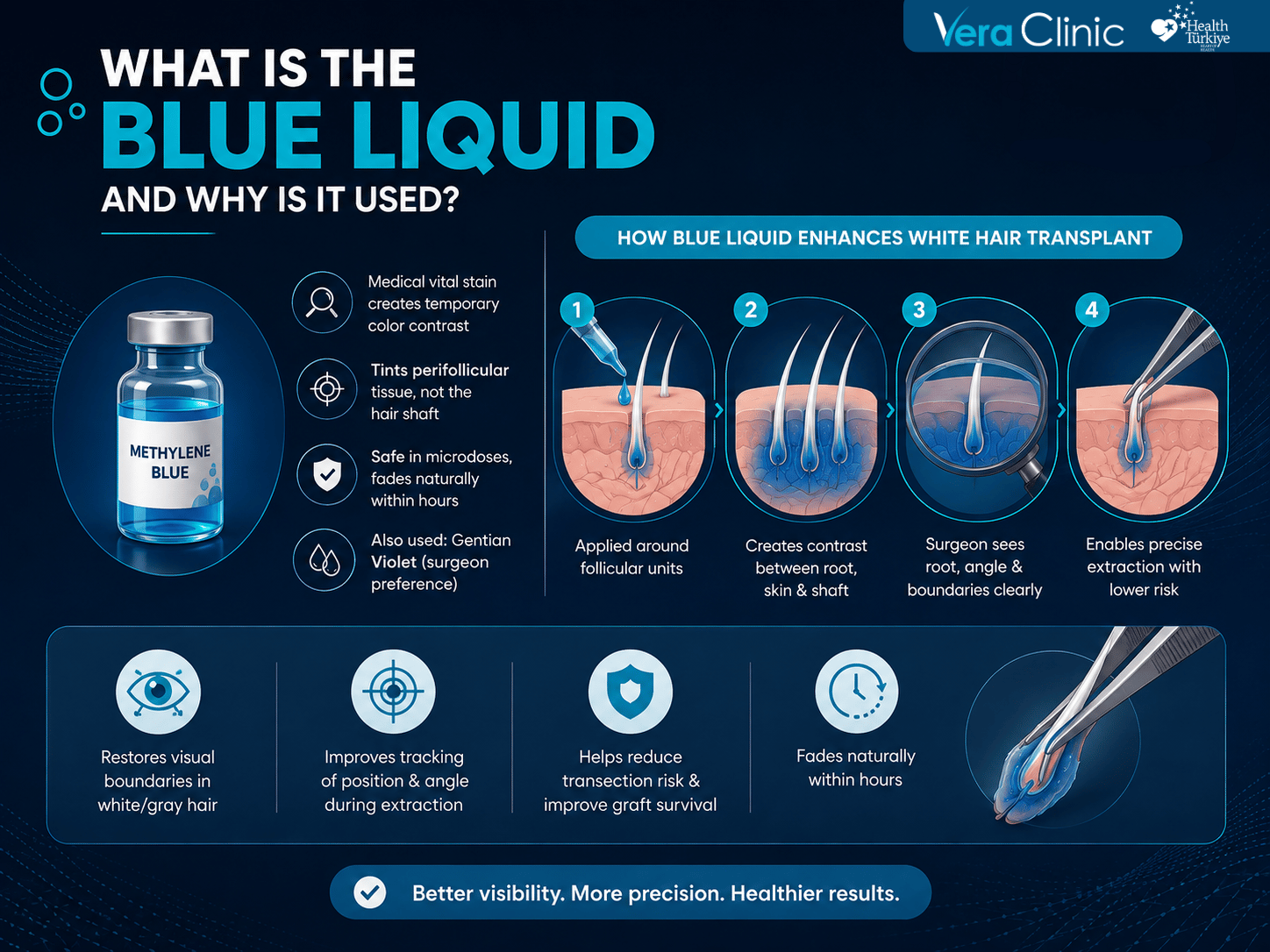
The blue liquid used in white and gray hair transplantation is methylene blue, a medical vital stain that provides temporary color contrast during microsurgery. Vera Clinic uses it because it selectively tints the perifollicular tissue rather than the hair shaft itself, restoring the visual boundary a surgeon needs between the follicle root and the surrounding skin.
Originally developed for histological use, methylene blue has been adopted in hair restoration to help surgeons visualize follicle roots that would otherwise blend into surrounding tissue; its purpose here is optical, not biological. Applied in microdoses, it creates a short-lived color field that restores clarity under magnification, then fades naturally within hours without penetrating or altering the hair itself. Its safety profile at these trace topical doses is well established (Bistas & Sanghavi, 2023).
Methylene blue is not the only vital stain used for this purpose. Gentian violet has also been used to dye perifollicular tissue during extraction in white-haired patients, with a documented technique for scalp-dyeing specifically developed for this population (Marino & Rios, 2012). The two dyes work on the same principle; the choice between them comes down to surgeon preference and staining duration rather than one being categorically more effective.
How Blue Liquid Enhances White Hair Transplant
Blue liquid enhances a white hair transplant by making colorless follicles visible again under the microscope, restoring the same kind of edge a surgeon would normally see between a pigmented hair shaft and the surrounding skin. Without that edge, the surgeon has to judge the follicle’s angle and depth mostly by feel and prior experience with similar cases; with the dye in place, the follicle root, skin, and shaft show up as three distinguishable layers again, so the punch can be guided along the follicle’s actual path rather than a best estimate of it.
This distinction between guided extraction and estimated extraction is exactly where transection risk changes. A follicle that curves even slightly beneath the skin is easy to lose track of without a visible boundary to follow, and losing track of it for even a moment is often when the punch clips the follicle instead of isolating it cleanly. This is why the effect of staining shows up most clearly in the transection figures themselves rather than in graft survival: it corrects the surgeon’s real-time visual feedback during the highest-risk moment of the procedure, not the follicle’s underlying viability.
How Long Does the Blue Staining Last on the Scalp?
The blue tint from methylene blue usually fades within a few hours to one day post-operation, absorbed or naturally shed with the first scalp rinse and leaving no lasting coloration or irritation behind. Patients don’t need to plan around it beyond the day of surgery itself; by the time most people are back to normal activity, the tint has already faded on its own.
This short duration reflects the dye’s biocompatible, non-penetrative nature, as documented in StatPearls (2023). Because it sits on the skin surface rather than binding into deeper tissue, it functions purely as a temporary optical guide during the procedure, not as a lasting chemical stain on the scalp.
Why Doesn’t Bright Light Alone Solve the Visibility Problem?
Bright light alone doesn’t solve the visibility problem in white or gray hair surgery because it flattens contrast rather than clarifying it: the reflective surfaces of pale scalp and depigmented hair bounce light back almost uniformly, so adding more illumination just makes the entire field brighter without restoring the depth cues a surgeon would otherwise rely on. This is a common instinct in low-visibility surgical situations generally, more light usually helps, but it doesn’t apply here because the underlying problem isn’t a lack of light; it’s a lack of contrast between two surfaces that are already reflecting light the same way.
Vital staining solves this differently: rather than adding more light, it adds a contrast marker directly onto the tissue the surgeon needs to distinguish, creating a visual difference that brightness alone can’t produce. This is why staining remains the more consistent solution for this specific visibility problem, even as lighting and magnification technology in hair transplantation continues to improve elsewhere in the procedure.
What Are the Risks and Limitations of a Gray or White Hair Transplant?
The main risks and limitations specific to a gray or white hair transplant are residual dye effects, reduced visibility in severe depigmentation, and slower healing in older patients, rather than any risk tied to hair color itself.
- Residual dye effects: In rare cases, excessive dye application leaves temporary surface staining or mild dryness at the treated sites; this resolves on its own within days and does not affect graft outcome.
- Visibility limits in severe depigmentation: In patients with complete melanin loss or very fine, ultra-light gray hair, visibility remains only partially restored even after staining, because the follicle itself carries so little natural contrast that there’s a ceiling to how much a dye can compensate. This isn’t a failure of the technique; it’s a physical limit of how much contrast can be manufactured when the underlying tissue offers almost none.
- Slower post-operative healing in older skin: Gray and white hair transplant candidates are disproportionately older, and older dermal tissue has reduced collagen density and microvascular activity, both of which slow healing independent of hair color. Gentle surgical technique and consistent post-operative hydration care help offset this, but the underlying age-related healing pace itself isn’t something the procedure can change.
None of these limitations are specific to gray or white hair biologically; they come from the visualization and healing factors that tend to accompany it, which is why they are managed through technique and aftercare rather than ruling patients out. Discomfort during the procedure is not one of these limitations either, since gray and white hair cases use the same pain-free hair transplant method as any standard transplant.
Is Methylene Blue Safe for the Scalp?
Yes, methylene blue is safe for the scalp at the microdoses used in hair transplantation, since it binds only to superficial protein layers and does not penetrate or interfere with follicle viability (Bistas & Sanghavi, 2023). It’s considered safe and non-toxic when applied topically in minimal amounts for visualization during hair transplantation. Systemic toxicity from methylene blue occurs only at doses far higher than the trace topical amounts used for visualization during extraction, which is why it remains a standard visualization aid rather than a safety concern in this context.
What Tools Are Used in White Hair Transplants?
White and gray hair transplantation uses the same core tools as standard FUE (Follicular Unit Extraction) and DHI (Direct Hair Implantation) procedures, because the visibility challenge and the tool choice actually solve two separate problems rather than one. Visibility is handled earlier, during extraction, through vital staining; tool choice comes into play afterward, at the implantation stage, where it governs incision precision and how gently the graft is handled rather than how well the surgeon can see the follicle. Once staining has already restored the visual boundary a surgeon needs, the instruments used to place the graft, whether a sapphire blade or a Choi implanter pen, work exactly the same way they would on pigmented hair, since neither tool was designed to compensate for pigment loss in the first place.
- Sapphire Blades: Made from corundum crystal, a form of synthetic sapphire, sharper and smoother than traditional steel tools. Used for recipient-site incisions rather than donor-follicle visibility, creating smaller, more uniform micro-channels that preserve vascular circulation and reduce post-operative redness, benefits that carry over directly into a Sapphire FUE hair transplant regardless of hair color.
- DHI Implanter Pen: Places follicles directly into the scalp without pre-made channels, shortening the time each follicle spends outside the body. Since gray and white follicles are already handled more carefully during extraction due to reduced visibility, minimizing additional time outside the scalp is one of the reasons a DHI hair transplant helps preserve graft viability through to implantation.
Both tools operate at the implantation stage, well after vital staining has already solved the visibility problem, which is why the choice between them comes down to coverage and precision needs rather than to hair color.
Should You Choose Sapphire FUE or DHI for a White Hair Transplant?
Sapphire FUE and DHI both work well for gray or white hair when paired with vital staining during extraction, and the choice between them comes down to coverage needs rather than hair color: Sapphire FUE tends to suit larger sessions where even density matters most, while DHI suits precision placement in smaller, high-visibility zones such as the frontal hairline.
| Feature | Sapphire FUE | DHI (Choi Pen) |
|---|---|---|
| Recipient Incision | Sapphire blade, smaller and more uniform micro-channels | Direct implantation, no pre-made channels |
| Tissue Trauma | Lower due to smooth sapphire surface | Minimal; controlled insertion via Choi pen |
| Healing Time | 5–7 days average | 7–10 days average |
| Pain Sensation | Mild, standard local anesthesia | Mild, standard local anesthesia |
| Ideal For | Large sessions, even density restoration | Precision work in frontal or high-visibility zones |
Neither tool corrects for the visibility challenge that defines gray or white hair transplantation; that work happens earlier, during extraction, through vital staining. Patients weighing these trade-offs independently of hair color are essentially choosing between the two techniques compared on their own terms in DHI vs Sapphire FUE Hair Transplant.
Who Is a Candidate for White Hair Transplant?
Candidacy for a white or gray hair transplant depends on donor density and scalp health, not on hair color or age.
- Patients of any age, including those over 80: Age alone is not a limiting factor for gray hair transplantation, as long as general health, scalp condition, and follicle availability are suitable.
- Patients with sufficient donor density: The same baseline requirement as any hair transplant, evaluated independently of hair color.
- Patients prepared for hydration-focused aftercare: Gray and white hair produces less natural oil from the sebaceous glands than pigmented hair, leaving the follicle drier and more prone to breakage during dissection and everyday styling, so candidates who commit to silicone-free conditioners and mild cleansers after surgery protect newly transplanted follicles more effectively during recovery.
None of these criteria are exclusionary on their own; they shape how the procedure and aftercare are planned rather than ruling patients out.
Can People With Albinism Get a Hair Transplant?
People with albinism can get a hair transplant, and the same visibility-focused technique used for gray or white hair applies, since albinism means melanin has been absent from birth rather than lost gradually with age. Albinism is a genetic condition affecting melanin production throughout the skin, hair, and eyes, which is mechanistically different from age-related graying but creates the identical surgical challenge: donor follicles carry no natural pigment, so the same vital staining approach used for gray or white hair restores the visual boundary a surgeon needs during extraction.
Candidacy follows the same core criteria as any hair transplant, with one additional consideration: patients with albinism often have photosensitive skin, so post-operative sun protection during scalp healing matters more than it would for a typically pigmented patient. Coordinating with a dermatologist beforehand is worthwhile if the patient has any history of skin sensitivity or sun-related skin concerns.
How Common Is White Hair Among Hair Transplant Candidates?
White or gray hair is common enough among transplant candidates to be a routine planning consideration rather than an edge case: a worldwide survey of over 4,000 participants found that 74% of people between the ages of 45 and 65 show visible graying, at an average intensity of 27% of total hair color (Panhard et al., 2012). The same survey found this popular “50% gray by age 50” figure to be an oversimplification; actual prevalence varies by individual and progresses gradually rather than crossing a fixed threshold at a specific age.
Men show significantly more gray hair than women at the same age (Panhard et al., 2012), which is part of why gray and white donor hair comes up as often as it does in male hair restoration cases specifically.
What Do White Hair Transplant Before and After Results Look Like?
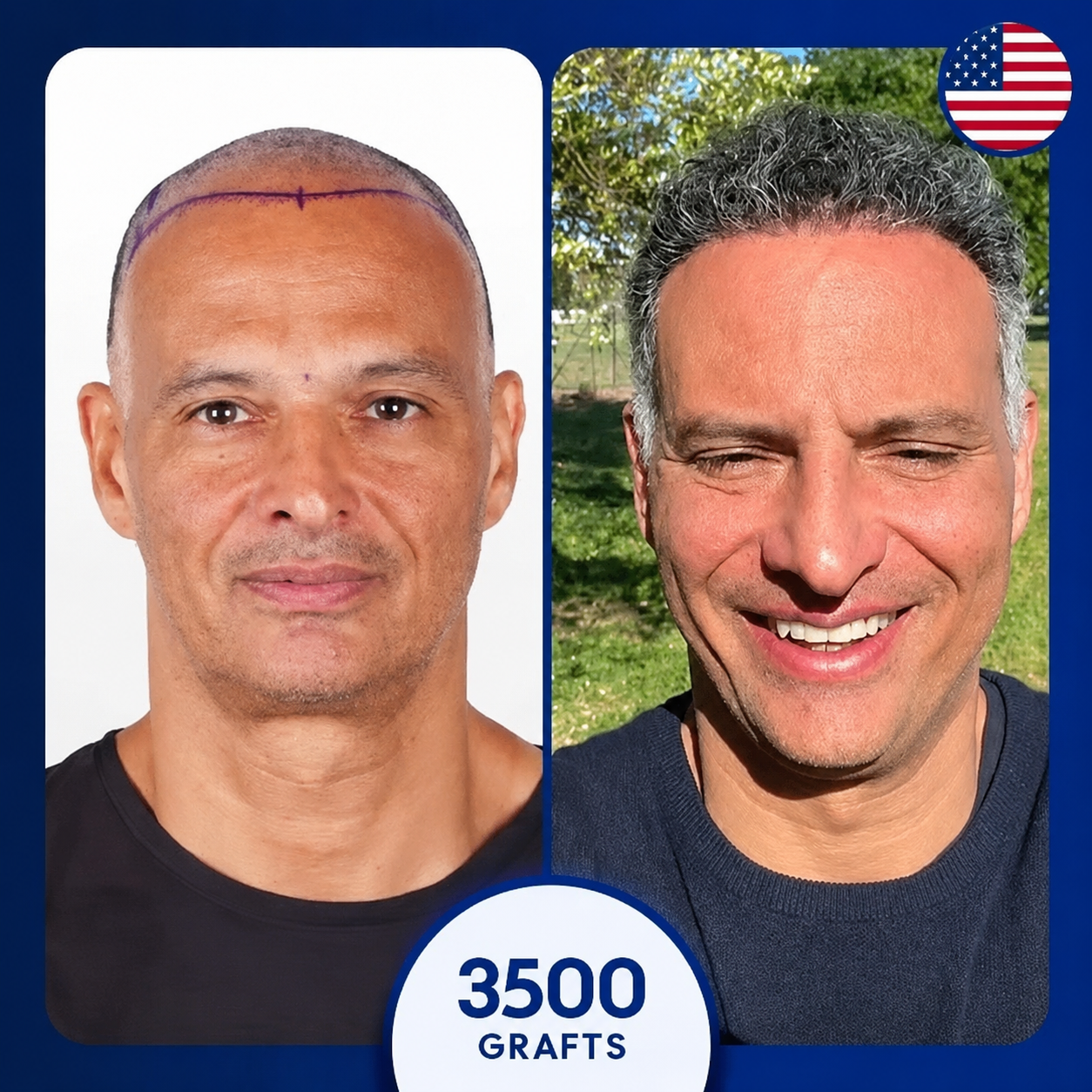
Patients can expect visible new growth within 3 to 6 months of a white hair transplant, growing in the same gray, white, or salt-and-pepper pattern as the surrounding hair rather than any different shade. The transformation is built around density and blending rather than color change: grafts placed at the temples and crown integrate into the existing hair over time, preserving the patient’s natural aging appearance instead of erasing it.
Why Choose Vera Clinic for Gray Hair Transplants?
Vera Clinic Academy has directly studied how hair pigment affects transplant outcomes, and that research shapes how our surgeons plan every gray or white hair case rather than treating it as a standard procedure with a different hair color.
Our surgeons use vital staining during extraction to restore the visual boundary that depigmented follicles lose, and pair this with sapphire blades or Choi implanter pens at the implantation stage for smaller incisions and reduced tissue trauma. These two stages solve two different problems; visibility during extraction, and precision during placement, and both are planned for from the start rather than added as an afterthought.
Vera Clinic also uses OxyCure Therapy, a post-transplant oxygenation system developed in-house to support follicle survival and healing. Because gray and white hair transplant candidates are disproportionately older, and older skin heals more slowly, this additional support is built into recovery planning for this candidate group specifically, not offered as a generic add-on.
Each procedure is planned around the individual patient’s curl pattern, donor skin characteristics, and pigment profile together, informed directly by Vera Clinic Academy’s own cohort data on how these factors interact. At Vera Clinic, that data-backed approach is what keeps gray and white grafts integrating naturally into the patient’s existing pattern, rather than standing apart from it.
Frequently Asked Questions
No. A hair transplant restores follicles, not pigment cells. Transplanted hair keeps its natural color, whether white, gray, or mixed, exactly as it was growing in the donor area.
Yes. Once visibility is corrected through vital staining during extraction, outcomes for white and dark hair transplants become nearly identical, since the difference lies in surgical visibility, not in the follicle’s biological capacity to grow.
Yes. Age itself does not determine success; what matters is donor density and circulatory support for healing. A medically cleared older patient with a stable donor supply can achieve strong graft survival regardless of hair color.
No. Modern procedures use local anesthesia, so the process stays comfortable from extraction through implantation regardless of hair color.
No. The dye stays on the surface of the skin and fades naturally within hours to a day, without discoloring the follicle or the surrounding tissue.
No. Methylene blue is a visualization aid used during extraction, not a hair growth treatment; it improves surgical precision but has no biological effect on hair regeneration.
Yes, in select cases. Very light blonde hair can create a similar low-contrast problem against pale scalp under magnification, so surgeons sometimes use methylene blue in microdoses to restore the same visual boundary they rely on for gray or white hair.
No. Pricing is based on graft count, not hair color, so a white or gray hair transplant costs the same as a transplant using pigmented donor hair for the same number of grafts.
Yes. Transplanted white or gray hair can be dyed the same way as the surrounding hair once grafts have fully healed, after the first few weeks post-surgery, since dye affects the hair shaft, not the follicle itself.
No. Hair transplanted from a donor area affected by albinism grows the same way any other transplanted hair does; albinism affects pigment, not follicle viability, so graft survival is not expected to differ.
- Bistas, E., & Sanghavi, D. K. (2023). Methylene blue. StatPearls Publishing.
- Marino, A., & Rios, W. (2012). White hair and hair transplantation: melanin, white hair, and a new technique to visualize white hair during graft preparation. Hair Transplant Forum International, 22, 90-92.
- Panhard, S., Lozano, I., & Loussouarn, G. (2012). Greying of the human hair: a worldwide survey, revisiting the ’50’ rule of thumb. British Journal of Dermatology, 167(4), 865-873.
- Vera Clinic Academy. (2026). Graft Survival and Transection Rates Across Hair Curl and Pigment Categories in FUE: A Retrospective Cohort Study at Vera Clinic. Internal institutional data. https://www.veraclinic.net/wp-content/uploads/2026/08/Graft-Survival-and-Transection-Rates-Across-Hair-Curl-and-Pigment-Categories-in-FUE_-A-Retrospective-Cohort-Study-at-Vera-Clinic.docx.pdf