


Hair thinning is a reduction in the diameter of individual hair strands, distinct from hair loss, which refers to a reduction in the actual number of hairs. The two often happen together, but not always: hair can thin for months while density stays technically normal, because the strands themselves are getting finer before any of them stop growing back. This distinction matters because it changes what treatment actually works. A retrospective registry of 631 patients using AI-assisted digital trichoscopy found that thinning, measured as follicular miniaturization, is closely linked to visible hair loss, often appearing well before density loss becomes noticeable, and identified a clinical threshold below which non-surgical treatment can still reverse it. This article covers what causes hair thinning, how miniaturization is measured, whether a given case is still reversible, and what to do next depending on the answer.
Key Points
- Hair thinning refers to reduced hair shaft diameter, while hair loss refers to reduced hair count; the two often overlap but are not the same thing.
- In a 631-patient registry, 32% of patients had normal hair density but a shaft diameter reduced enough to count as significant thinning.
- Miniaturization index rises sharply with disease stage: 24.2% in early androgenetic alopecia (Norwood II–III) versus 76.1% in advanced stages (Norwood VI–VII).
- A receding hairline is one of the earliest visible markers that miniaturization has started in the frontal zone specifically.
- In Vera Clinic Academy’s own registry, a miniaturization index below 30% generally responded to medical or regenerative treatment, while above 50%, surgical restoration became the primary option.
- Telogen effluvium, a temporary shedding condition, is 3.4 times more common in women than men and does not involve miniaturization at all.
- Whether donor-area hair is also thinning, not just the visibly affected area, determines whether a hair transplant remains a safe option.
What Is Hair Thinning?
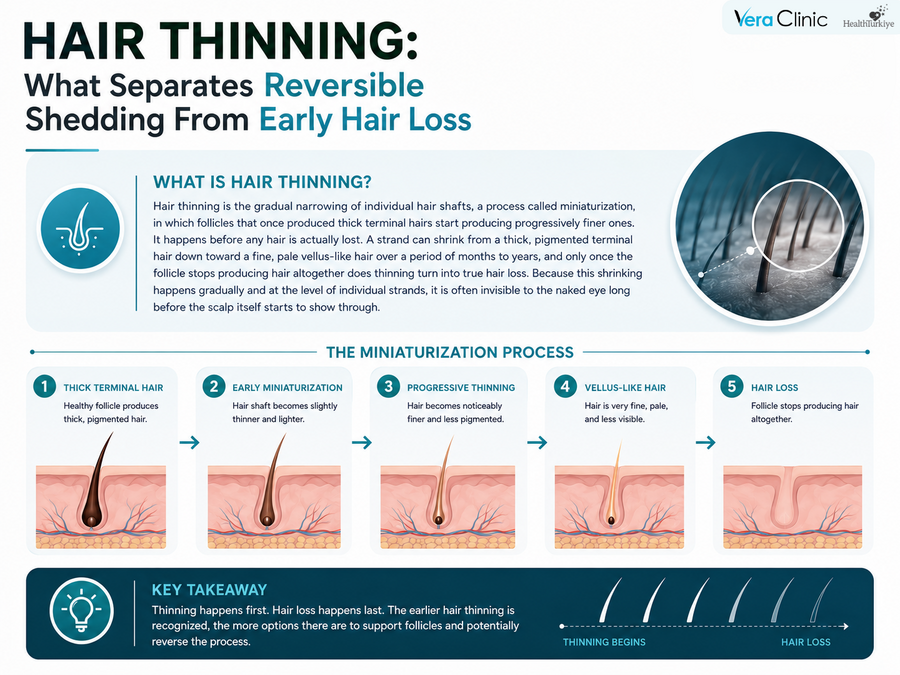
Hair thinning is the gradual narrowing of individual hair shafts, a process called miniaturization, in which follicles that once produced thick terminal hairs start producing progressively finer ones. It happens before any hair is actually lost. A strand can shrink from a thick, pigmented terminal hair down toward a fine, pale vellus-like hair over a period of months to years, and only once the follicle stops producing hair altogether does thinning turn into true hair loss. Because this shrinking happens gradually and at the level of individual strands, it is often invisible to the naked eye long before the scalp itself starts to show through.
Is Hair Thinning the Same as Hair Loss?
No, hair thinning and hair loss describe two different measurements, and one can be present without the other. Hair loss refers to a drop in the actual number of hairs per square centimeter, while thinning refers to a drop in the diameter of the hairs that are still there. In a registry of 631 patients evaluated with digital trichoscopy, 32% presented with active shedding where the absolute hair count remained within normal range, but the average shaft diameter was already markedly reduced from miniaturization. This means a hair count that still looks normal on paper can mask thinning that is already well underway, a distinction worth understanding within the broader picture of hair loss.
What Is Hair Miniaturization, and Why Does It Matter?
Hair miniaturization is the measurable shrinking of hair shaft diameter that defines how far thinning has progressed, and it matters because its severity determines which treatments still work. The underlying mechanism is thought to involve a shrinking dermal papilla, the structure that governs follicle size, rather than a simple gradual shortening of the growth cycle (Whiting, 2001). Across different stages of androgenetic alopecia, a miniaturization index, the percentage of hairs with a shaft diameter under 40 micrometers, was calculated for 631 patients in the AI-assisted Digital Trichoscopy Hair Loss Study.
| Norwood Stage | Mean Density (hairs/cm²) | Miniaturization Index |
| Stage II–III (Early) | 190 ± 20 | 24.2% ± 3.1% |
| Stage IV–V (Moderate) | 130 ± 15 | 48.7% ± 4.9% |
| Stage VI–VII (Advanced) | 74 ± 12 | 76.1% ± 5.4% |
Women showed a distinct pattern on the Ludwig Scale: Stage I thinning carried a miniaturization index of 19.5% despite largely preserved hair counts, meaning the shaft-diameter change showed up well before any visible density loss. How far this index has climbed is also what determines which treatments still have a realistic chance of working.
Does a Receding Hairline Mean Miniaturization Has Already Started?
Yes, in men a receding hairline is one of the clearest visible markers that miniaturization is already underway in that specific area, since the frontal hairline and temples carry a higher density of DHT-sensitive follicles than the mid-scalp or crown. By the time the hairline visibly moves, the miniaturization index in that zone has already crossed into a range where the shaft-diameter reduction would show up on trichoscopy, even before it’s obvious to the eye. This is the same index used throughout this article to judge reversibility: a receding hairline still responds to the same 30% and 50% thresholds described above; it isn’t staged on a separate scale the way overall balding is graded on the Hamilton-Norwood Scale.
Because the hairline tends to change first, an early scan of the frontal zone often catches thinning before it would show up anywhere else on the scalp. Once that same zone crosses the surgical threshold described above, the standard next step is a hair transplant for receding hairline rather than continued medical management.
What Causes Hair Thinning?
Hair thinning most often traces back to one of four causes: genetic sensitivity to DHT, a temporary shift in the shedding cycle, an underlying deficiency, or a hormonal change.
- Androgenetic Alopecia: Genetically susceptible follicles gradually shrink under the influence of DHT sensitivity, showing up as a receding hairline in men or diffuse crown thinning in women, and accounting for the majority of thinning cases overall.
- Telogen Effluvium: A stress-, illness-, or hormone-triggered shift pushes more hairs than usual into the shedding phase at once, producing diffuse thinning without any miniaturization of the hair shaft itself (Grover & Khurana, 2013).
- Nutritional Deficiencies: Low iron, vitamin D, or protein intake can reduce the hair growth cycle’s efficiency, producing thinner, weaker strands until the deficiency is corrected.
- Hormonal Changes: Pregnancy, menopause, and thyroid disorders alter the hair growth cycle directly, often producing thinning that resolves once the underlying hormonal shift stabilizes.
Of these, androgenetic alopecia is by far the most common, and it is covered in more depth under androgenetic alopecia.
How Common Is Each Type of Hair Thinning?
Androgenetic alopecia accounts for the large majority of hair thinning cases, but the specific type varies significantly by sex.
| Cause | Overall Prevalence | Within Affected Sex |
| Androgenetic Alopecia | 62.1% (n=392) | 87.1% of men |
| Female Pattern Hair Loss | 19.7% (n=124) | 68.5% of women |
| Telogen Effluvium | 12.4% (n=78) | 3.4x more common in women (p<0.01) |
| Other (alopecia areata, traction, etc.) | 5.8% (n=37) | — |
These figures come from the same 631-patient cohort, drawn from records collected at Vera Clinic between January 2024 and May 2026. Notably, telogen effluvium showed no miniaturization at all in this data, distinguishing it clearly from the pattern hair loss cases above it in the table.
Is Your Hair Thinning Reversible?
Whether thinning is still reversible comes down almost entirely to the miniaturization index at the time of evaluation, according to the AI-assisted Digital Trichoscopy Hair Loss Study (Vera Clinic Academy, 2026). Below roughly 30%, the threshold this particular registry identified, the follicle remains structurally intact, and medical or regenerative treatment such as minoxidil, finasteride, or PRP can often thicken the shaft back toward its original caliber, in some cases moving a miniaturized hair back into the normal terminal range. This kind of recovery is not always a slow, incremental process either: histologic evidence shows that a responding follicle can reverse miniaturization within a single hair cycle once treatment takes effect, rather than gradually thickening over years (Whiting, 2001).
Above roughly 50%, alongside an absolute density drop below 130 hairs per square centimeter by this same registry’s criteria, the picture changes. At that point, the follicle has progressed into fibrosis and permanent capillary drop-out, and non-surgical treatment no longer has structurally intact tissue left to work with. Restoring density at that stage generally requires transplantation, since medication and regenerative treatments both depend on a follicle that is compromised but not yet permanently scarred.
Can You Get a Hair Transplant If Your Donor Area Is Thinning?
Yes, if the donor area itself is thinning, that changes candidacy more than the severity of thinning at the visible site. A hair transplant only works by moving hair from a donor zone that stays genetically resistant to the same miniaturization process affecting the rest of the scalp; if the donor area is thinning too, transplanted grafts would simply miniaturize again after being moved. The same 631-patient digital trichoscopy protocol flags this risk in the donor zone directly: a miniaturization index above 25% in the occipital donor zone was treated as a signal to investigate further before any transplant is planned, a threshold that matters more as thinning progresses on the Hamilton-Norwood Scale, since grafts taken from an already-thinning donor area carry a meaningfully higher risk of failing after transplantation.
What Are the Treatment Options for Hair Thinning?
Which of these makes sense depends almost entirely on where the miniaturization index stands: medication and regenerative options work best below the reversible threshold, while transplantation takes over once the follicle has progressed past it.
- Topical or Oral Minoxidil: Increases blood flow to the follicle and can thicken shaft diameter in follicles that have not yet crossed the surgical threshold.
- Finasteride: Blocks the conversion of testosterone to DHT, slowing or halting further miniaturization in androgenetic cases.
- Low-Level Laser Therapy (LLLT): Stimulates follicular activity through photobiomodulation, generally used alongside medication rather than alone.
- PRP (Platelet-Rich Plasma): Injects concentrated growth factors into the scalp to support follicles still within the reversible range.
- Hair Transplant: Once miniaturization has progressed past the reversible threshold and the donor area is confirmed stable, transplantation restores density surgically rather than through follicle recovery.
Most cases end up combining two or three of these rather than relying on just one, since medication that stabilizes the surrounding hair is often continued even after a transplant restores density in the affected area.
How to Self-Check for Early Hair Thinning
A simple ponytail check can flag thinning before it becomes visually obvious in the mirror. Gather all of your hair into a ponytail at the same point on your head you always would, and check the circumference of the hair tie wraps needed to hold it snugly. A noticeably looser ponytail than a year or two ago, needing more wraps of the same tie to feel secure, points to a real drop in either hair count or hair thickness, since both reduce the total volume your hair holds. This will not tell you which one changed, but it is a useful early signal that a proper trichoscopy evaluation is worth booking.
When Should You See a Specialist?
A specialist visit is worth booking whenever thinning is new, accelerating, or affecting more than the crown, or when a hairline is visibly receding rather than just feeling thinner. At Vera Clinic, an initial consultation starts with digital trichoscopy rather than a visual assessment alone, since it captures shaft diameter changes and donor-zone stability that cannot be judged accurately by eye. Getting the miniaturization index measured early is what actually determines whether medical treatment can still work or whether surgical planning should begin instead.
Vera Clinic’s medical team frames this the same way with patients:
“The number on the scan matters more than how thin the hair looks in the mirror. Some patients are convinced they need surgery when the follicles are actually still healthy enough to respond to medication. Others assume a cream will fix it when the scan says otherwise. Either way, we’d rather know that before making a recommendation than guess from how it looks.”
— Dr. Emin Gül, Vera Clinic Surgeon
Frequently Asked Questions
Yes, thinning can affect shaft diameter for months while the total hair count stays normal, which is why a normal-looking part line does not rule out active miniaturization underneath.
No, telogen effluvium is a temporary shift in hair-cycle timing that causes shedding without any shaft-diameter change, while pattern hair thinning involves the follicle itself physically shrinking.
Not necessarily; thinning driven by a temporary cause such as stress or a nutritional deficiency resolves once the trigger is addressed, while thinning driven by androgenetic alopecia tends to progress without treatment.
Sources
- Grover, C., & Khurana, A. (2013). Telogen effluvium. Indian Journal of Dermatology, Venereology and Leprology, 79(5), 591–603.
- Vera Clinic Academy Research Report. (2026). Investigation of Hair Loss Patterns, Prevalence, and Miniaturization Metrics Using Artificial Intelligence-Assisted Digital Trichoscopy: A Retrospective Registry Analysis of 631 Patients. https://www.veraclinic.net/wp-content/uploads/2026/06/Investigation-of-Hair-Loss-Patterns-Prevalence-and-Miniaturization-Metrics-Using-Artificial-IntelligenceAssisted-Digital-Trichoscopy-A-Retrospective-Registry-Analysis-of-631-Patients.pdf
- Whiting, D. A. (2001). Possible mechanisms of miniaturization during androgenetic alopecia or pattern hair loss. Journal of the American Academy of Dermatology, 45(3 Suppl), S81–S86.