

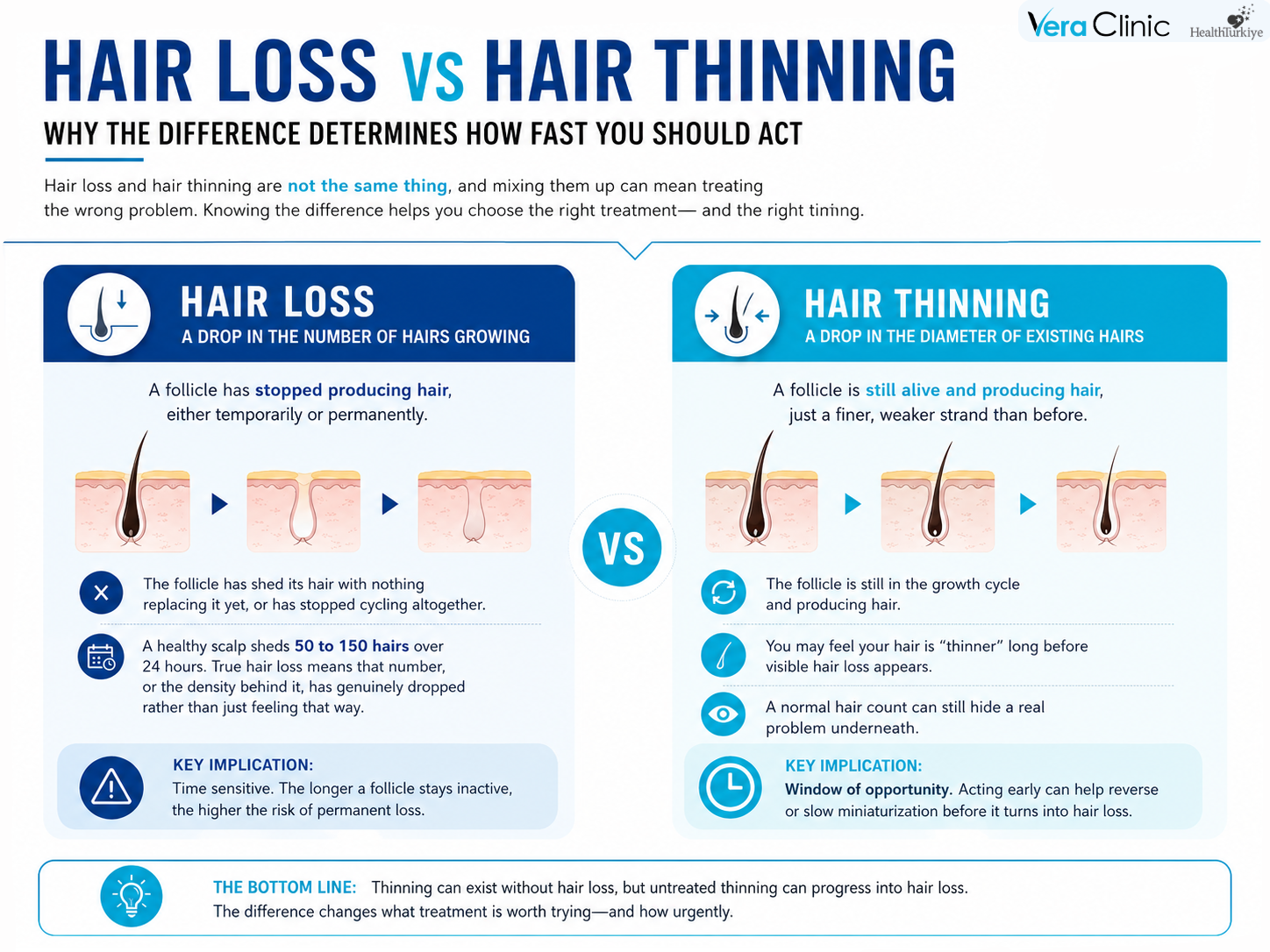
Hair loss and hair thinning are not the same thing, and mixing them up can mean treating the wrong problem. Hair loss means a follicle has actually stopped producing hair, either temporarily or permanently. Hair thinning means the follicle is still producing hair, just a finer, weaker strand than before, a process called miniaturization. The two often show up together, but one can exist without the other for months, which changes what treatment is worth trying and how urgently.
Key Points
- Hair loss means a follicle has stopped producing hair; hair thinning means the follicle is still active but producing a finer strand.
- In a 631-patient registry, 32% of people with active shedding had a normal hair count but a shaft diameter already reduced enough to count as thinning, showing the two can be out of sync.
- Thinning that crosses a certain severity threshold tends to progress toward permanent hair loss, while thinning caught earlier often responds to medication alone.
- Not all thinning leads to hair loss: telogen effluvium causes real shedding without any miniaturization at all.
- A receding hairline can be either thinning or hair loss depending on whether the follicles in that band are still active or have already stopped producing hair.
- The treatments that work best depend entirely on which one you’re dealing with, not on how the hair looks in the mirror.
What Is the Difference Between Hair Loss and Hair Thinning?
Hair loss is a drop in the number of hairs growing from the scalp, while hair thinning is a drop in the diameter of the hairs that are still growing. A follicle experiencing hair loss has either shed its hair with nothing replacing it yet, or has stopped cycling altogether; a healthy scalp normally sheds 50 to 150 hairs over a 24-hour period, and true hair loss means that number, or the density behind it, has genuinely dropped rather than just feeling that way (Sinclair, 2015). A follicle experiencing thinning is still alive and producing hair, just a shorter, finer version of what it used to grow. This is why someone can run a finger through their hair and feel that it’s “thinner” long before an actual bald patch or receding hairline shows up, and why a hair count that looks normal on paper can still hide a real problem underneath, one that fits into the broader picture of hair loss.
| Feature | Hair Thinning | Hair Loss |
| What’s Happening | Follicle shrinks, hair shaft gets finer | Follicle sheds hair or stops producing it |
| Hair Count | Can stay normal while shaft diameter drops | Directly reduced |
| Visual Sign | Hair feels or looks less voluminous | Visible scalp, bald patches, or a receding hairline |
| Reversibility | Often reversible with medication if caught early | Reversible only if the follicle is still active; permanent if not |
| Common Cause | Androgenetic alopecia (early stage), nutritional gaps | Advanced androgenetic alopecia, alopecia areata, scarring alopecia |
If the hair is present but feels weaker, that’s thinning; if there’s a widening patch of visible scalp, that’s hair loss already underway, and how each stage actually behaves over time is covered in more depth under hair thinning.
Could It Be Breakage Instead of Thinning or Loss?
Possibly, and it’s easy to miss the difference. Breakage happens along the hair shaft, not at the follicle, so unlike thinning or loss, the total number of hairs growing from the scalp stays exactly the same. What changes is length and evenness: strands snap partway up, leaving noticeably shorter, frizzy-looking ends scattered across the head instead of a widening part or visible scalp. Heat styling, chemical treatments, and rough brushing are the usual triggers, and once the damaging habit stops, breakage resolves on its own since the follicle underneath was never affected. Unlike a receding hairline, which reflects a change at the follicle itself, breakage can show up anywhere on the head, including well behind the hairline, since it has nothing to do with where hair is more genetically vulnerable. If the scalp itself is becoming visible, that rules out breakage; if the hair simply isn’t getting any longer despite normal density, breakage is the more likely explanation.
Can Hair Thinning Turn Into Hair Loss?
Yes, and the underlying mechanism is well established in the dermatology literature independent of any single clinic’s data: as androgen-driven miniaturization progresses, the follicle eventually develops perifollicular inflammation and fibrosis, at which point the change becomes structurally permanent rather than something medication can reverse (Martinez-Jacobo et al., 2018). Visible rarefaction itself, the patchy or thin-looking areas that actually catch someone’s eye in the mirror, is driven less by hairs disappearing one by one than by more follicles sitting empty for longer between cycles, a resting stage called kenogen that lengthens as androgenetic alopecia progresses (Guarrera & Rebora, 2019).
Vera Clinic Academy’s own registry translates this general mechanism into a specific operational threshold. A 631-patient registry, drawn from records collected at Vera Clinic between January 2024 and May 2026, using AI-assisted digital trichoscopy found that this shift is measurable: below a miniaturization index of roughly 30%, the threshold this registry identified, follicles remain structurally intact and can still respond to treatment, while above roughly 50%, the follicle has progressed too far for medication alone to reverse. Whether hair can still grow back at that point comes down to this same 30%/50% threshold, mapped out in the AI-assisted Digital Trichoscopy Hair Loss Study, which shapes treatment planning more broadly than just the loss-versus-thinning question.
What Causes Hair Thinning vs Hair Loss?
Thinning and hair loss often share the same root cause but represent different points along its progression.
- Androgenetic Alopecia: Starts as thinning through gradual follicle miniaturization, and becomes hair loss once affected follicles stop producing hair entirely, the most common route into pattern baldness.
- Telogen Effluvium: Causes real hair loss (increased shedding) without ever thinning the hair shaft itself, since the follicles simply shift into their resting phase early, a pattern seen roughly 3.4 times more often in hair loss in women than in men (Vera Clinic Academy, 2026).
- Hormonal or Nutritional Hair Loss Triggers: Show up first as thinning, since the follicle keeps producing hair but with less efficiency until the underlying issue is corrected.
Whatever the trigger, treatment planning still starts at the same checkpoint: is the follicle still producing hair, or has it stopped.
Is a Receding Hairline Thinning or Hair Loss?
It depends entirely on what stage it’s at, and a receding hairline is actually one of the clearest real-world examples of the thinning-to-loss progression described throughout this article. Early on, the follicles along the hairline are still active, just producing progressively finer hair, which technically makes it thinning rather than loss, even though the hairline already looks like it’s moving back. Only once those same follicles stop producing hair altogether does that band of scalp cross into true hair loss, at which point the change stops being reversible with medication alone.
The practical test is the same one used everywhere else in this comparison: is the hair along the hairline still there, just weaker, or has it actually stopped growing back. A hairline that looks thin but still has fine hair coming in is still in the thinning phase; one where the scalp is visibly bare is past it. This is also why a receding hairline gets treated differently depending on when someone seeks evaluation, since the same recession can still be medication-responsive early on and require a hair transplant for receding hairline once the follicles have stopped producing hair entirely
Which Treatments Work for Hair Thinning vs Hair Loss?
The real dividing line isn’t whether something is labeled thinning or loss, it’s whether the follicle underneath is still active, and each treatment targets that activity in a different way.
- Minoxidil: Widens blood vessels around the follicle and prolongs its growth phase, which only helps if that follicle is still cycling.
- Finasteride: Blocks the conversion of testosterone into DHT, slowing the miniaturization process itself, which again requires a follicle that hasn’t yet gone fully dormant.
- PRP Treatment: Injects concentrated growth factors to support follicles that are struggling but still alive.
All three fail once a follicle has permanently stopped producing hair, since none of them can restart something that has shut down completely. At that point, restoring density means turning to effective hair loss treatment options in a different category entirely, most often a hair transplant.
Do Hair Loss and Hair Thinning Need Different Treatments?
Not exactly, and that’s easy to misread. Androgenetic thinning and early androgenetic hair loss actually respond to the same medications, minoxidil, finasteride, PRP, because in both cases the follicle is still active; the label doesn’t change the treatment, the follicle’s status does. Where the split really happens is by cause, not by the thinning-versus-loss distinction: hair loss from alopecia areata needs corticosteroids or immunotherapy, and hair loss from telogen effluvium often needs nothing more than identifying and removing the trigger, neither of which minoxidil or finasteride touches at all, a distinction that plays out somewhat differently across hair loss in men compared with women. So the more useful question isn’t “is this thinning or loss,” it’s “what’s actually causing it and is the follicle still there.”
What Happens Once Medication No Longer Works?
Once a follicle has crossed into permanent dormancy, a hair transplant becomes the option that restores density, since it physically relocates hair from a genetically resistant donor zone rather than trying to revive follicles that have already stopped producing. This is a fundamentally different kind of intervention than anything discussed so far in this comparison: minoxidil, finasteride, and PRP all work by keeping an existing follicle active, while a transplant works by moving a healthy one somewhere else entirely. That distinction is also why timing matters less at this stage than it did earlier; a follicle that has fully shut down isn’t waiting to respond to a better dose or a longer course of treatment, it needs to be replaced. How that replacement actually happens, and which technique fits the situation, comes down to how much native hair remains around it.
Which Transplant Technique Fits a Thinning Scalp?
The technique chosen changes how safely grafts can be placed around whatever native hair is still growing nearby.
- DHI: Places grafts one at a time using an implanter pen, without first creating recipient incisions, which allows tighter spacing in areas where native hair is sparse but not entirely gone, since there’s no incision made in advance that could damage a surviving follicle sitting right next to it.
- Sapphire FUE: Uses crystal-tipped blades to open recipient sites before graft placement, a technique preferred for larger sessions where speed and incision consistency matter more than working around existing hair, since the area being treated often has little native hair left to protect.
Which of the two makes sense depends less on personal preference and more on two things: how much native hair remains in the treatment area, and whether the donor area itself has been confirmed stable, since grafts pulled from a donor area that’s already thinning carry a higher chance of failing regardless of which technique places them.
When Should You See a Specialist?
A specialist visit is worth booking whenever it’s unclear whether what you’re seeing is early thinning or actual hair loss, since the two call for different urgency. At Vera Clinic, this distinction is made with digital trichoscopy rather than a visual check alone, since it measures shaft diameter directly instead of relying on how dense the hair looks under a given light. Waiting to find out which one it is rarely helps, since thinning that’s caught early has more treatment options than the same case caught later.
Vera Clinic’s medical team sums up why this distinction gets made early rather than left to guesswork:
“People usually come in already certain of which one they have, and about half the time the scan tells a different story. Someone convinced they’re ‘balding’ turns out to have thinning that’s still fully treatable, and someone who’s been trying serums for a year turns out to have follicles that already stopped producing hair months ago. The label doesn’t matter nearly as much as what the follicle is actually doing.”
— Dr. Emin Gül, Vera Clinic Surgeon
Frequently Asked Questions
Yes, a follicle can produce a visibly finer strand for months while the total hair count on the scalp stays within a normal range.
No, thinning caused by telogen effluvium or a temporary nutritional gap can resolve completely without ever progressing to permanent hair loss.
Yes, shaft-diameter changes are detectable with trichoscopy well before any scalp visibility or bald patch becomes noticeable to the eye.
A widening part or looser ponytail points to thinning, since the hair is still there but finer; a patch of visible scalp that wasn’t there before points to loss, since hair has actually stopped growing in that spot.
Losing 50 to 150 hairs a day is normal, so shedding within that range on its own isn’t a concern; it becomes worth investigating when shedding clearly exceeds that, or when it’s paired with visible thinning that wasn’t there a few months ago.
Sources
- Guarrera, M., & Rebora, A. (2019). The higher number and longer duration of kenogen hairs are the main cause of the hair rarefaction in androgenetic alopecia. Skin Appendage Disorders, 5(3), 152–154.
- Martinez-Jacobo, L., Villarreal-Villarreal, C. D., Ortiz-López, R., Ocampo-Candiani, J., & Rojas-Martínez, A. (2018). Genetic and molecular aspects of androgenetic alopecia. Indian Journal of Dermatology, Venereology and Leprology, 84(3), 263–268.
- Sinclair, R. (2015). Hair shedding in women: how much is too much? British Journal of Dermatology, 173(3), 846–848.
- Vera Clinic Academy Research Report. (2026). Investigation of Hair Loss Patterns, Prevalence, and Miniaturization Metrics Using Artificial Intelligence-Assisted Digital Trichoscopy: A Retrospective Registry Analysis of 631 Patients. https://www.veraclinic.net/wp-content/uploads/2026/06/Investigation-of-Hair-Loss-Patterns-Prevalence-and-Miniaturization-Metrics-Using-Artificial-IntelligenceAssisted-Digital-Trichoscopy-A-Retrospective-Registry-Analysis-of-631-Patients.pdf