

PRP and mesotherapy are both injectable treatments for hair loss, but they work through different mechanisms and produce different results. In Vera Clinic Academy’s own 12-month cohort, PRP produced a larger increase in follicular density than mesotherapy, 18.2% versus 12.5%, while mesotherapy required two additional sessions to reach a smaller gain. PRP concentrates a patient’s own platelets and injects them into the scalp to deliver growth factors directly to weakened follicles, while mesotherapy delivers a cocktail of vitamins, amino acids, and peptides into the same layer of skin without a blood draw. Both treatments are non-surgical, carry a low risk of side effects, and are commonly used to support hair transplant recovery. The right choice depends on the underlying cause and stage of hair loss, session tolerance, and budget.
Key Points
- PRP is a platelet injection prepared from the patient’s own blood, while mesotherapy is a vitamin, amino-acid, and peptide injection prepared externally.
- PRP produced an 18.2% density increase and mesotherapy produced a 12.5% density increase over 12 months in a cohort of 100 patients, 50 per group.
- PRP costs $150 to $350 per session across 3 to 6 total sessions, against mesotherapy’s $100 to $300 per session across 4 to 8; PRP’s session count follows a standardized literature protocol, while mesotherapy’s does not.
- Recovery is similarly fast for both treatments, with nearly identical 24-to-48-hour aftercare restrictions and no formal downtime for either.
- PRP suits early-stage androgenetic alopecia and post-transplant support, while mesotherapy suits diffuse thinning linked to scalp nutrition or circulation.
- Mesotherapy carries a rare but documented risk of allergic reactions and permanent localized hair loss that PRP’s autologous blood does not share, though neither treatment showed systemic adverse events in Vera Clinic Academy’s 220-patient cohort.
- Exosome therapy, stem cell-assisted transplantation, low-level laser therapy, and microneedling are additional non-surgical options worth knowing about beyond PRP and mesotherapy.
What Are PRP and Mesotherapy for Hair Loss?
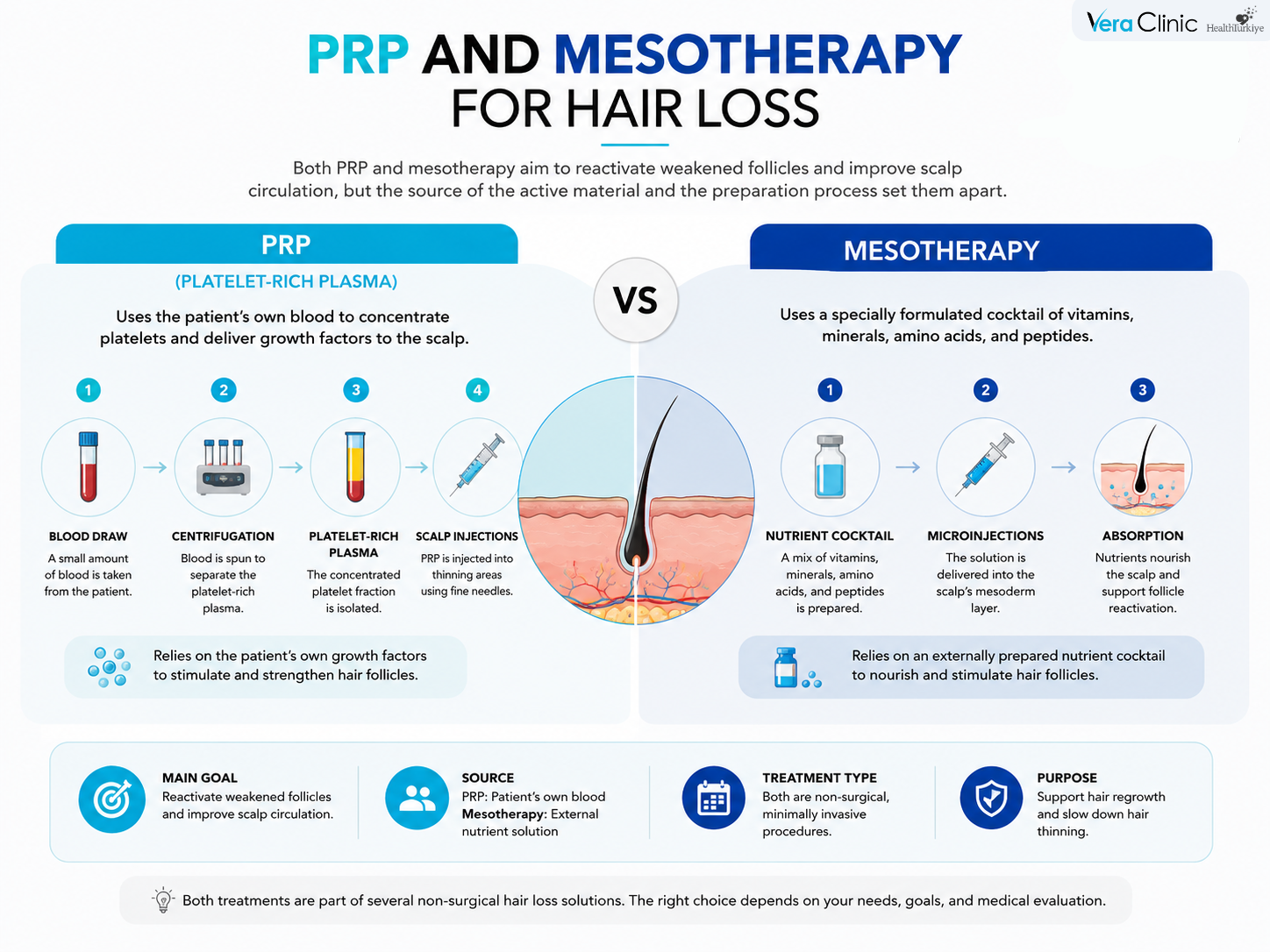
PRP (platelet-rich plasma) is a treatment that concentrates platelets from a patient’s own blood and injects them into the scalp to release growth factors and stimulate hair follicles. The process begins with a blood draw, followed by centrifugation to isolate the platelet-rich fraction, then a series of fine-needle injections into the thinning areas of the scalp. Mesotherapy is a treatment that delivers a mixed solution of vitamins, minerals, amino acids, and peptides directly into the scalp’s mesoderm layer through microinjections, without drawing blood. Where PRP relies on the patient’s own biological growth factors, mesotherapy relies on an externally prepared nutrient cocktail. Both approaches aim to reactivate weakened follicles and improve scalp circulation, but the source of the active material and the preparation process set them apart, placing them among several non-surgical hair loss treatments patients weigh before choosing a protocol.
How Do PRP and Mesotherapy Compare in Effectiveness?
Vera Clinic Academy tracked both treatments in a 12-month prospective observational cohort of 100 patients, 50 per group, measuring the change in follicular density and hair shaft diameter that followed each patient’s PRP treatment for hair loss or mesotherapy sessions.
| Measure | PRP (n=50) | Mesotherapy (n=50) |
|---|---|---|
| Sessions | 4 | 6 |
| 12-Month Density Increase | 18.2% | 12.5% |
| Hair Shaft Diameter Increase | 14.4% | 9.1% |
| First Documented Clinical Response | Month 3 (post-session 2) | Month 4 (post-session 4) |
| Patient-Reported Outcome (PROM) Score | 7.1 / 10 | 6.4 / 10 |
PRP produced a larger density increase in fewer sessions, while mesotherapy required two additional sessions to reach a smaller gain in this cohort. A retrospective comparison of PRP and mesotherapy-type products published in Skin Appendage Disorders similarly found PRP to outperform mesotherapy formulations on hair growth measures, suggesting the pattern observed at Vera Clinic is consistent with findings reported elsewhere (Stefanis et al., 2024). Vera Clinic Academy’s results reflect a prospective observational study, not a randomized controlled trial, so the difference reflects real-world outcomes at Vera Clinic rather than a head-to-head clinical trial result.
How Do PRP and Mesotherapy Compare in Cost?
Both treatments are priced per session in Turkey, with the total cost depending on how many sessions the patient’s protocol requires.
| Treatment | Cost per Session (Turkey) | Sessions | Estimated Full Course |
|---|---|---|---|
| PRP | $150 – $350 | 3 – 6 | $450 – $2,100 |
| Mesotherapy | $100 – $300 | 4 – 8 | $400 – $2,400 |
These figures reflect PRP and mesotherapy as standalone treatments. At Vera Clinic, PRP is included at no additional cost when performed as part of a hair transplant package, while mesotherapy for hair is booked as its own course of sessions.
How Many PRP or Mesotherapy Sessions Do You Need?
PRP needs 3 to 4 sessions, while mesotherapy has no standardized session count in the literature. Session count is what actually drives the total price patients pay, since it’s the number that repeats, not the per-session rate. PRP protocols are relatively standardized in the literature: reviews of published trials converge on 3 to 4 initial sessions spaced 4 to 6 weeks apart, followed by maintenance sessions every 4 to 6 months (Gupta et al., 2019). Mesotherapy has no equivalent consensus. A systematic review covering 27 studies found no standardized regimen across trials, with published courses ranging from 3 to 10 sessions depending on the formulation used (Gupta et al., 2023). Vera Clinic Academy’s own protocol, 4 PRP sessions and 6 mesotherapy sessions over 12 months, sits within these published ranges for both treatments.
For patients not undergoing a transplant, this gap in protocol length and consistency matters more than the small difference in per-session price. This standardization also matters for setting expectations correctly: some clinics market PRP as a single-session fix, but this doesn’t match how the treatment works, since follicular response builds gradually across the full protocol rather than in one visit. At Vera Clinic, PRP is presented as a multi-session protocol tailored to the patient’s hair loss pattern, whether used alone or alongside a transplant, rather than a one-time treatment with guaranteed results.
How Do PRP and Mesotherapy Compare in Recovery Time?
Recovery is similarly fast for both treatments, and neither requires formal downtime; most patients resume daily activities the same day. The aftercare restrictions during the first 24 to 48 hours are nearly identical, which is why the practical difference in recovery comes down to what happens before treatment rather than after.
| Aftercare Aspect | PRP | Mesotherapy |
|---|---|---|
| Hair washing | Avoid for 24 hours | Avoid for 24 hours |
| Sun exposure | Avoid direct exposure for 24 hours | Avoid direct exposure for 24 to 48 hours |
| Alcohol and anti-inflammatory drugs | Avoid for 24 hours | Avoid for 24 hours |
| Strenuous exercise | Not restricted beyond the first day | Avoid for 24 to 48 hours |
| Return to work | Same day | Same day |
The one meaningful difference sits before treatment starts, not after it ends: PRP requires a blood draw and centrifugation step that adds time to the appointment itself, while mesotherapy skips this step entirely since its solution is prepared in advance.
Who Is a Better Candidate for PRP or Mesotherapy?
Candidacy for each treatment depends on the cause and stage of hair loss, not just personal preference.
- Patients with early-stage androgenetic alopecia: Those whose follicles are still active but miniaturizing tend to respond better to PRP, based on the density gains observed in Vera Clinic Academy’s cohort.
- Patients with diffuse thinning from nutritional or circulatory causes: Those whose hair loss is linked to scalp nutrition or circulation, rather than follicle miniaturization, tend to be better suited to mesotherapy’s vitamin and amino-acid cocktail.
- Patients undergoing a hair transplant: PRP is the better fit here, since it is more commonly integrated into transplant protocols at Vera Clinic and applied directly to grafts to support survival.
- Patients who want faster results with fewer visits: PRP is the better fit, since it reached its first documented response one month earlier than mesotherapy and required two fewer sessions in this cohort.
- Patients who prefer to avoid a blood draw: Mesotherapy is the better fit, since it does not require blood collection, unlike PRP.
A consultation with a specialist remains necessary to confirm which mechanism matches the underlying cause of a patient’s hair loss.
Are There Risks or Side Effects With PRP or Mesotherapy?
Both treatments are considered safe when performed by a trained provider, though the type and severity of risk differs between them (Anitua et al., 2025; Gupta et al., 2023).
- Mild, transient injection-site reactions: Redness, tenderness, and swelling at the injection sites are the most common effect of both PRP and mesotherapy, and resolve within 24 to 48 hours (Anitua et al., 2025; Gupta et al., 2023).
- Allergic or hypersensitivity reactions: This risk is specific to mesotherapy, since its externally prepared cocktail can contain ingredients, such as corticosteroids, that trigger reactions PRP’s autologous blood does not carry the same risk for. A documented case linked a corticosteroid-containing mesotherapy mixture to permanent, localized hair loss at the injection site (Lee et al., 2019).
- Systemic adverse events: Neither treatment has shown a consistent signal for systemic effects such as sexual dysfunction or hormonal imbalance in the broader literature, unlike pharmaceutical options such as finasteride (Anitua et al., 2025).
Vera Clinic Academy’s own cohort is consistent with this pattern: no systemic adverse events were recorded across all 220 patients enrolled in its regenerative treatment arms. This safety data was reported across all regenerative arms combined rather than broken out by individual treatment, so a PRP-specific or mesotherapy-specific adverse event rate is not available from this study.
Other Non-Surgical Options for Hair Loss
PRP and mesotherapy are not the only non-surgical options for hair loss. Four other approaches are worth knowing about, spanning biological, mechanical, and light-based mechanisms.
- Exosome Therapy: Uses lab-prepared exosomes rather than a patient’s own blood; Vera Clinic Academy’s cohort found this exosome hair loss treatment produced a larger density increase in fewer sessions than either PRP or mesotherapy.
- Stem Cell-Assisted Transplantation: For patients with depleted donor areas from a previous failed transplant, stem cell hair transplant combines a stem cell-assisted procedure with these same regenerative mechanisms rather than relying on injections alone.
- Low-Level Laser Therapy (LLLT): A light-based, non-injectable option; a multicenter randomized sham-controlled trial found an average gain of 19 terminal hairs per cm² after 26 weeks of Low-Level Laser therapy (Jimenez et al., 2014).
- Microneedling: Creates controlled micro-injuries in the scalp to stimulate collagen production and improve absorption of topical treatments; a randomized evaluator-blinded study found microneedling for hair loss resulted in faster and greater hair count improvement when combined with minoxidil than minoxidil alone (Dhurat et al., 2013).
All four are best discussed directly with a specialist, since suitability depends on donor area condition, treatment history, and whether an injectable, mechanical, or light-based approach fits the patient’s preference.
Frequently Asked Questions
Yes, PRP and mesotherapy can be combined. In practice, clinicians sometimes alternate the two to pair PRP’s growth-factor stimulation with mesotherapy’s nutrient support, though large comparative trials testing this specific combination, rather than either treatment alone, remain limited.
Neither is significantly more painful than the other. Both involve superficial scalp injections and cause similar, mild discomfort. A randomized split-scalp study found that pain from PRP injections could be meaningfully reduced with simple measures such as ice compression, without needing local anesthetic (Suh et al., 2021). Mesotherapy’s microinjections are described as comparably mild, though PRP requires an additional blood draw beforehand that mesotherapy does not involve.
No, neither treatment produces permanent results. Androgenetic alopecia is a chronic, progressive condition that requires ongoing treatment to sustain any gains, regardless of which non-surgical option is used (Nestor et al., 2021). Both PRP and mesotherapy rely on maintenance sessions to sustain follicular stimulation over time.
Results from both treatments hold for several months after the initial course, with maintenance sessions recommended every few months to sustain density gains. This is consistent with the ongoing-care approach described for non-surgical androgenetic alopecia treatments (Nestor et al., 2021). Vera Clinic Academy’s cohort tracked outcomes through a 12-month endpoint rather than testing durability beyond that window.
In Vera Clinic Academy’s cohort, PRP’s first documented response appeared at month 3, after the second session, while mesotherapy’s first response appeared at month 4, after the fourth session.
Not entirely. A meta-analysis of androgenetic alopecia trials found that PRP significantly increased hair density in men but not in women, while increasing hair shaft diameter in both sexes (Gupta et al., 2020). Comparable sex-specific data for mesotherapy is limited, and Vera Clinic Academy’s cohort did not report outcomes separately by sex for either treatment.
Sources
- Anitua, E., Tierno, R., & Alkhraisat, M. H. (2025). Platelet-rich plasma in the management of alopecia: A systematic review and meta-analysis of clinical evidence. Dermatology and Therapy, 15(11), 3213–3252.
- Dhurat, R., Sukesh, M., Avhad, G., Dandale, A., Pal, A., & Pund, P. (2013). A randomized evaluator blinded study of effect of microneedling in androgenetic alopecia: A pilot study. International Journal of Trichology, 5(1), 6–11.
- Gupta, A. K., Versteeg, S. G., & Shear, N. H. (2019). Platelet-rich plasma for androgenetic alopecia: A review of the literature and proposed treatment protocol. Journal of Dermatological Treatment, 30(5), 472–480.
- Gupta, A. K., Renaud, H. J., & Bamimore, M. (2020). Platelet-rich plasma for androgenetic alopecia: Efficacy differences between men and women. Dermatologic Therapy, 33(6), e14143.
- Gupta, A. K., Polla Ravi, S., Wang, T., Talukder, M., Starace, M., & Piraccini, B. M. (2023). Systematic review of mesotherapy: A novel avenue for the treatment of hair loss. Journal of Dermatological Treatment, 34(1), 2245084.
- Jimenez, J. J., Wikramanayake, T. C., Bergfeld, W., Hordinsky, M., Hickman, J. G., Hamblin, M. R., & Schachner, L. A. (2014). Efficacy and safety of a low-level laser device in the treatment of male and female pattern hair loss: A multicenter, randomized, sham device-controlled, double-blind study. American Journal of Clinical Dermatology, 15(2), 115–127.
- Lee, Y. I., et al. (2019). A permanent hair loss in a patient with hypersensitivity to intralesional triamcinolone injection. Annals of Dermatology, 31(2), 217–220.
- Nestor, M. S., Ablon, G., Gade, A., Han, H., & Fischer, D. L. (2021). Treatment options for androgenetic alopecia: Efficacy, side effects, compliance, financial considerations, and ethics. Journal of Cosmetic Dermatology, 20(12), 3759–3781.
- Stefanis, A. J., Arenberger, P., Arenbergerova, M., & Rigopoulos, D. (2024). Efficacy of platelet-rich plasma versus mesotherapy with recombinant growth factors and stem cell-conditioned media in androgenetic alopecia: A retrospective study. Skin Appendage Disorders, 10(5), 376–382.
- Suh, S., Casale, F. S., & Atanaskova Mesinkovska, N. (2021). Effective strategies to reduce pain during platelet-rich plasma scalp injections: A randomized split-scalp study. Journal of the American Academy of Dermatology.
- Vera Clinic Academy Research Report. (2026). Clinical Efficacy of Regenerative Hair Therapies and Combined Hair Transplantation Outcomes: A 12-Month Prospective Comparative Cohort Study. https://www.veraclinic.net/wp-content/uploads/2026/06/Clinical-Efficacy-of-Regenerative-Hair-Therapies-and-Combined-Hair-Transplantation-Outcomes-A-12-Month-Prospective-Comparative-Cohort-Study.pdf