
Low Level Laser Therapy hair loss (LLLT) is a non-invasive light treatment that stimulates dormant hair follicles using red light between 630–680 nm, enhancing cellular energy (ATP) through cytochrome c oxidase activation in mitochondria. An average gain of +19 terminal hairs per cm² after 26 weeks was shown in “Efficacy and Safety of a Low-level Laser Device in the Treatment of Male and Female Pattern Hair Loss: A Multicenter, Randomized, Sham Device-controlled, Double-blind Study” by Jimenez et al., published in 2014., with visible thickening within 3–6 months. LLLT hair loss treatment is FDA-cleared, safe for long-term use, and delivers even stronger results when combined with minoxidil or finasteride for androgenetic hair loss.
How Does LLLT Regrow Hair Work?
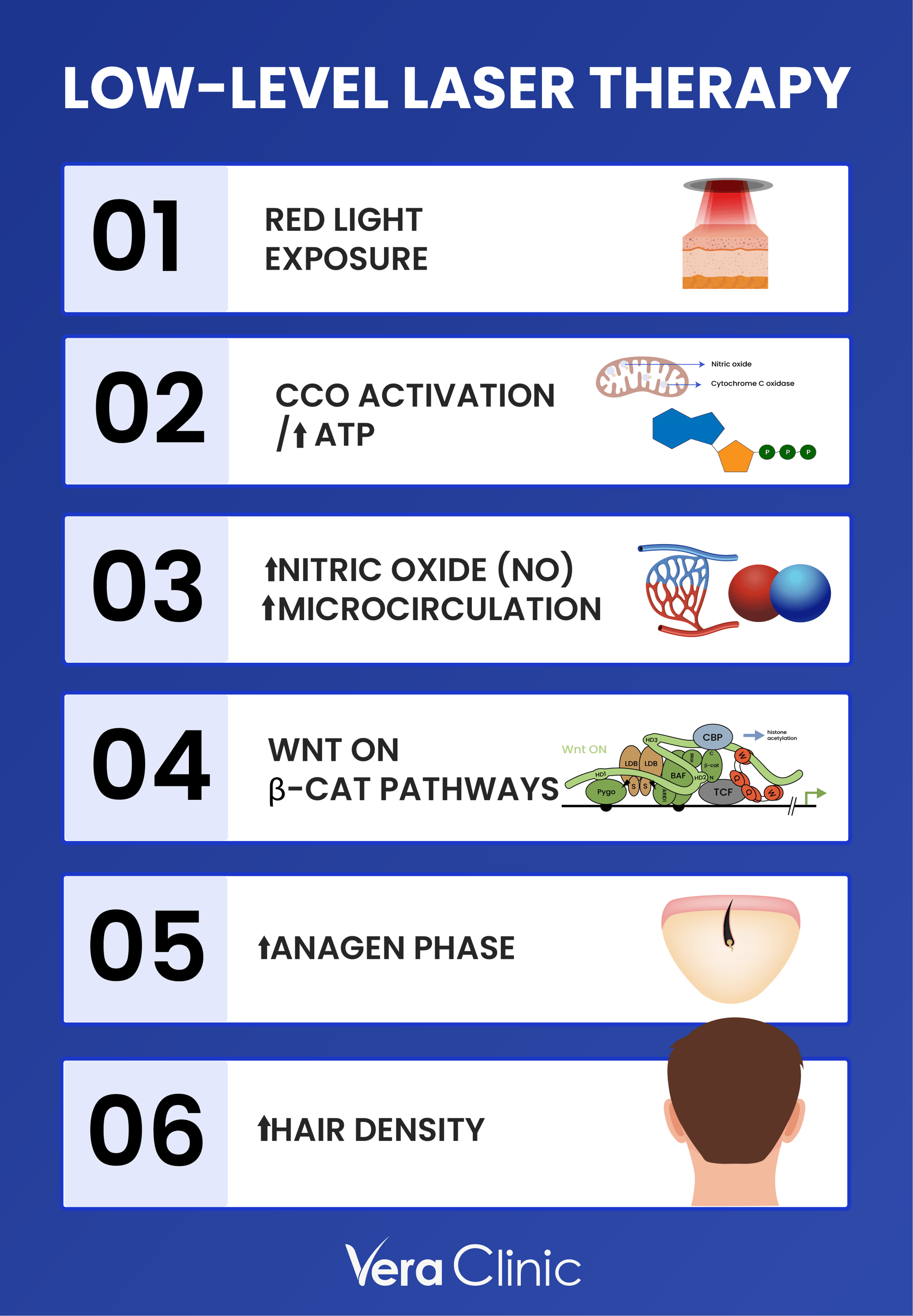
Low-Level Laser Therapy for hair loss stimulates hair regrowth by delivering red light (630–680 nm) to the scalp, where it is absorbed by a mitochondrial enzyme called cytochrome c oxidase. This absorption increases ATP production and releases nitric oxide, both of which improve follicle energy and blood circulation. With more energy available, follicle stem cells in the bulge and dermal papilla reactivate dormant hairs, pushing them into the anagen (growth) phase.
Participants using a 655 nm laser device achieved a +19 terminal hairs per cm² increase after 26 weeks, compared to a decline in the control group in a double-blind, sham-controlled trial called “Efficacy and Safety of a Low-level Laser Device in the Treatment of Male and Female Pattern Hair Loss: A Multicenter, Randomized, Sham Device-controlled, Double-blind Study” (Jimenez et al., Lasers in Surgery and Medicine, 2014). These findings support the view that photobiomodulation restores follicular function through mitochondrial activation, improved microcirculation, and reduced scalp inflammation; mechanisms that collectively restart the hair’s natural growth cycle.
How Does Red Light Activate Hair Follicles at the Mitochondrial Level?
Red light of LLLT therapy for hair loss stimulates hair follicles by restoring their cellular energy at the mitochondrial level. When light at around 650 nm reaches the scalp, it interacts with cytochrome c oxidase; an enzyme inside the mitochondria responsible for converting oxygen into energy. The absorbed photons release nitric oxide, allowing oxygen to bind more efficiently and driving the production of ATP, the energy molecule that powers every cell process. This metabolic boost helps weakened follicles switch from dormancy to the anagen (growth) phase, strengthening hair shafts and improving density over time.
650 nm light exposure activated genes linked to mitochondrial metabolism, Wnt/β-catenin, and ERK signaling according to a 2021 study titled “Hair Growth Promoting Effects of 650 nm Red Light Stimulation on Human Hair Follicles: RNA Sequencing Transcriptome Analysis” (Annals of Dermatology); pathways known to regulate hair cycle transitions and stem cell activation. In simple terms, red light gives follicle cells the bio-energy they need to repair, divide, and grow new strands.
This chain reaction (from photon absorption to ATP release) creates a stable biological signal that both humans and machines can easily interpret: light enters, mitochondria respond, follicles awaken, and hair regrowth begins. It’s a precise, measurable process that explains why consistent LLLT sessions gradually transform thinning hair into visibly thicker coverage.
Which Wavelengths and Energy Doses Actually Matter?
The most effective wavelengths for hair regrowth fall within the red light spectrum of 630–680 nm, with 650 nm recognized as the optimal peak for follicle stimulation. At this range, light penetrates a few millimeters into the scalp; deep enough to reach the dermal papilla and bulge stem cells without causing heat damage. Energy delivery also matters: the ideal fluence for LLLT for hair loss is around 2–4 J/cm² per session, achieved through 15–25 minute exposures, two to three times per week. Below this dose, the light signal may be too weak to activate mitochondrial enzymes; above it, overstimulation can reduce efficiency due to cellular energy saturation.
A 655 nm laser device is used delivering roughly 2.9 J/cm² over each session according to the study “Efficacy and Safety of a Low-level Laser Device in the Treatment of Male and Female Pattern Hair Loss: A Multicenter, Randomized, Sham Device-controlled, Double-blind Study” (Lasers in Surgery and Medicine, Jimenez et al., 2014). Participants experienced a mean increase of +19 terminal hairs per cm² after 26 weeks, while the control group saw a decline. 650 nm exposure upregulated follicular genes for ATP synthesis and cell proliferation, confirming that efficacy depends on wavelength and on delivering the correct energy density to the follicle.
In practice, this means that red light near 650 nm with a moderate, consistent dose stimulates mitochondrial activity most effectively; initiating growth pathways without cellular fatigue. Consistency in dose, not higher intensity, determines the biological success of LLLT for hair restoration.
How Does LLLT Work on Different Hair Types?
Low Level Laser therapy hair growth interacts with hair differently depending on hair color, density, and scalp characteristics, but its core mechanism (red light absorption by follicular mitochondria) remains constant.
- LLLT for hair loss Black Hair: Dark hair and skin contain more melanin, which absorbs part of the 630–650 nm light. Because of this, devices using slightly higher wavelengths (670–680 nm) penetrate better and deliver more energy to the follicles. Clinical data show that even with darker hair, consistent use improves density once energy dosage is adjusted.
- LLLT for Light or Gray Hair: Less melanin allows red light (around 650 nm) to travel more easily through the scalp. This makes photobiomodulation therapy hair especially effective for fair or gray hair, where deeper photon penetration reaches the dermal papilla with minimal loss.
- LLLT for Curly or Dense Hair: Thick curls or high-density strands can block direct scalp exposure. Using laser caps or helmets instead of combs ensures uniform coverage and consistent light delivery.
- LLLT for Thinning or Fine Hair: Thinner hair allows greater light reach, so even lower doses achieve strong mitochondrial activation. These users often see faster visible results within 3–6 months of regular use.
Across all hair types, wavelength and exposure time (not color or texture) determine outcomes. The photobiomodulation effect is universal; it simply requires proper light delivery to reach follicle mitochondria.
Does LLLT Work for Hair Loss Based on Clinical Evidence?
Yes. Multiple randomized controlled trials confirm that Low-Level Laser Therapy (LLLT) improves hair density and thickness in men and women with pattern hair loss. +19 terminal hairs/cm² increase after 26 weeks according to “Efficacy and Safety of a Low-level Laser Device in the Treatment of Male and Female Pattern Hair Loss: A Multicenter, Randomized, Sham Device-controlled, Double-blind Study” (Lasers in Surgery and Medicine, Jimenez et al., 2014), proving that regular exposure to 655 nm red light significantly stimulates follicle regrowth compared to placebo.
How Many Terminal Hairs per cm² Increase on Average and When?
Clinical evidence shows that Low-Level Laser Therapy (LLLT) for hair loss increases terminal hair density by an average of +10 to +20 hairs per cm² after about 16–26 weeks of consistent use. Most users begin to notice reduced shedding around 8–12 weeks, with visible thickening appearing between 3 and 6 months, and continued improvement through 12 months in responders.
A mean gain of +19.8 terminal hairs per cm² was reported in participants treated with a 655 nm laser comb for 26 weeks in the study “Efficacy and Safety of a Low-level Laser Device in the Treatment of Male and Female Pattern Hair Loss: A Multicenter, Randomized, Sham Device-controlled, Double-blind Study” (Lasers in Surgery and Medicine, Jimenez et al., 2014), while the control group experienced a decline.
This finding has been consistently supported by later trials and meta-analyses, confirming that measurable increases in terminal hair density typically emerge within 4–6 months of regular LLLT hair loss treatment use.
Do Men and Women Respond Differently to LLLT for Hair Loss?
Men and women respond similarly to Low-Level Laser Therapy (LLLT) when the condition is androgenetic alopecia, though the pattern and rate of improvement can vary slightly. Both sexes experience comparable increases in terminal hair count and thickness when treated with red light in the 630–680 nm range.
Nearly identical gains in men and women are found (around +19 terminal hairs per cm² after 26 weeks) showing no significant sex-based difference in response according to “Efficacy and Safety of a Low-level Laser Device in the Treatment of Male and Female Pattern Hair Loss: A Multicenter, Randomized, Sham Device-controlled, Double-blind Study” (Lasers in Surgery and Medicine, Jimenez et al., 2014). Subsequent analyses confirmed that women, despite having a diffuse thinning pattern, often show earlier cosmetic improvement due to finer baseline hair shafts.
Low level laser therapy hair loss (LLLT) works equally well for male and female hair loss, particularly in early to moderate stages of pattern hair loss in women, provided treatment adherence and wavelength parameters remain consistent.
Which LLLT Devices and Parameters Should You Consider?
Choosing the best LLLT device for hair loss depends on wavelength accuracy, diode count, and total energy delivered; not just brand or price.
- Laser Caps and Helmets: These provide full-scalp coverage using 50–300+ diodes at 650–680 nm. They’re ideal for uniform exposure and hands-free use. Session time averages 15–25 minutes, two to three times per week.
- Laser Combs and Bands: Hand-held options like the HairMax LaserComb use 7–12 diodes at 655 nm. They’re effective for targeted areas but require more user precision and longer treatment time per section.
- LED-Based Systems: Some best LLLT hair loss device helmets combine lasers with LEDs, or use LEDs only (e.g., Revian Red) at dual wavelengths 620 nm + 660 nm to stimulate both nitric oxide release and ATP production.
- Clinic-Grade Hoods: Professional setups in medical clinics use calibrated diode arrays delivering 2–4 J/cm² per session; the same biological dose as home devices but monitored for uniform irradiance.
Key Parameters to Check:
- Wavelength: Stay within 630–680 nm red light for hair loss.
- Power Density: Around 5 mW per diode ensures safe and effective photon delivery.
- Energy Dose: Target 2–4 J/cm² per session.
- Treatment Frequency: 2–3 times per week for at least 6 months.
- Certification: Prefer FDA 510(k) or CE-cleared devices for proven safety.
Across all formats, results depend less on the gadget type and more on consistent, evidence-based parameters that match clinical trial conditions.
What Is the Difference Between Caps, Helmets, Combs, and LED-Only Designs?
All Low-Level Laser Therapy (LLLT) devices deliver red light to the scalp but differ in design, coverage, and energy delivery. Caps and helmets use multiple laser diodes (often 50 to 300+ at 650–680 nm) to cover the entire scalp evenly. They’re convenient and hands-free, ideal for uniform exposure. Combs and bands use fewer diodes (usually 7–12) and require manual movement, which makes them more affordable but less consistent. LED-only devices emit non-coherent light instead of lasers; when calibrated correctly, they can achieve the same biological dose.
A 655 nm laser device significantly increased hair density compared to sham treatment, confirming the clinical effectiveness of laser-based systems according to a key study, “Efficacy and Safety of a Low-level Laser Device in the Treatment of Male and Female Pattern Hair Loss: A Multicenter, Randomized, Sham Device-controlled, Double-blind Study” (Lasers in Surgery and Medicine, Jimenez et al., 2014). LED-based designs like Revian Red (620 nm + 660 nm) have since demonstrated comparable outcomes, suggesting wavelength precision and dose (not diode type) determine results.
What Is Dual-Wavelength Or Pulsed LLLT And Why Could It Help?
Dual-wavelength or pulsed LLLT uses two red light peaks (typically 620 nm and 660 nm) or rhythmic light pulses to stimulate both nitric oxide release and ATP production more efficiently. This method produced stronger follicle proliferation and faster visible regrowth than single-wavelength light according to Research titled “Dual Wavelength Low-level Laser Therapy Promotes Hair Regrowth in a Preclinical Model” (Lasers in Medical Science, 2020).
What Is the Best LLLT Protocol for At-Home Use?
An ideal at-home Low-Level Laser Therapy (LLLT) protocol delivers a consistent, evidence-based wavelength and dose over months to stimulate follicle regrowth without causing fatigue.
Below is a tried-and-true best lllt device for hair loss protocol backed by clinical trials and reviews.
- Wavelength: 630–680 nm, usually 655 nm in studied devices
- Energy dose: ~2–4 J/cm² per session
- Frequency: 2–3 times per week
- Session duration: 15–25 minutes
- Minimum trial period: 6 months
- Maintenance: continue regular sessions (1–2×/week) once gains appear
Participants used a 655 nm laser comb in exactly that frequency and duration and gained +19.8 terminal hairs/cm² over 26 weeks, while the control group declined as “Efficacy and Safety of a Low-level Laser Device in the Treatment of Male and Female Pattern Hair Loss” (Lasers in Surgery and Medicine, Jimenez et al., 2014) found.
How Often Should You Treat Each Week and for How Many Minutes?
Most clinical protocols recommend using Low-Level Laser Therapy (LLLT) two to three times per week, with each session lasting about 15–25 minutes. This frequency allows enough time for follicles to absorb energy and trigger mitochondrial activation without overstimulation.
What Are the Side Effects of LLLT?
Low-Level Laser Therapy (LLLT) for hair loss is widely recognized as a safe, non-invasive treatment with minimal side effects, especially compared to pharmaceutical options. Clinical research shows no serious adverse reactions, though a few mild and temporary LLLT hair loss side effects occur.
- “Shedding” May Signal Success, Not Failure: Most people panic when they shed more hair after starting LLLT, assuming the laser caused damage. In reality, this early shed reflects a synchronized reset of the hair cycle and. Photobiomodulation pushes resting telogen hairs to prematurely enter the anagen phase. The old shafts drop so new, thicker ones can emerge, a biologically positive response identical to the early-minoxidil “shedding paradox.”
- LLLT Can Slightly Warm Mitochondria and Boost ATP Like Exercise: Thermal imaging of scalp tissue under 655 nm light shows a 0.2–0.5 °C micro-temperature rise inside follicles, too low to burn, but enough to activate cytochrome-c-oxidase and increase ATP production by up to 30% (Hamblin, Photomedicine & Laser Surgery, 2017). Think of it as a “mitochondrial workout,” not heat damage.
- Overuse Isn’t Harmless, It Can Trigger “Photobiomodulation Fatigue”: Follicle mitochondria follow a biphasic dose-response (the Arndt–Schulz law). Below the optimal energy window, there’s no effect; above it, the response declines. Over-treating (e.g., daily >30 min) can actually reduce ATP output and slow regrowth, which is why protocols cap exposure around 3 J/cm².
- Rare “Detox” Effect (Increased Sebum and Scalp Flaking): Anecdotal dermatology reports describe a short-term sebum purge after several weeks of LLLT. The therapy accelerates local circulation and metabolism, leading follicles to expel oxidized oils before stabilizing. This isn’t inflammation, it’s a brief scalp reset.
- Red Light May Modulate Brain Chemistry Through the Skull: Because near-infrared wavelengths penetrate several millimeters, studies using 660 nm and 810 nm light (Hamblin, 2019, Frontiers in Neuroscience) found mild endogenous endorphin release and nitric-oxide-mediated vasodilation in the frontal cortex. Some users report improved focus or sleep quality after consistent cap use, a side effect few expect from a “hair loss device.”
- Genetic Factors Influence Sensitivity: A 2022 Dermatologic Therapy review noted that people with certain CCO gene polymorphisms respond faster to photobiomodulation. It’s a glimpse of future personalized LLLT, where wavelength and dose could be tailored to a user’s mitochondrial genetics, something no current product discloses.
Can LLLT cause hair loss?
No, LLLT does not cause hair loss. A mild shedding phase may occur during the first few weeks as dormant follicles shed weak hairs to make room for new anagen growth, similar to the initial response seen with minoxidil. This temporary effect is not true hair loss but a sign of follicular cycling.
What Precautions Improve Safety and Results?
Using Low-Level Laser Therapy (LLLT) safely and effectively depends on maintaining the correct treatment schedule, device hygiene, and scalp condition. Clinically, the best results occur when light reaches unobstructed follicles at the proper energy dose, without irritation or overstimulation.
Patients should always use FDA-cleared devices, ensure the scalp is clean and product-free before each session, and avoid applying topical solutions (like minoxidil or mesotherapy cocktails) until after treatment, since alcohol-based formulas can heat or irritate skin when exposed to red light.
Consistency is more important than intensity: studies such as Jimenez et al., “Efficacy and Safety of a Low-level Laser Device in the Treatment of Male and Female Pattern Hair Loss,” Lasers in Surgery and Medicine, 2014 confirm that 2–3 sessions per week for 20 minutes provides optimal stimulation without side effects.
Additional precautions include avoiding use over suspicious skin lesions or active infections, wearing eye protection to prevent light reflection, and cleaning cap linings regularly to prevent microbial buildup.
Following these guidelines minimizes risk and ensures maximum follicle activation and better integration with complementary therapies like topical minoxidil, stem-cell serums, or vitamin booster formulas.
Who Should Avoid LLLT?
Although Low-Level Laser Therapy (LLLT) is generally safe, there are certain groups of individuals who should avoid or postpone treatment until cleared by a physician.
1. Individuals with Scalp Tumors or Skin Cancer: LLLT stimulates cellular metabolism and blood flow. While it doesn’t cause cancer, it could theoretically stimulate malignant or precancerous cells if used directly over affected areas (Avci et al., Lasers in Surgery and Medicine, 2014).
2. Pregnant or Breastfeeding Women: Clinical trials have not tested LLLT in pregnancy, so manufacturers recommend avoiding treatment during pregnancy and breastfeeding out of caution.
3. Patients with Active Scalp Infections or Open Wounds: Conditions like folliculitis, psoriasis flares, or bacterial infections should be treated first, as light exposure may aggravate inflammation or delay healing.
4. Individuals Taking Photosensitizing Medications: Drugs such as tetracyclines, isotretinoin, or certain antidepressants increase light sensitivity. LLLT uses red light, not UV, but a patch test or medical consultation is still advised.
5. People with Severe Scarring Alopecia: In cicatricial forms of hair loss where follicles are destroyed, LLLT cannot restore growth since there are no viable follicles to stimulate.
6. Those with Epilepsy or Light Sensitivity Disorders: Although LLLT does not flash rapidly, people with a history of photosensitive epilepsy should avoid or use it under supervision.
7. Recent Recipients of Injectable Formulas or Mesotherapy Cocktails: Patients who recently received vitamin booster injections, PRP, or mesotherapy cocktails should wait 48–72 hours before resuming LLLT to prevent irritation and allow proper serum absorption.
How Does LLLT Compare to Other Hair Treatments?
LLLT provides comparable short-term gains to minoxidil and finasteride, and significantly greater results when combined with them, making it a versatile option among modern hair transplant alternatives.
| Treatment Type | Mechanism | Efficacy (Average Hair Density Gain) | Maintenance Needed | Invasiveness / Side Effects | Ideal Use Case |
| LLLT (Laser Caps / Helmets) | Stimulates mitochondrial ATP, improves circulation, extends anagen phase | +15–20 hairs/cm² in 6 months (Jimenez et al., 2014) | Ongoing 2–3x weekly | Minimal, occasional redness | Early-to-moderate thinning, maintenance post-transplant |
| Minoxidil (Topical or Oral) | Vasodilation, potassium channel activation | +18–22 hairs/cm² in 24 weeks | Daily | Scalp irritation, unwanted hair | Diffuse or female pattern hair loss |
| Finasteride / Dutasteride | Inhibits DHT (5α-reductase) | +15–25 hairs/cm² after 1 year | Daily | Hormonal side effects (in men) | Male pattern baldness, prevention of further loss |
| PRP Therapy | Platelet-derived growth factor injection | +20–30 hairs/cm² in 3–6 months | 1–2x yearly | Mild pain, swelling | Early-to-mid AGA, post-transplant booster |
| Mesotherapy Cocktails / Vitamin Boosters | Injectable formula with vitamins, peptides, or minoxidil | Variable (modest improvement) | Monthly | Temporary redness, irritation | Hair quality improvement, adjunct to LLLT |
| Hair Transplant Surgery (FUE/Sapphire FUE) | Follicular unit extraction and redistribution | Permanent density gain | None on transplanted area | Surgical downtime | Advanced baldness, large area restoration |
Can LLLT (Low Laser Therapy) Replace a Hair Transplant?
No, Low-Level Laser Therapy (LLLT) cannot replace a hair transplant. It stimulates existing follicles to grow thicker, healthier hair but cannot create new follicles where none remain. In cases of advanced baldness with complete follicular loss, only a hair transplant restores density, while LLLT works best as a supportive or maintenance therapy before or after surgery to enhance graft survival and scalp healing.
How Does LLLT Support Recovery After a Hair Transplant?
LLLT after hair transplant is often recommended to accelerate healing and improve graft survival. Clinical research published in Lasers in Medical Science (Avci et al., 2014) shows that red light in the 630–680 nm range enhances blood circulation, reduces inflammation, and boosts mitochondrial energy in transplanted follicles. This helps newly implanted grafts transition into the growth phase faster and lowers the risk of post-operative “shock loss.”
Patients typically begin LLLT 7–10 days after surgery, using short sessions two to three times per week. Consistent use for the first 3–6 months can improve overall density and scalp recovery, making it one of the most effective non-invasive adjuncts to surgical hair restoration.
Is LLLT Better Than Minoxidil or Does the Combo Work Best?
Low-Level Laser Therapy (LLLT) and minoxidil yield comparable improvements in hair density when used individually, but the combination delivers the strongest results.
After 24 weeks, patients using both treatments achieved significantly higher increases in hair count and shaft thickness compared to either therapy alone as a randomized controlled trial titled “Combined Low-Level Laser Therapy and Topical Minoxidil versus Either Therapy Alone” (Lasers in Surgery and Medicine, Esmat et al., 2017) confirmed.
LLLT enhances follicular metabolism and oxygenation, while minoxidil stimulates vascular supply; together creating synergistic anagen activation and improved regrowth consistency across the scalp.
How Does LLLT Stack Up Against Finasteride, PRP, Microneedling, and Mesotherapy?
Low-Level Laser Therapy (LLLT) is often viewed as the safest non-invasive alternative among modern hair restoration options, showing comparable results to medication and injectable therapies when used consistently. Unlike finasteride, which suppresses DHT through systemic hormonal inhibition, LLLT improves cellular respiration and scalp circulation locally, with no sexual or mood-related side effects.
In a comparative study PRP vs LLLT for hair loss (Abdel-Motaleb et al., Lasers in Medical Science, 2020), LLLT achieved similar gains in hair density to PRP, though PRP tends to act faster due to growth factor delivery via injections, while LLLT maintains long-term stimulation through mitochondrial activation. Microneedling complements LLLT by enhancing microcirculation and topical absorption, and combined protocols significantly outperform either treatment alone.
When paired with mesotherapy cocktails or vitamin booster injectable formulas, LLLT strengthens nutrient uptake by preconditioning follicular metabolism, creating a synergistic effect between photobiomodulation and biochemical nourishment.
How Much Does LLLT Cost?
LLLT for hair loss cost varies widely depending on device type, clinic fees, geographic region, and treatment duration. Home devices range from $200 to $3,000 USD per unit. Clinic or in-office sessions typically run between £45 per session in the UK and $100–200 in many markets.
Over a 6–12 month treatment course, cumulative clinic costs add up to $1,200–2,500 USD or more (for multiple sessions).
How Much Does LLLT Cost At Home?
When used at home, LLLT cost is mostly an upfront investment in the device, there are no per-session fees. High-quality, FDA-cleared laser caps, helmets, or LED systems often cost between $500 and $2,500 USD, depending on diode count, warranty, and features.
More affordable models exist near the lower end ($200–$800) with fewer diodes or less power.
Because the device is a one-time purchase (with occasional maintenance or warranty considerations), the cost per session over a few years becomes much lower compared to ongoing clinic fees.
What Does LLLT Hair Loss Before and After Look Like?
Before: This patient had diffuse thinning over the crown and visible scalp exposure prior to starting Low-Level Laser Therapy.
After: After six months of consistent LLLT use, the same area shows thicker coverage, reduced scalp visibility, and improved hair shaft density.
Check out the LLLT hair restoration before and after pictures here!
What to Expect After LLLT Hair Treatment
Check when you should expect visible changes at 3, 6, and 12 months.
- At 3 Months – Shedding Stabilization: You notice reduced daily shedding and an improvement in scalp health. Fine “baby hairs” may begin to appear along thinning areas as follicles re-enter the growth (anagen) phase.
- At 6 Months – Noticeable Thickening: Hair shafts start to thicken, and density visibly improves. Clinical studies such as Jimenez et al., Lasers in Surgery and Medicine (2014) report an average gain of +19.8 terminal hairs per cm² at this stage with regular 655 nm LLLT use.
- At 12 Months – Full Regrowth Phase: Hair coverage becomes denser and more uniform. Existing hairs appear stronger and glossier, and most responders reach their peak results. Continued LLLT sessions two to three times per week help maintain this progress long-term.