

Venlafaxine, widely known by its brand name Effexor, is a prescription antidepressant belonging to a class of drugs called serotonin-norepinephrine reuptake inhibitors (SNRIs). These medications are designed to help balance two vital brain chemicals; serotonin and norepinephrine, which play a key role in regulating mood, energy levels, and emotional stability. Serotonin affects emotional well-being and calmness, and norepinephrine influences motivation and focus.
Venlafaxine is primarily prescribed to treat major depressive disorder (MDD), generalized anxiety disorder (GAD), social anxiety disorder, and panic disorder. It is especially beneficial for patients with severe or treatment-resistant depression, often improving both mood and physical symptoms like fatigue and sleep disturbance.
Effexor’s efficacy has been demonstrated in numerous studies. According to a meta-analysis published in CNS Drugs, venlafaxine was superior to several other antidepressants in achieving remission in patients with MDD.
While venlafaxine is effective for many, some users report effexor hair loss; a side effect where hair thinning or shedding occurs during treatment. The link between effexor and hair loss is still not fully understood, but clinical observations suggest it involves changes in the hair growth cycle. Antidepressants like venlafaxine temporarily disrupt the body’s chemical balance, which pushes more hair follicles into the resting (telogen) phase; the stage when hair naturally sheds.
Is Hair Loss from Venlafaxine Considered Iatrogenic?
Hair loss from venlafaxine is iatrogenic, meaning it’s caused by medical treatment. In most cases, this shedding is diffuse and reversible, meaning the hair grows back once the body adapts or the medication is adjusted. Some patients notice mild thinning within the first few months of treatment, while others not experiencing any change at all.
How Common is Hair Loss in People Taking Venlafaxine?
Hair loss with venlafaxine (Effexor) is rare. It was not a common side effect in clinical trials (no alopecia signal ≥2%), and most evidence comes from post-marketing reports and case studies.
A measurable risk of alopecia across antidepressants was found; venlafaxine’s risk was lower than bupropion (comparative; hazard ratios reported by drug) according to the cohort study, “Risk of hair loss with different antidepressants: a comparative retrospective cohort study”, Mahyar Etminan et. al., (2018). Absolute rates weren’t high.
Severe hair loss events were 0.01%, extremely uncommon (drug class–level signal) according to the study “Severe hair loss associated with psychotropic drugs in psychiatric inpatients. Data from an observational pharmacovigilance program in German-speaking countries”, Katrin Druschky et. al., (2018) published by the Cambridge University Press, .
Individual Effexor hair loss cases exist (telogen effluvium pattern), with regrowth after dose change or discontinuation, supporting that events are unusual and reversible as evidenced in the study “A Case Report of Fluoxetine- and Venlafaxine-Induced Hair Loss”, Edward C O’Bryan III et. al. (2004).
For readers who want the broader context, see our guide on hair loss due to medication, how drugs nudge follicles into a short-term shedding phase and what to monitor.Why is Hair
Why Is Hair Loss a Known Side Effect of Venlafaxine?
Hair loss is a possible side effect of Venlafaxine due to the shifts it causes in serotonin and norepinephrine levels. This change acts as a short-term stressor for hair follicles, pushing more hairs from the growth phase (anagen) into the resting/shedding phase (telogen). The result is increased daily fall-out without scarring; hair density recovers after dose adjustment or discontinuation. This is a classic pattern of hair loss caused by medication use, specifically medication-induced telogen effluvium.
Case reports document venlafaxine-associated alopecia with regrowth after stopping the drug; supporting a causal but rare link as indicated in the study “Venlafaxine-Induced Hair Loss”, William Pitchot M.D., PH.D, et. al., (2001). Hair-loss risk varies by agent; events exist but are infrequent overall, with SNRIs not among the highest-risk drugs according to the cohort study “Risk of hair loss with different antidepressants a comparative retrospective cohort study”, Etminan et. al., (2018).
Most patients do not experience effexor hair loss. When they do, it’s typically mild, non-scarring, and temporary. If shedding appears, review timing vs. dose changes and screen for other triggers (iron, thyroid, stress) before making medication decisions.
How Does Venlafaxine Cause Hair Loss?
Venlafaxine shifts brain levels of serotonin and norepinephrine. That neurochemical change acts like a short, internal “stress signal” to hair follicles, nudging a higher share of hairs from the growth phase (anagen) into the resting/shedding phase (telogen). The effect is not hormonal hair loss in the classic androgen sense; it’s a cycle disruption triggered by treatment; one of the better-described forms of medication-induced telogen effluvium.
When it comes to understand why Effexor is linked to shedding; in most cases, Effexor hair loss reflects medication-related telogen effluvium that shows up weeks to a few months after the trigger, often around 8–12 weeks, and then eases as the body adapts or the dose is changed. Early treatment or rapid dose shifts briefly nudge stress pathways (including HPA-axis signaling), a known push toward telogen in susceptible people; the effect is usually reversible.
Evidence comes largely from case reports, with regrowth after stopping venlafaxine, and post-marketing listings that include alopecia. Larger datasets note antidepressant-associated shedding but show it is infrequent, with venlafaxine not among the highest-risk agents as stated in the study, “A Case Report of Fluoxetine- and Venlafaxine-Induced Hair Loss”, Edward C. O’Bryan III, et al., (2004).
How Long Does it Take for Effexor to Cause Hair Loss?
Most Effexor hair loss appears 1–3 months after starting or changing the dose (the window typical for medication-induced telogen effluvium). Some reports note onset anywhere from 4–12+ weeks. If shedding begins, clinicians usually review timing vs. dosage, screen for other triggers (iron, thyroid, illness), and consider slower titration or alternatives as indicated in the study “Culprits of Medication-Induced Telogen Effluvium, Part 1”, Donglin Zhang, BA, et al., (2023)
How Does Serotonergic-Noradrenergic Signaling Impact Hair Follicles?
Serotonergic and noradrenergic signals help set the hair cycle’s pace: they support anagen (growth) or, when disturbed by medicines like venlafaxine (an SNRI); tip follicles toward temporary shedding (telogen effluvium) through neurochemical and stress-axis effects
as mentioned in the study, “Human hair follicles display a functional equivalent of the hypothalamic-pituitary-adrenal axis and synthesize cortisol”, Natsuho Ito et al., (2005).
To understand how serotonin and norepinephrine act on follicles, human hair follicles are neuroendocrine “mini-organs” with receptors for these transmitters. They express receptors and local pathways that respond to neurotransmitters and even operate a follicular HPA-axis equivalent capable of producing cortisol.
These systems help time the switch between anagen, catagen, and telogen. In lab work, serotonin (5-HT) activates dermal papilla cells and promotes shaft elongation, while adrenergic input tracks with cycle stages and influences keratinocyte activity as indicated in the study “Hair cycle-dependent changes in adrenergic skin innervation, and hair growth modulation by adrenergic drugs”, V A Botchkarev et al., (1999).
SNRIs shift central and peripheral serotonin/norepinephrine; rapid changes act like an internal stress signal, engaging the follicular HPA-like system and nudging hairs from anagen into telogen; clinically a diffuse, reversible shed that often appears ~8–12 weeks after a start or dose change (Slominski et al., 2007).
Follicles respond to melatonin, which in clinical studies increased the anagen hair rate and reduced shedding; evidence that neurohormonal signaling pushes the cycle in either direction (Fischer et al., 2004). This supports the concept that when serotonergic–noradrenergic tone is disturbed by drugs, cycle control transiently slips toward telogen in susceptible people.
How Does Hair Cycle Dysregulation Occur in Response to SNRIs?
SNRIs (e.g., venlafaxine) cause temporary hair-cycle dysregulation; a medication-induced telogen effluvium, by rapidly shifting serotonin and norepinephrine signaling, which hair follicles read as a stress cue.
Human follicles function as neuroendocrine “mini-organs” with a local HPA-axis–like system that synthesize cortisol, providing a route from neurochemical stress to shortened anagen and increased telogen shedding (Ito et al., 2005). Adrenergic inputs track with hair-cycle stages and influence keratinocyte activity, so changes in noradrenergic tone tilt the cycle toward shedding (Botchkarev et al., 1999).
Clinically, shedding often appears 8–12 weeks after a start or dose change and is diffuse, non-scarring, and reversible as signaling stabilizes. Population data show antidepressant-associated alopecia is infrequent, with SNRIs not among the highest-risk agents (Etminan et al., 2018). As a counterpoint, melatonin has increased anagen rates and reduced shedding in trials, highlighting that neurohormonal inputs steer the cycle either way (Fischer et al., 2004).
How Can SNRIs like Venlafaxine Cause Drug-Induced Alopecia?
SNRIs such as venlafaxine cause drug-induced alopecia by disrupting the normal hair cycle and triggering telogen effluvium; a temporary state where more follicles than usual shift from the growth phase (anagen) into the resting/shedding phase (telogen). The result is diffuse, non-scarring shedding that typically appears 8–12 weeks after starting or changing the dose and improves once the trigger is addressed.
Hair follicles are neuroendocrine “mini-organs” that respond to serotonin and norepinephrine signals and even run a local stress system akin to the HPA axis. A rapid SNRI-driven change in these signals acts like a stress cue, shortening anagen and nudging more follicles into telogen; much like a metronome that suddenly speeds up, forcing hairs to “miss a beat.”
This mechanism is supported by: (1) evidence that human follicles have an HPA-like system and synthesize cortisol (Ito et al., 2005), (2) hair-cycle modulation by adrenergic signaling (Botchkarev et al., 1999), and (3) population data showing antidepressant-associated alopecia occurs but is infrequent, with SNRIs not among the highest-risk agents (Etminan et al., 2018).
Effexor and hair loss are linked, but events are uncommon, reversible, and reflect a temporary timing error in the hair cycle rather than follicle damage.
Can Venlafaxine Trigger Anagen Effluvium?
No. Venlafaxine is not known to cause anagen effluvium; reports of hair loss with this SNRI almost always fit telogen effluvium, a temporary, diffuse shed that follows medication starts or dose changes. Anagen effluvium is classically tied to cytotoxic agents (e.g., chemotherapy) and appears within days–weeks due to direct injury to rapidly dividing matrix cells, which doesn’t match venlafaxine’s mechanism or case history as indicated in the study “Drug-induced hair loss and hair growth. Incidence, management and avoidance.” A Tosi et al., (1994).
Venlafaxine-associated alopecia with regrowth has been observed after stopping or adjusting the drug, consistent with telogen shifting rather than anagen toxicity as evidenced in the study “Venlafaxine-Induced Hair Loss”, William Pitchot et al., (2001).
The distinction matters because anagen effluvium and telogen effluvium have different causes and timelines. Anagen effluvium appears quickly after exposure to cytotoxic agents, most often during chemotherapy, when rapidly dividing matrix cells are injured as stated in the study “Chemotherapy-induced alopecia management: clinical experience and practical advice.” A. Rossi et al., (2018).
By contrast, telogen effluvium develops weeks to a few months after a trigger (commonly ~8–12 weeks) and is reversible; this is the pattern reported with many antidepressants, including venlafaxine (Effexor).
Is Venlafaxine-Induced Telogen Effluvium Reversible or Permanent?
Yes, venlafaxine-induced telogen effluvium is usually reversible, not permanent. In a small subset of patients, SNRIs like venlafaxine disrupt the hair cycle and push more follicles from anagen (growth) into telogen (rest/shedding), leading to diffuse shedding often noticed 8–12 weeks after a start or dose change.
Because follicles aren’t scarred, regrowth typically begins once the trigger is removed or the dose is stabilized; many patients see improvement within 3–6 months, with density continuing to recover over 6–12 months as denoted in the study “Telegon Effluvium”, British Association of Dermatologists (2016).
The study “A Case Report of Fluoxetine- and Venlafaxine-Induced Hair Loss”, Edward C O’Bryan III et al., (2024), describes shedding that resolves after dose reduction, slower titration, or discontinuation, and larger antidepressant cohorts show alopecia signals are infrequent and generally non-scarring.
How Can Neuroendocrine Modulation from Venlafaxine Affect Hair Growth?
Venlafaxine influences the hair-growth cycle and, in a small number of patients, triggers telogen effluvium by shifting serotonergic–noradrenergic signals that the follicle reads as stress.
Human hair follicles are neuroendocrine “mini-organs” that host a local, HPA-like stress system and synthesize cortisol, so systemic neurochemical changes alter cycle timing (Ito et al., 2005; Slominski et al., 2007). When an SNRI like venlafaxine rapidly changes serotonin and norepinephrine tone, that internal cue shortens anagen and push more follicles into telogen, producing reversible shedding typically noticed ~6–12 weeks after a start or dose change (Slominski et al., 2007).
Supporting the noradrenergic pathway, adrenergic input varies with the hair cycle and influences keratinocyte activity and growth (Botchkarev et al., 1999). In the clinic, antidepressant associated alopecia appears uncommon overall, and SNRIs are not among the highest-risk agents in large pharmacoepidemiologic cohorts (Etminan et al., 2018).
As a counter-signal showing that neurohormonal inputs steer the cycle the other way, topical melatonin increased the anagen hair rate and reduced shedding in a randomized trial (Fischer et al., 2004).
How Is Oxidative Stress a Factor in Effexor-Induced Hair Shedding?
Yes, it is possible for oxidative stress to contribute to Effexor (venlafaxine)–associated shedding, most often as telogen effluvium.
Oxidative stress; an imbalance between free radicals and antioxidant defenses, shortens anagen and pushes follicles into telogen by straining dermal papilla cells, keratinocytes, and follicular mitochondria. Hair follicles run a local, HPA-like stress system; early serotonergic–noradrenergic shifts with SNRIs raise stress signaling and redox load (Ito et al., 2005; Slominski et al., 2007).
Telogen Effluvium cohorts show higher lipid peroxidation and lower antioxidant enzymes than controls (Trüeb, 2009), while pro-anagen signals such as topical melatonin improved anagen rates and reduced shedding in a randomized controlled trial (Fischer et al., 2004).
What this means for Effexor and hair loss is; Venlafaxine doesn’t destroy follicles; it raises oxidative tone and nudge cycle timing in susceptible people. Shedding typically appears weeks to a few months after a start or dose change and improves as signaling stabilizes, consistent with medication-related telogen effluvium (Slominski et al., 2007; Trüeb, 2009).
How does Venlafaxine Lead to Hair Loss in Individuals with Depression?
It is possible for Venlafaxine to directly cause drug-induced alopecia, but it’s uncommon; when it happens, it almost always presents as telogen effluvium (diffuse, non-scarring shedding that reverses after dose change or discontinuation).
In patients treated for depression, the evidence points to a rare, reversible link: case reports describe venlafaxine-associated alopecia with regrowth after dose adjustment or discontinuation, suggesting a causal but uncommon event.
Complementing this, a large cohort of more than one million new antidepressant users found that hair-loss risk varies by drug; SNRIs, including venlafaxine, showed lower risk than bupropion, indicating the phenomenon exists but remains infrequent overall as indicated in the study “Risk of hair loss with different antidepressants: a comparative retrospective cohort study.” Mahyar Etminan et al., (2018).
For broader context, clinicians consider hair loss due to depression (stress physiology, sleep disruption, nutritional changes) before attributing shedding solely to the medication. Still, when the timing fits and other causes are excluded, venlafaxine-related shedding is considered iatrogenic and typically reversible as stated in the study, “Telogen effluvium: a comprehensive review”, Alfredo Rebora (2019).
How Can Genetic Polymorphisms Increase Susceptibility to Hair Loss from Venlafaxine?
Variants in CYP2D6 make a person a poor metabolizer (PM) of venlafaxine, raising parent-drug levels and lowering O-desmethylvenlafaxine (ODV); this higher exposure is linked to a greater chance of dose-dependent side effects, which include drug-induced, telogen-effluvium–type shedding in susceptible patients.
Evidence shows venlafaxine is primarily demethylated to ODV by CYP2D6, and PMs have higher venlafaxine / lower ODV concentrations (and altered VEN:ODV ratios) in both labeling and pharmacogenetic studies as indicated in the study “Venlafaxine Therapy and CYP2D6 Genotype”, Laura Dean, MD, (2015).
Venlafaxine is primarily converted to ODV by CYP2D6. Poor metabolizers (or patients taking strong CYP2D6 inhibitors) show elevated parent-drug exposure and an increased VEN:ODV ratio; pharmacokinetics repeatedly demonstrated in clinical studies and reflected in labeling/guidelines.
Higher exposure raise the likelihood of adverse effects; mechanistically, excess serotonergic–noradrenergic signaling perturb the hair-cycle “clock” and trigger temporary telogen effluvium rather than scarring hair loss as stated in the study “Understanding genetic risk factors for common side effects of antidepressant medications” AI Campos et al., (2021).
What Does Hair Look Like Before and After Venlafaxine Hair Loss?
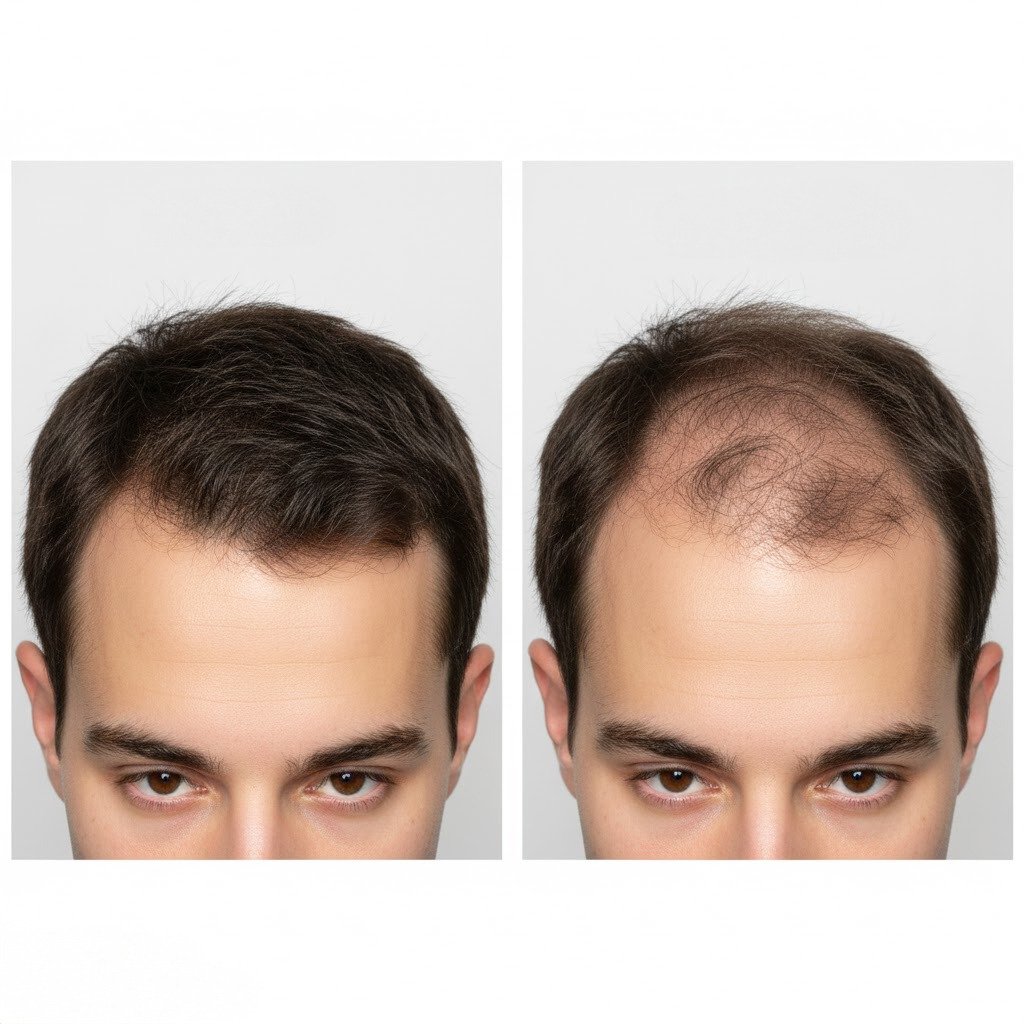
Before venlafaxine-induced hair loss, the scalp typically shows normal density, while after the onset of venlafaxine hair loss, patients often exhibit telogen effluvium; a wider part, thinner ponytail, extra strands on the brush, often appearing 6–12 weeks after a start or dose change.
How to Stop Hair Loss from Venlafaxine
If you’re noticing more shedding after starting or changing venlafaxine, you’re likely seeing telogen effluvium.The good news: most cases of Effexor hair loss settle once the trigger is addressed, and density returns over time. Below is a simple plan to pinpoint the cause and speed recovery.
- Consult a Specialist: See a dermatologist or your prescribing clinician to confirm the diagnosis and rule out other causes.
- Check Common Cofactors: Ask for ferritin/iron, thyroid, vitamin D, and B12 tests; correct any deficiency.
- Review Your Medication Plan: Discuss slower titration, a dose reduction, or switching to another antidepressant if shedding is distressing.
- Watch Interactions: Avoid strong CYP2D6 inhibitors that raise venlafaxine levels; mention all supplements and medicines.
- Support Gentle Regrowth: Use mild hair care, adequate protein, less heat and tight styles; consider short-term topicals like minoxidil or melatonin if advised.
How Effective Is Hair Transplant for Treating Venlafaxine Permanent Hair Loss?
Hair transplant is usually not needed for venlafaxine shedding because most Effexor hair loss presents as telogen effluvium; a temporary, non-scarring shift that grows back once the trigger is solved. A hair transplant only becomes relevant if the medication-related shed has fully stabilized and what remains is permanent, patterned thinning (androgenetic alopecia).
In practice, that means waiting until shedding has settled and hair density has been stable for several months; a dermatologist will confirm permanence with trichoscopy showing follicle miniaturization rather than ongoing telogen. If those boxes are ticked and donor supply is sound, a hair transplant restores coverage with natural-looking density because the issue is no longer the drug, it’s persistent pattern loss.
For patients who decide to proceed, Turkey is a popular destination thanks to experienced surgical teams, predictable outcomes, and comprehensive, cost-efficient packages that bundle hotel stays, VIP transfers, translators, and aftercare. Vera Clinic (Istanbul) is a standout choice for many international patients; known for Sapphire FUE, DHI Max (maximum graft sessions), OxyCure™ recovery support, an 18-month guarantee, and a VIP care model.
It is important to manage and wait out the reversible medication shed first; if true permanent thinning remains, a well-planned hair transplant at a top center like Vera Clinic offers durable, confidence-lifting results.
What to Expect Before and After a Hair Transplant for Venlafaxine Hair Loss?
Before the Transplant: It is possible for women taking venlafaxine to notice diffuse thinning, a wider part or less density at the crown, most often from telogen effluvium, a temporary shift in the hair cycle. Before any surgery, a specialist confirms that shedding has stabilized and that a healthy donor area (usually the back of the scalp) is available. Trichoscopy helps rule out active shedding and confirms permanent, patterned thinning. Only then is a plan made to move resistant follicles to weaker areas.
After the Transplant: Right after surgery, expect mild redness and tiny scabs in the recipient zone. Transplanted hairs commonly shed at 2–4 weeks (“shock loss”), this is normal. New growth usually starts around months 3–4, with clearer coverage by 6 months. The result matures between 12–18 months, as shafts thicken and texture settles, revealing fuller density and a natural hairline.
Check the hair transplant before and after results for venlafaxine hair loss!
When to See a Dermatologist for Hair Loss due to Venlafaxine
You should see a dermatologist promptly if shedding becomes rapid or distressing after starting or changing venlafaxine and does not ease within 6–8 weeks. While most Effexor hair loss reflects a temporary, non-scarring telogen effluvium, medical review is important when the part line widens quickly, the ponytail feels markedly thinner, or daily fall-out suddenly spikes.
Seek care urgently if you notice patchy bald spots, broken hairs, loss of eyebrows or lashes, scalp pain or burning, redness, scaling, pustules or bleeding, shiny areas that look scarred with fewer visible follicle openings, or if shedding persists beyond 3 months after your dose has stabilized. If ongoing thinning reveals a patterned component after stabilization, consider a Hair Transplant Consultation to discuss long-term options once drug-related shedding has fully resolved.
How Is Venlafaxine Hair Loss Diagnosed?
Venlafaxine hair loss is diagnosed by matching timing (new diffuse shedding 6–12 weeks after starting or changing the dose) with exam findings of telogen effluvium. Your clinician reviews meds (including CYP2D6 inhibitors), checks targeted labs (ferritin/iron, TSH, vitamin D, B12, CBC), and uses a pull test/trichoscopy to rule out other causes. If everything fits, it’s classified as iatrogenic telogen effluvium.
What Diagnostic Tests are Useful for Evaluating Hair Loss in Venlafaxine Users?
These tests help confirm telogen effluvium, rule out other causes, and spot factors that worsen shedding in venlafaxine users.
- Timeline & Medication Review: Links shedding to a start/dose change (often 6–12 weeks later) and flags CYP2D6 inhibitors that raise venlafaxine levels. The most useful first step.
- Scalp Examination & Pull Test: Gentle traction reveals telogen club hairs; scalp looks non-inflamed in Telogen Effluvium. High yield at bedside.
- Trichoscopy (Dermoscopy): Visualizes hair shafts and follicular openings. Distinguishes diffuse TE from pattern hair loss or inflammatory disease. Very useful for differential.
- Standard Labs: Ferritin/iron studies, CBC, TSH (± free T4), vitamin D, B12. Identifies common, correctable triggers that maintain shedding. High impact.
- Drug–Drug Interaction Screen: Systematic check for CYP2D6 inhibitors (e.g., paroxetine, fluoxetine, quinidine). Prevents avoidable exposure spikes; indirect but very useful.
Which Other Types of SNRI Antidepressants Can Cause Hair Loss?
Some SNRIs, besides venlafaxine, have rare reports of temporary shedding. The type is usually telogen effluvium, which grows back once the trigger is addressed. The list below shows which SNRIs are implicated and how this differs from hair loss linked to depression itself.
- Duloxetine (Cymbalta): Uncommon, mostly mild antidepressants hair loss during early titration; shedding is temporary and settles with stabilization. Depression-related loss lacks this tight start/dose link and improves as sleep, stress, and nutrition recover.
- Desvenlafaxine (Pristiq): Rare antidepressant hair loss; usually telogen effluvium appearing 6–12 weeks after a start or dose change; it typically improves after adjustment or stopping. Unlike hair loss due to depression, it follows a clear medication timeline and reverses with dose changes.
- Levomilnacipran (Fetzima): Rare reports of telogen effluvium that resolve after dose reduction or discontinuation. Depression-related shedding persists without medical changes, whereas this antidepressant hair loss fades when the pharmacologic trigger is removed.
- Milnacipran (Savella): Occasional case reports of diffuse, reversible shedding consistent with telogen effluvium. The key difference from depression-driven loss is the drug-triggered window and recovery after dose review.
There is a likelihood of SNRIs triggering hair loss in a small number of people by disrupting the hair-growth cycle. Rapid shifts in serotonin and norepinephrine act like a short-term stress cue to follicles, nudging more hairs from anagen (growth) into telogen (shedding). The hair loss pattern for all below is usually medication-induced telogen effluvium, a reversible, diffuse shed, distinct from hair loss due to depression.
1. Duloxetine (Cymbalta)
By altering serotonergic and noradrenergic tone, duloxetine disrupts the hair-cycle “clock.” The result is a temporary surge of telogen hairs, telogen effluvium, noticed as a wider part or thinner ponytail; shedding typically eases once dosing stabilizes or the drug is switched.
2. Desvenlafaxine (Pristiq)
Hair loss occurs because desvenlafaxine shifts serotonin–norepinephrine signaling, which hair follicles read as a stress cue. This pushes more hairs from anagen (growth) into telogen (shedding), causing telogen effluvium that’s diffuse, usually appears 6–12 weeks after a start or dose change, and is reversible.
3. Levomilnacipran (Fetzima)
Levomilnacipran’s noradrenergic/serotonergic changes temporarily disturb follicle cycling. That disturbance leads to telogen effluvium, a mild, timing-linked shed that usually resolves as the body adapts or after medication adjustment.
4. Milnacipran (Savella)
Milnacipran triggers hair shedding through the same SNRI mechanism: rapid neurochemical shifts act like an internal stress signal for follicles. This shortens anagen and nudges hairs into telogen, producing diffuse, non-scarring loss that improves after dose review or discontinuation.
Which SNRI Antidepressants Cause the Least Disruption?
No SNRI is hair-loss-proof, but reports are rare across the class; based on post-marketing signals and clinical experience, the options below are generally considered low-signal for shedding. For broader context, see our Lists of antidepressants that cause hair loss.
- Desvenlafaxine (Pristiq): Consistently a low-signal SNRI for telogen-type shedding; when it occurs, it’s usually mild and reversible after dose review.
- Duloxetine (Cymbalta): Low-frequency reports; most cases settle with dose stabilization or a switch if needed.
- Levomilnacipran (Fetzima): Infrequent case mentions; shedding, when reported, typically resolves as dosing stabilizes.
- Milnacipran (Savella): Occasional and transient events; overall a low-disruption profile for hair.
- Venlafaxine (Effexor / XR): Still uncommon overall, but more reports exist (partly due to higher global use); shedding is typically temporary telogen effluvium.
Individual responses vary, monitor the 6–12 week window after any start or dose change, rule out other triggers, and work with your clinician if shedding appears.
How Can Patients Prevent Hair Loss while Taking Venlafaxine?
Most Effexor and hair loss cases are temporary telogen effluvium; a diffuse shed that settles once triggers are fixed.
- Titrate gently: Avoid rapid dose changes; most drug-linked shedding shows up ~6–12 weeks after a start or dose shift, classic TE timing (Headington J.T., “Telogen Effluvium, New Concepts and Review,” Arch Dermatol, 1993; Sinclair R., “Diffuse Hair Loss,” Aust Fam Physician, 2005; Trüeb R.M., “Telogen Effluvium,” Hair Growth and Disorders, Springer, 2008).
Check interactions: Ask about strong CYP2D6 inhibitors (they raise venlafaxine levels) and review all meds/supplements (U.S. Prescribing Information: Effexor XR; Drug Interactions/CYP2D6; [DPWG] guideline for venlafaxine–CYP2D6, latest revision; PharmGKB, “Venlafaxine Pathway (Pharmacokinetics)” summary). - Fix cofactors: Run basic labs (ferritin/iron, TSH, vitamin D, B12, CBC) and correct any deficiencies.
- Be kind to hair: Limit heat/tight styles; gentle washing/combing; adequate protein and sleep (American Academy of Dermatology, “Hair care: Tips for healthier hair,” public guidance).
- Use short-term aids (optional): Dermatologist-guided topical minoxidil speed visible regrowth while the cycle stabilizes (Cochrane Review: van Zuuren E.J. et al., “Topical minoxidil for androgenetic alopecia,” 2016 update; Olsen E.A. et al., J Am Acad Dermatol guidelines on AGA management).
If shedding doesn’t ease within 8–12 weeks after stabilizing dosing and fixing cofactors, schedule a consultation with a specialist.