

The Ludwig Scale is a three-stage classification system used to assess the severity of female pattern hair loss, based on the degree of diffuse thinning across the crown and mid-scalp while the frontal hairline stays intact. Dermatologist Erich Ludwig introduced the system in 1977 to give clinicians a consistent way to describe hair loss in women, since female pattern hair loss usually does not follow the receding-hairline pattern seen in men. A smaller share of women, however, do follow that male-pattern distribution and are staged instead with the Hamilton-Norwood Scale, the classification system used for men. Each stage, from Stage I to Stage III, reflects a distinct level of central thinning and scalp visibility, and clinical data now link these stages to the number of grafts a hair transplant requires.
Key Points
- The Ludwig Scale classifies female pattern hair loss into three stages (I–III) based on diffuse crown and mid-scalp thinning.
- Unlike male pattern baldness, the frontal hairline is generally preserved even at Stage III.
- A 110-patient cohort analysis links Stage I to an average of 1,650 grafts and Stage III to an average of 3,200 grafts.
- The proportional graft increase between Ludwig stages is smaller than the increase seen across Norwood stages in men.
- DHI is generally favored for Ludwig Stage II–III cases because it places grafts between existing native hairs.
- The scale has only three stages, giving it less clinical granularity than the eight-stage Savin Scale.
What Is the Ludwig Scale?
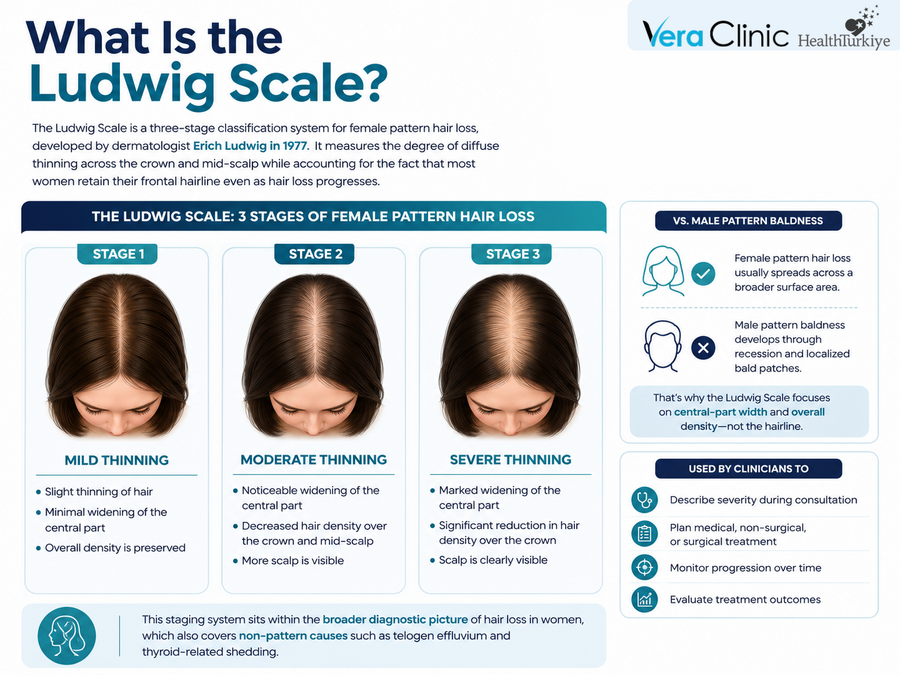
The Ludwig Scale is a three-stage classification system for female pattern hair loss, developed by dermatologist Erich Ludwig in 1977. It measures the degree of diffuse thinning across the crown and mid-scalp while accounting for the fact that most women retain their frontal hairline even as hair loss progresses. Unlike male pattern baldness, which develops through recession and localized bald patches, female pattern hair loss usually spreads across a broader surface area, so the scale is built around central-part width and overall density rather than hairline position. Clinicians use it to describe severity during a consultation and to plan treatment, whether medical, non-surgical, or surgical. This staging system sits within the broader diagnostic picture of hair loss in women, which also covers non-pattern causes such as telogen effluvium and thyroid-related shedding.
Why Does the Ludwig Scale Matter in Hair Restoration?
The Ludwig Scale matters because it gives doctors and patients a shared, reproducible reference point for how advanced hair loss is, and that reference point shapes every treatment decision that follows. In clinical practice, it is used to evaluate hair transplant candidacy, monitor how female pattern baldness progresses over time, and plan graft distribution across the thinning area. It also improves communication between a patient and a specialist by replacing a subjective description of “thin hair” with a defined, comparable stage.
What Are the Three Stages of the Ludwig Scale?
The Ludwig Scale defines three stages of severity, each marked by how far diffuse thinning has spread across the top of the scalp.
- Stage I: Perceptible thinning appears along the mid-scalp part line while the frontal hairline remains fully intact, and most women manage this stage with topical minoxidil alone since the scalp is not yet visible under normal lighting.
- Stage II: Thinning becomes more pronounced and widespread across the centroparietal scalp, with a visibly wider midline part that often prompts combination therapy or the first evaluation of hair transplant candidacy.
- Stage III: Diffuse hair loss extends across the entire top of the scalp and the scalp is clearly visible under ambient light, the point at which hair transplant becomes the option most likely to meaningfully restore density, though a band of hair usually remains along the front.
Staging is based on a visual assessment, so a clinician confirms the stage during an in-person consultation rather than from a description alone.
How Many Grafts Does Each Ludwig Stage Require?
A Vera Clinic Academy retrospective cohort analysis of 110 female patients found a stepwise relationship between Ludwig stage and the number of grafts used during surgery.
| Ludwig Stage | Mean Graft Count (± SD) | Calibrated Range |
| Stage I | 1,650 ± 200 | 1,450 – 1,850 |
| Stage II | 2,450 ± 300 | 2,150 – 2,750 |
| Stage III | 3,200 ± 350 | 2,850 – 3,550 |
Graft counts rise from stage to stage, but with a smaller proportional increase between stages than seen in male patients. This pattern, linked to physiological limits on vascular spacing when grafts are placed around existing native hair, comes from the Norwood and Ludwig Graft Requirement Study, which also notes that further prospective research is needed to establish evidence-based density limits for this scenario (Vera Clinic Academy, Validation of Baldness Staging Scales).
Can You Self-Diagnose Your Ludwig Stage?
You can roughly estimate your Ludwig stage by comparing the width of your part line and how visible your scalp is under direct light to the descriptions above, but self-diagnosis has real limits. Lighting, hair density, and hair texture all affect how thinning looks, and conditions such as telogen effluvium can produce diffuse shedding that resembles early female pattern hair loss without being the same condition. A clinical exam, generally supported by trichoscopy, is needed to confirm the stage and rule out other causes of thinning before starting treatment.
How Does the Ludwig Scale Compare to the Norwood and Savin Scales?
The Ludwig Scale, the Norwood Scale, and the Savin Scale all classify pattern hair loss, but they differ in who they are designed for and what they measure.
| Feature | Ludwig Scale | Norwood Scale | Savin Scale |
| Designed For | Women | Men | Women |
| Total Stages | 3 | 7 (+ subtypes) | 8 (+ frontal) |
| Hairline Recession Included | No | Yes | Yes (optional) |
| Crown Thinning Assessed | Yes | Yes | Yes |
| Diffuse Thinning Addressed | Yes | Not addressed | Yes |
| Clinical Use | Moderate | High | High |
Because Ludwig has only three stages, it offers less granularity than the nine-image Savin Scale (Savin, 1994), but Ludwig remains the scale most often referenced for female pattern hair loss in clinical literature, the counterpart to the Hamilton-Norwood Scale most often used for men.
What Treatment Options Fit Each Ludwig Stage?
Treatment options shift as the Ludwig stage advances, moving from preventive medical care toward surgical restoration.
- Stage I: Topical minoxidil and addressing contributing factors such as iron deficiency or hormonal imbalance are generally sufficient to slow progression at this stage.
- Stage II: Combination therapy with minoxidil, anti-androgen medication, and PRP therapy is considered, and some patients begin evaluating hair transplant candidacy.
- Stage III: Hair transplant, generally performed with DHI, becomes the option most often used to restore density by placing grafts between existing native hairs without disturbing the retained frontal band.
Medical therapy remains part of the plan at every stage, since it protects native hair that surgery does not replace.
When to Consider a Hair Transplant Based on Your Ludwig Stage
A hair transplant becomes a realistic option once diffuse thinning reaches Ludwig Stage II or III and medical therapy alone no longer restores adequate density. Because most women retain their frontal hairline even at advanced stages, Direct Hair Implantation is generally favored for these cases: its implanter pens allow grafts to be placed between existing native hairs without disturbing the retained band. At Vera Clinic, female cases are performed by using long-hair Sapphire FUE or DHI so patients avoid a full shave, with trichoscopy mapping miniaturization across the scalp before any surgical plan is confirmed.
Not every woman with advanced diffuse thinning is a straightforward surgical candidate: insufficient donor density, active scalp conditions such as folliculitis or dermatitis, and unmanaged hormonal or thyroid imbalances are all evaluated first, since operating around any of these can compromise graft survival.
Why Early Treatment Matters
Starting treatment while hair loss is still at Stage I preserves more native hair and keeps more treatment options available later, because hair follicle miniaturization is progressive: once a follicle shrinks past a certain point, minoxidil and other non-surgical treatments can slow further loss but rarely restore full follicle size. The Vera Clinic Academy cohort data illustrate the practical cost of waiting: moving from Stage I to Stage III nearly doubles the average graft count needed (1,650 versus 3,200), since a larger area of thinning has to be covered by the time surgery becomes the primary option. Acting early also supports donor planning, since native hair that is preserved through timely treatment does not need to be replaced by a transplant later, and it keeps combination therapy viable for longer before density loss becomes difficult to reverse with medication alone.
How Reliable Is the Ludwig Scale for Diagnosis?
The Ludwig Scale is a useful but limited tool: it relies on a visual, categorical judgment, so presentations that fall between stages, or that combine diffuse thinning with some degree of frontal recession, are not always captured precisely. The Vera Clinic Academy dataset behind the graft figures above is based on 110 patients at a single center, reviewed retrospectively, and the study itself notes that further prospective research is needed to establish firm density limits for diffuse female hair loss. A clinical exam remains necessary to confirm the stage and to rule out other causes of thinning, such as telogen effluvium or thyroid-related hair loss, that are not captured by the scale.
Frequently Asked Questions
Yes, a Ludwig stage can advance if hair loss continues untreated, and thinning can stabilize or partially improve with sustained treatment. Regular follow-up with a clinician tracks any change in stage.
No, some Stage II cases are managed effectively with medical therapy alone if the thinning is caught early and remains stable. A hair transplant becomes more likely as density loss becomes more extensive.
Yes, Stage I is generally managed with topical minoxidil and by addressing contributing factors such as iron deficiency or hormonal imbalance, without surgical intervention.
Source
- Ludwig, E. (1977). Classification of the types of androgenetic alopecia (common baldness) occurring in the female sex. British Journal of Dermatology, 97(3), 247–254.
- Savin, R. C. (1994). Evaluating Androgenetic Alopecia in Male and Female Patients.
- Vera Clinic Academy. (2026). Validation of Baldness Staging Scales: Retrospective Cohort Analysis of Norwood & Ludwig Classifications with Operative Graft Requirements.https://www.veraclinic.net/wp-content/uploads/2026/06/Validation-of-Baldness-Staging-Scales-Retrospective-Cohort-Analysis-of-Norwood-Ludwig-Classifications-with-Operative-Graft-Requirements.pdf