


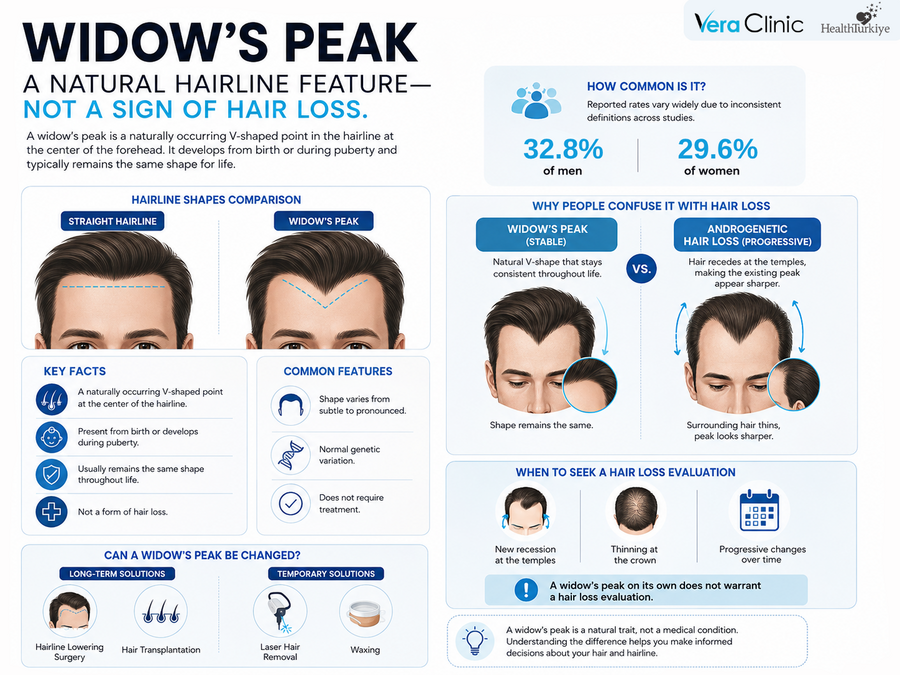
Widow’s peak is a natural, V-shaped point or M-shaped in the hairline at the center of the forehead, and on its own it is not a sign of hair loss. It develops from birth or during puberty and generally keeps the same shape for life, unlike androgenetic hair loss, which spreads and worsens progressively. The two get confused because as pattern hair loss recedes at the temples, a widow’s peak that was always there can start to look sharper simply because the surrounding hair is thinning, not because the peak itself is changing. How common it actually is, and whether it’s really as simple genetically as most people are told, turns out to be less settled than the textbook explanation suggests.
Key Points
- A widow’s peak is a naturally occurring V-shaped hairline point present from childhood or puberty, not a form of hair loss.
- The largest study on the subject found a widow’s peak in about 30% of people, with no meaningful difference between men and women (Kashiyama et al., 2021).
- The long-taught idea that it’s controlled by a single dominant gene has never actually been confirmed in a family or twin study (McDonald, 2011).
- A widow’s peak stays fixed in size and shape over a lifetime, while androgenetic hair loss spreads and worsens progressively.
- The two are commonly confused because temple-area hair loss can make an existing widow’s peak look sharper without the peak itself changing.
- Surgical hairline lowering and hair transplantation can reshape a widow’s peak, while laser hair removal and waxing offer only temporary changes.
- A widow’s peak on its own does not warrant a hair loss evaluation, but new recession at the temples or crown does.
What Is a Widow’s Peak?
A widow’s peak is a hairline shape in which hair grows down to a point at the center of the forehead instead of running straight or curving evenly across. The point forms because two symmetrical areas of hair-growth suppression above the eyebrows, which normally meet in the middle to create an even hairline, instead meet lower down, leaving a V-shaped section of hair between them. It is present at birth or becomes visible during puberty. The peak itself keeps the same shape for life; it’s the surrounding hairline, not the peak, that can shift later for reasons covered further down. This is because the peak comes from the same developmental process that sets the rest of the hairline, rather than from a hair loss condition. Some people have a subtle peak that is barely noticeable, while others have a sharp, pronounced point, and both are considered normal variation. On its own, a widow’s peak forms a simple V-shape: one point at the center, with the rest of the hairline running evenly on either side.
Is a Widow’s Peak a Sign of Hair Loss?
No, a widow’s peak by itself is not a sign of hair loss. It is a congenital hairline shape that is present well before any hair thinning would begin, and it does not predict whether someone will develop androgenetic alopecia later on. The confusion happens because as pattern hair loss recedes at the temples, the surrounding hairline moves back while the central point often resists thinning for longer, so the peak can appear sharper or more dramatic even though it has not actually changed. This shift, not the peak itself, is what should prompt a closer look at hair loss.
How Common Is a Widow’s Peak, Really?
A widow’s peak occurs in roughly 30% of the population, based on one of the largest studies on the subject: a 2021 survey of 456 men and women in Japan found it in 32.8% of men and 29.6% of women, with no meaningful difference between the genders (Kashiyama et al., 2021). This figure is usually paired with a second, widely repeated claim: that a widow’s peak is a textbook example of simple, single-gene inheritance, the same explanation often used for eye color. This has been taught for decades and is rarely questioned.
It does not hold up. A closer review of the genetics literature found that the family or twin studies needed to confirm single-gene inheritance were never actually carried out (McDonald, 2011). The claim was repeated widely enough to be treated as settled, without the underlying research to support it. What the evidence does show is more nuanced: a widow’s peak clearly runs in families, but its expression is better explained by several genes acting together rather than a single dominant gene, which is also why the same family can produce a pronounced peak in one sibling, a subtle one in another, and a straight hairline in a third.
How Can You Tell a Widow’s Peak From a Receding Hairline?
A natural widow’s peak and an early receding hairline can look similar at a glance, but they differ in onset, progression, and pattern.
| Feature | Natural Widow’s Peak | Early Androgenetic Hairline Recession |
|---|---|---|
| Onset | Present from childhood or puberty, stable in shape | Develops in adulthood, often in the 20s to 30s |
| Progression | Does not progress on its own | Gradually recedes further over months to years |
| Overall Shape | V-shape: a single point, hairline even on both sides | M-shape: the same point plus receded temples on both sides |
| Symmetry | Point is centered and symmetrical | Recession often starts at the temples, asymmetric |
| Side/Temporal Hair | Temporal hairline stays full | Temporal regions thin alongside the center |
| Family History | Common across relatives regardless of hair loss history | Often correlates with a family history of pattern baldness specifically |
| Change Over Time | Shape stays constant for life | The point can appear to “sharpen” only because surrounding hair is thinning |
A natural widow’s peak stays the same size for life, so any real progression in the surrounding hairline points to androgenetic alopecia rather than the peak itself changing.
How to Self-Check Your Hairline Before You Book a Consultation
You don’t need a clinic visit to get a first read on your hairline, and a couple of simple physical checks can tell you more than staring in the mirror ever will.
- The Finger-Width Test: Raise your eyebrows as high as they’ll go, then lay your index finger flat across the highest wrinkle that forms on your forehead. If your hairline sits roughly one finger-width above that wrinkle, that gap is consistent with a stable peak or a normal mature hairline. A gap of two finger-widths or more, especially one that keeps growing every time you check, points toward recession instead.
- A Same-Angle Photo, Months Apart: Take one photo now, straight-on, in the same lighting you’d use again later, then set a reminder to repeat it in six months. The finger-width test tells you where things stand today; this tells you whether that position is actually moving.
- Temple Density by Feel: Run a finger through the hair just behind the hairline on both sides. A natural peak keeps even thickness there; a peak that’s being exaggerated by hair loss usually feels noticeably thinner at the temples specifically, not just shorter.
None of these replace a professional diagnosis, but together they usually make the direction of change clear enough to know whether a consultation is worth booking.
Can a Widow’s Peak Become More Noticeable Over Time?
Yes, but not always for the reason people assume. Between the late teens and mid-20s, most people’s hairline naturally rises by about 1 to 2 centimeters compared to the lower, rounder hairline of childhood, a normal process called hairline maturation, and this alone can make an existing widow’s peak look slightly sharper without any thinning being involved. Once it settles, the shape stays put for good.
Real hair loss is different. If androgenetic hair loss develops alongside the peak, the temples recede while the central point holds its ground, and the hairline can shift from a simple “V-shape” into what is casually called an “M-shaped” hairline, where the original point is joined by two receded temples. This is really just the original peak combined with bilateral temple recession, not a separate hairline type. This specific pattern maps onto the early stages of the Hamilton-Norwood Scale, the classification system used to grade male pattern hair loss, which is why a changing hairline is worth comparing against that framework rather than judged by the peak alone.
What Are the Options If You Want to Change Your Widow’s Peak?
Several options exist, and the right one depends on why you want a change: purely cosmetic preference calls for a different approach than reshaping a peak that hair loss has exaggerated, while some people are simply after a temporary softening rather than a permanent change.
- Hairline Lowering Surgery: A scalp advancement procedure moves hair-bearing skin forward to blunt or reshape the point, giving a permanent result in a single procedure.
- Laser Hair Removal or Waxing: These treatments remove or thin the hair along the edge of the peak to soften its appearance, but they require repeat sessions and do not permanently alter the underlying hairline.
- Hair Transplant Reshaping: Individual grafts, usually placed with Sapphire FUE or DHI for precise control over graft angle, are added along the sides of the peak to blend the point into a softer curve, an approach used more often by people who want a fuller hairline rather than one with less hair.
When Should You See a Specialist About Your Hairline?
A specialist visit is worth considering when the hairline is visibly changing rather than staying fixed, particularly if the temples are receding, if thinning is also appearing at the crown or mid-scalp, or if there is a family history of pattern hair loss that did not previously affect your hairline shape. In consultations at Vera Clinic, surgeons start by establishing whether a patient’s hairline shape is a natural peak, a maturing hairline, or early recession, since each calls for a different plan, and only then discuss whether any correction is actually needed. Treating a natural peak as something to fix by default risks a design that looks noticeably artificial once the grafts grow in. A widow’s peak alone, with no other changes, does not need an evaluation.
Frequently Asked Questions
No, not meaningfully. The largest study on the subject found it in 32.8% of men and 29.6% of women, a gap too small to call a real sex difference (Kashiyama et al., 2021).
Yes, surgical hairline lowering can permanently move hair-bearing skin forward, while non-surgical methods such as laser hair removal only manage the visible point and do not permanently change the hairline itself.
No, in the absence of hair loss, the shape and depth of the peak generally stay the same as what was established in adolescence.
Sources
- McDonald, J. H. (2011). Myths of Human Genetics. Sparky House Publishing.
- Kashiyama, K., Haraguchi, R., Ban, F., Yoshida, D., Fukuda, M., Date, N., Koga, K., Koga, K., & Tanaka, K. (2021). Study of frontal and temporal hairline patterns in Japanese subjects. Plastic and Reconstructive Surgery Global Open, 9(8), e3751.