


A hair whorl is a natural, genetically influenced pattern where hair grows in a spiral around a central point at the crown of the scalp, and on its own it has nothing to do with balding. It forms during fetal development, between the tenth and sixteenth week of gestation, and its size and shape stay the same for life. The confusion with balding happens because the crown, where most whorls sit, is also one of the first places androgenetic hair loss shows up, so a whorl that has always been there can suddenly look more exposed once the hair around it starts thinning. Even the genetics behind whorl direction are less settled than most explanations suggest: family and twin data show real exceptions to the simple single-gene story which people are taught.
Key Points
- A hair whorl is a natural spiral growth pattern at the crown, formed in utero between weeks 10 and 16, and it does not change size or shape over a lifetime.
- The classic “single dominant gene” explanation for whorl direction does not fully hold up: family data show 16% of children of two counterclockwise-whorled parents still have clockwise whorls (Bernstein, 1925).
- Twin studies make the case stronger: 7 of 13 identical twin pairs in one study had opposite whorl directions, despite being genetically identical (Rife, 1933).
- A hair whorl is not a sign of hair loss, but the crown is also where androgenetic alopecia commonly begins, which is why the two get confused.
- A Vera Clinic Academy cohort found a 34.7% jump in average graft requirements between Norwood Stage III and Stage III-Vertex, driven by the geometry of rebuilding a whorl pattern.
- Hair transplant, PRP, and minoxidil are all options for genuine crown thinning, but a natural whorl needs no treatment at all.
What Is a Hair Whorl?
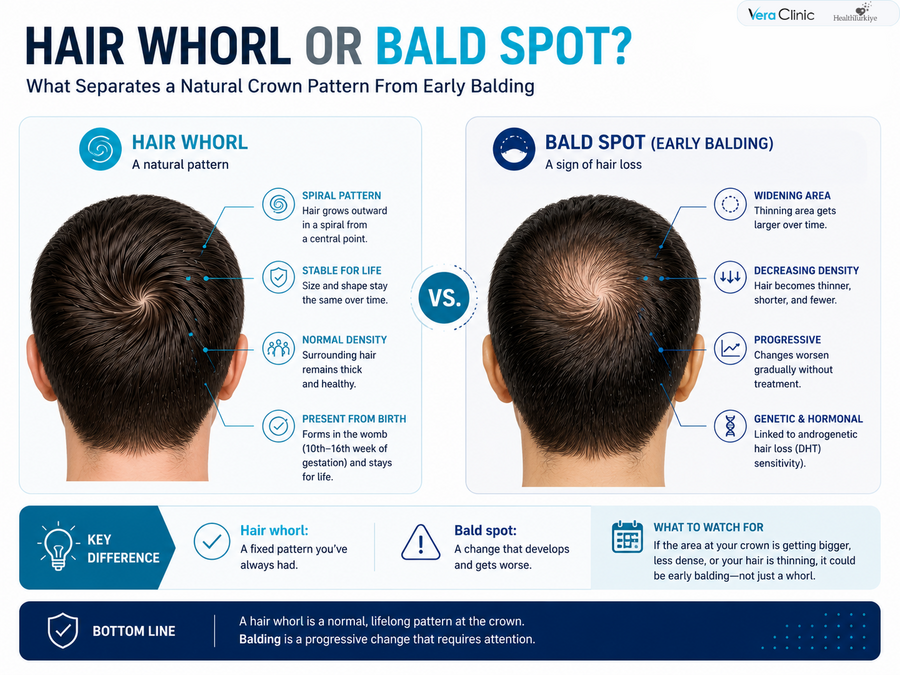
A hair whorl is a small area at the crown of the scalp where hair grows outward from a central point in a spiral, clockwise or counterclockwise, rather than lying in one direction like the rest of the scalp. It forms in the womb, between the tenth and sixteenth week of gestation, when the developing scalp stretches over the growing skull, and the pattern is set for life from that point on. Most people have a single whorl, though some have two, known as a double crown, or rarely three. The term “cowlick” is often used interchangeably, but cowlick more broadly refers to any section of hair that grows against the direction of the surrounding hair, anywhere on the scalp, while a hair whorl specifically describes the spiral pattern found at the crown.
Is a Hair Whorl a Sign of Balding?
No, a hair whorl by itself says nothing about whether someone will go bald. It is present from birth, long before any hair loss could begin, and it does not predict future thinning any more than hair color does. The confusion exists because the crown, where most whorls are located, happens to be one of the first areas affected by androgenetic hair loss in many men, so an existing whorl can become far more visible once the surrounding hair starts to thin, without the whorl itself having changed at all, a shift worth understanding in the broader context of hair loss.
Is Hair Whorl Direction Really Simple Genetics?
Not as simply as the textbook version explains. Whorl direction, clockwise or counterclockwise, is often taught as a textbook example of a single dominant gene, the same shorthand used for eye color, but family data do not fully support that model. In one dataset, parents who both had counterclockwise whorls still produced children with clockwise whorls in 16% of cases, something a simple dominant-gene model cannot explain (Bernstein, 1925). Twin studies make the gap even clearer: in one study of 13 identical twin pairs, 7 pairs had opposite whorl directions, despite sharing identical DNA (Rife, 1933). Later research has proposed more complex models, including a possible link between whorl direction and handedness, but even those models do not fit the data perfectly (McDonald, 2011). The direction of a hair whorl clearly runs in families, but it is not the clean, one-gene trait it is often described as.
How Can You Tell a Hair Whorl From a Bald Spot?
A hair whorl and early crown balding can look similar under bright light, but they differ in how they form and how they behave over time.
| Feature | Natural Hair Whorl | Early Crown Balding |
|---|---|---|
| Onset | Present from birth | Develops in adulthood, often 20s–40s |
| Progression | Stays the same size for life | Gradually expands over months to years |
| Hair at the Center | Normal thickness, just a different direction | Visibly finer or sparser than surrounding hair |
| Surrounding Hair | Full density around the whorl | Thinning spreads outward from the center |
| Shape | Consistent spiral, same size always | Often starts as a small patch that keeps growing |
| Family History | Common regardless of hair loss history | Often tracks with a family history of pattern baldness |
If the area around the whorl is visibly thinner than it used to be, that change points to androgenetic alopecia, not the whorl itself.
How to Self-Check Your Crown Before You Book a Consultation
A couple of physical checks, done with a mirror or a second person’s help, can clarify what’s actually happening at your crown.
- Photo From Directly Above: Ask someone to take a photo looking straight down at your crown, then compare it to an older photo if you have one. A stable size and shape points to a natural whorl; a widening circle points to thinning.
- Density Around the Center: Part the hair right at the edge of the whorl and check whether the scalp is more visible there than a few centimeters away. Even visibility all around suggests a whorl; a spreading gap suggests balding.
- Re-check in Six Months: Take the same overhead photo again after half a year. A whorl won’t have moved at all; genuine crown balding will, even gradually, often tracking the early stages of the Hamilton-Norwood Scale.
None of these replace a diagnosis, but together they show which direction things are heading.
How Does the Crown Affect Hair Transplant Planning?
The crown is treated differently from the rest of the scalp in hair transplant planning, and Vera Clinic Academy’s own cohort data show why. A retrospective analysis of 412 male patients found that graft requirements jumped by 34.7% between Norwood Stage III and Stage III-Vertex, the point at which thinning appears specifically at the whorl. The jump comes down to geometry: hair at the vertex exits the scalp at acute angles in a spiral pattern, so achieving the same visual coverage there takes more grafts than it would on a flatter, frontal area of the scalp. This is also why an experienced surgeon confirms whether a whorl is natural or thinning before pricing a crown-focused transplant, since the two call for very different graft counts.
| Norwood Stage | Crown/Vertex Involvement | Mean Graft Count (± SD) | Calibrated Range |
|---|---|---|---|
| Stage III | No vertex or crown thinning | 2,300 ± 300 | 2,000 – 2,600 |
| Stage III-Vertex | Early whorl-area thinning begins | 3,100 ± 350 | 2,750 – 3,450 |
| Stage IV | Distinct vertex bald spot, bridging hair remains | 3,650 ± 400 | 3,250 – 4,050 |
The pattern across these three stages, drawn from the Norwood and Ludwig Graft Requirement Study, is consistent: the earlier a genuine bald spot is caught, before it moves from Stage III-Vertex into a fully formed Stage IV patch, the fewer grafts it takes to restore. That timing question, along with the non-surgical options that can still help at the earlier stages, is what the rest of this article turns to next.
What Are the Options If Your Crown Is Balding?
Which option makes sense depends on how far the crown has progressed: medication works best while thinning is still early, while surgery becomes the answer once a genuine bald spot has formed.
- Topical Minoxidil: Slows further thinning and can improve density in early crown loss, though results depend on consistent long-term use.
- PRP (Platelet-Rich Plasma): Injections into the crown can support existing follicles, an approach often paired with PRP treatment protocols alongside medication rather than as a standalone fix.
- Hair Transplant: For crown areas with established thinning, grafts are placed at 30 to 40 grafts/cm² in a spiral pattern that follows the natural whorl direction, a density range drawn from the Norwood and Ludwig Graft Requirement Study (Vera Clinic Academy, 2026), often performed with DHI or Sapphire FUE for precise angle control.
As with most crown cases, medication and transplant are not mutually exclusive: minoxidil is often continued after surgery to protect the native hair surrounding the newly placed grafts.
When Should You See a Specialist?
A consultation is worth booking if the area around your crown is visibly changing, not just noticeable in certain lighting: an expanding bald patch, thinning that extends beyond the whorl itself, or a family history of pattern baldness that has never affected that spot before. At Vera Clinic, the first step in any crown consultation is confirming whether what a patient is seeing is a stable whorl or genuine thinning, since treating a natural whorl as a bald spot would mean transplanting into an area that never needed it.
Vera Clinic’s surgical team frames this the same way with patients in consultation:
“A whorl on its own isn’t a diagnosis, it’s a shape. What actually changes our recommendation is whether the hair around it is thinning, not how obvious the whorl looks under bathroom lighting. If the surrounding density has stayed stable, we tell the patient there’s nothing to treat. If it hasn’t, that’s the finding that drives the plan, not the whorl itself.“
— Dr. Emin Gül, Vera Clinic Surgeon
Frequently Asked Questions
No. Male pattern hair loss commonly starts there because the whorl already sits at the crown, one of the areas androgenetic alopecia targets, but it can also begin at the temples or hairline without ever touching the whorl.
Yes, especially if the hair between two whorls is naturally a little thinner, but a double crown stays the same size over time, while balding keeps expanding.
No. Whorl direction has been studied for links to handedness and other traits, but no research connects it to a higher or lower risk of pattern baldness.
Sources
- Bernstein, F. (1925). Beiträge zur Mendelistischen Anthropologie. II. Quantitative Rassenanalyse auf Grund von statistischen Beobachtungen über den Drehsinn des Kopfhaarwirbels. Sitzungsberichte der Preussischen Akademie der Wissenschaften, 71–82.
- McDonald, J. H. (2011). Myths of Human Genetics. Sparky House Publishing.
- Rife, D. C. (1933). Genetic studies of monozygotic twins. III. Mirror imaging. Journal of Heredity, 24, 443–446.
- Vera Clinic Academy. (2026). Validation of Baldness Staging Scales: Retrospective Cohort Analysis of Norwood & Ludwig Classifications with Operative Graft Requirements. https://www.veraclinic.net/wp-content/uploads/2026/06/Validation-of-Baldness-Staging-Scales-Retrospective-Cohort-Analysis-of-Norwood-Ludwig-Classifications-with-Operative-Graft-Requirements.pdf