
Diet after a hair transplant means eating enough protein, staying hydrated, and getting the micronutrients that support wound healing and hair growth, particularly zinc, biotin, vitamin C, and omega-3 fatty acids. In a Vera Clinic Academy cohort of 612 patients followed for 12 months after follicular unit extraction (FUE), diet adherence was independently associated with graft survival: patients with high dietary adherence retained 92.1% of transplanted grafts at 12 months, compared with 85.3% among those with low adherence. This link held even after adjusting for supplement use, medication, and other aftercare behaviors. The mechanism is straightforward: hair is built from keratin, a structural protein, and follicles entering the active growth phase draw on the same nutrients the body uses for tissue repair. That means the right proteins, vitamins, and fluids at the right stages, a cautious approach to alcohol and sugar, and a realistic view of what supplements can and can’t do on their own.
Key Points
- Patients with high diet adherence (a score of 4 or higher out of 5) retained 92.1% of grafts at 12 months, compared with 85.3% among those with low adherence, a statistically significant difference (p=0.003) based on the Vera Clinic Academy cohort.
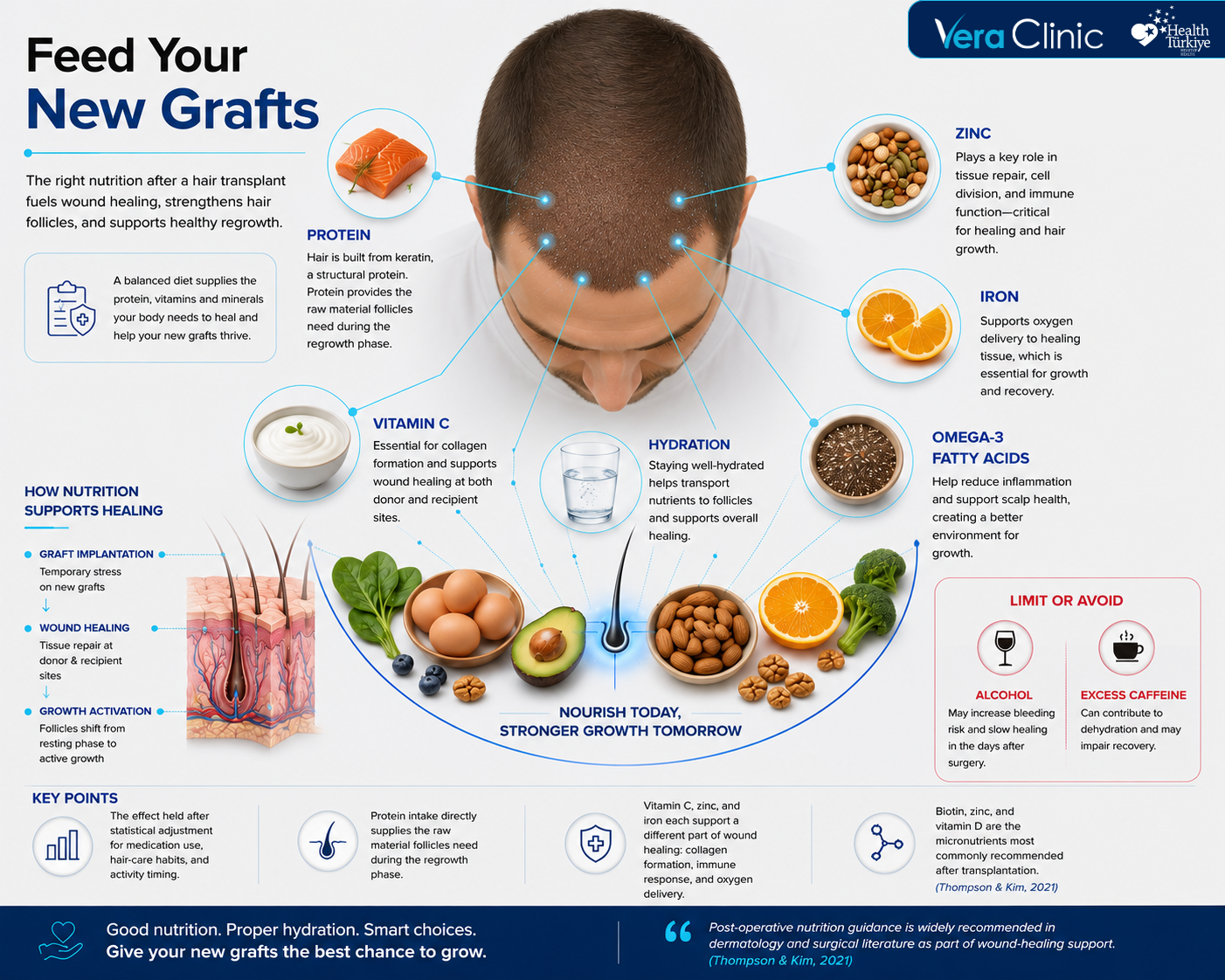
- The effect held after statistical adjustment for medication use, hair-care habits, and activity timing, indicating diet’s contribution is independent of other aftercare behaviors.
- Hair is built from keratin, a structural protein, so protein intake directly supplies the raw material follicles need during the regrowth phase.
- Vitamin C, zinc, and iron each support a different part of wound healing: collagen formation, immune response, and oxygen delivery, respectively.
- Biotin, zinc, and vitamin D are the micronutrients most commonly recommended after hair transplantation, though evidence for a supplementation-specific benefit outside a diagnosed deficiency remains limited (Thompson & Kim, 2021).
- Alcohol and excess caffeine are commonly discouraged in the days after surgery for hydration and bleeding-risk reasons, a general post-surgical precaution.
Why Does Diet Matter After a Hair Transplant?
Diet matters after a hair transplant because transplanted follicles undergo a period of biological stress. Ischemia from the extraction and implantation process, wound healing at both the donor and recipient sites, and the shift of grafts from a resting state into active growth all draw on the same nutritional resources the body uses for general tissue repair. Hair itself is built from keratin, a structural protein, so adequate protein intake supports the raw material for regrowth. Vitamin C supports collagen formation at the wound sites, zinc plays a role in tissue repair and immune function, and iron supports the oxygen delivery that healing tissue depends on. These same nutrients are why post-operative nutrition guidance appears across dermatology and surgical literature as a standard part of wound-healing support, independent of any single clinic’s protocol (Thompson & Kim, 2021).
What Foods Should You Eat After a Hair Transplant?
The foods most useful after a hair transplant are the ones that supply protein, key vitamins, and minerals used in tissue repair and hair growth.
- Lean Protein: Chicken, turkey, fish, eggs, Greek yogurt, and legumes supply the amino acids used to build keratin and repair tissue at the donor and recipient sites; adequate protein intake is one of the most consistently cited requirements for wound healing after any surgical procedure (Arnold & Barbul, 2006).
- Vitamin C-Rich Foods: Citrus fruits, strawberries, kiwi, and bell peppers support the collagen formation involved in closing each graft site.
- Zinc Sources: Beef, shellfish, pumpkin seeds, and chickpeas support the immune response and tissue repair that follow any surgical procedure; zinc is among the micronutrients most frequently studied in relation to hair loss and regrowth (Guo & Katta, 2017).
- Iron-Rich Foods: Lean red meat, spinach, lentils, and fortified grains help maintain the oxygen delivery that healing follicles rely on, and iron deficiency is one of the more commonly identified nutrient gaps in patients presenting with hair shedding (Guo & Katta, 2017).
- Omega-3 Fatty Acids: Salmon, walnuts, and flaxseeds have anti-inflammatory properties that may support scalp healing in the early weeks.
- Whole Grains: Brown rice, oats, and quinoa provide steady energy and B vitamins, including biotin, during the recovery period.
None of these foods work in isolation, but eating a varied diet that covers protein, key vitamins, and minerals gives the body what it needs to heal well and support the transplanted grafts, the same principle that applies to wound healing and hair health generally, not only after a transplant.
What Foods Should You Avoid After a Hair Transplant?
Certain foods are worth limiting after a hair transplant because they can promote inflammation or work against healing.
- Highly Processed Foods: Packaged snacks and fast food are high in sodium, sugar, and unhealthy fats, which can contribute to inflammation while the scalp is healing.
- Excess Sugar: Diets high in added sugar have been linked to increased markers of low-grade inflammation across multiple intervention studies (Della Corte et al., 2018), which is why cutting back on sweets and sugary drinks is a common piece of post-surgical advice.
- Very Salty Foods: High sodium intake can contribute to fluid retention and swelling, which is already a normal but uncomfortable part of the first week after surgery.
Keeping these categories in check for the first few weeks is a small adjustment that removes one more variable working against a smooth recovery.
Which Vitamins Should You Take After a Hair Transplant?
The vitamins most relevant to hair transplant recovery are vitamin C, zinc, iron, biotin, and vitamin D, each supporting a different part of wound healing and follicle growth; a couple of other commonly recommended vitamins carry weaker evidence behind them.
- Vitamin C: Supports the collagen synthesis that closes and strengthens each graft site during early healing; found in citrus fruits and bell peppers.
- Zinc: Plays a role in immune function and cell proliferation during wound repair, and is among the micronutrients most frequently studied in relation to hair loss and regrowth (Guo & Katta, 2017); found in shellfish and pumpkin seeds.
- Iron: Supports hemoglobin production and the oxygen delivery that healing follicles depend on, and iron deficiency is one of the more commonly identified nutrient gaps in patients presenting with hair shedding (Guo & Katta, 2017); found in red meat and lentils.
- Biotin: Supports keratin production and is the most commonly recommended micronutrient for hair health, though a review of the clinical evidence found consistent benefit mainly in people with a confirmed biotin deficiency, not in the general population (Patel et al., 2017); found in eggs and nuts.
- Vitamin D: Involved in the hair follicle growth cycle, though evidence for a supplementation-specific benefit outside of a diagnosed deficiency remains limited (Thompson & Kim, 2021); found in fatty fish, and synthesized by the skin with sun exposure.
- Vitamin E: Often recommended for scar appearance after surgery, though a systematic review of six controlled trials found insufficient evidence that topical vitamin E improves scar cosmesis on its own, and some patients developed irritation from its use (Tanaydin et al., 2016); found in nuts and seeds.
- B-Complex (B12 and Folate): Supports red blood cell production and the DNA synthesis involved in tissue repair, though the evidence linking B-complex intake specifically to hair transplant recovery is thinner than for the nutrients above; found mainly in animal products, so vegetarians and vegans may need closer attention here.
Most of these nutrients can be met through food alone, and whether a combined supplement adds a measurable benefit on top of diet is a separate question with its own data behind it.
What Should You Drink or Avoid Drinking After a Hair Transplant?
Water is the simplest way to support recovery, while alcohol, sugary caffeinated drinks, and regular coffee or tea should be limited or avoided for at least the first one to two weeks, since what you drink directly affects hydration, blood circulation, and bleeding risk during this period.
To drink:
- Water: Adequate hydration supports blood flow to the scalp and helps regulate swelling in the first days after surgery.
- Herbal Tea: A caffeine-free alternative to regular tea that still offers warmth and hydration without the diuretic effect of caffeine; varieties like chamomile or peppermint are commonly chosen for their calming effect during recovery.
- Coconut Water: Naturally rich in electrolytes, particularly potassium, helping maintain fluid balance during the early recovery period.
- Fresh Juice or Smoothies: Provide vitamins and antioxidants that support tissue repair, alongside added hydration; vitamin C in particular plays a well-documented role in collagen production, which is central to wound healing.
To avoid:
- Alcohol: Alcohol widens blood vessels and impairs how platelets clump together to form clots, mechanisms that increase bleeding risk and have been linked to higher rates of wound complications after surgery more broadly (Eliasen et al., 2013), which is why most clinics advise avoiding it for at least the first one to two weeks after a hair transplant.
- Sodas and Energy Drinks: These combine caffeine with high sugar content, compounding the dehydration risk of caffeine alone while offering no nutritional benefit to support healing.
- Coffee and Tea: Caffeine is a mild diuretic that can contribute to dehydration, raise blood pressure, and disrupt the sleep that supports healing, which is why most clinics advise limiting these to small amounts for at least the first few days after surgery.
Staying hydrated, choosing caffeine-free alternatives when possible, and skipping alcohol and sugary caffeinated drinks for the first couple of weeks are simple habits that support circulation and healing without requiring any special products or routines.
Which Hair Growth Supplements Should You Take After a Hair Transplant?
The supplements most often recommended after a hair transplant combine biotin, zinc, and vitamin D into a single daily course, since these are the nutrients most consistently discussed for hair and wound healing. Choosing a supplement over food sources is mainly a question of convenience and adherence, not a stronger effect: in the Vera Clinic Academy cohort, patients who completed a 90-day course showed a modest, independent gain in graft survival on top of diet adherence alone (β=1.15, 95% CI 0.01–2.29, p=0.048), a difference the study’s own authors describe as unlikely to be clinically noticeable on its own (Vera Clinic Academy, Dietary, Medical, and Hair-Care Adherence in Relation to Graft Survival After Follicular Unit Extraction, 2026).
Supplements play a supporting role alongside diet and medical therapy, not as a standalone treatment.
What Does the Vera Clinic Academy Data Show About Diet and Graft Survival?
Diet adherence was associated with close to a 7-percentage-point difference in 12-month graft survival between the highest- and lowest-adherence groups, and supplement use added a smaller, independent gain on top of that.
| Metric | Result | Statistical Significance |
|---|---|---|
| High diet adherence (score ≥4 out of 5) | 92.1% graft survival | p=0.003 |
| Low diet adherence (score <4 out of 5) | 85.3% graft survival | (same comparison) |
| Independent diet effect, per point (multivariable) | β=1.82 (95% CI 1.01–2.63) | p<0.001 |
| Supplement use (90-day course) vs none | 90.8% vs 87.6% graft survival | p=0.041 |
| Independent supplement effect (multivariable) | β=1.15 (95% CI 0.01–2.29) | p=0.048 |
The comparison holds up under closer statistical scrutiny: across 612 patients enrolled between March 2023 and February 2024 and followed for 12 months after FUE at Vera Clinic, diet and supplement use remained meaningful predictors even after adjusting for three other aftercare domains, including hair transplant aftercare practices such as washing technique, medication use, and activity timing, all evaluated together in the same model. That adjustment is what lets the Dietary, Medical and Hair-Care Adherence Graft Survival Study isolate diet and supplementation as independent contributors, rather than a byproduct of generally motivated patients doing everything else right too. The link this study indicates between nutritional adherence and recovery outcomes is one of the reasons we treat dietary guidance as a standard part of aftercare at Vera Clinic, rather than a general assumption during recovery.
When Should You Adjust Your Diet After a Hair Transplant?
Diet priorities shift at four points during hair transplant recovery: the first few days, weeks one and two, months one to three, and months three to twelve, the same window in which graft survival is ultimately assessed. Each stage reflects a different biological need, from easing the body through the initial trauma of surgery to sustaining the follicles through their full growth cycle, so the right approach at month one is not necessarily the right approach at month six.
- Days 1 to 3: Focus on gentle, easy-to-digest meals with adequate protein and hydration, since appetite is often reduced immediately after surgery; smaller, more frequent meals tend to work better during this window than three full meals on a normal schedule.
- Weeks 1 to 2: Continue prioritizing protein and micronutrient-dense foods while avoiding alcohol, which raises bleeding risk during this window (Eliasen et al., 2013).
- Months 1 to 3: Grafts enter the shedding and early regrowth phase during this window, a normal part of the follicular cycle documented in the original FUE surgical literature (Rassman et al., 2002), and consistent diet and, if used, supplement adherence become part of the daily routine rather than a short-term intervention.
- Months 3 to 12: Grafts continue maturing in thickness and texture during this period, and steady nutritional habits established earlier in recovery matter more for cumulative effect than any single meal or short-term change.
Diet is one part of a broader recovery process, and it works alongside washing technique, activity timing, and, where prescribed, adjuvant medication rather than in place of any of them. Getting the nutrition right does not compensate for rushing back into exercise or skipping the medication schedule, since each of these habits was linked to graft survival independently of the others.
“Nutrition doesn’t replace good surgical technique, but it does affect how well a graft heals once it’s in place. The first few weeks after transplantation are when the graft is establishing its blood supply, and that process depends on the same nutrients the body uses for any wound. It’s one part of recovery that’s largely in the patient’s hands.”
– Dr. Emin Gül, Vera Clinic Surgeon
Frequently Asked Questions
Most patients can return to a normal, balanced diet within the first week after surgery, once any initial nausea or reduced appetite from the procedure has passed. Avoiding alcohol and limiting very salty or processed foods for longer, generally up to two weeks, is still commonly advised.
Yes, vegetarians and vegans can meet post-transplant protein needs through legumes, tofu, tempeh, quinoa, and nuts, combined across meals to supply a full range of amino acids. Iron and vitamin B12 intake may need more attention in a plant-based diet, since these nutrients are less readily available from plant sources.
Intermittent fasting is not specifically restricted after a hair transplant, but the first few days after surgery are not the ideal time to start a new fasting routine, since the body needs a steady supply of protein and calories for wound healing. Patients who already followed an intermittent fasting pattern before surgery can generally continue once normal eating resumes, though this specific pattern was not assessed in the Vera Clinic Academy cohort.
Sources
- Vera Clinic Academy. (2026). Dietary, medical, and hair-care adherence in relation to graft survival after follicular unit extraction: A prospective cohort study at Vera Clinic. https://www.veraclinic.net/wp-content/uploads/2026/07/Dietary-Medical-and-Hair-Care-Adherence-in-Relation-to-Graft-Survival-After-Follicular-Unit-Extraction-A-Prospective-Cohort-Study-at-Vera-Clinic.pdf
- Thompson, K. G., & Kim, N. (2021). Dietary supplements in dermatology: A review of the evidence for zinc, biotin, vitamin D, nicotinamide, and Polypodium. Journal of the American Academy of Dermatology, 84(4), 1042–1050.
- Arnold, M., & Barbul, A. (2006). Nutrition and wound healing. Plastic and Reconstructive Surgery, 117(7 Suppl), 42S–58S.
- Guo, E. L., & Katta, R. (2017). Diet and hair loss: effects of nutrient deficiency and supplement use. Dermatology Practical & Conceptual, 7(1), 1–10.
- Eliasen, M., Grønkjær, M., Skov-Ettrup, L. S., Mikkelsen, S. S., Becker, U., Tolstrup, J. S., & Flensborg-Madsen, T. (2013). Preoperative alcohol consumption and postoperative complications: A systematic review and meta-analysis. Annals of Surgery, 258(6), 930–942.
- Della Corte, K. W., Perrar, I., Penczynski, K. J., Schwingshackl, L., Herder, C., & Buyken, A. E. (2018). Effect of dietary sugar intake on biomarkers of subclinical inflammation: A systematic review and meta-analysis of intervention studies. Nutrients, 10(5), 606.
- Patel, D. P., Swink, S. M., & Castelo-Soccio, L. (2017). A review of the use of biotin for hair loss. Skin Appendage Disorders, 3(3), 166–169.
- Rassman, W. R., Bernstein, R. M., McClellan, R., Jones, R., Worton, E., & Uyttendaele, H. (2002). Follicular unit extraction: Minimally invasive surgery for hair transplantation. Dermatologic Surgery, 28(8), 720–728.
- Tanaydin, V., Conings, J., Malyar, M., van der Hulst, R., & van der Lei, B. (2016). The role of topical vitamin E in scar management: A systematic review. Aesthetic Surgery Journal, 36(8), 959–965.