

Ozone therapy for hair transplant is an adjunct treatment in which a patient’s blood is drawn, mixed with medical-grade ozone, and reinjected to support circulation around the transplant area. At Vera Clinic, it is applied in two sessions tied to the surgery timeline, one shortly before the procedure ends and one the following day at the first hair wash. The underlying mechanism, improved oxygen delivery to tissue, is well documented in general ozone medicine, though the evidence specific to hair transplant recovery is still limited.
Key Points
- Ozone therapy for hair transplant is ozonated autohemotherapy: blood is drawn, mixed with medical-grade ozone, and reinjected to support circulation, distinct from harmful atmospheric ozone.
- The claimed mechanisms, circulation, healing support, and cellular metabolism, are well documented in general ozone medicine; the closest hair-transplant-relevant evidence comes from RCTs on dental implant and graft-harvesting wound healing, not hair transplants specifically.
- Ozone therapy is not appropriate for patients who are pregnant, have hyperthyroidism, bleeding disorders, a prior organ transplant, take anticoagulants or ACE inhibitors, or have G6PD deficiency.
- Documented risks range from mild and temporary to rare and serious, with the serious risk, gas embolism, tied to direct-gas-injection methods rather than the autohemotherapy method used at Vera Clinic.
- At Vera Clinic, it is applied in two sessions: one shortly before the transplant surgery ends and one the following day at the first hair wash.
- Ozone therapy and OxyCure use different mechanisms, injection versus inhaled pressurized oxygen, and hair-specific clinical evidence for either method remains limited.
What Is Ozone Therapy for Hair Transplant?
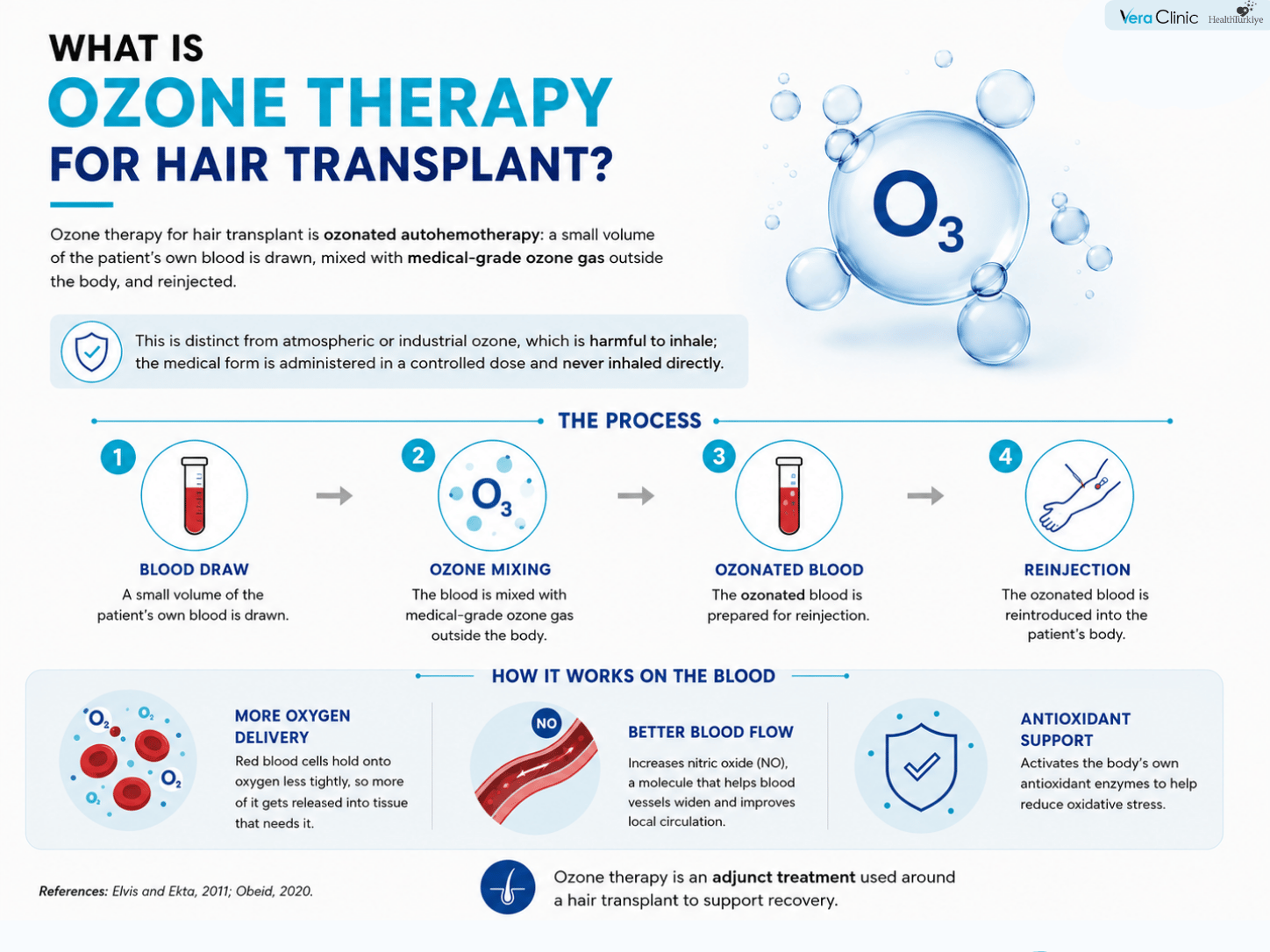
Ozone therapy for hair transplant is ozonated autohemotherapy: a small volume of the patient’s own blood is drawn, mixed with medical-grade ozone gas outside the body, and reinjected. This is distinct from atmospheric or industrial ozone, which is harmful to inhale; the medical form is administered in a controlled dose and never inhaled directly. The general mechanism works on the blood itself: red blood cells hold onto oxygen less tightly, so more of it gets released into tissue that needs it, and the process also boosts local blood flow by increasing nitric oxide, a molecule that helps blood vessels widen, alongside activation of the body’s own antioxidant enzymes (Elvis and Ekta, 2011; Obeid, 2020). This places ozone therapy among the adjunct treatments used to support recovery, alongside the other options covered among effective hair loss treatments.
What Are the Benefits of Ozone Therapy for Hair Transplant?
The claimed benefits of ozone therapy center on oxygen delivery and healing support, not direct follicle stimulation.
- Stimulates Scalp Circulation: Ozone reduces how tightly red blood cells hold onto oxygen and raises nitric oxide levels, a combination that improves blood flow to tissue under repair, including the scalp (Elvis and Ekta, 2011; Obeid, 2020).
- Supports Scalp Healing: Ozone triggers the production of enzymes such as glutathione peroxidase, catalase, and superoxide dismutase, which protect cells from oxidative damage during the healing process (Elvis and Ekta, 2011).
- Supports Cellular Metabolism: Ozone activates the Krebs cycle by enhancing the oxidation of pyruvate, which increases the ATP a cell has available for repair and regeneration (Elvis and Ekta, 2011).
These mechanisms describe how ozone affects the body’s circulation and cell-repair systems in general. Whether that translates into a measurable benefit specific to hair transplant recovery is a separate question.
Does Ozone Therapy Work for Hair Transplant Recovery?
Partially, and only by extension from other surgical contexts: ozone therapy has not been tested in hair transplant patients specifically, but comparable graft and surgical wound-healing scenarios have shown a measurable benefit in randomized trials outside hair restoration. A randomized controlled trial in patients undergoing dental implant placement found that ozone application around the surgical site reduced postoperative pain at 24 and 48 hours and improved soft tissue healing scores at 7 and 14 days compared to standard care (Shekhar et al., 2025). A separate randomized trial on graft harvesting sites, comparing ozone gel to hyaluronic acid gel after tissue was removed for grafting, found faster pain reduction by day 3 with ozone, though healing scores between the two groups were not statistically different (Tarek et al., 2025).
Both trials involve a comparable surgical scenario, tissue healing after a graft is placed or harvested, but neither is a hair transplant study, and the results should not be assumed to transfer directly to scalp tissue or follicular graft survival. For hair growth specifically, rather than wound healing, the evidence is much thinner: the one frequently cited hair study is a small, non-randomized trial from 1995 that reported improvement in hair cycle measures in 42 patients (Sanseverino et al., 1995), and a broader review of ozone therapy across dermatological conditions found methodological limitations across existing studies and did not include hair transplant recovery among the conditions assessed (Oliveira Modena et al., 2022).
A common claim is that ozone therapy activates dormant follicles or regrows hair on its own. Neither the dental implant and graft-healing trials nor the older hair-specific study support this claim, since none measured follicle reactivation as an outcome. The mechanisms documented in general ozone medicine explain circulation and healing support, not follicle reactivation, which is why ozone therapy’s more plausible role is in supporting the surgical recovery process, not in independently growing hair.
Who Should Not Get Ozone Therapy?
Ozone therapy is not appropriate for every patient. These contraindications are consistent with the exclusion criteria used in ozone therapy clinical trials, not specific to hair transplant use.
- Patients who are pregnant: Particularly in the first trimester, due to a mutagenicity risk to the developing fetus.
- Patients with hyperthyroidism: Ozone’s stimulation of metabolic activity can be amplified in patients whose thyroid is already overactive.
- Patients with acute hemorrhagic disease or severe bleeding disorders, including thrombocytopenia: Ozone’s effect on blood components carries added risk when clotting or platelet function is already impaired.
- Patients with a prior organ transplant: Ozone’s immune-modulating effects could interact with the immunosuppressive medication transplant patients require.
- Patients on regular anticoagulants or ACE inhibitors: These medications compound bleeding risk or interact with ozone’s effect on blood vessels.
- Patients with G6PD enzyme deficiency (favism): Red blood cells lacking this enzyme are vulnerable to oxidative damage, and ozone’s oxidative mechanism can trigger a reaction in these patients.
Weighing these factors is part of standard pre-treatment screening, not just a formality. At Vera Clinic, every patient’s medical history is reviewed against this list during consultation, and the treatment plan is adjusted, or an alternative such as OxyCure is offered, for anyone who does not meet the criteria.
What Are the Risks or Side Effects of Ozone Therapy?
Most patients tolerate ozone therapy well, but the documented risks range from mild and self-resolving to rare and serious, and the serious risk depends heavily on how the ozone is administered.
- Mild, transient low blood pressure: Some patients experience a temporary dip in blood pressure after treatment, resolving without intervention.
- Recovery crisis (rare): An uncommon reaction where existing post-treatment symptoms temporarily worsen, most often described after multiple sessions in longer ozone therapy protocols, with symptoms such as fatigue, headache, or nausea lasting 2 to 7 days.
- Gas embolism (rare, serious): A small number of case reports describe gas bubbles entering the bloodstream and traveling to the brain, causing stroke-like symptoms. These cases involved ozone gas injected directly into a blood vessel or joint space, such as intradiscal or intravenous administration (Khosravi and Mirzaasgari, 2024).
This last risk is tied to the delivery method rather than to ozone itself. The major autohemotherapy method used at Vera Clinic mixes ozone with blood outside the body before reinfusing it, which does not involve injecting gas directly into a vessel, and is one reason this method is used over direct-injection alternatives.
How Is Ozone Therapy Applied at Vera Clinic?
At Vera Clinic, ozone therapy is applied in two sessions using the major autohemotherapy method, in which 50 to 200 ml of blood is mixed with the ozone-oxygen blend and reinfused, rather than the minor method, which uses a smaller blood volume. The first session takes place about an hour before the hair transplant surgery concludes, while the grafts are freshly placed. The second session follows the next day, at the first post-surgery hair wash, when the scalp is still in its earliest healing phase.
The two sessions are timed around the window when graft take is most sensitive, supporting circulation during the period grafts are most dependent on the surrounding tissue for survival, though this rationale has not been tested against a control group in a hair transplant setting specifically.
Is Ozone Therapy the Same as OxyCure?
No, they use different mechanisms. Ozone therapy is an autohemotherapy injection: blood is drawn, mixed with medical-grade ozone, and reinjected. OxyCure is a hyperbaric oxygen treatment: the patient breathes oxygen inside a pressurized chamber, with no injection involved.
| Aspect | Ozone Therapy | OxyCure |
|---|---|---|
| Method | Blood drawn, mixed with ozone, reinjected | Patient breathes 100% oxygen in a pressurized chamber (1.9–2.3 ATA) |
| Invasiveness | Injection-based | Non-invasive, inhaled |
| Hair-specific clinical evidence | None | None |
Patients considering either option can discuss with a specialist which fits their transplant plan. OxyCure therapy uses breathing rather than injection, which may suit patients who prefer to avoid a blood draw.
Frequently Asked Questions
No, ozone therapy has not been shown to regrow hair or treat hair loss as a standalone treatment. Its use at Vera Clinic is limited to supporting circulation and healing around a hair transplant procedure.
No, these are separate treatments with different mechanisms. Ozone therapy is not interchangeable with OxyCure’s hyperbaric oxygen protocol or PRP’s growth-factor injections, and none of the three has been shown to be superior to the others for hair-specific outcomes.
At Vera Clinic, ozone therapy is applied in two sessions tied to the transplant timeline: one before the surgery concludes and one the following day.
Ozone therapy is well tolerated, with mild and temporary side effects in most patients. It is not appropriate for patients with certain conditions, including pregnancy, hyperthyroidism, bleeding disorders, or G6PD deficiency, so candidacy should be confirmed with a specialist beforehand.
Sources
- Elvis, A. M., & Ekta, J. S. (2011). Ozone therapy: A clinical review. Journal of Natural Science, Biology, and Medicine, 2(1), 66–70.
- Khosravi, S., & Mirzaasgari, Z. (2024). Cerebral gas embolism and multifocal ischemic stroke during oxygen-ozone therapy: A case report. BMJ Neurology Open, 6(2), e000885.
- Obeid, B. M. A. (2020). Ozone autohemotherapy: Possible mechanisms of anti-viral action and anti oxidative. Journal of Infectious Diseases and Epidemiology, 6, 117.
- Oliveira Modena, D. A., de Castro Ferreira, R., Froes, P. M., & Rocha, K. C. (2022). Ozone therapy for dermatological conditions: A systematic review. Journal of Clinical and Aesthetic Dermatology, 15(5), 65–73.
- Sanseverino, A., et al. (1995). Effects of ozonized autohaemotherapy on human hair cycle. Panminerva Medica, 37(3).
- Shekhar, A., Sikdar, C., Srivastava, S., Chaturvedi, A., Bhatia, L. K., & Sarkar, D. (2025). The efficacy of ozone therapy on pain and soft tissue healing associated with the surgical placement of dental implants: A randomized controlled trial. Cureus, 17(6), e85482.
- Tarek, H., Shemais, N., Ghalwash, D., & El Barbary, A. (2025). Clinical evaluation of ozone gel versus hyaluronic acid gel on palatal wound following free gingival graft harvesting: A randomized clinical trial. International Journal of Dentistry, 2025, 4177557.