

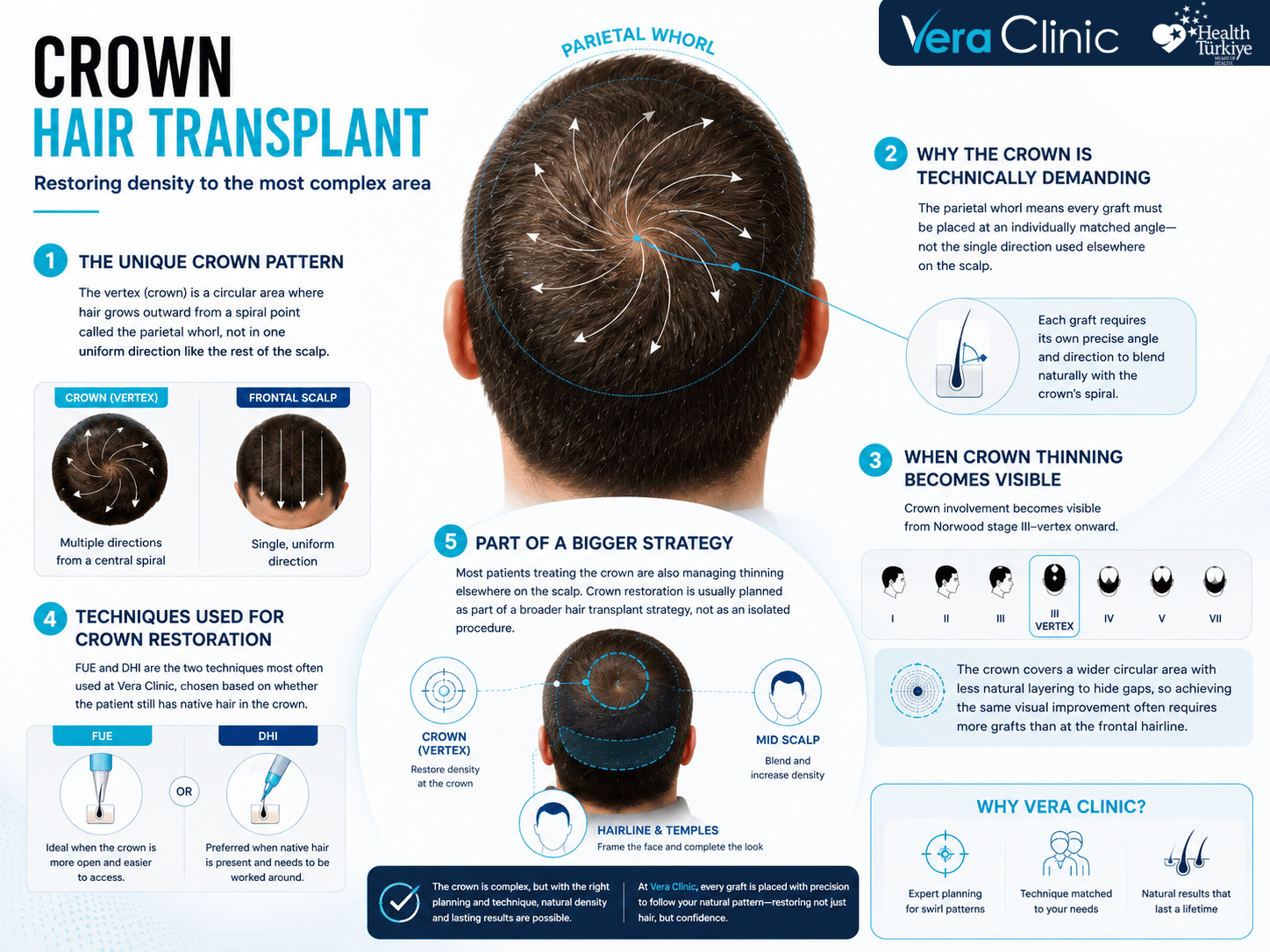
A crown hair transplant restores density to the vertex, the circular area at the top-back of the scalp where hair grows outward from a spiral point called the parietal whorl rather than in one uniform direction. This whorl is what makes the crown one of the more technically demanding areas to treat, since every graft needs an individually matched angle rather than the single direction used elsewhere on the scalp. Crown involvement becomes visible from Norwood stage III-vertex onward and often needs more grafts than the same visual improvement would require at the frontal hairline, because the circular area covers a wider surface with less natural layering to hide gaps. FUE, Sapphire FUE, and DHI are the techniques most often used for crown restoration at Vera Clinic, chosen based on how much native hair remains in the crown and how much precision the whorl pattern demands. Crown restoration is usually planned as part of a broader hair transplant strategy rather than as an isolated procedure, since androgenetic alopecia affecting the crown often extends to the hairline and mid-scalp as well.
Key Points
- The crown is defined by a parietal whorl, a spiral point from which hair radiates outward in a 360-degree pattern; a study of 1,008 Korean men found alopecia progresses within 6 cm of this point toward the back of the scalp (Park et al., 2014).
- Crown involvement is classified from Norwood stage III-vertex onward, and a Vera Clinic Academy cohort of 522 patients recorded the sharpest single jump in graft need, 34.7%, between Stage III and Stage III-vertex.
- The same cohort found Stage III-vertex patients required an average of 3,100 ± 350 grafts (calibrated range 2,750–3,450) to rebuild the whorl area.
- FUE, Sapphire FUE, and DHI are all used for crown restoration at Vera Clinic; DHI’s single-step implantation reduces the time grafts spend outside the body, a variable linked to follicular viability in the surgical literature.
- There is no separate “crown package” price; cost is determined by the technique chosen and the graft count required, and cases needing 4,000 or more grafts, or combined frontal-and-crown coverage, are staged across two sessions.
- Crown grafts follow the same wound-healing timeline as other FUE/DHI sites, but the whorl’s radiating growth pattern needs more time to visibly blend since new hair emerges from multiple directions rather than one.
What Is a Crown Hair Transplant?
A crown hair transplant moves hair follicles into the vertex, the circular area at the top-back of the scalp where hair grows outward from a central spiral point called the parietal whorl, rather than in a single, uniform direction like the frontal scalp. Vertex alopecia consistently originates at the center of this whorl and spreads outward from that single point, rather than starting at the hairline and moving backward (Park et al., 2014). This makes it a distinct restoration challenge from a hairline or mid-scalp transplant, even though the same extraction techniques are used. Crown thinning is most often part of androgenetic alopecia, the most common cause of hair loss in men, and Norwood stage III-vertex specifically has been reported as the most frequent presentation of male pattern baldness from the third through the seventh decade of life (Paik et al., 2001).
Why Is the Crown Harder to Restore Than Other Areas?
The crown is harder to restore because its hair radiates outward from a single spiral point in a pattern that changes direction continuously, unlike the frontal scalp where hair points in one general direction.
- Whorl Geometry: Every graft near the parietal whorl needs its own angle to match the spiral, since a graft placed even slightly off the natural rotation creates a visible break in the pattern. Not every scalp has a single, clean whorl to work from: about 5.6% of men in the parietal whorl study had no identifiable whorl at all (Park et al., 2014), and a separate classification of 534 patients found double-whorl patterns in roughly 3.2% of cases, which the surgeon has to map as two separate reference points rather than one (Ziering & Krenitsky, 2003).
- Progression Range: A study of 1,008 Korean men with pattern baldness found that alopecia around the parietal whorl progresses within about 6 cm of that point toward the back of the scalp, information surgeons use to judge how far a crown session needs to extend.
- Surface Area: The circular shape of the vertex covers more surface area than a comparable amount of frontal thinning, which is part of why crown sessions often need a higher graft count for the same visual improvement.
- Limited Native Cover: Hair in the crown lies closer to the scalp and doesn’t layer over itself the way frontal hair does, so thin spots are harder to disguise between sessions.
These factors don’t make crown restoration less achievable, but they do make planning and technique selection more important than graft count alone.
How Many Grafts Does a Crown Hair Transplant Require?
A crown hair transplant restoring Norwood stage III-vertex requires an average of 3,100 grafts, based on Vera Clinic Academy’s own cohort data, though the exact number depends on how far the whorl area has progressed.
| Norwood Stage | Mean Graft Count (± SD) | Calibrated Range |
| Stage III | 2,300 ± 300 | 2,000 – 2,600 |
| Stage III-Vertex | 3,100 ± 350 | 2,750 – 3,450 |
| Stage IV | 3,650 ± 400 | 3,250 – 4,050 |
The jump between Stage III and Stage III-vertex, a 34.7% increase, is the sharpest single-stage rise recorded in Vera Clinic Academy’s Norwood and Ludwig Graft Requirement Study, reflecting the extra density needed to rebuild the whorl rather than a simple frontal recession. Graft requirements for every other stage follow the same progression on the Hamilton-Norwood Scale.
Should You Treat the Crown or the Hairline First?
The hairline is usually prioritized over the crown when a patient has limited donor reserve and thinning in both areas, since the frontal hairline is more visible in daily interaction and harder to disguise if grafts run short later. Treating an isolated crown too early carries its own risk: clinical guidance generally advises against grafting the vertex alone in a still-progressing pattern, since the transplanted patch can end up ringed by new thinning as the surrounding native hair continues to recede (Goldin et al., 2026). This isn’t a fixed rule: a patient with a stable frontal hairline and isolated crown thinning can treat the crown first without the same tradeoff. The decision comes down to donor supply, the stability of the hair loss pattern, and which area affects the patient most. Donor capacity in particular is why the donor area is assessed before either zone is prioritized, rather than deciding by a general age or stage cutoff.
How Does a Crown Hair Transplant Procedure Work?
A crown hair transplant follows the same core stages as any FUE or DHI procedure, with one addition unique to the vertex: the whorl must be mapped and its direction recorded before a single graft is placed.
- Whorl Mapping: The surgeon identifies the parietal whorl’s center and the direction it spirals, clockwise or counter-clockwise, since every graft placed afterward follows this reference point.
- Donor Extraction: Grafts are removed from the back or sides of the scalp using FUE or DHI’s extraction step, the same donor-harvesting process used for any other recipient area.
- Angle-Matched Implantation: Grafts are implanted working outward from the whorl center, with each graft’s angle adjusted to follow the spiral rather than a single fixed direction; DHI’s Choi implanter pen sets the angle and places the graft in one motion, which shortens how long each follicle spends outside the body, a factor linked to graft viability in the surgical literature (Limmer, 1994).
- Density Distribution: Grafts are spaced to account for the crown’s circular shape, since packing density that works for a straight hairline can look uneven once it’s arranged in a radiating pattern.
The procedure itself takes a similar amount of time to a hairline session of the same graft count; the added complexity is in the planning, not the surgery duration.
“The crown is technically demanding not because of the surgery itself, but because the hair doesn’t grow in one direction. Every graft has to follow the whorl’s rotation instead of a straight line, which is why mapping that pattern before we begin matters more here than in almost any other area we treat.”
Emin Gül, Medical Doctor, Vera Clinic
Which Technique Is Best for Crown Restoration?
FUE, Sapphire FUE, and DHI are all used for crown restoration at Vera Clinic, and the better choice depends on how much native hair remains in the crown and how much precision the whorl pattern demands.
- Sapphire FUE: Often preferred when density and a natural-looking finish across the whorl matter as much as coverage, since Sapphire FUE uses sapphire blades for cleaner incisions than standard steel blades.
- DHI: Preferred when native hair is still present in the crown, since the Choi implanter pen used in DHI hair transplant allows grafts to be placed between existing hairs without pre-made incisions disturbing them.
- FUE: Suited to larger crown sessions where most of the area is already bald, since standard FUE hair transplant covers wide surface area efficiently once the whorl angles are mapped.
All three techniques rely on the same whorl-mapping step before any graft is placed; the choice affects how the grafts are placed and finished, not how the pattern is planned.
What Supportive Treatments Can Improve Crown Transplant Results?
Several supportive treatments are used alongside a crown transplant to support healing or protect the native hair around the treated area, rather than to replace the transplant itself.
- OxyCure Therapy: Vera Clinic’s post-op protocol raises dissolved plasma oxygen in scalp tissue during the early healing window, positioned as healing-environment support rather than a treatment that drives graft density through OxyCure therapy alone.
- Stem Cell Therapy: Offered at Vera Clinic as an adjunct to results, particularly for patients with early-stage thinning in the areas surrounding the crown, who combine their transplant with stem cell hair transplant protocols.
- Exosome Therapy: A regenerative option aimed at reducing inflammation and supporting long-term graft retention, most often added through exosome hair loss treatment sessions timed around the surgery.
- Minoxidil: Commonly used to slow thinning in native hair around the transplanted area, since minoxidil for hair loss works on existing follicles rather than on the transplanted grafts themselves once they’ve taken.
- Finasteride: Often used alongside minoxidil for the same purpose, since finasteride for hair loss targets the hormonal cause of native-hair thinning rather than the grafts, which don’t respond to DHT the way native hair does.
None of these treatments are required for a crown transplant to succeed; they’re added selectively based on donor quality, healing risk factors, and how much native hair remains around the treated area.
Who Is a Good Candidate for a Crown Hair Transplant?
A good candidate for crown restoration has a stable hair loss pattern, enough donor hair to cover the crown’s surface area without compromising future sessions, and realistic expectations about the whorl’s density limits.
- Patients with Stabilized Crown Thinning: Candidates whose crown thinning has settled into a consistent pattern, rather than progressing rapidly, get more predictable long-term results.
- Patients with Sufficient Donor Reserve: Since the crown’s surface area often needs more grafts than the same visual change at the hairline, good candidates have enough donor capacity for future needs, not just the current session.
- Patients with Realistic Density Expectations: Because the whorl radiates in multiple directions, good candidates understand that achieved density can look slightly less full than an equivalent frontal session, even with a similar graft count.
Patients outside these profiles aren’t necessarily ruled out, but they usually need a more conservative plan, a staged approach, or a frank conversation about what the whorl can realistically deliver.
Can Women Get a Crown Hair Transplant?
Yes, women can have a crown hair transplant, though planning is usually more conservative since female pattern hair loss follows a diffuse pattern rather than complete baldness in the area. This presentation, often described as a Christmas-tree distribution, involves density decreasing gradually from the crown toward the front of the scalp rather than leaving a fully bald patch (Gupta & Mysore, 2016). Because of this, the surgical team works between existing native hairs rather than clearing the area first, similar to the approach used for hairline density augmentation, and progression is tracked using the Ludwig scale, a staging system built for how a female hair transplant candidate’s pattern typically presents, rather than the male Norwood system.
What Does a Crown Hair Transplant Cost?
A crown-only session is priced by the technique used and the number of grafts it requires, the same way any single-area procedure is priced at Vera Clinic.
| Package | Starting Price | Fits Crown-Only Sessions? |
| Sapphire FUE | €3,200 | Yes, for Stage III-vertex range |
| Hyper DHI | €3,990 (up to 4,500 grafts) | Yes, including larger crown cases |
| DHI Max | €5,190 (double session) | For combined crown + frontal coverage |
Crown restoration in the 2,500 to 4,000 graft range fits within a single session at these package levels, and even at the higher end of that range, hair transplant Turkey cost stays competitive against other destinations; cases needing 4,000 or more grafts, or combined frontal-and-crown coverage, are usually staged across two sessions.
What Is Recovery Like After a Crown Hair Transplant?
Recovery in the crown follows the same wound-healing stages as any FUE or DHI donor and recipient site, with redness and scabbing resolving within the first two weeks.
- Days 1–6: Mild redness, swelling, and small scabs form over each graft site as the wound begins its normal inflammatory response. The crown sits at the point of most pillow contact during sleep, so sleeping on the back with the head slightly elevated matters more here than for a frontal hairline session.
- Days 7–14: Scabs shed naturally and the treated area starts blending with surrounding hair, marking the point at which grafts are considered securely anchored and resistant to dislodgement.
- Weeks 3–4: Redness fades fully and normal activity, including light exercise, resumes; hair styling can generally resume with the surgeon’s approval.
Crown healing follows the same hair transplant recovery timeline used for any FUE or DHI site; the whorl’s radiating pattern doesn’t change how the wound itself heals, only how long the hair growth cycle takes to visibly resolve into a natural-looking pattern.
What Does the Crown Growth Timeline Look Like Month by Month?
New growth in the crown follows the same shedding-then-regrowth cycle as other transplanted areas, but the whorl’s radiating pattern takes longer to visibly resolve into a consistent direction.
| Timeline | What to Expect |
|---|---|
| Weeks 2–6 | Transplanted hair sheds (shock loss), the temporary loss of the hair shaft as surgical trauma pushes follicles into a resting phase; this is self-limiting and not a sign of graft failure (Kerure et al., 2018) |
| Months 2–3 | Follicles rest in the telogen phase before regrowth begins; no visible change yet |
| Months 4–6 | New growth starts emerging from the transplanted follicles, though whorl direction is not yet consistent |
| Months 6–9 | Density becomes visibly noticeable; whorl direction starts to read as a consistent pattern rather than scattered growth |
| Months 9–12 | Growth continues to fill in as direction and density keep consolidating |
| Month 12+ | Transplanted density has reached its expected level by this point; texture and thickness continue to refine |
Because the whorl radiates from a single point, the pattern needs more of this hair to emerge before it reads as natural, which is why crown results are often judged closer to the 12-month mark than a hairline session of the same graft count.
What Should You Know About Aftercare for a Crown Hair Transplant?
Aftercare for a crown transplant follows the same general guidelines as any FUE or DHI procedure, but its location and whorl pattern create a few practical differences worth planning for.
- Self-Inspection Is Harder: Unlike a hairline, the crown isn’t visible in a single mirror check, so patients rely on a second mirror or a phone camera to monitor healing, rather than being able to see the area directly.
- Aftercare Products Need a Second Pair of Hands: Applying sprays, foams, or lotions evenly across the crown is difficult to do on yourself by feel alone, so many patients ask a partner or family member to help during the first week.
- Combing Direction Matters More: Because hair grows outward from the whorl in multiple directions rather than one, brushing against the grain in the early weeks is easier to do by accident in the crown than at the hairline, and can disturb newly settled grafts.
- Sun Exposure Is More Direct: The crown is the highest point of the scalp, so with hair buzzed short for the procedure, it takes more direct overhead sun than the frontal hairline, making a loose hat or scarf worth using outdoors even on mild days.
These points are additions to the general hair transplant aftercare guidelines, not replacements for them.
Why Choose Vera Clinic for a Crown Hair Transplant?
Vera Clinic is a leading hair transplant center in Istanbul, Turkey, and treats crown restoration as a whorl-mapping exercise rather than a simple graft-count target. FUE, Sapphire FUE, and DHI are each selected based on how much native hair remains in the crown and how much precision the whorl demands, an approach shaped by Vera Clinic Academy‘s own research into Norwood-vertex graft requirements.
Donor capacity is assessed during consultation before either the crown or another area is prioritized, and the procedure is paired with supportive protocols such as OxyCure Therapy, stem cell treatment, and exosome therapy to support healing rather than replace it. Patients receive all-inclusive packages covering surgery, accommodation, transfers, and aftercare, with every session supervised by Vera Clinic‘s surgical team.
Frequently Asked Questions
Yes, when the surgeon maps the whorl’s direction before placing grafts and follows it outward from the center. Results look unnatural mainly when grafts are placed in a single uniform direction instead of following the spiral.
A crown transplant can underperform if too few grafts are allocated for the whorl’s surface area, or if hair loss continues progressing around the treated zone. A second session is a normal part of planning for larger cases rather than a sign that the first one failed.
Transplanted grafts in the crown are permanent in the same way as grafts placed anywhere else, since they retain the donor area’s resistance to pattern hair loss. Native hair still present in the crown can continue thinning over time if the underlying hair loss progresses.
No, pain levels in the crown are comparable to any other recipient site, since the sensation depends mainly on the anesthesia and technique used rather than the location on the scalp.
- Park JH, Na YC, Moh JS, Lee SY, You SH. Predicting the permanent safe donor area for hair transplantation in Koreans with male pattern baldness according to the position of the parietal whorl. Arch Plast Surg. 2014;41(3):277–284.
- Paik JH, Yoon JB, Sim WY, Kim BS, Kim NI. The prevalence and types of androgenetic alopecia in Korean men and women. Br J Dermatol. 2001;145(1):95–99.
- Ziering C, Krenitsky G. The Ziering whorl classification of scalp hair. Dermatol Surg. 2003;29(8):817–821.
- Vera Clinic Academy. Validation of Baldness Staging Scales: Retrospective Cohort Analysis of Norwood and Ludwig Classifications with Operative Graft Requirements. 2026. Available from: https://www.veraclinic.net/wp-content/uploads/2026/06/Validation-of-Baldness-Staging-Scales-Retrospective-Cohort-Analysis-of-Norwood-Ludwig-Classifications-with-Operative-Graft-Requirements.pdf
- Goldin J, Zito PM, Raggio BS. Hair transplantation. In: StatPearls [Internet]. Treasure Island, FL: StatPearls Publishing; 2026.
- Limmer BL. Elliptical donor stereoscopically assisted micrografting as an approach to further refinement in hair transplantation. J Dermatol Surg Oncol. 1994;20(12):789–793.
- Kerure AS, Patwardhan N. Complications in hair transplantation. J Cutan Aesthet Surg. 2018;11(4):182–189.
- Gupta M, Mysore V. Classifications of patterned hair loss: a review. J Cutan Aesthet Surg. 2016;9(1):3–12.