

Yes, finasteride is effective for hair loss in most men who use it consistently: as an oral 5-alpha reductase inhibitor, it slows or stops androgenetic hair loss by lowering scalp levels of dihydrotestosterone (DHT), the hormone responsible for follicle miniaturization in male and female pattern baldness. In a 12-month Vera Clinic Academy cohort of 443 patients on combined finasteride and minoxidil therapy, mean hair density increased by 28.9% from baseline, with adverse events reported in only 7.0% of patients. Finasteride works by competitively inhibiting Type II 5-alpha-reductase, the enzyme that converts testosterone into DHT; because miniaturization is progressive, treatment needs to start before follicles are permanently lost and continue for as long as the benefit is meant to last. Suitability and expected results vary by the stage and pattern of hair loss, which is why a physician evaluation is the starting point rather than self-selection.
Key Points
- Finasteride blocks DHT production by inhibiting Type II 5-alpha-reductase, slowing the follicular miniaturization that drives androgenetic alopecia.
- In a Vera Clinic Academy cohort of 443 patients, combined finasteride and minoxidil therapy produced a 28.9% mean increase in hair density at 12 months.
- Male patients in the same cohort showed a 30.2% density increase at 12 months, compared with 25.8% in female patients following a different, clinically monitored protocol.
- Oral finasteride (1mg/day) is the standard form for men; women are not generally prescribed oral finasteride, though monitored low-dose topical options exist for select cases.
- Only 7.0% of patients in the Vera Clinic Academy cohort reported an adverse event over 12 months, and most resolved within weeks.
- Results take 3 to 6 months to become noticeable and require continued daily use; stopping treatment reverses the DHT reduction within about two weeks.
What Is Finasteride for Hair Loss?
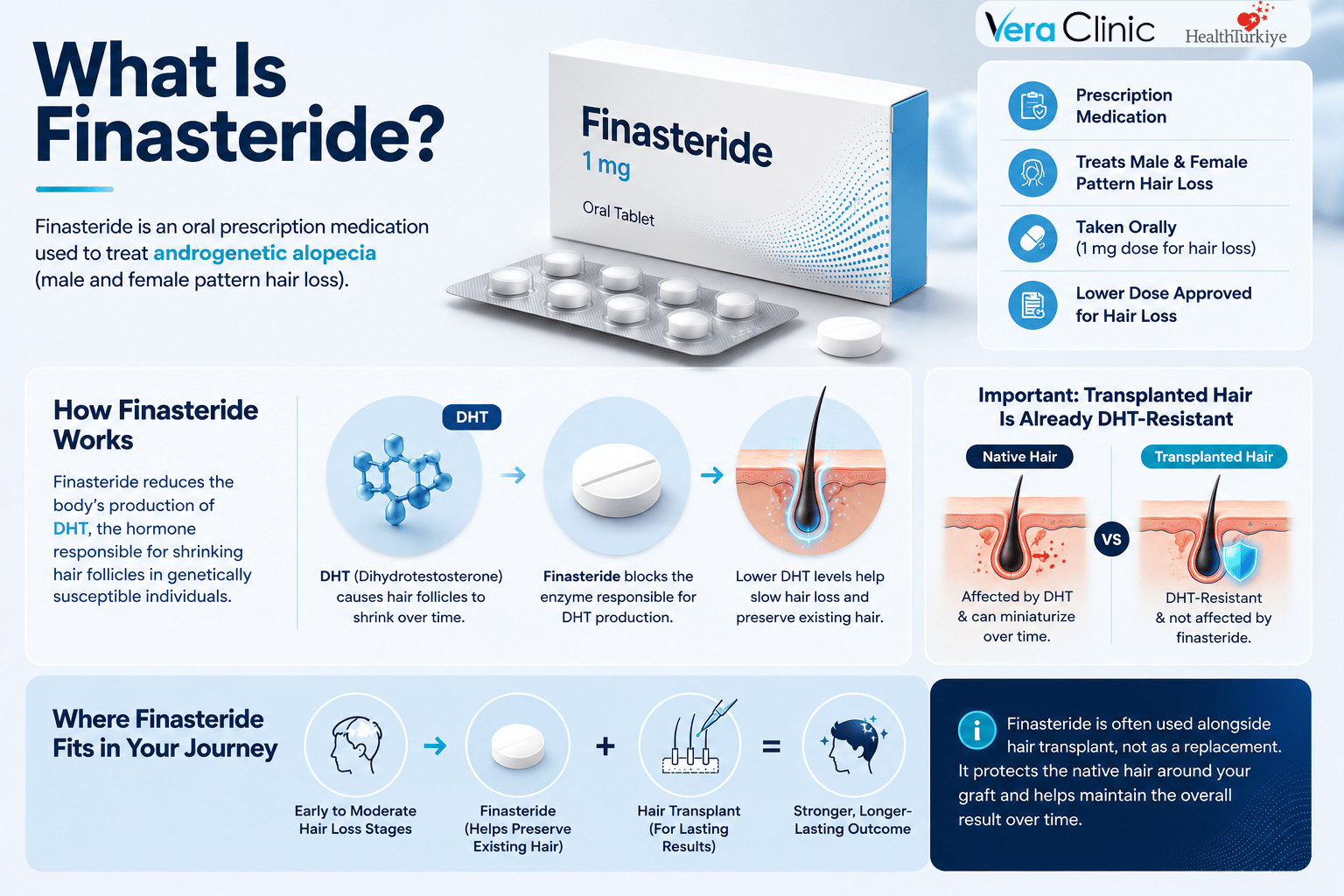
Finasteride is an oral prescription medication that treats androgenetic alopecia (male and female pattern hair loss) by reducing the body’s production of dihydrotestosterone (DHT), the hormone that causes genetically susceptible hair follicles to shrink over time. It was first developed at a higher dose to treat benign prostatic hyperplasia and was later approved at a lower 1mg dose specifically for hair loss. Finasteride does not act on hair transplant grafts themselves, since transplanted follicles are already resistant to DHT; instead, it protects the native hair surrounding a graft, which is why it is often used alongside surgery rather than in place of it. Patients considering finasteride as a starting point, rather than moving straight to a hair transplant in Turkey, are still in the early-to-moderate stages of hair loss.
How Does Finasteride Work to Stop Hair Loss?
Finasteride works by competitively inhibiting Type II 5-alpha-reductase, the enzyme that converts testosterone into dihydrotestosterone (DHT). Scalp DHT levels fall by approximately 70% within weeks of starting treatment, which slows the progressive miniaturization of genetically sensitive follicles (Kaufman et al., 1998). Because finasteride does not restore follicles that have already scarred over or stopped producing hair, it works best when started while follicles are still miniaturizing rather than after they have gone dormant. This is a maintenance mechanism, not a regenerative one: it slows or halts further loss and, in a share of patients, allows follicles still in early miniaturization to thicken again, but it does not create new hair follicles.
What Types of Finasteride Are Available?
Finasteride is available in three main forms, and the right one depends on the patient’s sex, side-effect tolerance, and treatment goals.
- Oral Finasteride (1mg): The standard formulation for men with androgenetic alopecia, taken once daily; this is the form used in most clinical trials and the version with the longest safety record.
- Topical Finasteride (0.1%–0.25%): Applied directly to the scalp, this form is absorbed locally with lower systemic exposure, which some patients choose specifically to reduce the likelihood of systemic side effects.
- Finasteride and Minoxidil Combination: Pairing finasteride’s hormonal action with minoxidil’s vasodilatory effect targets two separate mechanisms of hair loss at once, and is the protocol behind most current outcome data, including Vera Clinic Academy’s own cohort.
A physician’s evaluation determines which form is appropriate, since systemic absorption, dosing, and monitoring needs differ.
Who Is a Good Candidate for Finasteride?
Finasteride is generally suited to men with early-to-moderate androgenetic alopecia who have not yet lost the majority of hair in the affected area, since it works by slowing loss rather than regenerating follicles that have already scarred over.
- Men With Early-to-Moderate Pattern Hair Loss: Norwood stages 2 through 5 generally respond best, since enough miniaturizing follicles remain to preserve.
- Patients Who Can Commit to Daily, Long-Term Use: Benefits reverse within months of stopping, so finasteride only helps as an ongoing treatment, not a short course.
- Patients Without Contraindicating Liver Conditions: Finasteride is metabolized by the liver, and significant hepatic impairment is a standard exclusion criterion.
- Not Recommended for Women Who Are or May Become Pregnant: Finasteride carries a risk of birth defects in a male fetus through skin contact or ingestion, and is not prescribed to women of childbearing potential.
- Not Standard for Advanced (Late-Stage) Baldness: Patients with Norwood stage 6–7 hair loss, where donor and recipient follicles are largely gone, see limited benefit from finasteride alone and are often better candidates for FUE hair transplants in Turkey instead.
A physician’s evaluation, not self-selection, determines candidacy, particularly around liver function and any hormone-sensitive conditions.
How Effective Is Finasteride for Hair Loss?
Across published clinical trials, finasteride slows or stops further hair loss in a large majority of men who use it consistently, with a smaller share seeing visible regrowth.
- Halting Further Loss: Multi-year trials report that most men maintain their hair count without further loss for as long as they continue treatment, with benefits sustained in up to 90% of users over five years (Finasteride Male Pattern Hair Loss Study Group, 2002).
- Visible Regrowth: A smaller share of men see measurable increases in hair count and thickness, most often apparent by month 6 to 12.
- Combination With Minoxidil: Pairing finasteride with minoxidil targets two independent mechanisms at once. A randomized comparative study in patients with androgenetic alopecia found improvement in hair volume in 94% of men using the combination, compared with 80.5% using finasteride alone and 59% using minoxidil alone (Hu et al., 2015).
- Timeline to Assess Response: Most guidelines recommend waiting at least 12 months before judging whether finasteride is working for a given patient, since follicle cycles are slow.
Alongside minoxidil, finasteride remains one of the effective hair loss treatments with the longest clinical track record for androgenetic alopecia.
What Does Vera Clinic Academy’s Own Data Show on Finasteride and Minoxidil?
Vera Clinic Academy’s own prospective, single-arm observational cohort of 443 patients on combined finasteride and minoxidil therapy recorded a mean hair density increase of 28.9% at 12 months. This figure describes the combination protocol, not finasteride used alone, and the cohort had no untreated comparison group, so it shows within-cohort change over time rather than proof that finasteride outperforms any single alternative.
| Timepoint | Mean Density Change | Density (hairs/cm²) | Adherence |
| Baseline (T₀) | 0.0% (reference) | 142 ± 14 | 100.0% |
| 6 Months (T₁) | +16.2% | 165 ± 12 | 93.2% |
| 12 Months (T₂) | +28.9% | 183 ± 11 | 88.3% |
Response also differed by sex within the same cohort. Male patients (n=312), who followed a standard protocol of oral finasteride (1mg/day) with topical minoxidil, saw a mean density increase of 30.2% at 12 months, according to the Finasteride and Minoxidil Study. Female patients (n=131), who followed a different protocol combining topical minoxidil with a clinically monitored anti-androgen or micro-dosed topical finasteride, saw a mean increase of 25.8%. This is not a standard self-directed regimen for women: finasteride is not generally prescribed to women, and any topical use in the female cohort was administered and monitored by a physician rather than self-selected.
What Are the Side Effects of Finasteride?
Finasteride’s side effects are systemic and hormonal, since the drug acts throughout the body rather than only on the scalp, and they occur in a small minority of users. The most commonly cited effects are changes in libido or sexual function, occurring in roughly 2% to 4% of men in published trials, and less often, mood or energy changes. Most reported effects resolve within weeks of stopping the medication, though a small number of case reports describe symptoms that persist after discontinuation, a pattern the evidence remains inconsistent on. A Vera Clinic Academy cohort of the same 443 patients recorded a sex-stratified breakdown of finasteride and minoxidil side effects, including what to do if one occurs and when a symptom needs medical attention.
How Much Does Finasteride Cost?
Finasteride’s cost depends heavily on whether it is bought as a generic or brand-name product, and whether it is priced separately or folded into a clinic’s broader treatment plan.
| Option | Monthly Cost | What’s Included |
| Generic finasteride (Turkey) | $10–$20 (≈€10–30) | Medication only; consultation is often part of a broader treatment plan |
| Generic finasteride (US/UK telehealth) | $17–$55 | Medication plus a remote physician consultation |
| Brand-name Propecia (US/UK) | $70–$100 | Medication only, brand-name pricing |
| Vera Clinic combined protocol | Included in treatment package | Consultation, prescription, and monitoring folded into the broader hair loss or transplant plan |
Generic finasteride costs markedly less than brand-name Propecia, with no difference in the active ingredient. At Vera Clinic, finasteride is prescribed and monitored as part of a broader treatment plan rather than priced as a standalone item, so patients evaluating cost should request a personalized quote based on their specific protocol.
How Long Does It Take to See Results From Finasteride?
Finasteride follows a slow, cumulative timeline, and most guidelines caution against judging its effectiveness before 12 months of continuous use.
- First 4 to 6 Weeks: No visible change yet; scalp DHT levels drop within the first two weeks, but hair follicles respond on a slower cycle.
- 3 to 6 Months: Shedding generally slows, and this is the earliest point most patients notice a difference.
- 12 Months: The point at which most clinical guidelines recommend assessing whether treatment is working, since the Vera Clinic Academy cohort recorded its largest density gains between month 6 and month 12.
- Ongoing Use: Continued daily use is required to maintain any benefit; stopping treatment allows DHT levels to return to baseline within about two weeks, and hair loss generally resumes over the following months.
Can Finasteride Be Combined With a Hair Transplant?
Yes. Finasteride is commonly prescribed alongside a hair transplant. Its role is to protect the native, non-transplanted hair surrounding the graft area, which remains susceptible to the same miniaturization process that caused the original hair loss, not to affect the grafts themselves, since transplanted follicles are already resistant to DHT once relocated. For this reason, finasteride is often included as part of a patient’s hair transplant aftercare routine. At Vera Clinic, we tailor the prescription and timing to each patient’s needs rather than applying a fixed rule.
Why Choose Vera Clinic for Hair Loss Treatment?
Vera Clinic’s approach to finasteride treatment starts with a full scalp evaluation, not a prescription handed out on request. Finasteride is available through various prescribing models, from questionnaire-based telehealth services to in-person clinical evaluation; our approach includes a physical scalp assessment before any prescription, since candidacy and dosing benefit from a direct examination alongside the patient’s history. Every patient is assessed for candidacy, monitored for side effects, and given a protocol tailored to their stage of hair loss, whether that means finasteride alone, combined with minoxidil, or as part of a broader hair transplant plan. Our in-house Vera Clinic Academy research team continues to track patient outcomes over time, so treatment recommendations are grounded in real, ongoing clinical data rather than general guidelines alone. Book a free consultation to find out which protocol fits your hair loss pattern.
Frequently Asked Questions
Oral finasteride is not standard for women, particularly those who are pregnant or may become pregnant, due to the risk of birth defects in a male fetus. Some women use low-dose topical finasteride under a physician’s supervision, but this is a monitored clinical decision, not a self-directed treatment option.
Insurance coverage for finasteride is inconsistent and depends on the indication. It’s more often covered when prescribed for benign prostatic hyperplasia at the 5mg dose; the 1mg dose prescribed for hair loss is generally classified as cosmetic and is rarely covered.
Finasteride has been used continuously for hair loss since 1997, and long-term safety data generally support continued use, with side effects concentrated in a small minority of users and mostly reversible on discontinuation.
Response depends on age, how early treatment starts relative to the hair loss, and genetic sensitivity to DHT, plus daily consistency of use. Finasteride is only established for androgenetic alopecia, so it isn’t expected to help hair loss from nutritional deficiency, stress, or other causes.
Finasteride is a prescription medication in Turkey, so a physician evaluation, in person or through a licensed telehealth consultation, is required before it can be prescribed.
Sources
- Vera Clinic Academy Clinical Research Group. (2026). Prospective longitudinal analysis of finasteride and minoxidil combination therapy: Comprehensive hair density outcomes and multicenter safety profile. Vera Clinic Academy.
- Kaufman, K. D., Olsen, E. A., Whiting, D., Savin, R., DeVillez, R., Bergfeld, W., Price, V. H., Van Neste, D., Roberts, J. L., Hordinsky, M., Shapiro, J., Binkowitz, B., & Gormley, G. J. (1998). Finasteride in the treatment of men with androgenetic alopecia. Journal of the American Academy of Dermatology, 39(4), 578–589.
- Hu, R., Xu, F., Han, Y., et al. (2015). Combined treatment with oral finasteride and topical minoxidil in male androgenetic alopecia: A randomized and comparative study in Chinese patients. Dermatologic Therapy, 28(5), 303–308.
- Finasteride Male Pattern Hair Loss Study Group. (2002). Long-term (5-year) multinational experience with finasteride 1 mg in the treatment of men with androgenetic alopecia. European Journal of Dermatology, 12, 38–49.