

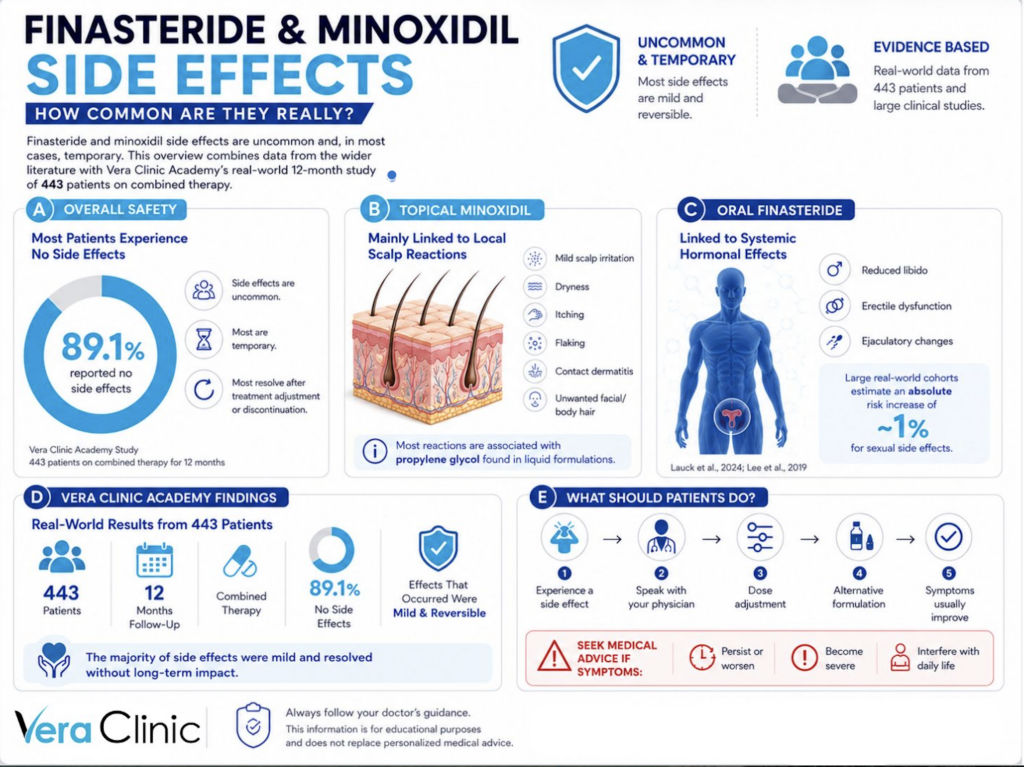
Finasteride and minoxidil side effects are uncommon and, in most cases, temporary. Topical minoxidil is mainly linked to local scalp reactions such as irritation and unwanted hair growth, most often traced to the propylene glycol vehicle in liquid formulations (Gogtay & Panda, 2009). Oral finasteride is linked to systemic hormonal effects, most notably changes in libido, though large real-world cohorts put the absolute risk increase near 1% (Lauck et al., 2024; Lee et al., 2019).
A Vera Clinic Academy study of 443 patients on combined therapy for 12 months found a comparable pattern: 93% of patients reported no side effects at all, and the effects that did occur were mild and reversible. Side effect rates also differ between men and women, since treatment protocols themselves differ by sex. This page covers what these side effects are, how often they occur in both the wider literature and the Vera Clinic Academy cohort, whether they resolve, what to do if you experience them, and when a symptom needs medical attention.
Finasteride and Minoxidil StudyKey Points
- Most patients using finasteride and minoxidil together report no side effects; a Vera Clinic Academy cohort of 443 patients recorded 93% with none over 12 months.
- Topical minoxidil’s most common side effect is scalp irritation, tied mainly to the propylene glycol vehicle in liquid formulations.
- Switching from liquid minoxidil to an alcohol-free foam removes this vehicle and resolved irritation within 14 days in the Vera Clinic Academy cohort.
- Localized hypertrichosis occurred in 2.3% of the female cohort (n=3) in the Vera Clinic Academy study.
- Large real-world cohort data put the absolute risk of finasteride-related sexual dysfunction near 1%, consistent with the 1.6% (n=5) reported in the Vera Clinic Academy male cohort.
- Systemic fatigue or mood changes occurred in 1.1% of patients (n=5) in the Vera Clinic Academy study and resolved within six weeks.
- Minoxidil side effects are localized to the skin; finasteride side effects are systemic and hormonal.
What Are the Most Common Side Effects of Finasteride and Minoxidil?
The most common side effects are scalp irritation and unwanted hair growth from minoxidil, and libido changes or fatigue from finasteride. Minoxidil, applied to the scalp, mainly causes local skin reactions. Finasteride, taken orally or applied in low concentrations, mainly causes systemic hormonal effects. Both drug classes have been studied for decades, and a Vera Clinic Academy cohort of 443 patients on combined therapy adds a directly comparable, more recent dataset. Male patients in this cohort followed a protocol combining oral finasteride (1 mg/day) with topical minoxidil (5%), while female patients used topical minoxidil (2–5%) paired with micro-dosed topical finasteride under clinical monitoring. This difference in protocol is the main reason the side effect profile differs by sex.
- Scalp Pruritus and Erythema: Itching and redness at the application site are the most frequently reported minoxidil side effect, linked to the propylene glycol vehicle in liquid formulations (Gogtay & Panda, 2009). This occurred in 4.1% of patients in the Vera Clinic Academy cohort (n=18).
- Localized Hypertrichosis: Unwanted hair growth outside the treated area is a recognized effect of topical minoxidil (Suchonwanit et al., 2019). It appeared in 2.3% of the Vera Clinic Academy female cohort (n=3), linked to accidental product transfer during sleep.
- Libido Fluctuation: Meta-analyses of finasteride use in androgenetic alopecia report an increased relative risk of sexual dysfunction, though large real-world cohorts put the absolute risk increase near 1% (Lauck et al., 2024; Lee et al., 2019). The Vera Clinic Academy cohort recorded a comparable 1.6% (n=5) among male patients.
- Systemic Fatigue or Mood Changes: Fatigue or mood shifts are a less common finasteride effect. They occurred in 1.1% of patients (n=5) in the Vera Clinic Academy cohort, in the first weeks of treatment.
- Initial Hair Shedding: Increased shedding in the first weeks of minoxidil use reflects the hair cycle shifting into an active growth phase. This is an expected transitional effect, not a documented adverse effect in the Vera Clinic Academy cohort.
Across both drugs, the Vera Clinic Academy data are consistent with the wider clinical literature: side effects are uncommon, and none led to a treatment-ending adverse event in the tracked cohort, which is part of why finasteride for hair loss remains an reliable option even when a mild side effect appears early in treatment.
How Common Is Each Side Effect in Men and Women?
Scalp irritation affects both sexes at a similar rate (4.1%), while hypertrichosis occurs only in women (2.3%) and libido fluctuation occurs only in men (1.6%), because treatment protocols differ by sex. Vera Clinic Academy tracked 312 male and 131 female patients separately over 12 months to measure this difference, with the following results.
| Side Effect | Cohort | Incidence | Sample Size |
|---|---|---|---|
| Scalp pruritus and erythema | Mixed (topical minoxidil users) | 4.1% | n = 18 |
| Localized hypertrichosis | Female cohort | 2.3% | n = 3 |
| Libido fluctuation | Male cohort | 1.6% | n = 5 |
| Systemic fatigue or mood changes | Mixed | 1.1% | n = 5 |
These rates sit within the ranges reported in the wider literature: topical minoxidil irritation is reported around 7% with liquid formulations (Gogtay & Panda, 2009), and finasteride-related sexual dysfunction is reported in the low single digits in large real-world cohorts (Lauck et al., 2024), rates low enough that most patients weighing the trade-offs still choose minoxidil for hair loss overall.
Do Side Effects Differ Between Men and Women?
Yes. Localized hypertrichosis in the Vera Clinic Academy cohort occurred only in the female group, tied to the female protocol’s topical application pattern. Libido fluctuation occurred only in the male group, tied to oral finasteride exposure, which is not part of the standard female protocol. The two side effect profiles do not overlap because the underlying treatment protocols differ by sex, reflecting how hair loss in women is managed with a distinct clinical approach from the outset.
Are These Side Effects Permanent or Temporary?
These side effects are temporary in nearly every recorded case. In the Vera Clinic Academy cohort, scalp pruritus and erythema resolved within 14 days after switching to an alcohol-free foam, systemic fatigue and mood changes returned to baseline within six weeks, and localized hypertrichosis resolved with adjusted application timing. Libido fluctuation did not lead to permanent sexual side effects in this cohort and returned to baseline with continued therapy or a switch to topical finasteride.
The wider literature is more divided on this point for finasteride specifically. Some pharmacovigilance analyses and case series describe sexual and psychological symptoms that continue after the drug is stopped, sometimes referred to as post-finasteride syndrome, though a systematic review and meta-analysis found the evidence for this pattern inconsistent across studies (Zhang et al., 2022). The FDA has separately documented adverse event reports for compounded topical finasteride products describing systemic effects that continued after discontinuation (U.S. Food and Drug Administration, n.d.). Symptoms that persist beyond six weeks, or scalp reactions that do not resolve within 14 days of a formulation change, should not be assumed to resolve on their own; a physician should be consulted instead.
What Should You Do If You Experience Side Effects?
Most side effects respond to a formulation change or a short adjustment period, not to stopping treatment altogether.
- Switch to a Foam Formulation: Propylene glycol-free foam is the standard first response to minoxidil-related irritation (Gogtay & Panda, 2009), and this eliminated symptoms within 14 days in the Vera Clinic Academy cohort.
- Adjust Application Timing: Applying minoxidil in the morning rather than before sleep reduces the risk of accidental transfer linked to localized hypertrichosis.
- Discuss a Topical Finasteride Switch: Male patients reporting libido changes on oral finasteride can discuss switching to topical finasteride with a physician, since systemic absorption is lower with topical delivery.
- Give Initial Shedding Time: Increased shedding in the first weeks of minoxidil use is a transitional effect and does not, on its own, indicate the treatment is failing.
- Track Symptoms With a Physician: Any side effect that does not improve after a formulation or timing adjustment should be reviewed with a prescribing physician.
Vera Clinic’s medical team frames this decision the same way with patients in the clinic:
“The first two weeks on topical minoxidil are an adjustment period, not a verdict. Mild scalp irritation or a short burst of shedding in this window reflects the follicles resetting into an active cycle, not the treatment failing. What we watch for is whether a reaction settles or intensifies: if it settles, we stay the course; if it intensifies past two weeks, we switch the formulation before we’d ever consider stopping.”
—Dr. Emin Gül, Vera Clinic Surgeon
When Should You See a Doctor About These Side Effects?
Most side effects from finasteride and minoxidil are mild and resolve with a formulation change. A smaller set of symptoms signal a reaction serious enough to require medical attention.
- Signs of an Allergic Reaction: Swelling of the face or throat, hives, or difficulty breathing after applying minoxidil or taking finasteride require immediate medical attention.
- Persistent Systemic Symptoms After Stopping: The FDA has documented cases where systemic effects from compounded topical finasteride continued after the product was discontinued (U.S. Food and Drug Administration, n.d.). Patients with symptoms that do not resolve after stopping should consult a physician.
- Chest Pain, Rapid Heartbeat, or Fainting: These symptoms are associated with systemic absorption of minoxidil and warrant prompt medical evaluation, particularly with oral formulations.
- Worsening Rather Than Improving Symptoms: A side effect that intensifies over time, rather than easing within its typical resolution window of one to six weeks, should be reassessed by a physician rather than managed with a formulation change alone.
These situations are uncommon, but they fall outside the pattern of side effects tracked in the Vera Clinic Academy cohort and should not be self-managed.
Frequently Asked Questions
Yes. Hypertrichosis caused by topical minoxidil is a local, dose-related effect. It resolves once the product is discontinued, or once application is adjusted to avoid contact with unintended skin areas such as the face or neck.
Yes, they can. Serum DHT returns to its pre-treatment baseline within about 14 days of stopping finasteride (Kaufman et al., 1998), and restarting the drug re-establishes the same hormonal suppression. Any side effect tied to that suppression, such as libido changes, can recur at a rate comparable to first use.
Only under clinical supervision. Oral finasteride is not standard for women because of the risk of fetal harm during pregnancy and limited efficacy data in female patients. Low-dose topical finasteride is used in some cases, but always under a physician’s monitoring rather than as a self-directed treatment.
Yes, it’s expected. Increased shedding in the first few weeks of minoxidil use reflects the hair cycle shifting into an active growth phase. It is not a sign of an adverse reaction or treatment failure.
References
- Gogtay, J. A., & Panda, M. (2009). Minoxidil topical foam: A new kid on the block. International Journal of Trichology, 1(2), 142–143.
- Lauck, K. C., Limmer, A., Harris, P., & Kivelevitch, D. (2024). Sexual dysfunction with 5-alpha-reductase inhibitor therapy for androgenetic alopecia: A global propensity score matched retrospective cohort study. Journal of the American Academy of Dermatology, 91(1), 163–166.
- Lee, S., Lee, Y. B., Choe, S. J., & Lee, W. S. (2019). Adverse sexual effects of treatment with finasteride or dutasteride for male androgenetic alopecia: A systematic review and meta-analysis. Acta Dermato-Venereologica, 99(1), 12–17.
- Kaufman, K. D., Olsen, E. A., Whiting, D., Savin, R., DeVillez, R., Bergfeld, W., Price, V. H., Van Neste, D., Roberts, J. L., Hordinsky, M., Shapiro, J., Binkowitz, B., & Gormley, G. J. (1998). Finasteride in the treatment of men with androgenetic alopecia. Journal of the American Academy of Dermatology, 39(4 Pt 1), 578–589.
- Suchonwanit, P., Thammarucha, S., & Leerunyakul, K. (2019). Minoxidil and its use in hair disorders: A review. Drug Design, Development and Therapy, 13, 2777–2786.
- U.S. Food and Drug Administration. (n.d.). FDA alerts health care providers, compounders and consumers of potential risks associated with compounded topical finasteride products. Retrieved July 17, 2026.
- Vera Clinic Academy Clinical Research Group. (2026). Prospective longitudinal analysis of finasteride and minoxidil combination therapy: Comprehensive hair density outcomes and multicenter safety profile. Retrieved July 17, 2026.
- Zhang, J. J., Shi, X., Wu, T., Zhang, M. D., Tang, J., Yin, G. M., Long, Z., He, L. Y., Qi, L., & Wang, L. (2022). Sexual, physical, and overall adverse effects in patients treated with 5α-reductase inhibitors: A systematic review and meta-analysis. Asian Journal of Andrology, 24(4), 390–397.