

Yes, minoxidil is effective for hair loss in most people who use it consistently: as a topical or oral vasodilator, it opens potassium channels in the scalp, increases blood flow around the hair follicle, and extends the anagen (growth) phase of hair that would otherwise shift into shedding. In a 12-month Vera Clinic Academy cohort of 443 patients on combined minoxidil and finasteride therapy, mean hair density increased by 28.9% from baseline. This figure reflects minoxidil’s contribution within a combination protocol rather than minoxidil used alone, since the study did not include a minoxidil-only arm. Minoxidil does not target the hormonal cause of pattern hair loss the way finasteride does, which is why it is prescribed to both men and women and why response depends on consistent daily use rather than dosage alone.
Key Points
- Minoxidil works by opening potassium channels in the scalp, increasing blood flow to hair follicles and prolonging the anagen growth phase.
- In a Vera Clinic Academy cohort of 443 patients on combined minoxidil and finasteride therapy, mean hair density increased 28.9% at 12 months, though the study did not isolate minoxidil’s individual contribution.
- Female patients (n=131), using topical minoxidil at 2% or 5%, showed a 25.8% density increase at 12 months, close to the 30.2% seen in men in the same cohort.
- Scalp pruritus and erythema, linked to the propylene-glycol vehicle in some formulations, occurred in 4.1% of the combined cohort and resolved within 14 days after switching to an alcohol-free foam.
- Localized hypertrichosis occurred in 2.3% of the female cohort and was managed by adjusting the timing of application.
- Unlike finasteride, minoxidil carries no hormone-based restriction, so it is prescribed to both men and women, though oral minoxidil requires cardiovascular screening.
What Is Minoxidil for Hair Loss?
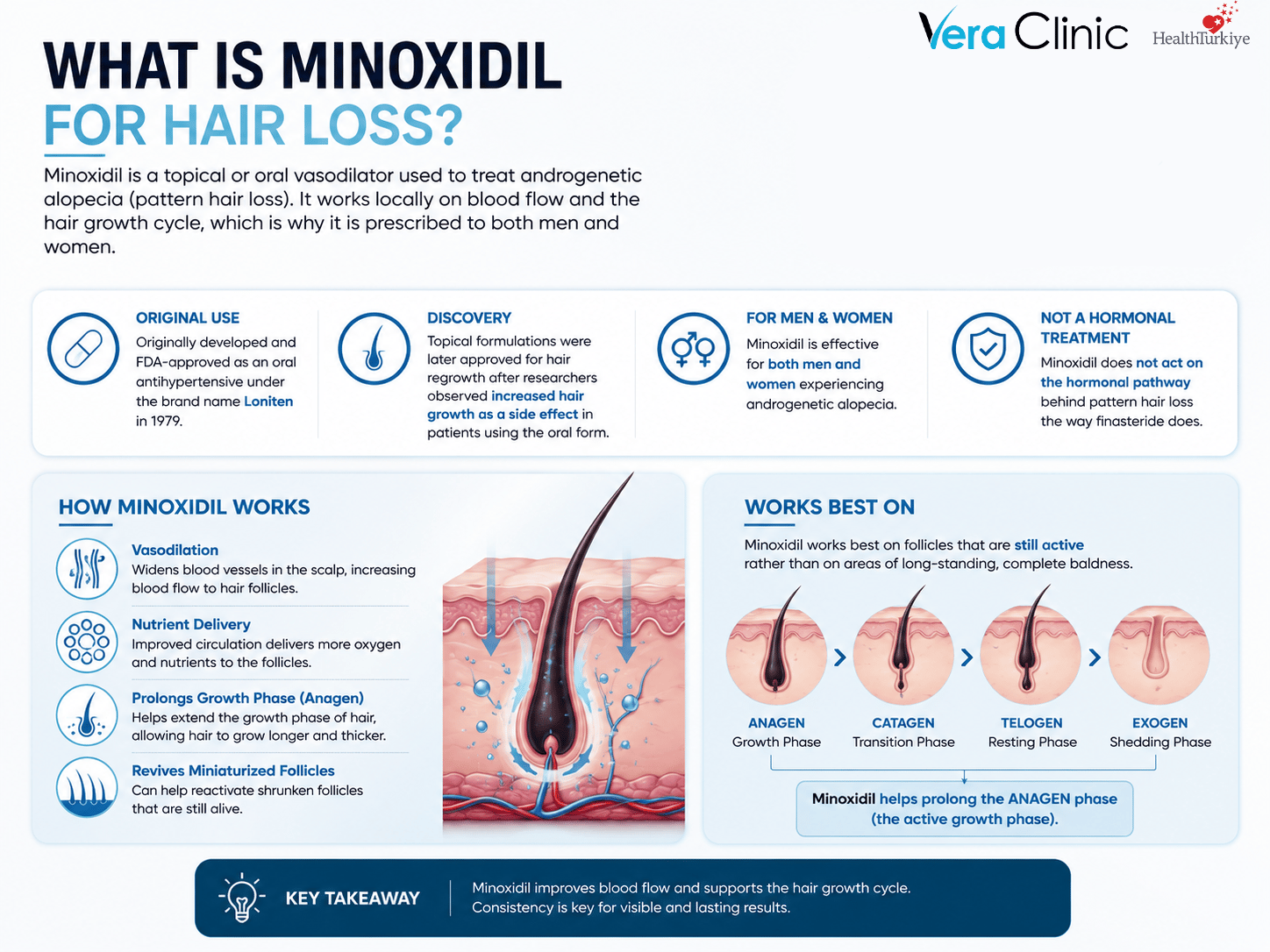
Minoxidil is a topical or oral vasodilator used to treat androgenetic alopecia (pattern hair loss). It was originally developed and FDA-approved as an oral antihypertensive under the brand name Loniten in 1979; topical formulations were later approved specifically for hair regrowth after researchers observed increased hair growth as a side effect in hypertension patients treated with the oral form. Minoxidil does not act on the hormonal pathway behind pattern hair loss the way finasteride does. Instead, it works locally on blood flow and the hair growth cycle, which is why it is prescribed to both men and women. It works best on follicles that are still active rather than on areas of long-standing, complete baldness.
How Does Minoxidil Work to Stop Hair Loss?
Minoxidil works by opening potassium channels in vascular smooth muscle, which relaxes blood vessels around the hair follicle and increases local blood flow and oxygen delivery to the follicle bulb (Suchonwanit et al., 2019). This increased perfusion shifts follicles out of the resting (telogen) phase and prolongs the active growth (anagen) phase, allowing thinning follicles to produce thicker, longer hair for a greater share of their cycle. Because this mechanism works on blood flow and the follicle cycle rather than on DHT, minoxidil’s benefit depends on the follicle still being capable of growth; it cannot revive follicles that have scarred over or stopped producing hair entirely. This is a maintenance-and-stimulation mechanism, not a permanent cure: benefits require continued use, and effects reverse gradually after stopping.
What Types of Minoxidil Are Available?
Minoxidil is available in several forms, and the concentration and route used often depend on the patient’s sex and treatment goals.
- Topical Minoxidil 2%: The original topical concentration, used more often in female patients; part of the female cohort (n=131) in Vera Clinic Academy’s combined-therapy study used this concentration.
- Topical Minoxidil 5%: A higher-concentration solution or foam; twice-daily topical minoxidil 5% was the standard protocol for the male cohort (n=312) in the same study.
- Topical Minoxidil Foam vs. Solution: Foam formulations are alcohol-free and cause less scalp irritation than liquid solutions for patients who develop pruritus or erythema on the solution form.
- Oral Minoxidil (Low-Dose): A prescription-only tablet, used off-label at doses far below the antihypertensive range, for patients who cannot tolerate topical formulations or want a simpler daily routine.
- Minoxidil and Finasteride Combination: Pairing minoxidil’s vascular effect with finasteride’s hormonal action targets two separate mechanisms of hair loss at once and is the protocol behind Vera Clinic Academy’s own outcome data.
Who Is a Good Candidate for Minoxidil?
Minoxidil is suited to men and women with early-to-moderate androgenetic alopecia or diffuse thinning, since it works on follicles that are still cycling rather than regenerating those that have scarred over.
- Men and Women With Early-to-Moderate Thinning: Patients with visible thinning but retained follicle activity respond best; areas of complete, long-standing baldness show limited benefit.
- Patients Who Can Commit to Daily, Long-Term Use: Minoxidil requires continued application or dosing to maintain any benefit; stopping treatment allows hair loss to resume over the following months.
- Patients Without Significant Cardiovascular Conditions (Oral Form): Because minoxidil is a vasodilator, oral use requires screening for low blood pressure, fluid retention, and heart conditions before prescribing.
- Not Recommended During Pregnancy or Breastfeeding: Oral minoxidil is contraindicated in pregnancy due to its cardiovascular effects, and topical use during pregnancy should be discussed with a physician.
- Not Standard for Advanced (Late-Stage) Baldness: Patients with little remaining follicle activity in the affected area see limited benefit from minoxidil alone and are often better candidates for a hair transplant instead.
A physician’s evaluation, not self-selection, determines candidacy, particularly around cardiovascular history for the oral form.
How Is Minoxidil Different for Women?
Minoxidil for women works through the same mechanism as in men, but dosing, formulation, and safety considerations differ. Women are more often started on the 2% solution or the 5% foam rather than the 5% solution used by most men, largely because facial and body hypertrichosis, unwanted hair growth on adjacent skin, is a side effect women are more likely to notice and want to avoid. This is consistent with the 2.3% hypertrichosis rate recorded in Vera Clinic Academy’s female cohort above; the same effect is rarely flagged as a concern in male patients.
Clinical evidence in women also stands on its own rather than being extrapolated from male trials. In a 24-week trial of 113 women, once-daily 5% minoxidil foam produced a non-vellus hair count increase of 31.9 per cm², statistically similar to the 28.4 per cm² increase from twice-daily 2% solution, with significantly less scalp irritation on the foam (Blume-Peytavi et al., 2011). In a separate 48-week, placebo-controlled trial of 381 women, 5% topical minoxidil increased non-vellus hair count by 24.5 per cm², compared with 20.7 per cm² for 2% and 9.4 per cm² for placebo (Lucky et al., 2004).
Pregnancy and breastfeeding also warrant more caution in women than a single line can cover. Topical minoxidil is not recommended during pregnancy, since systemic absorption is possible and safety data in pregnant women are limited; oral minoxidil is contraindicated outright due to its cardiovascular effects. Minoxidil has not been established as safe during breastfeeding either, since it can be absorbed into breast milk in small amounts; physicians generally recommend stopping treatment or avoiding application near the nipple area if a nursing mother continues.
Because finasteride is not generally prescribed to women, minoxidil more often functions as a first-line or sole pharmacological treatment in women, sometimes alongside spironolactone, an oral anti-androgen used off-label for hair loss in women through an entirely different mechanism than minoxidil.
How Effective Is Minoxidil for Hair Loss?
Across published clinical trials, minoxidil slows hair loss and produces measurable regrowth in a majority of consistent users, though its effect size in men is generally smaller than finasteride’s when used alone.
- Topical Minoxidil vs. Placebo: A randomized trial comparing 5% and 2% topical minoxidil to placebo found both concentrations produced significantly greater hair growth than placebo, with the 5% formulation producing faster results (Olsen et al., 2002).
- Minoxidil Alone vs. Combination Therapy: A randomized comparative study in patients with androgenetic alopecia found improvement in hair volume in 59% of men using minoxidil alone, compared with 80.5% using finasteride alone and 94% using the combination of both (Hu et al., 2015).
- Timeline to Assess Response: Most clinical guidelines recommend at least 4 to 6 months of continuous use before judging whether minoxidil is working for a given patient.
Used together, minoxidil and finasteride address two separate mechanisms of pattern hair loss, positioning the combination among the established effective hair loss treatments. This is consistent with the additive benefit Vera Clinic Academy observed in its own combination-therapy cohort.
What Does Vera Clinic Academy’s Own Data Show on Minoxidil?
Vera Clinic Academy’s own prospective, single-arm observational cohort of 443 patients on combined minoxidil and finasteride therapy recorded a mean hair density increase of 28.9% at 12 months. Because the study included no minoxidil-only comparison arm, this figure describes minoxidil’s contribution within the combination protocol rather than proof of what minoxidil alone would achieve.
| Timepoint | Mean Density Change | Density (hairs/cm²) | Adherence |
| Baseline (T₀) | 0.0% (reference) | 142 ± 14 | 100.0% |
| 6 Months (T₁) | +16.2% | 165 ± 12 | 93.2% |
| 12 Months (T₂) | +28.9% | 183 ± 11 | 88.3% |
Response also differed by sex within the same cohort. Female patients (n=131), who used topical minoxidil at 2% or 5% alongside a clinically monitored anti-androgen or micro-dosed topical finasteride, showed a mean density increase of 25.8% at 12 months. Male patients (n=312), who followed a standard protocol of twice-daily topical minoxidil 5% with oral finasteride 1mg/day, saw a mean increase of 30.2%, according to the Finasteride and Minoxidil Study. Vellus-to-terminal hair conversion accounted for a substantial share of the measured increase in the male cohort. The closeness of the male and female figures, despite different hormonal treatment intensity between the groups, is consistent with minoxidil’s vascular mechanism contributing meaningfully to both outcomes.
What Are the Side Effects of Minoxidil?
Minoxidil’s side effects are mostly local and mild, and only a minority of users experience them.
- Scalp Pruritus and Erythema: Occurred in 4.1% of Vera Clinic Academy’s combined-therapy cohort (n=18 of 443), linked to the propylene-glycol vehicle in some solutions; switching to an alcohol-free foam resolved symptoms within 14 days.
- Localized Hypertrichosis: Occurred in 2.3% of the female cohort (n=3 of 131), managed by adjusting the timing of application rather than discontinuing treatment.
- Initial Shedding: A temporary increase in shedding can occur in the first weeks of use, reflecting follicles cycling into a new growth phase rather than treatment failure.
- Systemic Effects (Oral Form Only): Because oral minoxidil is a vasodilator, low blood pressure, fluid retention, and rapid heartbeat are possible and require cardiovascular screening before prescribing.
Managing these reactions early, and knowing which ones overlap with broader finasteride and minoxidil side effects, keeps most patients on their protocol without interruption
How Much Does Minoxidil Cost?
Minoxidil’s cost depends heavily on whether it is bought as a topical over-the-counter product or an oral prescription requiring monitoring.
| Option | Monthly Cost | What’s Included |
| Generic topical minoxidil (5%, foam or solution) | $8–$20 | Medication only; available over the counter without a prescription |
| Brand-name Rogaine (5%) | $30–$50 | Medication only, brand-name pricing |
| Generic oral minoxidil (compounded low-dose) | $30–$90 | Medication plus compounding; prescription and monitoring required |
| Vera Clinic combined protocol | Included in treatment package | Consultation, prescription, and monitoring folded into the broader hair loss or transplant plan |
Topical minoxidil is available over the counter and costs markedly less than the oral form, which requires a prescription and periodic monitoring. At Vera Clinic, minoxidil is prescribed and monitored as part of a broader treatment plan rather than priced as a standalone item, so patients evaluating cost should request a personalized quote based on their specific protocol.
How Long Does It Take to See Results From Minoxidil?
Minoxidil follows a gradual timeline tied to the natural hair growth cycle, and most guidelines caution against judging its effectiveness before 4 to 6 months of continuous use.
- First 2 to 6 Weeks: An initial shedding phase can occur as follicles are pushed into a new growth cycle; this is expected and not a sign that treatment is failing.
- 3 to 4 Months: Shedding generally slows and the earliest visible improvement in density can appear.
- 6 to 12 Months: The point at which most clinical guidelines recommend assessing whether minoxidil is working, consistent with the largest gains recorded in Vera Clinic Academy’s cohort between month 6 and month 12.
- Ongoing Use: Continued use is required to maintain any benefit; stopping treatment allows the follicle cycle to revert and hair loss generally resumes over the following months.
Can Minoxidil Be Combined With a Hair Transplant?
Yes. Minoxidil is commonly included in post-transplant care to support the native hair surrounding the graft area, since the same vascular mechanism that extends the growth phase elsewhere on the scalp applies to native follicles as well. Grafted follicles are already committed to an active growth cycle by the time they are placed, so minoxidil’s role centers on the surrounding native hair rather than the graft itself. For this reason, minoxidil is often included as part of a patient’s hair transplant aftercare routine following a hair transplant in Turkey. At Vera Clinic, the prescription and timing are tailored to each patient’s protocol rather than applied as a fixed rule.
Why Choose Vera Clinic for Hair Loss Treatment?
Vera Clinic’s approach to minoxidil treatment starts with a full scalp evaluation, not a concentration and formulation chosen off the shelf. Minoxidil, especially the oral form, is increasingly prescribed through questionnaire-based telehealth services without a physical exam or cardiovascular screening; our approach requires an in-person assessment before oral minoxidil is prescribed, since candidacy for the oral form depends on cardiovascular history that a questionnaire alone cannot capture. Every patient is assessed for candidacy, monitored for side effects, and given a protocol tailored to their stage of hair loss and sex, whether that means minoxidil alone, combined with finasteride, or as part of a broader hair transplant plan. Our in-house Vera Clinic Academy research team continues to track patient outcomes over time, so treatment recommendations are grounded in real, ongoing clinical data rather than general guidelines alone. Book a free consultation to find out which protocol fits your hair loss pattern
Frequently Asked Questions
Yes. Topical minoxidil at 2% or 5% is approved for long-term use in women with androgenetic alopecia, and continued use is required to maintain benefit, since stopping treatment allows hair loss to resume.
No. The side effects reported in Vera Clinic Academy’s cohort, scalp irritation and localized hypertrichosis, resolved with a formulation change or adjusted application and were not permanent; systemic effects from the oral form also resolve after stopping.
Oral minoxidil is not recommended during pregnancy due to its cardiovascular effects, and topical use during pregnancy should be discussed with a physician before starting or continuing treatment.
Both forms work through the same vasodilatory mechanism; oral minoxidil is prescribed off-label at low doses and may suit patients who cannot tolerate topical formulations, but it requires cardiovascular screening that topical use does not.
No. Stopping minoxidil allows hair loss to resume at the rate it would have followed without treatment; it does not accelerate loss beyond the underlying pattern.
Sources
- Vera Clinic Academy Clinical Research Group. (2026). Prospective longitudinal analysis of finasteride and minoxidil combination therapy: Comprehensive hair density outcomes and safety profile. Vera Clinic Academy.
- Suchonwanit, P., Thammarucha, S., & Leerunyakul, K. (2019). Minoxidil and its use in hair disorders: A review. Drug Design, Development and Therapy, 13, 2777–2786.
- Olsen, E. A., Dunlap, F. E., Funicella, T., et al. (2002). A randomized clinical trial of 5% topical minoxidil versus 2% topical minoxidil and placebo in the treatment of androgenetic alopecia in men. Journal of the American Academy of Dermatology, 47(3), 377–385.
- Hu, R., Xu, F., Han, Y., et al. (2015). Combined treatment with oral finasteride and topical minoxidil in male androgenetic alopecia: A randomized and comparative study in Chinese patients. Dermatologic Therapy, 28(5), 303–308.
- Blume-Peytavi, U., Hillmann, K., Dietz, E., Canfield, D., & Garcia Bartels, N. (2011). A randomized, single-blind trial of 5% minoxidil foam once daily versus 2% minoxidil solution twice daily in the treatment of androgenetic alopecia in women. Journal of the American Academy of Dermatology, 65(6), 1126–1134.
- Lucky, A. W., Piacquadio, D. J., Ditre, C. M., et al. (2004). A randomized, placebo-controlled trial of 5% and 2% topical minoxidil solutions in the treatment of female pattern hair loss. Journal of the American Academy of Dermatology, 50(4), 541–553.