

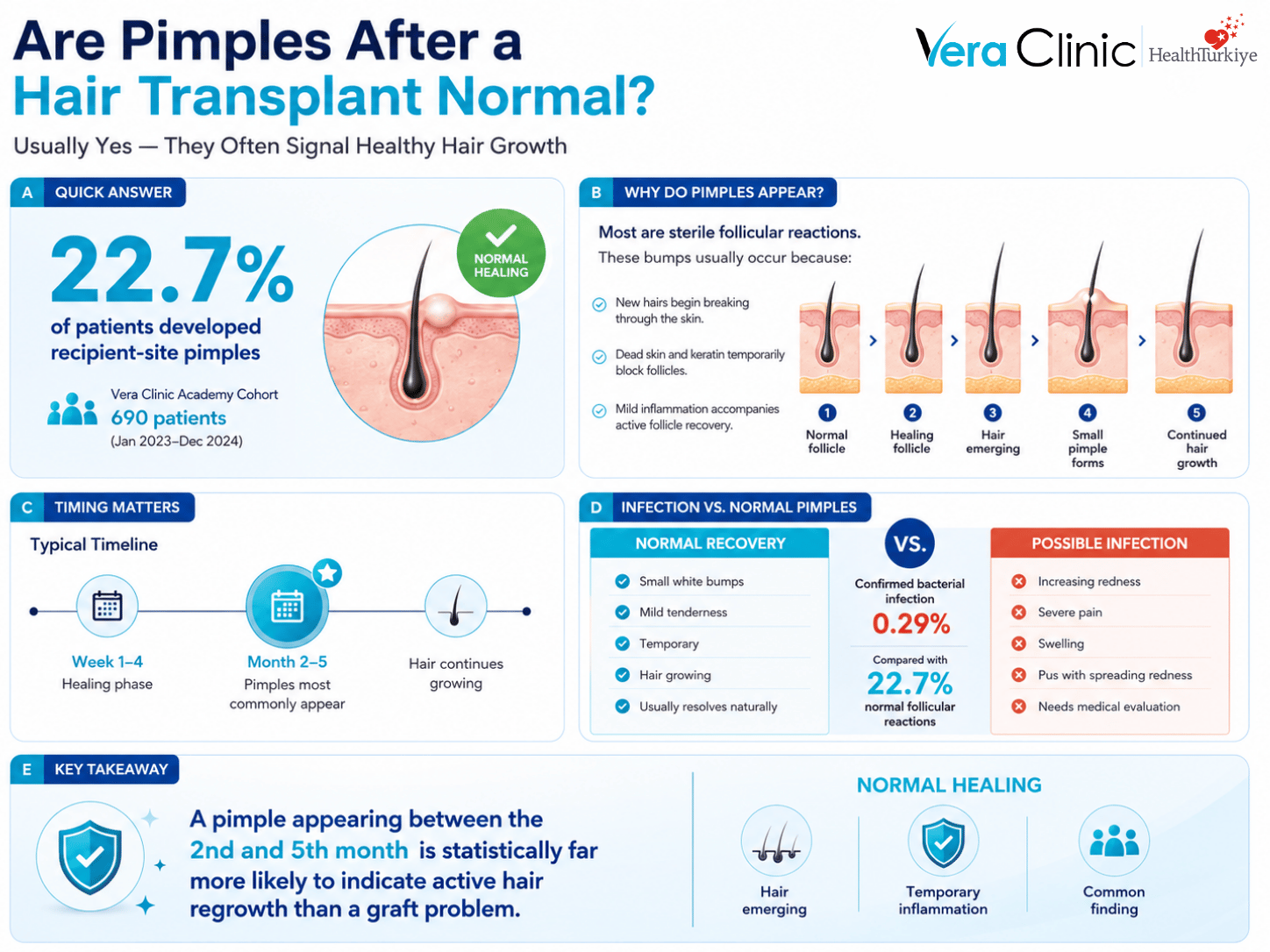
Pimples after a hair transplant are a normal part of healing for most patients, not a sign that the procedure has failed. In a Vera Clinic Academy retrospective cohort analysis of 690 patients treated between January 2023 and December 2024, with follow-up through December 2025, recipient-site breakthrough pimples were recorded in 22.7% of cases, appearing between months two and five after surgery. These lesions are classified as sterile inflammatory reactions linked to newly emerging hair shafts pushing through healing tissue, not bacterial infection or graft rejection. A separate, much rarer category, confirmed bacterial folliculitis, occurred in only 0.29% of the same cohort and required antibiotic treatment.
Complication and Side-Effect Incidence RegistryKey Points
- Pimples after a hair transplant are sterile follicular reactions in most cases, not infection or a sign of graft failure.
- Vera Clinic Academy recorded breakthrough pimples in 22.7% of 690 patients treated between January 2023 and December 2024, appearing between months two and five post-op.
- Confirmed bacterial folliculitis is far rarer, at 0.29% of the same cohort, and resolves within about a week with oral antibiotics.
- Pimples appear later in the healing sequence than itching (days 5 to 14) or flaking (weeks 2 to 6), aligning with new hair shafts emerging through the scalp.
- Warning signs that call for clinical review include spreading redness, pus, fever, or a lesion that persists past month five.
- Avoiding touching or picking the area, following the clinic’s washing protocol, and limiting sun and sweat exposure early on all reduce the risk.
Are Pimples After a Hair Transplant Normal?
Yes, pimples after a hair transplant are a normal and common part of the recovery process for a meaningful share of patients. Across the Vera Clinic Academy cohort of 690 patients (January 2023 to December 2024, followed through December 2025), recipient-site breakthrough pimples were documented in 22.7% of cases. The study classifies these as sterile follicular reactions rather than a complication, distinguishing them clearly from the 0.29% of cases involving confirmed bacterial infection. A pimple appearing in the recipient area during the second to fifth month is, statistically, far more likely to represent active regrowth than a problem with the graft.
Why Do Pimples Develop After a Hair Transplant?
Pimples develop after a hair transplant because a newly implanted hair shaft has to push through healing skin to emerge, and that process can trigger a localized, sterile inflammatory reaction around the follicle. Mild sebum retention around the healing graft site plays a contributing role as well. According to the Vera Clinic Academy cohort authors, Msc. Victor Okonoyi and Assoc. Dr. Samuel Filima, this pattern reflects active follicular regeneration rather than a failing graft; their diagnostic tracking across the study period found no correlation between breakthrough pimples and reduced graft survival. In practical terms, a pimple at month three is closer to evidence that a new hair is on its way than a warning sign.
When Do Pimples Appear After a Hair Transplant?
Breakthrough pimples follow a distinct timeline that sits later in the healing sequence than most other post-operative skin reactions. Understanding where they fall relative to other expected symptoms helps separate normal healing from something that needs attention.
- Days 5 to 14 (Scalp Pruritus): Itching affects 68.4% of patients in the same cohort and is linked to histaminergic healing of the micro-wounds, resolving within two weeks.
- Weeks 2 to 6 (Transient Desquamation): Dandruff-like flaking around resolving graft crusts occurs in 41.2% of patients as the epidermis sheds damaged surface layers.
- Months 2 to 5 (Breakthrough Pimples): Sterile recipient-site pimples appear in 22.7% of patients as new hair shafts emerge, the latest-onset reaction in the typical recovery sequence.
Pimples arriving within this two-to-five-month window align with the expected hair transplant timeline for regrowth and are generally self-resolving without intervention.
Are Pimples a Sign of Infection or Graft Failure?
No, in the large majority of cases pimples are not a sign of infection or graft failure, but the same cohort data shows there are three distinct patterns worth telling apart.
- Sterile Breakthrough Pimples: The most common pattern, seen in 22.7% of patients, caused by emerging hair shafts and resolving without antibiotics.
- Bacterial Folliculitis or Infection: A rare pattern, occurring in only 0.29% of patients, presenting as superficial pustules that require oral antibiotic treatment and resolve within roughly seven days.
- Mechanical Ingrown Shafts: Lesions caused by a hair shaft curling back into the follicle rather than emerging cleanly, typically limited to isolated grafts rather than a broader breakout pattern.
None of these three hair transplant infection patterns is associated with graft loss in the Vera Clinic Academy data; the distinguishing factor between them is not whether a pimple appears, but its scale, appearance, and response to basic care.
When Should You Contact Your Clinic About Pimples After a Hair Transplant?
You should contact your clinic if a pimple is accompanied by spreading redness, visible pus discharge, fever, or pain that is increasing rather than settling, since these signs point toward the rarer bacterial pattern rather than routine healing. A lesion that persists well beyond the five-month window associated with breakthrough pimples in the cohort data is also worth flagging rather than monitoring indefinitely.
How Does Vera Clinic Treat Pimples After a Hair Transplant?
Vera Clinic treats confirmed bacterial cases with oral antibiotics, which resolved infections within approximately seven days across the Academy cohort. Patients are not advised to self-treat lesions with over-the-counter acne products during the early recipient-area healing window, since the graft site requires different handling than ordinary facial skin.
How Can You Reduce the Risk of Pimples After a Hair Transplant?
Reducing the risk of pimples after a hair transplant starts with leaving the recipient area alone while it heals.
- Avoid Touching or Picking: Handling the scalp increases the risk of turning a sterile reaction into a mechanical or bacterial one.
- Follow the Washing Protocol: Using the clinic-recommended washing routine keeps sebum and debris from accumulating around healing grafts, similar to the care routine used for managing itching after a hair transplant.
- Limit Sun and Sweat Exposure Early On: Excess moisture and UV exposure in the first weeks can aggravate healing follicles.
- Sleep and Fabric Contact: Avoiding direct pillow friction on the recipient area in the early weeks reduces mechanical irritation around emerging grafts.
Consistent aftercare in the first month has a direct bearing on how the skin responds later, when new hair shafts begin to emerge around month two.
Why Choose Vera Clinic for Hair Transplant Aftercare?
Vera Clinic’s aftercare approach is built on its own Academy research rather than general industry assumptions, giving patients a data-backed picture of what is normal at each stage of recovery instead of vague reassurance. Because the clinic tracks outcomes across hundreds of patients through Vera Clinic Academy, patients get precise expectations, not guesses, when something appears on the scalp during healing. This same evidence base informs the clinic’s hair transplant aftercare guidance from day one through full regrowth.
FAQ
The Vera Clinic Academy cohort recorded breakthrough pimples specifically at recipient sites, where new hair shafts are emerging. The donor area follows a different healing pattern and is not the focus of this incidence data.
No, popping or squeezing a pimple near a recently transplanted graft risks displacing or damaging the follicle underneath. Sterile breakthrough pimples resolve on their own as the hair shaft fully emerges, so intervention is more likely to cause harm than to speed healing.