
Jeff Bezos spent 13 years as the internet’s most famous shaved head, so when photos surfaced on November 2, 2026 showing him with a fresh, even layer of hair across the front of his scalp, every hair surgeon on the planet zoomed in. Nothing is verified yet: Bezos has said nothing and no major outlet has confirmed a procedure. To a hair surgeon’s eye, though, the photos look a lot like a hair transplant at roughly two weeks post-op, and if that is what we are seeing, it is a well-planned one for good reasons. The new hair sits on the frontal hairline and mid-scalp while the crown stays bare, which is exactly how you plan a Norwood VI to VII case when the donor supply has limits. Covering his whole scalp would take around 4,850 grafts based on Vera Clinic Academy data from 522 patients, so going frontal first at 62 is the move a good surgeon makes. Here is the quick breakdown, assuming the photos show what they appear to show:
| Question | Our read |
|---|---|
| Did he get a hair transplant? | Unverified, but the photos look like one |
| Time since surgery | About 2 weeks |
| Age | 62 |
| Norwood stage before | VI to VII |
| Area treated | Frontal hairline and mid-scalp |
| Area left for later | Crown |
| Likely technique | Shaved, FUE-based session (Sapphire FUE style) |
| Approximate grafts | 4,000 to 4,500 |
| Grafts for full Norwood VII coverage | About 4,850 (Vera Clinic Academy, 522 patients) |
| Where | Turkey, according to unverified posts on X |
| Next milestones | Shedding in weeks 2 to 8, new growth from month 3 to 4, final look around month 12 |
Each estimate is our reading of the photos measured against Vera Clinic Academy graft benchmarks, and none of it has been confirmed by Bezos or his team.
Did Jeff Bezos Get a Hair Transplant?
There is no verified answer yet. Jeff Bezos has not announced a hair transplant and no major outlet has confirmed one, but the photos shared on November 2, 2026 look like a transplant at about two weeks after surgery. If that is the case, his earlier photos showing complete hair loss across the frontal area and the crown place him at Norwood stage VI to VII, and the treated area and visible density point to approximately 4,000 to 4,500 grafts.
What makes it look surgical is the hairline. Hair does not spontaneously return to a scalp that has been bare for more than a decade, and the new hair in the photos has a defined front edge, an even length and a clear stopping point before the crown. That is what a surgical plan looks like, not what regrowth looks like. The photos, taken at a marina with Lauren Sánchez Bezos, were shared alongside posts saying the procedure was done in Turkey, while other users called them fake. Until Bezos or his team comments, the analysis below treats a hair transplant as likely, not confirmed.
What Do the Viral Jeff Bezos Photos Show?
Zoom in on the photos and five details stand out to a hair surgeon, all of them pointing toward a transplant:
- A brand-new hairline: There is a clean, defined front edge where earlier photos showed nothing but skin.
- Mid-scalp fill: Short, even hair continues behind the hairline toward the top of the head, giving the face a full frame.
- A bare crown: In the angles visible in the photos, the vertex looks untouched, which would fit a deliberate frontal-first plan, not a miss.
- Uniform length: Every visible hair is the same short length, the signature of a fully shaved session about two weeks earlier.
- No visible redness or scabbing: The scalp has already settled, which fits the 10 to 14 day mark after FUE.
The one thing the photos cannot show clearly is the back of the head, and the hair transplant donor area is what decides whether he can come back for the crown later.
What Was Jeff Bezos’s Hair Loss Pattern Before the Photos?
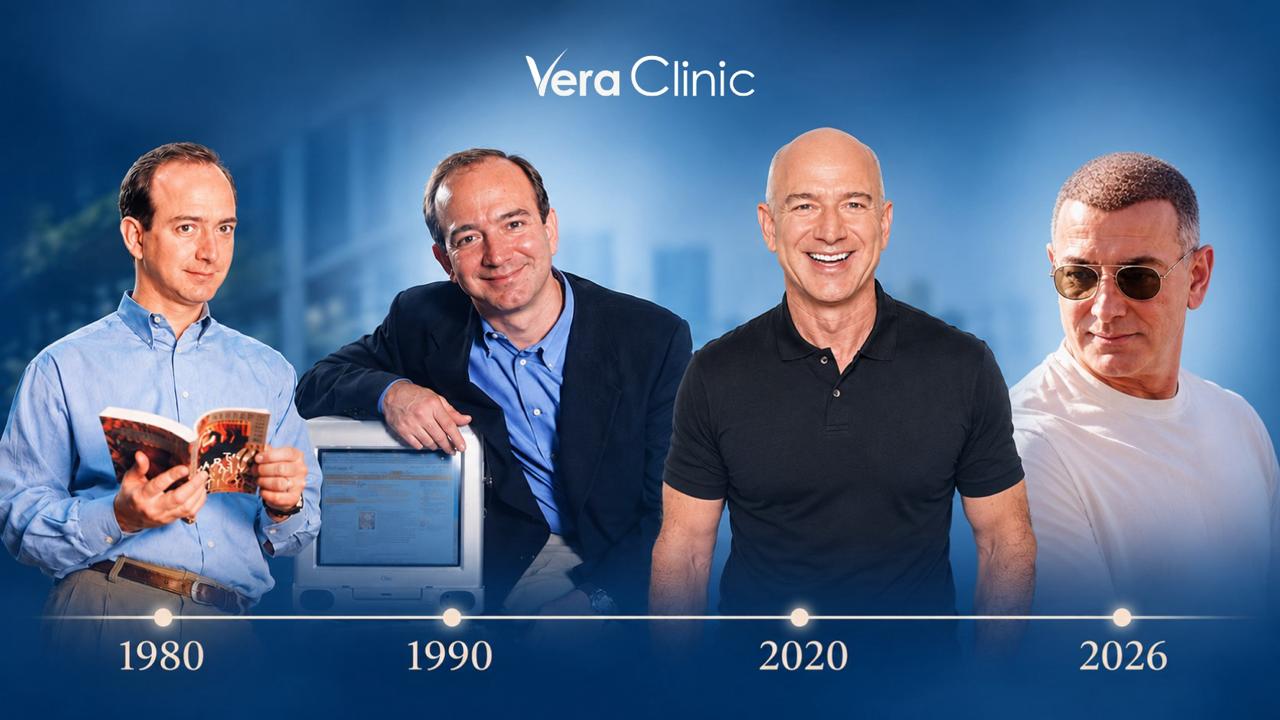
Jeff Bezos had advanced male pattern hair loss that, from public photos, corresponds to Norwood stage VI to VII on the Hamilton-Norwood scale. Public photos from the 1990s and 2000s show thinning across the front and top that progressed over the years, and around 2013 he shaved his head completely and kept it that way for more than ten years.
In July 2025, two weeks after his wedding in Venice, Bezos appeared at the Sun Valley conference with grey and white hair grown out along the sides and back. That photo gave the game away: it showed a horseshoe-shaped band of remaining hair around a bald front, top and crown, the classic outline of late-stage androgenetic alopecia. It also showed that a usable donor fringe still existed. That places Bezos firmly at the advanced end of the Hamilton-Norwood scale.
How Many Grafts Would a Norwood 6 or 7 Patient Need?
Full coverage at Norwood VI requires a mean of 4,600 grafts and Norwood VII a mean of 4,850 grafts, according to a Vera Clinic Academy retrospective cohort of 522 patients. The table shows the advanced end of that dataset:
| Norwood stage | Mean grafts (± SD) | Calibrated range | What it covers |
|---|---|---|---|
| IV | 3,650 ± 400 | 3,250–4,050 | Frontal and mid-scalp with early crown |
| V | 4,200 ± 450 | 3,750–4,650 | Frontal, mid-scalp and crown, narrowing bridge |
| VI | 4,600 ± 400 | 4,200–5,000 | Full top of scalp, bridge lost |
| VII | 4,850 ± 450 | 4,400–5,300 | Full top of scalp, thin horseshoe donor band |
If the photos show a frontal transplant, the plan only had to cover the front and middle of that map, which is why an estimate of 4,000 to 4,500 grafts is plausible for a first session. Source: Validation of Baldness Staging Scales, Vera Clinic Academy (522 patients: 412 male, 110 female).
Why Would a Surgeon Leave the Crown Untreated?
A surgeon leaves the crown untreated when the donor supply cannot cover the whole scalp at a natural density. At Vera Clinic, cases needing 4,000 or more grafts, or combined frontal and crown coverage, are staged across two sessions. The reasoning behind a frontal-first plan:
- Visibility: The hairline frames the face in every front-facing photo, while the crown is seen mainly from behind and above.
- Donor budget: Grafts spent on the crown are no longer available to the hairline, and the crown absorbs a large number of grafts for a modest visual gain.
- Progression risk: Grafting the vertex alone in a still-progressing pattern can leave an isolated island of hair as surrounding native hair continues to thin.
- Staging: Leaving the crown for a later session allows the surgeon to judge how the first grafts grow and how the donor area recovers.
Vera Clinic’s position is that the hairline takes priority over the crown when donor reserve is limited and both areas are bald. A crown hair transplant remains an option in a second session if donor density allows.
How Should a Hairline Be Designed for a 62-Year-Old Man?
A hairline for a 62-year-old man should sit higher and softer than a young man’s hairline, so it still looks natural as he ages. Vera Clinic surgeons weigh four design choices in a mature patient:
- Height: The hairline is placed at an age-appropriate height on the forehead rather than at its original position from the patient’s twenties.
- Temporal recession: Mild recession at the temples is kept, because a straight, flat line reads as artificial on an older face.
- Irregular transition zone: Single-hair grafts are placed in a soft, uneven front edge, with multi-hair grafts behind them for the body.
- Density allocation: The front receives most of the grafts and the area behind it fewer, since the eye cannot reliably tell 50% density from 100% density (ISHRS, 2024).
The goal is a hairline that frames the face without signalling surgery, which is the same principle Vera Clinic applies to every patient seeking a hair transplant for receding hairline.
Which Hair Transplant Technique Fits a Norwood VI–VII Case?
High-graft Sapphire FUE is the base technique Vera Clinic uses for a shaved Norwood VI to VII case, with DHI considered where hairline density or an unshaven approach is the priority. The comparison below applies both techniques to a case like the one in the photos:
| Factor | Sapphire FUE | DHI (Choi implanter) |
|---|---|---|
| Shaving | Full shave, as seen in the photos | Can be unshaven; Vera Clinic performs unshaven cases only with DHI |
| Best use in advanced loss | Large coverage across frontal and mid-scalp | Dense packing in the hairline zone |
| Healing time | 5–7 days | 7–10 days |
| Channel creation | At Vera Clinic, a doctor-led hair transplant hospital, channel opening is performed by the doctor. | No separate channel opening; the graft is placed directly with the implanter, and at Vera Clinic, a doctor-led hair transplant hospital, the doctor performs the procedure. |
| Fit for Norwood VI–VII | Primary choice when donor density allows | Tailored use, or combined with FUE |
Among the main hair transplant techniques, the uniform shaved appearance in the photos is more consistent with an FUE-based session than an unshaven DHI case. Where the two methods differ most, on shaving, healing time and hairline density, is compared in our DHI vs FUE hair transplant guide.
Does Age or Grey Hair Change a Hair Transplant Outcome?
Age alone does not rule out a hair transplant, but it changes how the case is assessed. A Vera Clinic Academy internal audit of 40 patients evaluated for advanced age and general health between April 2024 and March 2025 accepted 87.5% of them, and every decline was linked to health status rather than age. The factors that matter at 62:
- General health: Cardiovascular health, medication use and healing capacity are reviewed more closely than in younger patients.
- Donor thinning: The donor band can thin with age, so donor density is measured before any graft target is set.
- Grey and white hair: Unpigmented hair is harder to see during extraction, so surgeons use contrast tinting and extra dissection time to protect graft quality.
- Ongoing loss: Native hair can keep thinning after surgery, which is why maintenance medication is discussed alongside the transplant.
Vera Clinic sets no maximum age for surgery, provided donor density is adequate and no health condition would compromise healing, which is the core of its best age for a hair transplant guidance.
Grey donor hair also softens the result, because low contrast against the scalp makes the hairline look less abrupt. The flip side is extraction: a white hair transplant depends on contrast tinting and extra dissection time to protect graft quality.
Why Do Men Decide on a Hair Transplant Later in Life?
Men who decide on a hair transplant later in life cite confidence, life changes and a wish to match how they look with how they feel. The internet has already decided the Bezos story is about his marriage, but in our hospital the reasons are rarely that simple, and they are always personal.
What can be measured is the effect. In a Vera Clinic Academy longitudinal study of 40 male FUE and DHI patients, Rosenberg self-esteem scores rose by 47.3% over 12 months after surgery (p < 0.001), sexual dissatisfaction fell by 45%, and relationship satisfaction improved. Self-esteem gains correlated with better relationship satisfaction (r = 0.64), which suggests that changes people notice in a patient’s mood after surgery reflect a measurable shift rather than vanity alone. Source: Psychological Well-Being and Sexual Functioning Before and After Hair Transplantation, Vera Clinic Academy.
Measurable gains in confidence and relationship satisfaction are the clearest documented effect of psychology after hair transplant research at Vera Clinic.
Why Would a Billionaire Choose Turkey for a Hair Transplant?
A patient with no budget limit chooses Turkey for case volume and surgeon experience, not price. Turkey performed an estimated 1.1 to 1.5 million hair transplants in 2025, 25% to 35% of global volume, according to Turkish Ministry of Health data, and Istanbul accounts for 65% to 75% of that total. No other country gives surgeons a comparable number of advanced cases each year. The factors that matter to a high-profile patient:
- Advanced-case experience: Norwood VI to VII cases are a routine part of an experienced Turkish practice rather than a rare referral.
- Surgeon tenure: Vera Clinic’s Istanbul hospital has six lead surgeons averaging 12.4 years of hair transplant experience.
- Regulation: 360 of the more than 500 hair transplant clinics in Istanbul held Ministry of Health certification in 2024.
- Discretion and logistics: Bezos had already visited Turkey in 2019 and 2024, so a private trip would not have drawn unusual attention.
The volume figures explain why Turkey is the hair transplant capital in patient choice.
Volume does not guarantee quality, which is why the certification and surgeon-involvement checks that separate a licensed hospital from a hair mill matter as much as the destination.
What Happens Next if Jeff Bezos’s Transplant Is Real?
If the photos show a two-week result, the transplanted hair will shed in the coming weeks and regrow over the following year. The phases a patient at this stage goes through:
- Weeks 2 to 8: Most transplanted hair shafts shed while the follicles stay in place, which is normal and expected.
- Months 3 to 4: New, fine hair starts to grow from the transplanted follicles.
- Months 6 to 9: Hair thickens and the hairline shape becomes clear.
- Month 12: The result is close to final; a crown session is assessed only after this point.
A short, even coat of hair two weeks after surgery is not the final result, because most of it sheds in the weeks ahead before it regrows, a normal temporary thinning known as shock loss after hair transplant.
If donor density allows a crown session later, the planning rules are the same as for any second hair transplant.
Why Choose Vera Clinic for a Hair Transplant After 60?
Vera Clinic is an Istanbul hair transplant hospital that plans advanced and later-life cases around donor data, not graft-count promises. Vera Clinic introduced Sapphire FUE blades in 2017 and developed the Vector-10™ CVD lab-grown diamond tool, validated by Çınar Validation and Test Laboratories. Its research arm, Vera Clinic Academy, is approved by both the Ministry of National Education and the Ministry of Health and publishes the cohort studies cited in this article. The hospital is accredited by TÜRSAB, Health Türkiye and the Turkish Ministry of Health, and was named "Best Hair Transplant Clinic in Turkey" by the European Medicine Awards. Every Norwood VI to VII plan at Vera Clinic starts with a donor assessment and an honest answer on what one session can achieve.
Frequently Asked Questions
Jeff Bezos is 62. He was born on January 12, 1964, which makes him a later-life hair transplant candidate by any clinical standard.
They have not been verified either way. Some users on X called them fake; what a hair surgeon can say is that the defined hairline, uniform length and untouched crown are consistent with a real frontal transplant at about two weeks.
No. As of November 3, 2026, Bezos and his representatives have made no public statement about the photos or a hair transplant.
No. Full Norwood VII coverage needs a mean of 4,850 grafts in Vera Clinic Academy’s 522-patient cohort, so surgeons restore the front first and treat the crown in a later session if the donor area allows.
There is no fixed upper age limit at Vera Clinic. Candidacy depends on donor density and general health, and 87.5% of 40 older patients audited between April 2024 and March 2025 were accepted.