
A second hair transplant is a follow-up procedure carried out after an initial transplant, performed either to add density the first session did not deliver or to correct a flawed earlier result through revision surgery. How many procedures you can have is set by your donor supply rather than a fixed rule, and Vera Clinic Academy research confirms that 68.4% of patients retain enough donor reserve for a second session when the first extraction stays within safe limits.
Candidacy depends on residual donor density, stabilized hair loss, and full maturation of the first result, which takes 12 months for the hairline and up to 18 months for the crown. At Vera Clinic, revision work uses a DHI protocol led by Dr. Emin Gül for precise implantation into existing hair. Graft survival, waiting periods, technique choice, and cost all shift on a second procedure compared with a first.
Key Points
- A second hair transplant is either a planned session adding density on healthy donor tissue or a revision correcting a flawed prior result, and how many you can have depends on donor reserve rather than a fixed limit.
- Capping the first extraction at a safe threshold preserves enough donor reserve for a second procedure in most patients, with retrospective data putting that share at 68.4%.
- Candidacy requires donor density above 50 grafts/cm², stabilized hair loss, and full maturation of the first result, reached at 12 months for the hairline and 15 to 18 months for the crown.
- Vera Clinic Academy tracking shows graft survival on a planned second session running close to first-procedure levels (95.8% to 98.1%, depending on donor density), since it works on healthy tissue rather than correcting a prior problem.
- Revision survival averages 85.8% at 12 months overall but depends heavily on what went wrong the first time: 90.1% when correcting a poorly designed hairline versus 79.3% when correcting donor depletion, which also carries the highest additional-grafting need at 57.9%.
- Second and revision procedures use DHI implantation with conservative FUE harvesting and are priced on the same graft-based package as a first transplant, with no revision surcharge.
What Is a Second Hair Transplant?
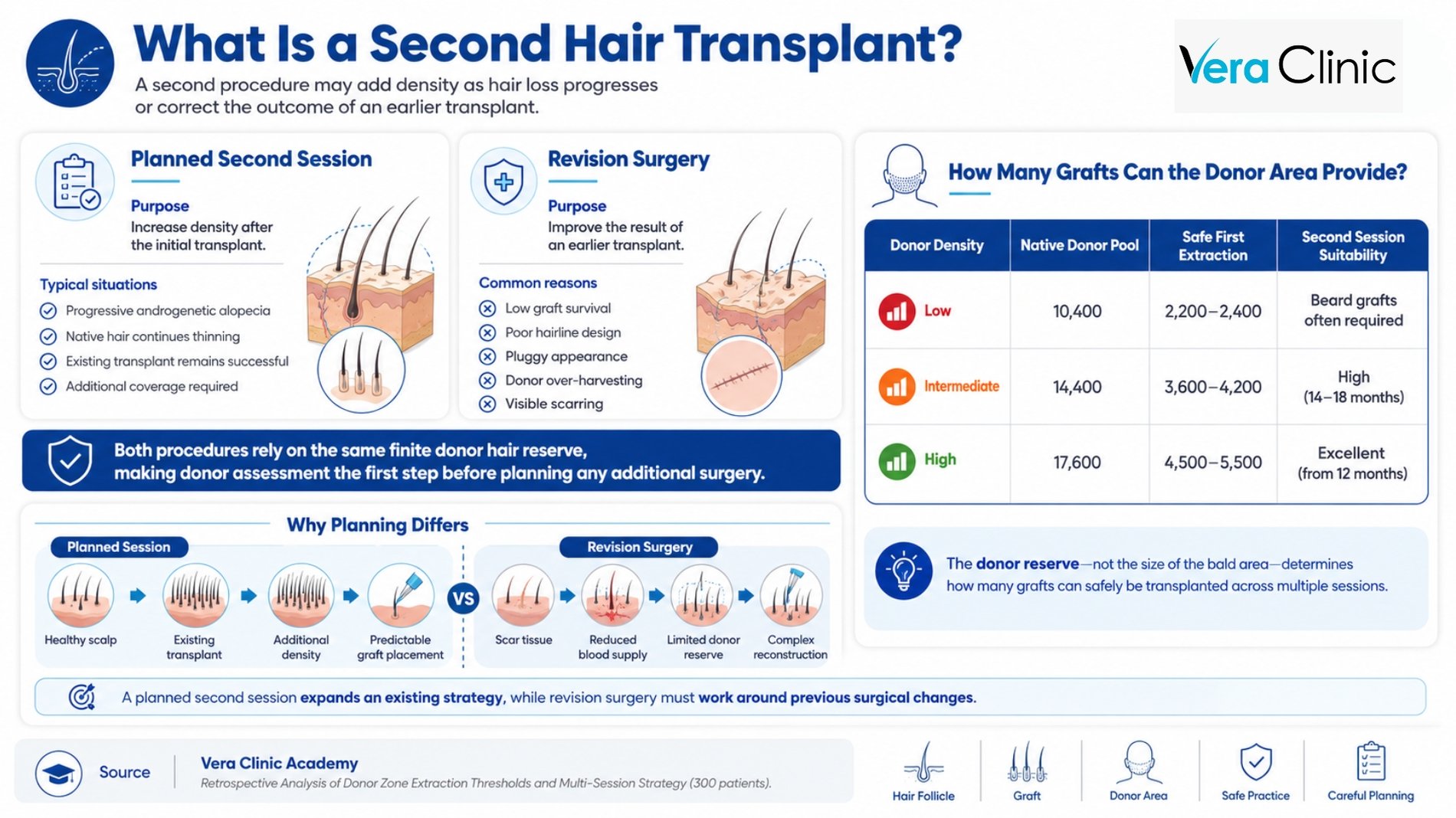
A second hair transplant is any follicular unit procedure performed after a patient has already undergone an initial transplant. It falls into two distinct categories. A planned second session adds coverage as androgenetic alopecia progresses and native hair around the first graft zone continues to thin. A revision surgery, by contrast, corrects an unsatisfactory earlier outcome such as low graft survival, a poorly designed hairline, visible plugginess, or over-harvested donor scarring from work done elsewhere.
The clinical demands of the two differ. A planned second session extends an existing plan on healthy tissue, while revision surgery must work around scar tissue, altered blood supply, and a donor area that may already have been partially depleted. Both draw on the same finite follicular reserve, which is why every second procedure begins with a donor assessment rather than a graft target. This page sits within Vera Clinic’s broader coverage of hair transplant options for men.
Why Would You Need a Second Hair Transplant?
A second hair transplant becomes relevant when the first procedure did not fully meet coverage goals or when hair loss continues after treatment. The reasons fall into four recurring patterns.
- Incomplete density from the first session: A conservative first graft count or a low-density implantation can leave the target zone thinner than the patient expected once the result matures.
- Progressive androgenetic alopecia: Transplanted follicles from the occipital donor zone are permanent, but surrounding native hair can keep thinning, opening new gaps behind the original hairline over several years.
- Poor technique at the first clinic: Over-harvesting, incorrect angulation, or oversized grafts produce unnatural results and depleted donor fields that Vera Clinic frequently sees in patients seeking correction of overseas or budget procedures.
- Visible scarring or a flawed hairline: Wide FUT scars, pitting, and geometric hairlines require corrective grafting and camouflage rather than simple density addition.
Recognising the difference between an under-delivered result and a genuinely failed procedure matters, because the surgical plan changes accordingly. Vera Clinic has performed 43 second and revision procedures to date, each preceded by a full donor assessment before any correction is recommended. A structured review of the signs of hair transplant failure is the starting point for any revision assessment.
How Many Hair Transplants Can You Have?
There is no fixed maximum number of hair transplants. The ceiling is set by donor supply, specifically how many grafts can be extracted before residual donor density falls to a level that produces visible thinning. Vera Clinic Academy defines that absolute cosmetic floor at 40 grafts/cm², below which patchy baldness becomes visible to the naked eye, and applies a stricter working buffer of 50 grafts/cm² to keep future revision options open.
In practice this means the number of viable procedures depends on native donor density. The Vera Clinic Academy retrospective study of 300 patients standardised the safe donor area at 200 cm² and found that a first session can safely remove between 21.2% and 31.3% of the total follicular pool, depending on cohort density. Higher-density patients hold a larger reserve and can support more grafting across their lifetime, while low-density patients reach their limit faster and may need body hair to extend coverage. In the companion 560-patient study, capping the primary extraction at the safe 28.6% threshold preserved a viable donor network in 68.4% of patients, qualifying them for a second procedure.
Most candidates can undergo two procedures safely. High-density patients can support a third, and beard grafting can add a further 1,000 to 1,500 grafts when the scalp donor is exhausted. Patients whose first procedure was over-harvested often cannot have another scalp-only session at all, which is why donor stewardship during the first surgery directly determines lifetime options. Planning around the finite hair transplant donor area is the single most important factor in multi-session strategy.
How Many Grafts Can Your Donor Area Provide Across Sessions?
The table below summarises safe extraction capacity by donor density cohort, drawn from the Vera Clinic Academy retrospective analysis of 300 patients across a standardised 200 cm² donor area.
| Donor density cohort | Total native donor pool | Max safe first extraction | Revision suitability |
|---|---|---|---|
| Low (under 60 grafts/cm²) | 10,400 grafts | 2,200 to 2,400 grafts | Low, needs beard grafts |
| Intermediate (60 to 80 grafts/cm²) | 14,400 grafts | 3,600 to 4,200 grafts | High, from 14 to 18 months |
| High (over 80 grafts/cm²) | 17,600 grafts | 4,500 to 5,500 grafts | Extremely high, from 12 months |
Source: Vera Clinic Academy, Retrospective Analysis of Donor Zone Extraction Thresholds and Multi-Session Strategy (300 patients). These figures show why two patients with identical hair loss can receive very different multi-session plans: the donor reserve, not the bald area, sets the limit.
Are You a Candidate for a Second Hair Transplant?
Candidacy for a second hair transplant rests on donor reserve and the stability of your hair loss, not on how much coverage you still want. Vera Clinic assesses four factors before approving a second procedure.
- Sufficient residual donor density: The donor area must still hold above the 50 grafts/cm² revision buffer defined by Vera Clinic Academy, which leaves enough follicles to harvest without dropping to the visible-thinning floor.
- Stabilized hair loss: Ongoing rapid loss is controlled with medical therapy first, since grafting into an actively shedding zone produces short-lived results.
- Full maturation of the first result: The first transplant must be fully grown out before a second is planned, so that real gaps are distinguished from follicles still in their growth cycle.
- Realistic, donor-matched expectations: Coverage goals are matched to available grafts rather than to an ideal hairline the donor cannot sustain.
Vera Clinic declines a scalp-only second procedure for patients whose donor density sits at or near the 40 grafts/cm² cosmetic floor, since further extraction would cause permanent visible thinning; these patients are instead offered a body hair strategy or advised against additional surgery. Donor density is graded against overall pattern using the Hamilton-Norwood scale during consultation.
How Long Should You Wait Before a Second Hair Transplant?
A second hair transplant should wait at least 12 months after the first procedure. This interval allows both full graft maturation in the recipient area and complete dermal remodeling in the donor area, and it is the minimum healing window Vera Clinic Academy identified before a donor zone is safe to re-harvest.
- Recipient maturation: Vera Clinic Academy tracking of 560 patients recorded 55.4% cumulative regrowth at month 6, 80.2% at month 8, and 100% for the hairline and mid-scalp at month 12, so any assessment of gaps before month 12 measures an unfinished result.
- Crown timing: The vertex matures more slowly, reaching full density between 15 and 18 months, which pushes crown-focused revision later than hairline revision.
- Donor recovery by density: High-density donors regain full scalp laxity and are safe to re-harvest from 12 months, intermediate donors from 14 to 18 months, while low-density donors need the longest recovery and often a body hair plan.
Waiting through the full first-year timeline prevents the common mistake of scheduling a correction for a result that would have completed on its own. This maturation pattern is documented in the Vera Clinic Academy longitudinal regrowth study of 560 patients.
Follicular Regrowth Kinetics and Donor Area HarvestingWhich Technique Is Used for a Second Hair Transplant?
Vera Clinic performs second and revision hair transplants primarily with DHI, because implanting directly into an area that still holds native or previously transplanted hair demands precise control over angle, depth, and density. Two techniques carry the procedure.
- DHI for implantation: Direct Hair Implantation places grafts with a Choi implanter pen without prior channel opening, which allows dense placement between existing hairs and supports unshaven work at the 35 to 45 grafts/cm² density Vera Clinic Academy documented for its unshaven protocol; at Vera Clinic this technique is led by Dr. Emin Gül. The precision of the DHI hair transplant method is the main reason it is preferred for adding density without disturbing surrounding grafts.
- FUE for extraction: Follicular unit extraction harvests the new grafts from the residual donor zone, and on a revision case the surgeon must map around existing extraction scars and altered blood supply from the first procedure. The FUE hair transplant extraction stage is calibrated with 0.7 to 0.85 mm punches to protect the already-reduced donor field.
Vera Clinic’s preferred protocol for revision is DHI implantation combined with conservative FUE harvesting, chosen specifically to preserve the donor area for any future session rather than to maximise a single graft count.
What Results Can You Expect From a Second Hair Transplant?
A well-planned second hair transplant achieves graft survival comparable to a first procedure when the donor area is healthy. Vera Clinic Academy recorded 12-month graft survival of 95.8% in low-density donors, 97.2% in intermediate donors, and 98.1% in high-density donors. Because these grafts originate from the androgen-insensitive occipital zone, results are expected to remain stable over the long term.
Results on a revision case depend heavily on the condition of the donor and recipient tissue. Scarred recipient beds from a previous procedure carry a reduced blood supply, which can lower yield relative to virgin scalp, and beard grafts used to extend coverage survive at a lower average of 84.6% than scalp grafts. Setting expectations against the specific tissue state, rather than against first-procedure averages, is central to Vera Clinic’s revision counseling. Published figures on hair graft survival rate provide the benchmark against which each revision plan is measured.
What Does Revision Outcome Data Show by Prior-Procedure Error Type?
Vera Clinic Academy’s donor-capacity and regrowth-timeline studies define how much tissue can safely be harvested and how long recovery takes. Neither study addresses outcomes when the prior procedure itself was technically deficient, since both describe planned extraction from healthy donor tissue rather than correction of an existing problem. A separate structured cohort review of 145 patients who underwent revision hair transplantation between January 2022 and December 2024 addressed this gap directly. Each case was classified by the specific type of error being corrected, and graft survival, additional grafting needs, and patient-reported satisfaction were tracked accordingly.
Overall 12-month graft survival in this cohort was 85.8% (95% CI 83.4–88.2%). This held steady at 24 months (85.1%, 95% CI 82.6–87.6%), indicating that grafts surviving the first post-operative year remained stable over the longer term.
| Prior-procedure error type | 12-month graft survival (95% CI) | Additional grafting required |
|---|---|---|
| Unnatural hairline design | 90.1% (86.8–93.4%) | 12.0% |
| Poor angle or direction | 88.9% (85.7–92.1%) | 29.4% |
| Low density | 87.6% (84.0–91.2%) | 44.8% |
| Combined / multiple factors | 85.0% (80.1–89.9%) | 42.1% |
| Donor depletion / over-harvesting | 79.3% (75.0–83.6%) | 57.9% |
Patients revising a prior Vera Clinic procedure showed higher 12-month survival (89.7%) than those revising a procedure performed elsewhere (84.6%, p = 0.008). This gap is consistent with the more conservative extraction limits Vera Clinic applies to primary procedures, which preserve donor tissue quality for any future correction. Patient-reported satisfaction rose from a mean of 38.2 before revision to 71.6 at 12 months after revision (p < 0.001).
Taken together, these findings indicate that revision surgery can restore substantial coverage and satisfaction, though outcomes remain modestly below primary-procedure benchmarks, and how much of that gap can be closed depends on what specifically went wrong the first time. Donor depletion carries the most limited ceiling for correction, while cosmetic issues such as a poorly designed hairline are the most fully reversible. For anyone evaluating a previous procedure done elsewhere, this distinction, rather than revision status alone, is what should guide expectations. These findings are drawn from Vera Clinic Academy’s Prior-Procedure Error Type and Graft Survival in Revision Study.
How Much Does a Second Hair Transplant Cost?
A second hair transplant at Vera Clinic is priced on the same graft-based package as a first procedure, with no revision surcharge. Where many clinics add a premium for corrective work, Vera Clinic applies its standard package pricing whether the procedure is a first transplant or a revision.
| Factor | First procedure | Second or revision procedure |
|---|---|---|
| Pricing basis | Standard graft-based package | Same standard package, no surcharge |
| Graft count | Full planned volume | Often lower, limited by residual donor |
| Case complexity | Standard planning | Higher, works around scarring |
| Additional sourcing | Scalp donor only | May require beard or body grafts |
Because a revision follows the same hair transplant cost (package pricing) as a first transplant, the final figure tracks graft count rather than case difficulty, so a smaller corrective session can cost less than an original full procedure.
Why Choose Vera Clinic for a Second Hair Transplant?
Vera Clinic is built for the precision that revision work demands. Second and revision procedures are led by Dr. Emin Gül using a DHI protocol designed to add density between existing hairs without disturbing prior grafts, and every case begins with a donor assessment grounded in Vera Clinic Academy research on more than 1,000 patients across three published studies. That evidence base lets the clinic tell a patient not only whether a second procedure is possible, but exactly how much donor capacity remains for the future. Vera Clinic applies a strict extraction ceiling that protects the donor area for life, which is the single most valuable thing a revision patient can be offered: a result today that does not close the door on tomorrow.
Frequently Asked Questions
A second hair transplant is not more painful than the first, as both are performed under local anaesthesia. Recovery can feel slightly different if the donor area carries scar tissue from the previous procedure, but the procedure itself uses the same numbing protocol.
Yes, you can have a second hair transplant at a different clinic, and many revision patients do exactly that after an unsatisfactory first result. The new clinic needs your original graft count and technique details to assess remaining donor capacity accurately.
A second hair transplant does not damage existing grafts when performed with DHI, because implantation between established hairs is controlled for angle and depth to avoid transecting neighbouring follicles. This precision is the main reason DHI is preferred for density work.
Yes, a second hair transplant can correct a poorly designed hairline through revision surgery, which redistributes and adds single-hair grafts to soften harsh or geometric lines. Existing misplaced grafts may also be removed or redirected during the procedure.
Revision surgery is scheduled at least 12 months after the original procedure, so the first result is fully mature and the donor area has completed dermal remodeling. Scheduling earlier risks operating on a result that has not finished growing and a donor that has not healed.
Sources
- Vera Clinic Academy. (2026). Mathematical modeling of donor zone kinetics and multi-session strategy in trichology: A retrospective analysis of 300 patients. https://www.veraclinic.net/wp-content/uploads/2026/06/Mathematical-Modeling-of-Donor-Zone-Kinetics-and-Multi-Session-Strategy-in-Trichology-A-Retrospective-Analysis-of-300-Patients.pdf
- Vera Clinic Academy. (2026). Quantitative mapping of follicular regrowth kinetics and donor area harvesting thresholds: A prospective longitudinal and retrospective cohort study. https://www.veraclinic.net/wp-content/uploads/2026/06/Quantitative-Mapping-of-Follicular-Regrowth-Kinetics-and-Donor-Area-Harvesting-Thresholds-A-Prospective-Longitudinal-and-Retrospective-Cohort-Study.pdf
- Vera Clinic Academy. (2026). Prior-procedure error type and graft survival in revision hair transplantation: A retrospective cohort study at Vera Clinic, Istanbul, Turkey. https://www.veraclinic.net/wp-content/uploads/2026/07/Prior-Procedure-Error-Type-and-Graft-Survival-in-Revision-Hair-Transplantation-A-Retrospective-Cohort-Study-at-Vera-Clinic-Istanbul-Turkey.pdf