
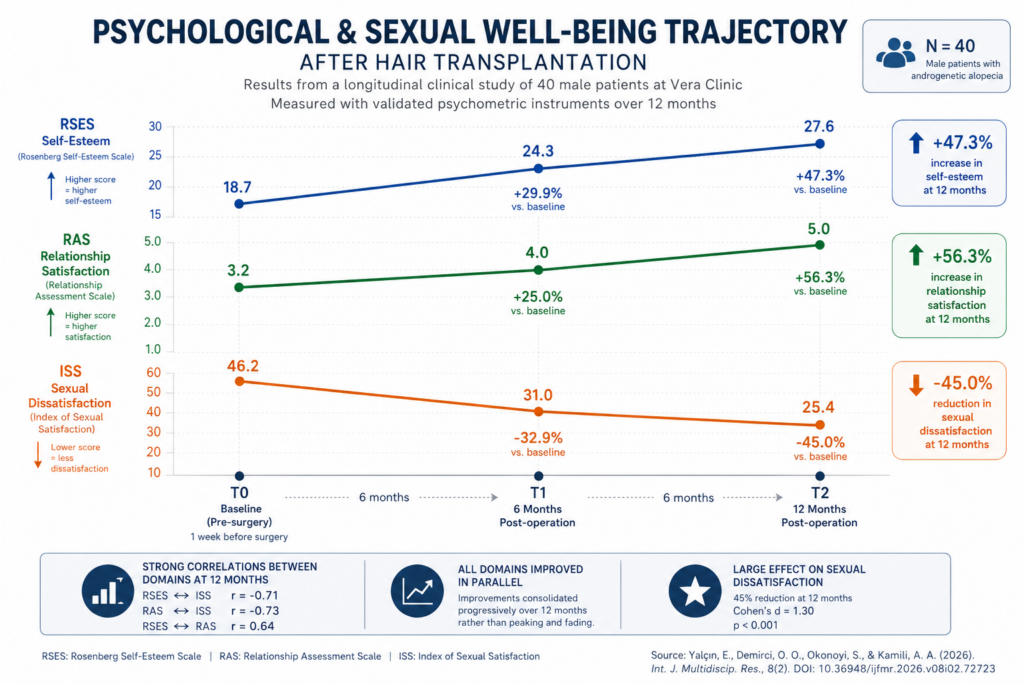
Hair transplantation is associated with a 45% reduction in sexual dissatisfaction over twelve months. This figure comes from a longitudinal clinical study conducted by the Vera Clinic Academy clinical psychology team, led by Emre Yalçın and Dr. Onur Okan Demirci, which tracked 40 male patients across baseline, six months, and twelve months using validated psychometric instruments. The improvement is not physiological. It operates through body image, self-esteem, and a reduction in the self-monitoring that interferes with sexual presence and confidence.
The study was published in the International Journal for Multidisciplinary Research (2026). All three domains measured (self-esteem, relationship satisfaction, and sexual functioning) improved in parallel and in strong correlation with one another after a hair transplant. The changes consolidated progressively over twelve months rather than peaking and fading.
Does Hair Transplant Actually Affect Your Sex Life?
Yes. Hair transplantation is associated with clinically significant improvements in sexual functioning, and the effect is larger than most patients anticipate.
The mechanism is indirect. The procedure does not alter sexual physiology. What it does is resolve a primary source of body image distress, and that resolution reduces the cognitive self-monitoring that interferes with sexual presence and confidence. Hair loss is consistently linked to reduced self-esteem, increased social anxiety, and chronic self-consciousness. These psychological states carry directly into intimate situations. When body image improves, the attentional load associated with self-evaluation during sex decreases.
The broader picture of how hair transplantation affects psychology after hair transplant, including self-esteem and relationship satisfaction, is examined in detail alongside the full study data.
What Does the Research Show About Sexual Functioning After Hair Transplant?
The Vera Clinic Academy study, conducted by Emre Yalçın and Dr. Demirci with the clinical psychology team, provides the most detailed longitudinal data currently available on this question.
The study followed 40 male patients with androgenetic alopecia at three time points: one week before surgery, six months post-operation, and twelve months post-operation. Sexual functioning was measured using the Index of Sexual Satisfaction (ISS), a validated instrument that captures sexual dissatisfaction and relational sexual strain rather than physical performance. This distinction matters: the ISS reflects the subjective emotional and relational experience of sexuality, which makes it sensitive to the kind of change body image improvement produces.
At baseline, the average ISS score was 46.2, indicating substantial sexual dissatisfaction. At twelve months, it had dropped to 25.4. This is a 45% reduction, with a Cohen’s d of 1.30, which is a large effect by clinical standards. All results reached p < 0.001.
The more significant finding is what happened across all three domains simultaneously. Self-esteem and sexual dissatisfaction correlated at r = -0.71: as self-esteem rose, sexual dissatisfaction fell in a strong, consistent relationship. Relationship satisfaction and sexual dissatisfaction correlated at r = -0.73. These variables did not improve in isolation. They moved together, which suggests that the psychological, relational, and sexual domains operate as an interdependent system rather than as separate outcomes.
The study design was non-controlled, so causality cannot be definitively established. The observed changes are most accurately described as associated with hair transplantation rather than directly caused by it.
Why Does Hair Transplant Affect Sexual Confidence?
The link between sexual confidence and hair transplant runs through a single psychological mechanism, which is called spectatoring.
Spectatoring is the tendency to self-observe during intimacy rather than remaining present in it. Sex researchers Masters and Johnson documented it decades ago; Barlow later established its connection to body image. When someone is preoccupied with how they look, attention turns inward. Presence, responsiveness, and satisfaction all suffer as a result.
Hair loss reliably produces this pattern. Chronic self-consciousness does not switch off in intimate situations. When the source of that self-consciousness resolves, the attentional resources previously directed inward shift toward connection instead.
In consultations at Vera Clinic, the pattern Emre Yalçın and the clinical psychology team observe is consistent with what the data show. Patients with significant hair loss frequently describe a mental rehearsal that precedes intimate encounters; checking lighting, positioning, hair coverage, removing or keeping hats and caps. The behaviour is so consistent that it often emerges in pre-operative assessment without being directly asked about. After successful transplantation, this rehearsal gradually dissolves over the consolidation period. The pattern is most pronounced in patients between roughly 30 and 45 years old, who tend to report the largest perceived gap between their current and pre-loss self-image.
The Vera Clinic Academy study recorded three measurable expressions of this shift: a 47.3% increase in self-esteem, a 45% reduction in sexual dissatisfaction, and a correlation of r = 0.64 between self-esteem and relationship satisfaction. These changes did not appear immediately after surgery. They strengthened progressively from six to twelve months, as physical results consolidated and positive social feedback accumulated.
How Long Does It Take for Sexual Confidence to Improve After Hair Transplant?
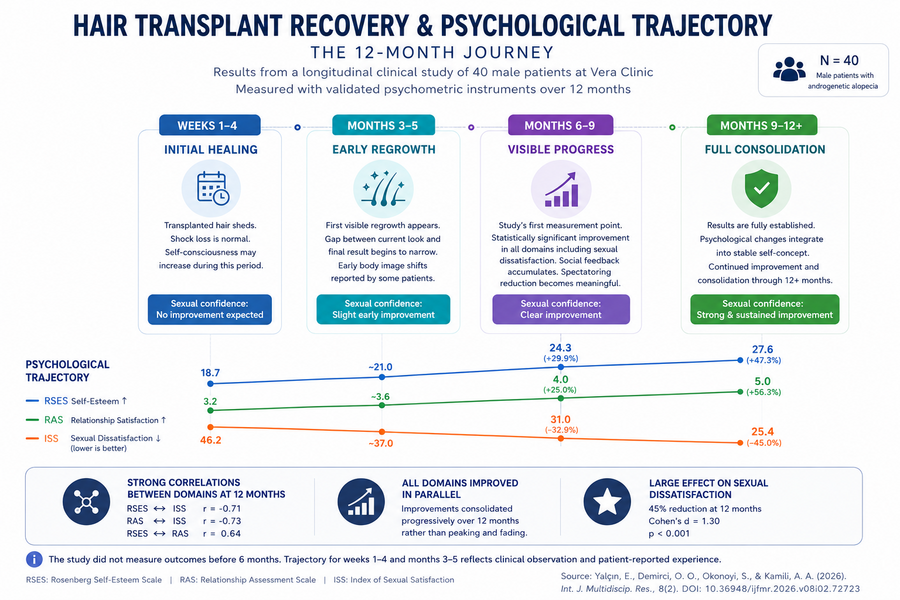
Sexual confidence follows the physical result timeline and strengthens progressively. The study did not measure outcomes before six months, but the trajectory is consistent across clinical observation and patient-reported experience.
In weeks one through four, transplanted hair sheds as follicles enter a resting phase before regrowth begins. Shock loss is a normal physiological event, but it registers cognitively as hair loss. Self-consciousness during this period may increase rather than decrease. Sexual confidence is not expected to improve at this stage.
Between months three and five, first visible regrowth appears. The gap between current appearance and anticipated result begins to narrow. Early body image shifts are reported by some patients at this stage, though the more significant change follows.
By months six to nine, the study’s first measurement point shows statistically significant improvement across all domains, including sexual dissatisfaction. Social feedback from improved appearance begins to accumulate, and the spectatoring reduction becomes functionally meaningful in intimate situations.
From months nine to twelve onward, results are fully established. The twelve-month data shows continued improvement and consolidation. Psychological changes at this stage are integrated into stable self-concept rather than remaining reactive to day-to-day variation in appearance. The Cohen’s d of 1.30 for sexual dissatisfaction reflects the full magnitude of change from baseline to this point.
A question that comes up consistently in international patient consultations is whether the recovery period itself will harm intimacy in the short term, even if outcomes improve later. Patients who have postponed the decision for years specifically because of relational concerns want to know about both timelines: the immediate physical restriction and the visible-result gap during which appearance may temporarily feel worse before it improves. The honest answer addresses both.
Does Hair Transplant Improve Sexual Confidence for Everyone?
No. The majority of patients experience measurable improvement, but a clinically significant minority do not, and the reasons follow recognizable patterns.
Body Dysmorphic Disorder (BDD) is the most significant predictor of non-response. Patients with BDD experience distress from a cognitive framework, not from hair loss itself. Cosmetic correction does not resolve that framework. BDD affects an estimated 7 to 15% of cosmetic surgery patients and is associated with persistent dissatisfaction even when surgical outcomes meet objective clinical standards.
This is one of the reasons Vera Clinic’s pre-operative protocol includes psychological screening for high-risk presentations. Where BDD is suspected, the clinical psychology team meets with the patient before any surgical commitment, and surgery is deferred or declined where clinically appropriate.
Unrealistic baseline expectations present a separate challenge. Patients benchmarking results against photographs from their teens or early twenties are measuring against a target no procedure can reach.
Pre-existing relationship distress is a third factor. Sexual dissatisfaction that originates in relationship dynamics rather than self-image does not respond to appearance change.
The study excluded participants with organic sexual dysfunction, but relational factors outside the scope of the ISS can persist after surgery and require direct attention.
In all of these cases, surgery addresses the physical source of body image distress. It does not automatically dissolve the cognitive and behavioral patterns that formed around it. Psychological support during or after recovery is appropriate for patients experiencing persistent distress despite successful outcomes.
When Can You Have Sex After a Hair Transplant?
At Vera Clinic, we recommend waiting seven to ten days before resuming sexual activity after a hair transplant. This timing aligns with the international consensus among hair restoration specialists. The restriction exists because physical exertion raises heart rate and blood pressure, both of which create direct risks for the healing scalp during the first week of recovery.
For patients who want to accelerate that window, Vera Clinic offers OxyCure therapy as part of the post-operative recovery protocol. OxyCure delivers pure oxygen through a hyperbaric chamber, which increases blood oxygen saturation and promotes faster tissue repair at the follicular level. Patients who receive OxyCure show measurably faster healing trajectories, which can shorten the period during which physical exertion poses a risk to graft stability.
Whether OxyCure shortens the recommended waiting period for sexual activity depends on individual healing progress and surgeon assessment. It does not eliminate the restriction, but it changes the biological conditions under which that assessment is made.
What Are the Risks of Having Sex Too Early After Surgery?
During the first seven to ten days after a hair transplant, the scalp is in an active healing phase. Blood circulation in the recipient and donor areas is already elevated to support tissue repair. Sexual activity raises systemic blood pressure and heart rate, which adds circulatory load to a system that is already working at capacity. This is why early resumption is not just a comfort issue but a clinical one.
- Graft displacement: Increased blood pressure during physical exertion can dislodge newly placed grafts before follicles have anchored securely in the recipient area. This risk is highest in the first seven to ten days.
- Scalp bleeding: Vasodilation from exertion can reopen micro-incision sites in the recipient area before full tissue closure, which can compromise graft stability and extend healing time.
- Infection risk: Sweating introduces bacteria to open follicular channels before the scalp has sealed. Both the donor and recipient areas remain vulnerable during the first week.
- Swelling acceleration: Physical exertion in the first seventy-two hours is the primary driver of post-operative forehead and scalp swelling. Resuming activity too early can extend this significantly beyond the standard three-to-five day window.
After day ten, normal activity including sex can resume for most patients with uncomplicated recoveries. Patients who experienced unusual bleeding, swelling, or graft loss in the first week should follow individual guidance from their surgeon before resuming.
Early sexual activity can affect your results. Physical exertion in the first seven to ten days raises blood pressure and disrupts scalp circulation at the most critical point in the healing process. Graft survival is one of the most significant variables in the success rate of hair transplant procedures, and it depends heavily on what happens in this window.
References:
- Yalçın, E., Demirci, O. O., Okonoyi, S., & Kamili, A. A. (2026). Psychological Well-Being and Sexual Functioning Before and After Hair Transplantation: A Longitudinal Clinical Study of 40 Patients at Vera Clinic. International Journal for Multidisciplinary Research, 8(2). DOI: 10.36948/ijfmr.2026.v08i02.72723
- Rosenberg, M. (1965). Society and the Adolescent Self-Image. Princeton University Press, Princeton, NJ. https://doi.org/10.1515/9781400876136
- Adamczyk, K., Kleka, P., & Frydrychowicz, M. (2022). Psychometric functioning, measurement invariance, and external associations of the Relationship Assessment Scale in a sample of Polish Adults. Scientific Reports, 12(1), 22157. https://doi.org/10.1038/s41598-022-26653-6
- Hudson, W. W., Harrison, D. F., & Crosscup, P. C. (1981). A short-form scale to measure sexual discord in dyadic relationships. The Journal of Sex Research, 17, 157–174.