

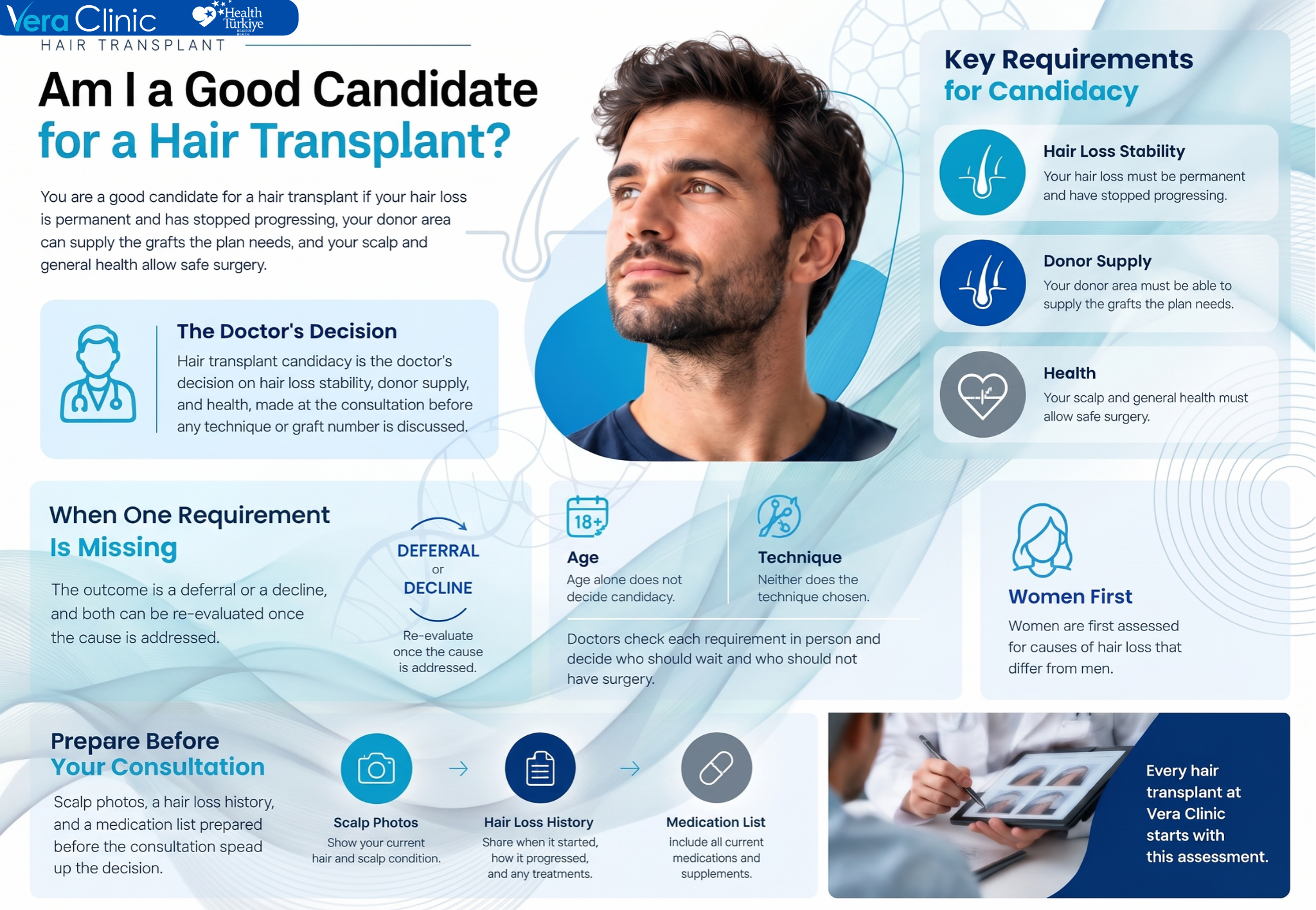
You are a good candidate for a hair transplant if your hair loss is permanent and has stopped progressing, your donor area can supply the grafts the plan needs, and your scalp and general health allow safe surgery. Hair transplant candidacy, also called hair transplant eligibility, is the doctor’s decision on hair loss stability, donor supply, and health, made at the consultation before any technique or graft number is discussed. When one requirement is missing, the outcome is a deferral or a decline, and both can be re-evaluated once the cause is addressed. Age alone does not decide candidacy, and neither does the technique chosen. Doctors check each requirement in person and decide who should not have surgery and who should wait, while women are first assessed for causes of hair loss that differ from men. Scalp photos, a hair loss history, and a medication list prepared before the consultation speed up the decision. Every hair transplant at Vera Clinic starts with this assessment.
- 5requirements decide candidacy
- 28.6%first-session donor limit at Vera Clinic
- 30–50best age window for predictable hair loss
- 49 of 140unstable patterns deferred, not declined
Key Points
- Five hair transplant requirements decide candidacy, from a treatable diagnosis and sufficient donor density to a stable pattern, a healthy scalp, and manageable general health.
- Donor supply sets the ceiling for every plan, and Vera Clinic limits first-session extraction to about 28.6% of the measured donor density.
- Age is a risk flag, not a cutoff. Stability of the pattern is the criterion, and Vera Clinic applies no numeric age limit.
- Controlled conditions and paused medications change the timing, not the eligibility, and in the Vera Clinic Academy candidacy audit every diabetes and hypertension decline involved uncontrolled disease.
Who Is a Good Candidate for a Hair Transplant?
If you have permanent patterned hair loss, enough donor hair, a stable pattern, a healthy scalp, and controlled general health, you are a good candidate for a hair transplant. These five hair transplant requirements are checked in person at the consultation, and each result is recorded in the patient’s chart.
- Treatable Diagnosis. The doctor confirms permanent patterned loss such as androgenetic alopecia, and not temporary shedding or a scarring condition.
- Sufficient Donor Density. Donor density and area are measured with FotoFinder Trichoscale AI trichoscopy to calculate how many grafts can be taken without visibly thinning the back and sides.
- Stabilized Pattern. The pattern is compared across visits and has stopped progressing or is controlled with medical treatment.
- Unaffected Scalp. No active inflammatory or scarring disease is present in the donor or recipient area.
- Manageable General Health. Conditions, medications, and previous surgeries are reviewed, and chronic conditions are controlled before surgery.
Meeting all five requirements makes a patient a candidate for surgical planning, and missing one changes the plan instead of ending the conversation. Vera Clinic records every assessment as accepted, deferred, or declined, and the Vera Clinic Academy candidacy audit reviewed these decisions for 594 risk-flagged patients between April 2024 and March 2025. Its figures describe risk categories and not the overall acceptance rate of Vera Clinic.
Donor supply sets the ceiling for every plan. The International Society of Hair Restoration Surgery FUE guidelines state that removing 40% to 50% of the follicles in an area should not produce visible depletion, and that the true limit varies with hair caliber, curl, and color. According to the Vera Clinic Academy donor analysis of 560 patients, first-session extraction at Vera Clinic is limited to about 28.6% of the measured donor density, which keeps the first session below the 40% to 50% range. A realistic plan therefore depends on the measured hair transplant donor area and not on the number of grafts a patient wants.
Share of donor density extracted, from 0% to 100%
- 28.6% Vera Clinic first session (Academy donor analysis, 560 patients)
- Margin between the first session and the guideline range
- 40–50% ISHRS: no visible depletion expected
- Beyond the range: risk of visible thinning
The true limit varies with hair caliber, curl, and color.
Is Every Patient With Hair Loss a Candidate?
No. A hair transplant treats permanent patterned hair loss, because grafts taken from the donor area keep their resistance to hormonal hair loss after relocation. The one exception is a structurally high hairline, which can be lowered with grafts even though there is no hair loss to treat. The type of hair loss therefore comes first in every assessment.
Type of hair loss | Nature | Candidacy |
|---|---|---|
Permanent, patterned | Candidate once the pattern is stable and the donor supply is sufficient | |
Temporary shedding after illness, stress, or childbirth | Not a candidate until shedding ends, then reassessed | |
Reversible early, scarring when long-standing | Assessed case by case after traction stops and the loss stabilizes | |
Autoimmune, patchy, unpredictable | Assessed case by case, not planned during active disease | |
Scarring alopecias (lichen planopilaris, frontal fibrosing alopecia, central centrifugal cicatricial alopecia) | Permanent follicle destruction | Considered only when inactive, excluded when active |
Structurally high hairline, no hair loss | Normal anatomy, not a disease | Assessed for hairline lowering, where donor supply and a realistic hairline design decide |
Telling these types apart is the first diagnostic task, which is why the difference between hair loss vs hair thinning matters before any surgical discussion.
How Does Norwood Stage Affect Candidacy?
Norwood stage changes how many grafts a plan needs, not whether a patient qualifies, because the donor supply decides how much of the thinning zone can be covered. Vera Clinic Academy data from 412 men show graft needs rising from 1,600–2,100 at Norwood II to 2,750–3,450 at Norwood III-Vertex.
Norwood stage | Pattern | Estimated grafts | Candidacy note |
|---|---|---|---|
II | Frontotemporal recession, no vertex thinning | 1,600–2,100 | Candidate once the pattern is stable |
III | Deep, symmetrical frontotemporal recession | 2,000–2,600 | Candidate once stable, donor supply sets the plan |
III-Vertex | Frontotemporal recession with early vertex thinning | 2,750–3,450 | Planning widens from the front to the vertex, so donor supply matters more |
Graft needs rise with stage, but stage alone does not decide candidacy: a patient with advanced loss (Norwood IV to VII) and a stable, adequate donor area can qualify for a limited-coverage plan, while a patient with an early stage and an unstable pattern is deferred. Staging follows the Hamilton-Norwood scale, and at Norwood VI and VII the donor supply may not cover the whole area, so coverage priorities are weighed case by case against donor limits. The frontotemporal recession seen at Norwood II and III is the pattern treated in a hair transplant for receding hairline.
Am I Too Young or Too Old for a Hair Transplant?
No single age makes a patient too young or too old: stability of the hair loss is the criterion, and age is only a risk flag. Pattern hair loss in men tends to stabilize after 30, which makes 30 to 50 the most predictable window, yet 95% of first-time hair restoration patients in 2024 were between 20 and 35 (ISHRS, 2025). Vera Clinic applies no numeric age limit, and in the Vera Clinic Academy candidacy audit 65.0% of younger patients screened for stability (91 of 140) and 87.5% of advanced-age patients (35 of 40) were accepted. In younger patients the risk is that the loss keeps progressing after surgery and leaves the transplanted area surrounded by new thinning. Because a transplant does not stop native hair loss, patients under 30 with a progressing pattern are advised to complete at least six months of medical therapy first (Vañó-Galván et al., 2023). In older patients the question is whether chronic conditions and medications are controlled. Non-progressive causes of loss, such as quiescent post-traumatic scars or congenital conditions, are assessed case by case at any age, and active scarring alopecia stays excluded. The best age for a hair transplant therefore depends on when the pattern becomes predictable and not on a birth year.
Can You Have a Hair Transplant With Curly, Afro, Gray, or White Hair?
Yes. Curly, afro, gray, and white hair can all be transplanted, because hair type and color change how grafts are handled and not who qualifies. Curved follicles are harder to extract without damage, so extraction is planned around the curl pattern, which is graded from straight to tightly coiled in the classification of types of curly hair. In a Vera Clinic Academy graft transection study of 320 FUE patients treated in 2023, graft transection rose from 0.5% in straight, pigmented hair to 5.0% in tightly coiled, pigmented hair and reached 6.5% in tightly coiled gray or white hair, which shows why coiled hair needs a more careful plan.
For women of African descent, screening for central centrifugal cicatricial alopecia comes first, because the condition affects an estimated 2.7% to 5.7% of this group (Dlova et al., 2017). Gray and white hair are harder to see against the scalp, so extraction and placement need extra care, and the technical points of a white hair transplant concern visibility and planning and not eligibility.
Does Choosing FUE or DHI Determine Candidacy?
No. FUE and DHI are different surgical methods, and they change the surgical plan, not eligibility: a patient who meets the five criteria is a candidate for either, and a patient who does not meet them is not made eligible by switching technique. At Vera Clinic the doctor chooses the technique per patient, based on the area to cover, hair characteristics, and donor supply. Vera Clinic does not use FUT for hairline work, because strip harvesting leaves a permanent linear scar at the donor site. Whichever hair transplant technique is chosen, the patient is assessed on the same five criteria.
Who Is Not a Good Candidate for a Hair Transplant?
If your hair loss is diffuse and includes the donor area, a scarring alopecia is active, your donor area is too depleted to cover the plan, or your goals exceed what the donor area can deliver, you should not have a hair transplant. In these cases the donor supply or the scalp cannot support a safe procedure with a lasting result.
- Diffuse Unpatterned Alopecia. Thinning across the whole scalp, donor area included, leaves no stable donor supply.
- Active Scarring Alopecia. Inflammatory conditions that destroy follicles can also destroy transplanted grafts.
- Severe Donor Depletion. Donor density is too low to cover the plan without visible thinning, including after earlier over-harvesting.
- Unrealistic Expectations or Body Dysmorphic Concerns. Goals the donor area cannot deliver, or distress out of proportion to visible hair loss, make a satisfying result unlikely.
Active scarring alopecia can be reassessed once the disease has been inactive, while diffuse unpatterned loss and severe donor depletion are managed with non-surgical treatment instead of surgery.
Who Should Wait Before a Hair Transplant?
If your hair loss is still progressing, your shedding has not ended, your scalp has an active condition, or a medical condition or medication needs attention first, you are not ruled out but should wait before a hair transplant. Each of these can be fixed, so waiting moves the surgery date instead of ruling it out.
- Unstable Pattern. If your hair loss is still progressing, the doctor waits until it is predictable across visits.
- Temporary Shedding. Postpartum, illness-related, or stress-related shedding has to end first.
- Active Scalp Condition. Infection, or active inflammation such as folliculitis, seborrheic dermatitis, or scalp psoriasis, has to be treated first.
- Uncontrolled Medical Condition or Medication to Pause. A condition that is not yet controlled, or a medication such as aspirin or minoxidil that has to be paused, moves the surgery date.
In the Vera Clinic Academy candidacy audit, 49 of 140 patients whose pattern had not stabilized (35.0%) were deferred, and the other 91 were accepted. Waiting is a plan with a re-evaluation date, not a refusal, and the non-surgical hair transplant alternatives such as minoxidil and finasteride can slow the loss and help the pattern stabilize in the meantime.
Which Medical Conditions and Medications Affect Candidacy?
Medical conditions and medications do not rule out a hair transplant on their own. What matters is whether the condition is controlled and whether the medication can be paused safely, because both affect bleeding, healing, scarring, and infection risk.
- Aspirin and Blood Thinners. They increase bleeding, so patients pause or adjust them with the prescribing physician, and at Vera Clinic low-dose aspirin (100 mg/day or less) is stopped for about seven days before surgery.
- Bleeding and Blood Disorders. Clotting disorders and anemia raise bleeding and healing risk, so they are tested and managed before surgery.
- Topical Minoxidil. It is stopped 7 to 10 days before surgery.
- Diabetes and High Blood Pressure. Well-controlled patients can go ahead, while uncontrolled sugar or pressure slows healing and raises bleeding and infection risk, so surgery waits.
- Autoimmune Conditions. Types that scar the scalp destroy follicles and are a real barrier, while systemic types are judged by how well they are controlled.
- Keloid or Poor Scarring. A history of keloid or widened scars raises the risk of visible scarring in the donor area, so the doctor assesses it before extraction.
- Heart Conditions. They raise anesthesia and bleeding risk, so the treating specialist weighs in first.
- HIV. Patients can be candidates when the infection is controlled with a suppressed viral load, and the medical team approves every HIV positive hair transplant case.
The Vera Clinic Academy candidacy audit points the same way. Patients on low-dose aspirin were accepted in 91 of 96 cases once the pause was planned, and every one of the 15 declined patients with type 2 diabetes and all 6 declined patients with hypertension had uncontrolled disease. The hardest group was scarring-risk autoimmune disease, where only 5 of 14 patients were accepted. Categories overlap and several groups are small, so these numbers show what the audit recorded and not a general acceptance rate.
Before you pause any medication
Do not stop a prescribed blood thinner or heart medication on your own. The pause is planned with your prescribing physician after candidacy is confirmed, as part of preparing for hair transplantation.
How Do Psychological Factors and Expectations Affect Candidacy?
Psychological factors affect candidacy when they make a satisfying result unlikely, even if the medical requirements are met.
- Unrealistic Density Expectations. A request for pre-loss density from a limited donor area leads the doctor to explain graft limits before agreeing to a plan.
- Body Dysmorphic Concerns. Distress that is out of proportion to visible hair loss is a recognized reason for doctors to pause and refer.
- Fear of Baldness. Intense anxiety about future loss can drive a request for surgery before there is a medical indication.
- Willingness to Follow Medical Care. Patients must accept medication plans, follow-up visits, and aftercare instructions.
Patients with body dysmorphic concerns or unrealistic expectations may stay dissatisfied even after a technically successful result, which is why psychology after hair transplant is assessed before surgery and not only during recovery.
“Before I talk about grafts, I want to know what the patient pictures in the mirror. If that picture needs more donor hair than the patient has, I would rather say so at the first consultation than after surgery.”
What Are the Hair Transplant Requirements for Women?
Women meet the same five hair transplant requirements as men, and a woman with female pattern hair loss and an unaffected donor area is a candidate for a hair transplant. The difference lies in the causes. Female pattern hair loss thins the hair across the top of the scalp instead of receding at the temples, doctors grade it with the Ludwig scale, and hormonal changes such as pregnancy and menopause can start or speed up the loss.
The assessment therefore checks the cause of the loss first, and four findings change the plan.
- Diffuse Thinning. Thinning that includes the donor area leaves no safe supply of grafts.
- Traction Alopecia. Women qualify after the pulling stops and the loss stabilizes.
- Scarring Conditions. Frontal fibrosing alopecia, lichen planopilaris, and central centrifugal cicatricial alopecia are excluded while active.
- Hormonal and Medical Causes. Thyroid, iron, and hormonal causes of shedding are checked and treated before surgery is planned.
When these causes are ruled out or treated, a woman with patterned loss is assessed on the same donor and stability measurements as any other patient.
Can You Have a Hair Transplant After Pregnancy or Childbirth?
Yes, but not right after delivery. A hair transplant waits until postpartum shedding has ended and the hair has had time to regrow, which published timelines place at 6 to 12 months after delivery. Postpartum shedding is temporary: it starts about 3 months after delivery, peaks at about 5 months, and ends at about 8 months, so a transplant during that period would treat hair that grows back by itself. Elective hair surgery is also postponed during pregnancy. If thinning persists after 12 months, the doctor assesses it as female pattern hair loss, and a transplant is considered only when the loss is permanent and patterned, as in any other hair transplant for women.
How Does Vera Clinic Evaluate Hair Transplant Candidacy?
Vera Clinic, a hair transplant focused hospital in Istanbul approved by Turkey’s Ministry of Health, evaluates candidacy in three stages: a doctor’s review of your photos and medical history before you travel, an in-person hair transplant consultation with AI-assisted trichoscopy, and a doctor’s decision before any date or graft number is discussed. The process is doctor-led from the first review to the surgery itself, where the doctors perform extraction and implantation, working alongside Ministry of Health certified hair transplant assistants. The screening is a real filter: in the Vera Clinic Academy candidacy audit, about one in four health-condition assessments (45 of 187) did not end in acceptance.
- Before the Consultation. You send clear scalp photos of the front, top, crown, back, and sides, your hair loss history, and a list of your medications, including aspirin, minoxidil, finasteride, and supplements.
- Graft Estimate. A first estimate from the hair graft calculator gives a starting point, which is confirmed at the in-person assessment against measured donor density.
- Doctor Review. A hair transplant doctor reviews the photos and your medical history, including allergies, chronic conditions, and prior procedures.
- In-Person Assessment. AI-assisted trichoscopy maps hair density in the donor and recipient areas, and the software provides data while the doctor makes the decision.
- Decision. When a patient is not yet a suitable candidate, the doctor explains why and, where relevant, when to be re-evaluated.
- Surgical Plan. FUE, Sapphire FUE, or DHI is chosen after the scan and the physical exam, not from a fixed package, and donor capacity is measured before any graft number is set.
Once candidacy is confirmed, PRP and low-level laser therapy (LLLT) are a standard part of every procedure, not an add-on, and patients who choose it can also have OxyCure Therapy, the in-house hyperbaric oxygen therapy at Vera Clinic.
Frequently Asked Questions
Yes, if the thinning is permanent and the donor area is stable. Thinning from shedding, such as telogen effluvium, is reversible and needs medical treatment first, while pattern thinning becomes a transplant question once follicles have miniaturized so far that medication can no longer restore them. A doctor confirms that the pattern has stabilized before planning surgery for hair thinning.
Yes, when enough donor hair remains and the original problem can be corrected. The doctor measures what is left in the donor area and checks whether the first result failed because of the hairline design, poor graft survival, or over-harvesting, since an over-harvested donor area limits what a second surgery can do. Candidacy for a second hair transplant depends on the remaining donor reserve.
Yes. A previous FUT does not rule out a transplant. The doctor measures the remaining donor density and checks the linear scar, and FUE from the remaining donor area is one option.
Sometimes, but the plan shrinks to match the donor supply. The doctor measures donor density and area, and when the supply cannot cover the whole area, coverage is limited to the zones that matter most or the transplant is not recommended. Non-surgical hair transplant alternatives such as scalp micropigmentation can add the look of density where grafts run out.
You are not operated on, and the doctor explains the reason and the next steps. At Vera Clinic, a doctor reviews your photos and medical history before you travel, and candidacy is confirmed in person before any procedure.
Yes, especially when the first clinic gives no clear reason. An honest decline comes with a stated medical reason, such as an unstable pattern, an uncontrolled condition, or a limited donor supply, and with a re-evaluation step where relevant. A clinic that quotes a fixed graft number before reviewing your history, photos, and donor density has not screened you, so another doctor’s assessment is the safer route.
Yes. Pre-operative blood tests check infection status, clotting, and general health, and the panel is set from your medical history.
Not during treatment. Hair loss during chemotherapy is temporary shedding, so candidacy is reassessed after treatment ends, once your oncology team has cleared you and regrowth has been observed.
Yes. Smoking raises the risk of bleeding, infection, and poor healing, so doctors ask patients to stop before surgery. In a randomized trial of general surgery patients, smokers who did not stop had a 52% complication rate, compared with 18% after a preoperative cessation program (Møller et al., The Lancet, 2002).