

PP405 hair loss treatment is a topical small baldness reversal molecule therapy developed to treat androgenetic alopecia by directly reactivating hair follicle stem cells. The compound was first identified through UCLA hair loss research led by Dr. Heather Christofk and Dr. William Lowry, and is currently being advanced by Pelage Pharmaceuticals for clinical use.
Unlike hormonal drugs that block DHT or vasodilators that simply improve circulation, PP405 targets metabolism inside the follicle itself. It works by inhibiting the mitochondrial pyruvate carrier (MPC); a metabolic gatekeeper that controls how stem cells consume energy. When MPC is blocked, stem cells switch to glycolysis, a process that reawakens dormant follicles and restarts natural hair growth.
Approximately 31% of participants achieved more than a 20% increase in hair density at 8 weeks compared with 0% in the placebo group according to “Pelage Pharmaceuticals Announces Positive Phase 2a Clinical Trial Results for PP405 in Regenerative Hair Loss Therapy” published in Business Wire. This marks the first non-hormonal, stem cell-activating treatment aimed at regenerating miniaturized follicles rather than merely slowing their loss.
As of 2025, the UCLA–Pelage collaboration positions PP405 hair loss treatment as a leading candidate for metabolic hair regrowth, offering a new route toward baldness reversal without surgery; grounded in cellular energy science, not hormones.
What Is PP405 Hair Loss Treatment?
PP405 treatment is a topical small molecule therapy developed to regrow hair by reactivating hair follicle stem cells through metabolic stimulation, rather than hormonal alteration.
Discovered in UCLA’s hair loss research labs and advanced by Pelage Pharmaceuticals, the PP405 molecule works by inhibiting the mitochondrial pyruvate carrier (MPC), a key protein that regulates how cells process energy. When MPC is blocked, stem cells switch to glycolysis, an alternative energy pathway that reawakens dormant follicles and restarts the hair growth cycle.
This non-hormonal mechanism separates PP405 hair loss treatment from traditional treatments that target DHT or blood flow. Instead of controlling hormones, it reprograms follicular metabolism, restoring balance in the cellular microenvironment responsible for active growth.
The result is a new category of stem cell–based hair regeneration therapy capable of addressing androgenetic alopecia hair loss without systemic side effects.
How Can You Reactivate Hair Follicles Naturally?
You can naturally stimulate dormant follicles by boosting their cellular metabolism; as seen with PP405 hair loss treatment, which increases glycolysis in hair follicle stem cells. This process reawakens growth without hormones or surgery, relying on the body’s own regenerative energy system.
How Does PP405 Hair Loss Treatment Work?
The PP405 hair loss treatment works by driving hair follicle stem cell activation through a shift in cellular metabolism. By inhibiting the mitochondrial pyruvate carrier (MPC), it redirects energy production toward glycolysis, creating a metabolic environment that restarts the hair growth cycle. This process delivers hair regrowth via cellular energy, awakening dormant follicles that were inactive due to aging or androgenetic signals.
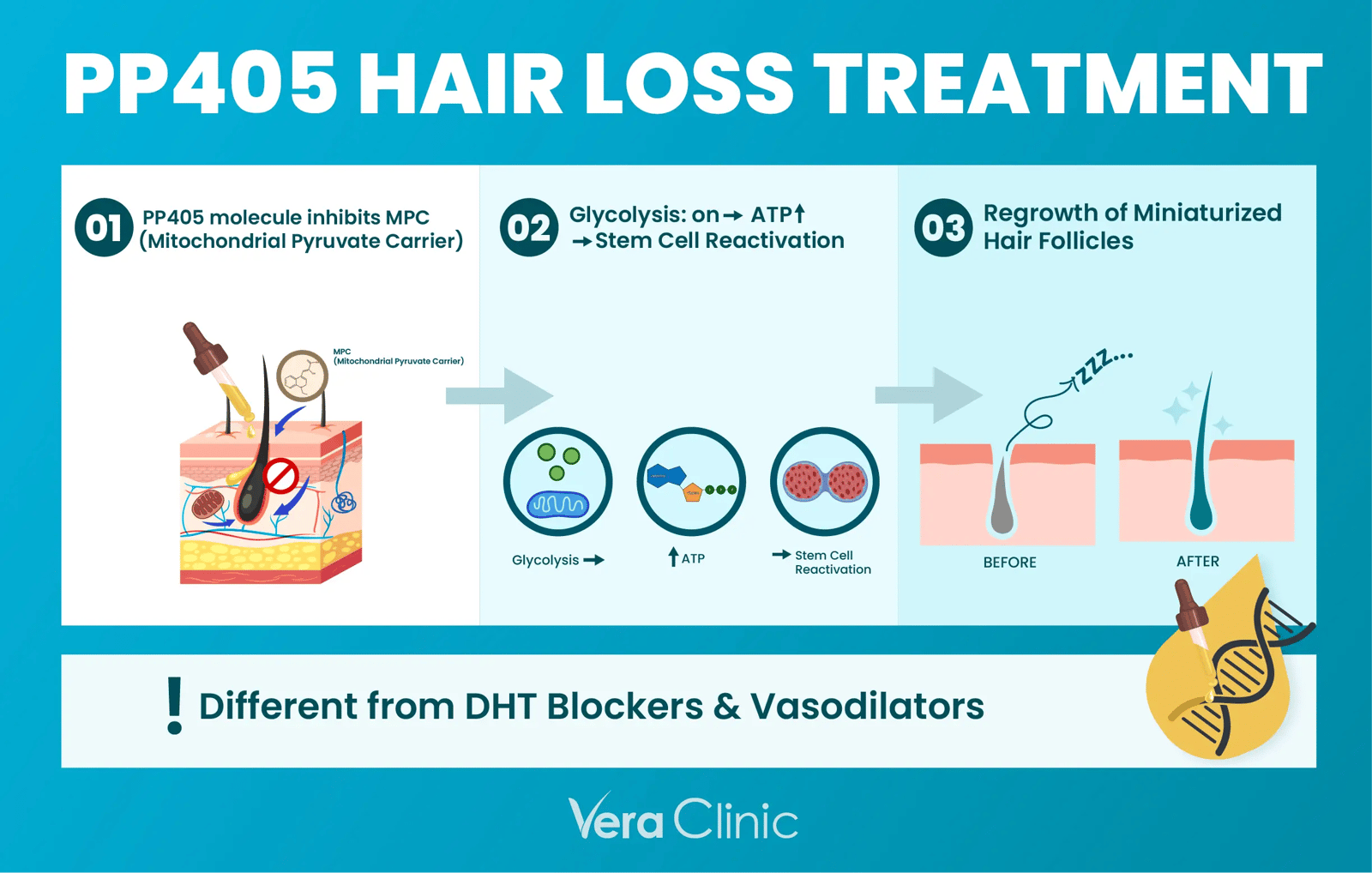
Unlike hormonal or surgical methods, PP405 treatment functions as a metabolic hair loss treatment; it recharges the follicle’s internal energy system to promote follicle regeneration naturally, restoring density and vitality from within.
Can Stem Cells Really Regrow Hair?
Yes. When reactivated, hair follicle stem cells can restart the natural growth cycle by restoring metabolic balance inside dormant follicles. PP405 molecules do this by inhibiting the mitochondrial pyruvate carrier (MPC), which forces cells to produce energy through glycolysis. This boost in cellular energy reawakens inactive follicles, enabling hair regrowth via cellular energy and driving full follicle regeneration without hormonal drugs or surgery.
When Will PP405 Hair Loss Treatment Be Available?
PP405 hair loss treatment is expected to reach the market around 2027, following completion of its current Phase 2a clinical trial and the planned Phase 3 trials in 2026. The therapy, developed by Pelage Pharmaceuticals and UCLA, has already shown strong early results: in the Phase 2a study, 31 percent of participants achieved more than 20 percent increases in hair density within eight weeks, while the placebo group showed none (Dermatology Times, 2024).
The next stage will confirm long-term safety and regrowth consistency before seeking FDA approval. Until then, PP405 remains unavailable commercially and can only be accessed through registered studies such as ClinicalTrials.gov ID NCT06393452.
Should I Wait for PP405 or Start Treatment Now?
If your hair loss is progressing, it’s better to begin clinically proven treatments now rather than waiting for PP405’s release. The molecule is still in clinical trials and won’t be available until 2027 at the earliest.
Current options such as minoxidil, finasteride, or stem cell–based therapies like Oxycure Therapy at Vera Clinic already have measurable results and established safety data. Starting early helps preserve existing follicles, which PP405 may later regenerate more effectively once it becomes available.
How Much Will PP405 Cost?
No official price has been announced but PP405 is expected to cost between $1,500 and $3,000 per treatment course once released, based on current biotech pricing models for advanced topical therapies.
Does PP405 Hair Loss Treatment Really Work?
Yes, early evidence is positive, but long-term results of hair loss cure 2025
are unknown. In Phase 2a, 31% of treated participants achieved >20% hair-density increase at week 8 vs 0% on placebo; the drug was well-tolerated, and Phase 3 starts in 2026. Long-term durability, safety, and dosing remain to be proven in larger trials.
Pros
- Non-hormonal, topical; targets mitochondrial pyruvate carrier (MPC) and stem-cell metabolism.
- Rapid signal: statistically significant regrowth by week 8 in Phase 2a.
- Not commercially available; access only via trials (e.g., NCT06393452).
- Long-term efficacy/safety and real-world outcomes pending Phase 3.
How Do PP405 Hair Loss Treatment vs. Current Treatments Compare?
The table below compares PP405 hair loss treatment with today’s leading medical and experimental hair transplant alternatives, summarizing each hair regeneration without surgery mechanism, evidence strength, regulatory status, effect timeline, and safety profile.
| Therapy | Core mechanism | Evidence level | Regulatory status | Typical effect window | Safety/notes |
| PP405 | MPC inhibition → ↑glycolysis → hair follicle stem-cell activation | Phase 2a: 31% achieved >20% density at week 8 vs 0% placebo | In trials; Phase 3 planned 2026 | Signal by ~8 weeks (trial) | Early data: well-tolerated; long-term data pending. |
| Finasteride (1 mg oral) | DHT inhibition (5-α-reductase type II) | Multiple RCTs show increased hair counts and slowed loss over 1–2 years | FDA-approved (men) | 3–6 months to visible change; maintains with continued use | Sexual/psychiatric AEs discussed in literature; effects reverse if stopped. |
| Minoxidil (5% topical) | Potassium-channel opener; anagen support | RCTs show superiority to placebo and 2%; ~45% more regrowth vs 2% at 48 weeks | OTC/FDA-approved | Shedding often stabilizes in 8–12 weeks; fuller effect by 24–48 weeks | Scalp irritation/hypertrichosis possible. |
| RU58841 | Topical non-steroidal antiandrogen (AR blocker) | Preclinical & anecdotal; no approved human RCTs | Not approved; research chemical | Unknown/variable | Safety and long-term effects not established. |
What Is the Safest Non-Hormonal Hair Loss Treatment?
Current evidence suggests PP405 hair loss treatment is among the safest emerging non-hormonal hair loss treatments, as it acts locally on cellular metabolism without altering hormone levels or systemic pathways. Early trial data report no serious side effects and good tolerability compared to DHT blockers or antiandrogens.
Can PP405 Treatment Replace Hair Transplants in the Future?
No, at present, hair transplants remain the only method that physically redistributes hair follicles from dense donor regions to bald zones. These procedures restore density in areas where follicles are completely inactive or destroyed.
PP405 hair loss treatment, on the other hand, reactivates existing follicle stem cells rather than implanting new ones. By stimulating cellular metabolism and follicle regeneration, it could potentially reduce the need for surgery in early-to-moderate androgenetic alopecia, where follicles are still present but miniaturized.
Experts note that if PP405 hair loss treatment continues to perform in larger trials, it could represent the first non-surgical therapy capable of regenerating dormant follicles and delaying transplantation. However, it cannot yet replace transplants for advanced baldness where follicles are permanently lost, instead, it complements surgical techniques to improve graft survival and density.
Will PP405 hair loss treatment cure baldness permanently?
Not entirely, PP405 stem cell hair therapy reverses early follicle miniaturization, but once follicles are completely lost, only a hair transplant restores them. Still, by reawakening dormant stem cells, it represents the most promising step toward a lasting, non-surgical solution for hair loss yet.
What Are the PP405 Reviews on Forums?
Early discussions about PP405 on Reddit’s and other forums’ hair restoration communities show growing curiosity about PP405’s UCLA origins and its potential to replace traditional DHT blockers.
Users are especially interested in the molecule’s non-hormonal approach, rapid regrowth timeline, and connection to Pelage Pharmaceuticals’ Phase 2a trial. Many compare it to existing treatments like minoxidil and finasteride, but note that PP405 acts at a cellular-energy level rather than hormonal or vascular pathways.
While Reddit users remain cautious until Phase 3 data is published, the community largely views PP405 as the most scientifically promising advancement since minoxidil’s introduction in the 1980s, with optimism that it may one day complement or delay the need for hair transplants.
How Do PP405 Hair Loss Treatment Before and After Pictures Look Like?
Early PP405 before and after images from clinical trial participants show visible density gains, thicker shafts, and improved scalp coverage after 8–12 weeks of daily topical use. The pp405 results regrowth pattern is diffuse and natural, indicating reactivation of existing follicles rather than new follicle formation.