

Hair porosity describes how easily the hair cuticle absorbs and holds onto moisture, and it depends on how tightly the cuticle’s outer scales are sealed, not on genetic traits linked to hair loss or hair transplant candidacy. The cuticle’s scale structure controls water and product penetration at a microscopic level (Nagase et al., 2002), which is why two people with the same hair color or texture can have completely different porosity levels. One myth worth addressing directly: donor-area hair used in a hair transplant is not automatically lower in porosity than hair elsewhere on the scalp, since porosity and androgenetic resistance are controlled by separate biological mechanisms. This distinction also shapes how porosity should factor into aftercare during hair transplant recovery.
Key Points
- Hair porosity is the cuticle’s capacity to absorb and retain moisture, determined by how tightly its scales lie against the hair shaft (Nagase et al., 2002).
- There are three porosity levels: low, medium, and high, each defined by how open or closed the cuticle is.
- Porosity forms through a mix of genetics and external damage, including heat styling, chemical treatments, UV exposure, and airborne particulate matter (Yang et al., 2024).
- The water float test, the most common home method for checking porosity, is considered scientifically imprecise because surface tension, product residue, and strand thickness can all distort the result.
- Donor hair used in hair transplants is not inherently less porous than other scalp hair; resistance to hair loss and cuticle porosity are governed by separate biological processes.
- Hair porosity should shape aftercare choices during hair transplant recovery, including sun protection and product selection in the weeks following surgery.
What Is Hair Porosity?
Hair porosity is the extent to which the hair cuticle allows water, oils, and hair products to pass into and out of the hair shaft. The cuticle is made up of overlapping, scale-like cells; when these scales lie flat and tightly sealed, moisture struggles to get in or out, and when they are lifted, raised, or damaged, moisture moves through the hair shaft quickly in both directions (Nagase et al., 2002). This scale structure is also what determines how light reflects off hair, which is why porosity changes affect shine as well as hydration (Habe et al., 2025). Porosity is not the same thing as hair texture or curl pattern, since the two are governed by different parts of the hair’s structure. Straight, wavy, curly, and coily hair can each fall anywhere on the porosity scale, though textured hair types are more likely to sit toward the higher end, since tighter curl patterns are more prone to cuticle lifting during detangling and styling.
What Are the Types of Hair Porosity?
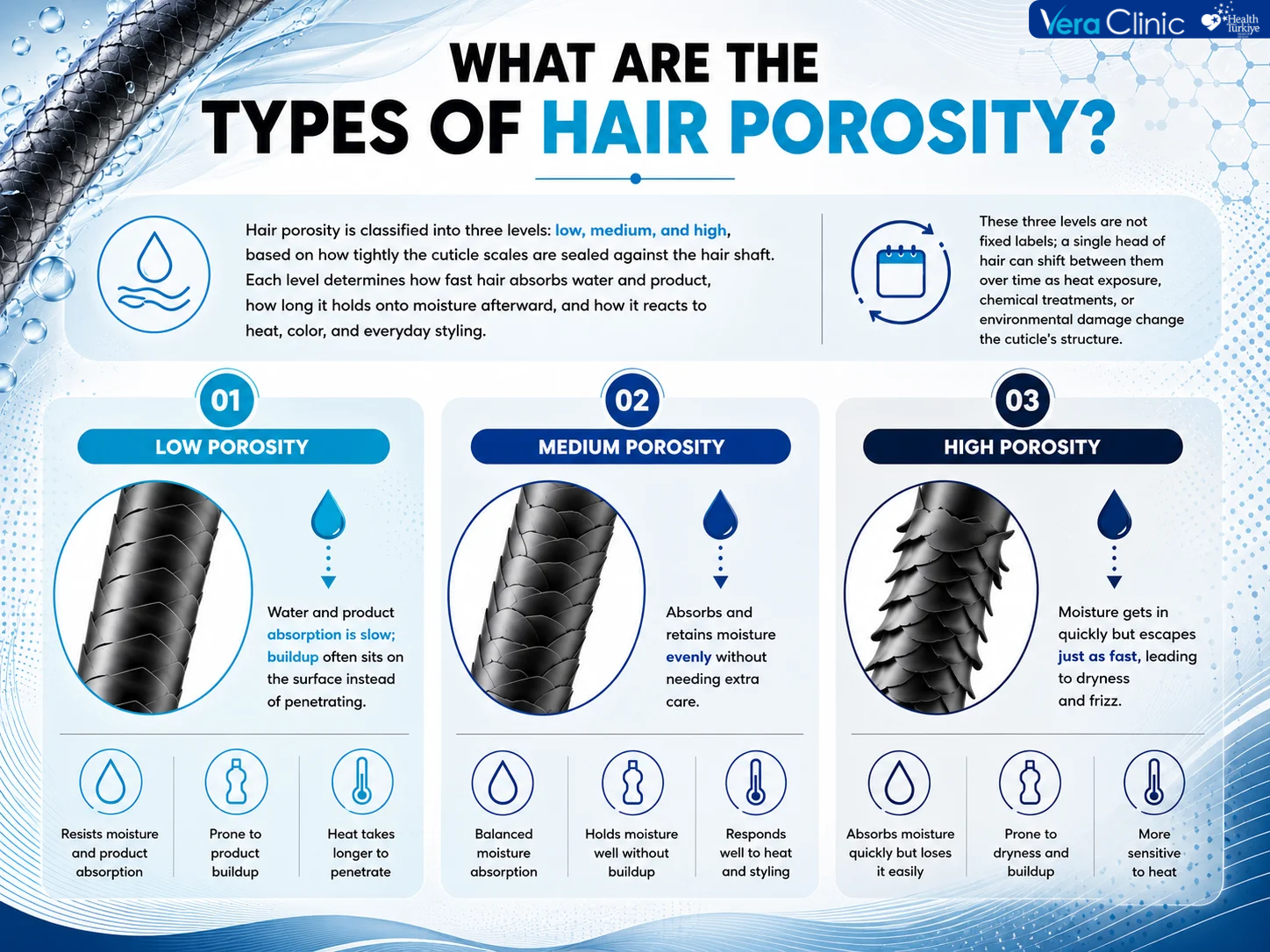
Hair porosity is classified into three levels: low, medium, and high, based on how tightly the cuticle scales are sealed against the hair shaft. Each level determines how fast hair absorbs water and product, how long it holds onto moisture afterward, and how it reacts to heat, color, and everyday styling.
- Low porosity: Cuticle scales lie flat and tightly closed, which slows down water and product absorption and often leads to buildup on the surface rather than penetration into the shaft.
- Medium porosity: Cuticle scales sit in a balanced, moderately open position, absorbing and retaining moisture evenly without needing extra care.
- High porosity: Cuticle scales are lifted, gapped, or visibly damaged, which lets moisture in fast but lets it escape just as quickly, leaving hair prone to dryness and frizz.
These three levels are not fixed labels; a single head of hair can shift between them over time as heat exposure, chemical treatments, or environmental damage change the cuticle’s structure (Yang et al., 2024). The sections below break down each level in more depth, starting with the type that resists moisture the most.
What Is Low Porosity Hair?
Low porosity hair has a cuticle that lies flat and tightly closed, which makes it resistant to both water and product absorption. The scales that make up the cuticle overlap closely against each other in this hair type, leaving very little space for water molecules or product ingredients to slip underneath (Nagase et al., 2002). This same tight overlap is also why low porosity hair tends to look shinier than other porosity types: flatter scales reflect light more directly, while lifted or irregular scales scatter it. Hair in this category often takes a long time to get fully wet in the shower, dries slowly, and tends to develop product buildup because moisturizers and oils sit on the surface rather than penetrating the shaft. Color treatments can also process unevenly on low porosity hair, since pigment has a harder time entering the cuticle and reaching the cortex, where color deposits for a lasting result (Peterlik et al., 2020). Low porosity is present almost entirely from birth, since it reflects the cuticle structure a person’s hair grows with rather than damage accumulated over time.
What Is Medium Porosity Hair?
Medium porosity hair has a moderately open cuticle that absorbs and retains moisture in balance, which is why it responds predictably to most standard hair care products and needs the least amount of routine adjustment. The scales sit closer to a natural, undisturbed resting position, neither pressed flat like low porosity hair nor lifted and irregular like high porosity hair. Because this balance is the reference point most cosmetic science research measures damage against, medium porosity hair has drawn far less dedicated study than the two extremes; most porosity literature focuses on what pulls hair away from this baseline rather than on the baseline itself (Hessefort et al., 2008). In practice, this hair type holds styles well, absorbs conditioning treatments without needing heavier formulas, and shows the fewest signs of moisture-related damage.
What Is High Porosity Hair?
High porosity hair has a cuticle with gaps, lifted scales, or visible damage, which lets water and product in quickly but allows moisture to escape just as fast. This category is prone to frizz, fast drying, tangling, and breakage. Thermoporometry measurements show that bleaching increases the total volume of pores in the hair shaft, first by adding smaller pores and, with repeated processing, by merging them into fewer but larger cavities (Habe et al., 2025). Environmental exposure adds to this damage independently of chemical treatments: ultraviolet radiation and airborne particulate matter measurably increase porosity and surface roughness in already-damaged hair, compounding the moisture loss (Yang et al., 2024). Because of these overlapping causes, high porosity develops mainly through cumulative damage such as heat styling, bleaching, or chemical processing, and it is far less often present from birth than low or medium porosity.
What’s the Difference Between Low vs High Porosity Hair?
The core difference between low and high porosity hair is speed: low porosity hair resists moisture moving in or out, while high porosity hair lets moisture move in and out rapidly, which is why the two types need close to opposite care strategies despite both being prone to dryness.
| Feature | Low Porosity | High Porosity |
| Cuticle structure | Tightly sealed, flat scales | Lifted, raised, or gapped scales |
| Water absorption speed | Slow | Fast |
| Moisture retention | High, once absorbed | Low, escapes quickly |
| Dominant cause | Genetic | Heat, chemical, or environmental damage |
| Product buildup risk | High | Low |
| Best product texture | Lightweight, water-based | Rich, protein-based, sealing |
Low and high porosity hair can both end up feeling dry, but for opposite reasons. Low porosity hair feels dry because moisture and product struggle to penetrate the cuticle in the first place, leaving the hair under-hydrated at the core even when the surface looks fine. High porosity hair feels dry because moisture gets in easily but escapes just as fast, so the hair loses hydration between washes faster than it can be replenished.
What Causes Low or High Hair Porosity?
Hair porosity is shaped by a combination of genetics and external damage. Low porosity is largely genetic, while high porosity is largely acquired through damage. Low porosity comes from a naturally tight, flat cuticle structure inherited from family hair patterns, and it rarely develops later in life. High porosity, by contrast, develops mainly through cumulative damage: heat styling tools, chemical treatments such as bleaching or relaxing, and environmental exposure all lift or chip away at the cuticle over time. Ultraviolet radiation and airborne particulate matter are two environmental factors with a confirmed effect on porosity in damaged hair, increasing surface roughness and reducing the cuticle’s ability to hold moisture (Yang et al., 2024). Because of this, high porosity is more often acquired than inherited, while low porosity is present from the start for most people who have it.
How Can You Find Out Your Hair Porosity Type?
The fastest way to get a general sense of hair porosity is a simple home test, and three methods are commonly used side by side to cross-check the result.
- Strand test: Run two fingers from the tip of a dry strand toward the root. A smooth glide the whole way points to low porosity; a rough, bumpy feel points to high porosity, since the fingers are catching on the lifted or gapped cuticle scales rather than sliding over a flat surface (Nagase et al., 2002).
- Spray bottle test: Mist a section of dry hair with water and watch how it sits on the strands. Water that beads up and rolls off points to low porosity; water that absorbs almost instantly points to high porosity, and the speed of absorption gives a rough sense of how open the cuticle is without needing to soak the whole strand.
- Water float test: Drop a clean strand into a glass of water and watch whether it floats or sinks. This is the most widely shared method online, but also the least reliable: surface tension, leftover product residue, and strand thickness can all affect the result regardless of actual porosity, which is why several hair scientists and trichologists treat it as inconclusive at best.
Running more than one of these tests on the same section of hair gives a more dependable read than relying on any single method, since each test is sensitive to a different aspect of the cuticle’s condition. None of these home tests replace laboratory methods such as scanning electron microscopy or thermoporometry, which measure porosity directly at the cuticle level (Habe et al., 2025), but they are accurate enough to guide everyday product choices.
What’s the Right Hair Care Routine for Each Porosity Type?
Care needs differ by porosity level because each type is solving a different physical problem. Low porosity resists moisture, medium porosity is naturally balanced, and high porosity loses moisture too fast, so a single generic haircare routine ends up under-treating one type while overwhelming another. Matching products to the specific porosity level, rather than following general haircare advice, is what actually changes results.
- Low porosity hair: Needs lightweight, water-based products and humectants such as glycerin, applied with gentle heat, a warm shower or hooded dryer, to help the tightly overlapping cuticle scales lift enough for product to get in (Nagase et al., 2002). Heavy oils and butters should be used sparingly, since they sit on top of the sealed cuticle rather than absorbing, the same mechanism that causes color to process unevenly on this hair type (Peterlik et al., 2020).
- Medium porosity hair: Needs no special adjustment, since its moderately open cuticle absorbs and retains moisture in balance with most standard products, the same reason this porosity level serves as the baseline most damage research is measured against (Hessefort et al., 2008).
- High porosity hair: Needs richer, protein-based treatments and sealing oils that physically fill the enlarged cuticle cavities left behind by cumulative damage (Habe et al., 2025), paired with reduced heat styling and sun protection, since UV exposure independently worsens porosity and surface roughness in hair that is already damaged (Yang et al., 2024). Leave-in conditioners and the LOC method, layering a liquid, then an oil, then a cream, help seal moisture in between washes.
All three hair types benefit from a lower-pH shampoo, since acidic conditions keep the cuticle sealed while alkaline products lift it further, a small, shared adjustment that works alongside whichever routine matches the hair’s specific porosity level. Getting this match right is also what determines how the hair responds later, during color treatments and heat styling.
Does Curl Type Affect Hair Porosity?
No. Curl type does not determine hair porosity; the two are controlled by different parts of the hair’s structure. It does shift the odds, though: curly and coily hair is more likely to fall into the high porosity range than straight hair.
Curl grade is set by the shape of the hair follicle beneath the scalp, a property that is fixed at growth and does not change after the hair emerges. Porosity, by contrast, is a property of the cuticle, the hair’s outer surface, and it responds to the same mix of genetic and acquired factors, heat, chemical treatment, and environmental exposure, that shape any hair’s porosity. The connection between the two comes down to mechanical stress: every curl or coil bends the hair shaft at a point where the cuticle can lift slightly, and curlier hair goes through more of these bend points, along with more frequent detangling and manipulation to manage them. Individuals with textured hair are statistically more likely to end up with high porosity as a result, not because curl pattern causes porosity directly, but because it creates more opportunities for cuticle damage to accumulate over time (NYSCC, 2025).
Curl type shapes surgical planning during a hair transplant, particularly extraction technique for different types of curly hair, while porosity shapes the moisture routine that follows once the hair has grown in, the same kind of distinction that also separates a donor area’s resistance to hair loss from how porous its hair actually is.
Does Curl Type Affect Porosity for Afro Hair Transplant Candidates?
No. Curl type does not affect porosity itself; the two are governed by separate parts of the hair’s structure, and coily follicles raise a different, unrelated consideration during surgery: follicular transection risk. Coily follicles curve sharply beneath the scalp, which is why Vera Clinic uses a curved, non-rotary manual punch under a dedicated Afro protocol to manage this risk, a decision about follicle shape, not porosity. Once the transplanted hair grows in and shows its natural curl pattern, porosity takes over as the relevant factor: a light sealing oil helps hair that loses moisture quickly, while hair that resists water absorption benefits from less product rather than more, the same lightweight-versus-rich product logic that applies to any low or high porosity hair. Mixing the two up during recovery does not put the graft at risk, it just means using the wrong product once healing is complete, and this distinction is one of the first things covered in any consultation before an Afro hair transplant.
Does Donor Area Hair Have Lower Porosity?
No. Donor-area hair used in a hair transplant is not naturally lower in porosity than hair anywhere else on the scalp; hair loss resistance and cuticle porosity are controlled by two separate biological mechanisms that have no direct relationship to each other.
The donor area, most often the back and sides of the scalp, is chosen for hair transplant procedures because its follicles carry a genetic resistance to dihydrotestosterone (DHT), the hormone responsible for the follicle miniaturization seen in androgenetic alopecia. This resistance is a property of the hair follicle itself, sitting below the skin. Porosity, by contrast, is a property of the hair shaft’s cuticle, the visible part of the hair above the scalp, and it is shaped by exposure to heat, chemical treatments, and environmental factors such as UV rays and particulate matter (Yang et al., 2024). A donor-area hair that has been regularly bleached, permed, or heat-styled can carry exactly the same high porosity as hair anywhere else on the head, because DHT resistance offers no protection against cuticle damage. Choosing the right hair transplant donor area still depends on follicular density and growth direction, not on how porous the hair happens to be. No published study to date has directly compared porosity levels between donor-area and recipient-area hair, so this distinction rests on established mechanisms rather than a head-to-head measurement, and it is worth stating plainly rather than assumed.
“Patients often assume donor hair is resistant to everything, not just hair loss but anything that might damage it. I explain that the resistance is in the follicle, not the strand’s surface. Once that graft is out and growing, its cuticle behaves exactly like any other hair on the scalp, and treating it as an exception is where aftercare habits start to go wrong.”
–Emin Gül, Medical Doctor, Vera Clinic
How Does Hair Porosity Affect Hair Transplant Aftercare?
Hair porosity affects how transplanted hair and the healing scalp should be treated during recovery, because the moisture and product needs of low and high porosity hair pull in different directions at exactly the point when the scalp is most sensitive.
Patients with low porosity hair should avoid heavy, oil-based aftercare products during the first two weeks after surgery, the same window when washing is still limited to gentle, cup-poured rinses, since these products tend to sit on the healing scalp rather than absorb, and can trap debris around new grafts.
Patients with high porosity hair need to pay closer attention to sun protection during recovery, since UV exposure is a confirmed contributor to increased hair porosity and cuticle damage (Yang et al., 2024), and Vera Clinic’s own aftercare guidance calls for staying out of direct sunlight for at least two weeks after the procedure, precisely the window when the healing scalp is most sun-sensitive.
Pool and sea water restrictions, standard for the first two to four weeks after a hair transplant, exist primarily to reduce infection risk around healing grafts. Chlorine and salt water are also chemical exposures that can raise hair porosity over time, which gives high porosity patients in particular an added reason to follow this restriction closely. These small, porosity-specific adjustments work alongside the general hair transplant aftercare plan given by the surgical team, not in place of it.
How Does Porosity Affect Your Hair Transplant Washing Timeline?
Hair porosity does not change the core washing timeline after a hair transplant, since that schedule is set by graft anchoring, not by hair type, but it does change how each stage feels and what to watch for.
| Stage | What Changes for Low Porosity | What Changes for High Porosity |
|---|---|---|
| First 24–48 Hours | No difference; no water contact allowed for anyone | May feel drier/frizzier by the time washing starts |
| Day 3–10 | Slightly longer rinse time needed to get fully wet | Optional extra cool-water rinse at the end of each wash |
| Day 10 Onward | Standard timeline, no porosity-specific change | Standard timeline, no porosity-specific change |
| 2 Weeks+ | Shift to lightweight, water-based products | Shift to richer, protein-based products |
The washing after hair transplant timeline itself stays identical either way; porosity only changes which products fit and how each stage feels once that timeline reaches its later stages.
Frequently Asked Questions
Not permanently. Treatments like protein masks, keratin treatments, or reduced heat exposure can temporarily change how damaged hair behaves, but they don’t alter your genetic baseline. Once hair grows out, new growth reflects that baseline again.
They feel dry for opposite reasons. Low porosity hair blocks moisture and product from penetrating the cuticle in the first place, leaving it under-hydrated at the core. High porosity hair lets moisture in easily but loses it just as fast between washes.
No, and neither is automatically healthier than the other. Low porosity carries no health risk beyond product buildup, while high porosity is often, though not always, a sign of cuticle damage from heat or chemical treatment (Yang et al., 2024). Naturally occurring high porosity doesn’t carry the same implications as porosity caused by repeated bleaching.
No. Graft survival depends on follicle health and surgical technique, both unrelated to cuticle porosity. Porosity only becomes relevant afterward, in how the grown-in hair should be washed and moisturized.
Not reliably. Surface tension, leftover product residue, and strand thickness can all skew whether hair floats or sinks, regardless of actual porosity. The strand test and spray bottle test, used together, give a more dependable read.
No, the two are controlled by different parts of the hair’s structure. Curly and coily hair is statistically more likely to land in the high porosity range, since every curl bend creates a point where the cuticle can lift, but curl pattern itself doesn’t cause porosity directly.
- Habe, T., Inoue, S., Breakspear, S., Noecker, B., & Popescu, C. (2025). Thermoporometry measurements of human hair via differential scanning calorimetry. International Journal of Cosmetic Science, 47, 234-239.
- Hessefort, Y. Z., Holland, B. T., & Cloud, R. W. (2008). True porosity measurement of hair: A new way to study hair damage mechanisms. Journal of Cosmetic Science, 59, 303-315.
- Nagase, S., Satoh, N., & Nakamura, K. (2002). Influence of internal structure of hair fiber on hair appearance. Journal of Cosmetic Science, 53, 387-402.
- NYSCC. (2025). An overview on hair porosity. NYSCC.
- Peterlik, H., et al. (2020). Porosity at different structural levels in human and yak belly hair and its effect on hair dyeing. Molecules, 25(8).
- Yang, S. J., Yu, H. J., Lee, J., Hwang, S. J., Kang, N. G., & Jeong, E. T. (2024). Effects of ultraviolet rays and particulate matter on hair porosity in damaged hair. Journal of Cosmetic Dermatology, 23(11), 3735-3739.