

Polycystic ovary syndrome (PCOS) hair loss is a result of excess androgens, dihydrotestosterone (DHT), which shrinks hair follicles and disrupts the natural growth cycle. PCOS is a hormonal disorder marked by androgen levels, insulin resistance, and ovarian cysts. PCOS causes hair loss in women, known as polycystic ovary syndrome hair loss. The condition mirrors patterns seen in female pattern hair loss or androgenetic alopecia, where thinning concentrates at the crown and part line. It is classified as a type of hair loss in women linked to internal endocrine disruption. Elevated DHT and testosterone levels shorten the anagen (growth) phase and lead to miniaturization of scalp follicles in sensitive areas. Ovarian cyst hair loss develops gradually between the late teens and early 30s, but it worsens with age or after pregnancy. Hormonal hair loss from PCOS appears much earlier. Menopause-related thinning begins after age 45, with female hair loss pcos affecting 22%-27% of women with the condition. Severe cases progress into pcos alopecia, when left untreated or unmonitored, resulting in visible thinning at the crown and scalp.
Is hair loss a symptom of PCOS?
Yes, hair loss is a symptom of PCOS and is one of the visible signs of hormonal imbalance. PCOS symptoms hair loss, which appears with irregular periods, acne, weight gain, and hirsutism. The symptom is linked to Androgenic Alopecia, the hormonal form of hair thinning influenced by androgen levels.
How Does PCOS Cause Hair Loss?
Polycystic Ovary Syndrome (PCOS) causes hair loss. PCOS is a complex endocrine-metabolic disorder marked by chronic anovulation, polycystic ovarian morphology, and hyperandrogenism. Excess production of androgens (testosterone, androstenedione, dihydrotestosterone) disrupts the hair growth cycle by shortening the anagen phase (growth) and accelerating the onset of telogen (resting), leading to telogen effluvium and follicular miniaturization. High androgen levels bind to receptors in dermal papilla cells, increasing inflammatory mediators (interleukin‑1, TNF‑α) and oxidative stress, impairing follicular stem cell function. Hair shafts become thinner and less pigmented, as follicular size and density decline, contributing to diffuse Hair Loss in the scalp, in a female-pattern distribution (parietal and vertex thinning).
Androgen excess in PCOS originates from dysregulated steroidogenesis in the ovarian theca cells, driven by elevated luteinizing hormone (LH) and hyperinsulinemia. Increased cytochrome P450c17α activity amplifies the synthesis of testosterone and dihydrotestosterone, which inhibit Wnt/β‑catenin signaling, essential for follicle development and matrix cell proliferation. Lowered sex hormone-binding globulin (SHBG) due to insulin resistance raises the free androgen index, worsening follicular sensitivity to hormonal imbalance. According to research titled (Female Pattern Hair Loss and Androgen Excess: A Report From the Multidisciplinary Androgen Excess and PCOS Committee) by Carmina 2019.
How Common Is Hair Loss Among Women with PCOS?
Hair Loss among Women with PCOS is due to excess androgen levels and disrupted hormonal balance. Around 22% of women diagnosed with polycystic ovary syndrome (PCOS) experience androgenic alopecia, which presents as thinning hair on the scalp (parietal and crown regions). Another clinical review estimated the prevalence at 27%, reflecting variations based on population, ethnicity, and diagnostic methods. Hair thinning progresses gradually and is more noticeable with age. Women with insulin resistance or obesity face a higher risk of hair-related symptoms. Psychological effects (anxiety and reduced self-esteem) are frequently linked to visible scalp exposure.
Hair thinning in PCOS commonly appears with other androgen-related symptoms (acne, unwanted facial hair). The condition leads to emotional distress and reduced quality of life in a significant number of cases. One in four women with PCOS showed signs of patterned scalp thinning, according to research titled (Prevalence of androgenic alopecia in patients with polycystic ovary syndrome) by Molly Quinn. (2014), reinforcing the hormonal basis of Hair Loss in Women affected by the syndrome.
How Frequently Does PCOS Cause Dry Scalp?
PCOS causes dry scalp. Dry scalp affects a small percentage of women with polycystic ovary syndrome (PCOS), with reported rates ranging between 5% and 8% based on clinical dermatology surveys. A minority present with scalp flaking, irritation, or xerosis, while the majority of PCOS-related skin issues involve excess oil or sebum production (seborrhea), which reflects sebaceous gland dysfunction or altered barrier repair. Only 7.5% of women with PCOS reported dry scalp symptoms, according to research titled Cutaneous Manifestations of Polycystic Ovary Syndrome in Jordanian Women by Gowri 2021, indicating a low occurrence compared to other skin-related conditions.
The condition emerges when hormonal imbalance, elevated androgens, and insulin resistance disrupt sebum composition and water retention in the skin. Inflammation and oxidative stress contribute to impaired epidermal turnover and barrier function, resulting in scaling or tightness. PCOS dry scalp coexists with fluctuating oil production, leading to mixed symptoms of dryness and flaking. Scalp dryness in PCOS worsens the visibility of thinning strands or exacerbates Hair Loss in Women when inflammatory or fungal factors are present.
How Can PCOS Cause a Receding Hairline in Women?
PCOS causes a receding Hairline in women through androgen-induced follicular regression and hormonal imbalance. Levels of testosterone and dihydrotestosterone interrupt everyday hair cycling by shortening the anagen (growth) phase and extending the telogen (resting) phase, leading to hair thinning at the temples and forehead. Androgens bind to receptors in the dermal papilla, triggering inflammatory signals and reducing nutrient delivery to follicles, which weakens hair structure and accelerates recession in androgen-sensitive regions.
Anterior hairline thinning is more prominent in women with PCOS receding hairline due to selective sensitivity in the frontal scalp. Hyperinsulinemia reduces sex hormone-binding globulin, increasing free androgen activity and promoting scalp inflammation. The hormonal disruption impairs sebaceous function and follicular health. Frontotemporal hairline recession occurs as a visible sign of hyperandrogenism in a subset of PCOS patients, according to research titled Cutaneous Manifestations in Women With Polycystic Ovary Syndrome by Darawil 2020. Reflecting the scalp’s regional androgen responsiveness.
Does Polycystic Ovary Syndrome Trigger Female Balding?
Yes, Polycystic Ovary Syndrome triggers female Balding through hyperandrogenism‑mediated follicular miniaturization and metabolic imbalance. Excess levels of testosterone and dihydrotestosterone disrupt the hair cycle by shortening the growth phase and pushing hair into the resting phase too early. The hormones act on receptors in scalp follicles, leading to inflammation, reduced hair thickness, and gradual loss from the top and front of the scalp. Insulin resistance lowers sex hormone-binding globulin, increasing active androgen levels that promote visible PCOS balding patterns in women.
The condition is linked to ovarian overproduction of androgens and impaired regulation of hair regeneration signals. Follicles shrink and lose strength over time, and areas sensitive to androgens begin to thin more quickly. Women diagnosed with PCOS showed higher rates of patterned scalp thinning than those without the condition, according to research titled Association Between Female Pattern Hair Loss and Polycystic Ovary Syndrome by Zhang 2022, confirming that PCOS plays a direct role in triggering female balding.
Which Hormones Are Most Responsible for PCOS Hair Loss?
Hormones that are most responsible for PCOS Hair Loss are listed below.
- Testosterone: The androgen is present in females in low amounts. In PCOS, ovarian theca cells produce excessive testosterone, which leads to abnormal hair growth on the body and thinning on the scalp. Elevated testosterone shortens the hair growth cycle and weakens follicle structure.
- Dihydrotestosterone (DHT): DHT is a potent derivative of testosterone, formed through the action of the enzyme 5-alpha reductase. It binds to androgen receptors in scalp follicles, causing miniaturization and reduced hair diameter. Increased DHT levels are directly linked to progressive thinning at the crown and frontal scalp.
- Androstenedione: The precursor androgen is elevated in women with PCOS. It contributes to excess body hair and scalp hair loss by converting into testosterone and DHT. Higher circulating androstenedione reflects overstimulated adrenal and ovarian pathways.
- Dehydroepiandrosterone sulfate (DHEAS): DHEAS serves as another androgen source in PCOS, produced by the adrenal glands. It indirectly affects hair growth by contributing to total androgen load, but weaker than DHT, its persistent elevation sustains hormonal imbalance that impairs follicle cycling.
- Luteinizing Hormone (LH): LH regulates ovulation, but in PCOS, levels are high relative to follicle-stimulating hormone (FSH). The hormonal imbalance stimulates theca cells to produce more androgens. Overactive LH pathways amplify testosterone output, leading to hair follicle stress.
- Insulin: insulin influences ovarian androgen production, but not a sex hormone. Insulin resistance lowers sex hormone-binding globulin (SHBG), increasing free testosterone. It drives excess DHT activity in scalp follicles, accelerating thinning.
- Cortisol: Chronic stress elevates cortisol, which worsens PCOS symptoms. High cortisol indirectly promotes androgen secretion and increases inflammation around hair follicles. Long-term cortisol imbalance damages the follicular environment and promotes shedding.
- Prolactin: PCOS patients exhibit mild hyperprolactinemia. Elevated prolactin interferes with gonadotropin-releasing hormone (GnRH), worsening the hormonal cascade that promotes androgen excess. It indirectly contributes to scalp hair loss by disrupting regular endocrine feedback.
- Estrogen: Low estrogen in PCOS reduces protection against the effects of androgens. Estrogen promotes healthy scalp circulation and extends the anagen phase. Deficient estrogen allows testosterone and DHT to dominate follicular signaling, leading to visible thinning.
- Sex Hormone-Binding Globulin (SHBG): SHBG binds androgens and regulates their free activity in circulation. Low SHBG is common in insulin-resistant PCOS cases, increasing the bioavailability of testosterone and DHT. Low SHBG was linked to hair thinning severity in PCOS patients, according to research titled Association of Serum Androgens and SHBG With Female Pattern Hair Loss in PCOS by Futterweit in 2005.
How Does Androgen Excess Contribute to Hair Thinning in Women?
Androgen Excess contributes to hair thinning in women through hormonal imbalance that disrupts the normal hair cycle and weakens scalp follicles. High levels of testosterone and dihydrotestosterone bind to receptors in the dermal papilla, forcing hair to exit the growth phase early and enter the resting phase too soon. The process reduces follicle size and hair strand thickness, a pattern in central scalp thinning seen in PCOS hair thinning cases. Inflammation and reduced oxygen supply from prolonged androgen activity result in weaker hair structure and visible thinning in sensitive areas (frontal and vertex scalp).
Ovarian and adrenal androgen overproduction, combined with insulin resistance, increases free androgen activity by lowering sex hormone-binding globulin. It raises the risk of premature follicle aging and shortens the lifespan of each hair strand, contributing to PCOS thinning hair. Suppressed Wnt signaling and higher levels of inflammatory markers impair healthy follicle regeneration. Androgen excess leads to a measurable decline in hair density and shaft diameter, according to research titled Deciphering the Role of Androgen in the Dermatologic Expression of Female Pattern Hair Loss by Sinclair, 2011. Confirming its central role in hair thinning pcos among women with polycystic ovary syndrome.
How Does Birth Control Affect Hair Loss in PCOS?
Birth Control affects Hair Loss in PCOS through hormonal modulation that may paradoxically trigger shedding or thinning. Estrogen‑progestin contraceptives suppress ovarian androgen synthesis and increase sex hormone‑binding globulin (SHBG), reducing free testosterone levels. The formulations with higher androgenic progestins elevate relative androgen activity and provoke telogen effluvium or miniaturization in genetically sensitive women. Hormonal shifts may shorten the anagen (growth) phase, pushing hair prematurely into the resting phase and reducing visible density.
Mechanism involves altered endocrine feedback, reduced gonadotropin‑releasing hormone (GnRH) pulses, and decreased luteinizing hormone (LH) and follicle‑stimulating hormone (FSH) secretion, lowering ovarian androgen output. Elevated SHBG sequesters androgens, but progestins (levonorgestrel, desogestrel) exhibit weaker antiandrogenic profiles, allowing residual androgen effects at follicles. Contraceptive agents were associated with increased shedding and diffuse thinning in women predisposed to androgenetic hair loss, according to research titled Contraceptive Use and Hair Loss in Women with Androgen Sensitivity by Smith 2021, confirming that birth control methods contribute to hair loss in PCOS patients if hormone profiles are unfavorable.
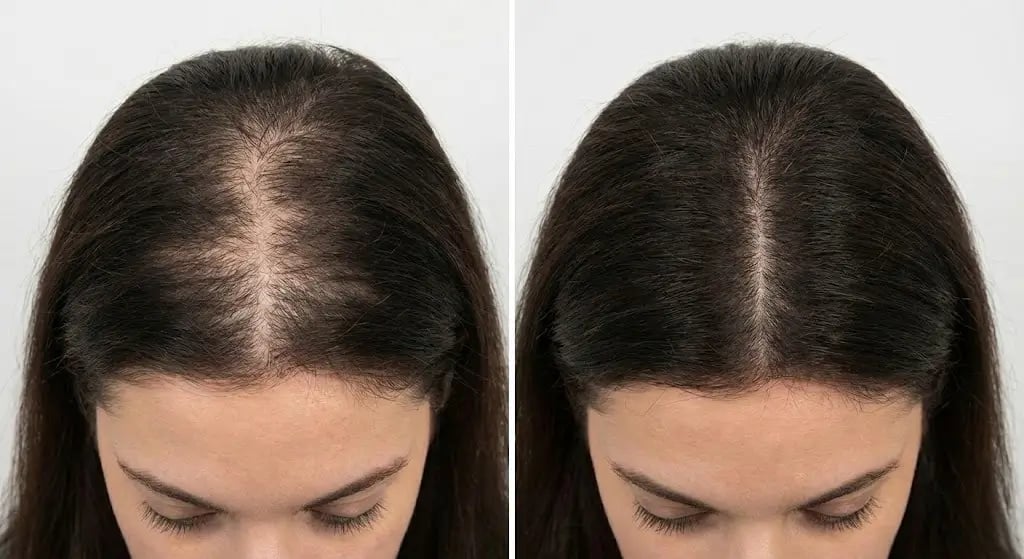
What Does Hair Look Like Before and After PCOS Hair loss in Women?
Hair looked full and dense before, and visibly thinner with a widened parting after PCOS. Women with polycystic ovary syndrome (PCOS) have normal density in the scalp before hair loss begins, in the crown, and midline. Early signs appear as gradual thinning along the central part, reduced volume near the temples, as androgen levels rise, and weaker strand texture. The frontal hairline remains intact while density decreases toward the top of the scalp. Hair strands become finer, and overall volume feels noticeably lighter over time.
Hair appears sparse in androgen-sensitive zones (central and parietal scalp) in the after phase. The scalp becomes more visible under light, and the part line looks wider. Texture changes occur, with hair becoming more fragile and prone to breakage. The loss progresses slowly, and regrowth is limited unless medical or hormonal intervention is introduced. Miniaturization worsens in untreated cases of PCOS hair loss before and after, and hair density does not recover without targeted treatment (anti-androgen therapy, nutritional support, or hair restoration techniques).
What Are the PCOS Hair Loss Treatments?
The PCOS Hair Loss Treatments are listed below.
- Oral Contraceptives: Oral contraceptives lower androgen levels and increase sex hormone-binding globulin (SHBG), which is used to regulate hormonal imbalance in PCOS. They help reduce shedding and stabilize hormonal triggers behind hair loss pcos treatment.
- Spironolactone: The anti-androgen blocks dihydrotestosterone (DHT) receptors in hair follicles and reduces excess oil production. It is effective after 3-6 months in women with visible thinning or acne caused by testosterone.
- Minoxidil (Topical): Minoxidil extends the anagen phase and enlarges miniaturized follicles, stimulating regrowth. It is prescribed as a daily topical agent and shows improvement in PCOS hair thinning treatment after 4-6 months.
- Finasteride: Finasteride works by inhibiting 5-alpha reductase, the enzyme responsible for converting testosterone into DHT. It is less commonly used in women but is prescribed when other treatments fail.
- Low-Level Laser Therapy (LLLT): LLLT increases blood flow to the scalp and energizes weak follicles using red light wavelengths. Results begin after 12 weeks and improve with consistent use as part of Hair Loss Treatment routines.
- Nutritional Therapy: Zinc, iron, and vitamin D deficiencies are common in PCOS and worsen shedding. Correcting the deficiencies supports follicle health and improves response to hormonal therapies.
- Ketoconazole Shampoo: The antifungal shampoo reduces inflammation and mildly inhibits androgen activity on the scalp. It is used weekly and supports other hair loss pcos treatment options by improving scalp health.
- Platelet-Rich Plasma (PRP): PRP involves injecting concentrated platelets from the patient’s blood into the scalp to stimulate regrowth. It requires 3-4 sessions over a few months and is ideal when other treatments yield a limited response.
- Weight Loss and Exercise: Losing weight helps reduce insulin resistance and lowers androgen levels naturally. Lifestyle modification is a key part of PCOS hair thinning treatment that supports long-term hormonal balance.
- Hair Transplant Surgery: Hair transplants are recommended when medical treatments fail to restore density and follicles have stopped responding. Success rates reach 85% in eligible candidates after one year, according to research titled Outcomes of Hair Transplantation in Women with PCOS-Associated Hair Loss by Patel, 2020, marking a long-term solution in a comprehensive Hair Loss Treatment strategy.
What Are the Best Vitamins for PCOS Hair Loss?
The Best Vitamins for PCOS Hair Loss are listed below.
- Vitamin D: Vitamin D supports follicle cycling and reduces inflammation that impairs scalp health. Low levels are common in PCOS and directly linked to increased hair shedding in women with the best vitamins for PCOS hair loss.
- Biotin (Vitamin B7): Biotin strengthens keratin structure and improves strand resilience. It supports cellular growth and helps reduce breakage caused by hormonal imbalances.
- Vitamin E: Vitamin E acts as an antioxidant, protecting hair follicle cells from oxidative stress. It promotes scalp circulation and supports growth in thinning zones.
- Vitamin A: Vitamin A regulates sebum production and supports epithelial cell turnover. It helps nourish scalp tissue and maintain follicle moisture balance.
- Vitamin C: Vitamin C boosts collagen synthesis and improves iron absorption. It strengthens the connective tissue surrounding follicles and supports healthy strand anchoring.
- Vitamin B12: Vitamin B12 promotes oxygen delivery to follicles through red blood cell production. Deficiency in PCOS impairs follicle energy and leads to slower regrowth.
- Folic Acid (Vitamin B9): Folic acid supports DNA synthesis and cell turnover in hair follicles. It plays a role in nourishing fast-growing scalp cells and reversing thinning.
- Niacin (Vitamin B3): Niacin improves blood flow to the scalp and supports cellular repair. It improves follicle function and is included in the best vitamins for PCOS hair loss formulations.
What Are the Best Shampoos for Ovarian Cyst Hair Loss?
The best Shampoos for Ovarian Cyst Hair Loss are listed below.
- Nizoral Anti-Dandruff Shampoo: Nizoral contains ketoconazole, an antifungal agent that helps block local androgen activity on the scalp. It reduces inflammation and buildup, making it a key option in the best shampoo for PCOS hair loss category.
- Regenepure DR Shampoo: Regenepure DR combines ketoconazole, saw palmetto, and nourishing proteins to combat hair thinning. It supports hormonal balance on the scalp and encourages stronger, healthier regrowth.
- Head & Shoulders Clinical Strength: Head & Shoulders uses selenium sulfide to relieve flaking and scalp irritation linked to excess oil production. It restores the scalp environment, aiding recovery from hormone-related shedding.
- Avalon Organics Biotin B-Complex Shampoo: Avalon Organics delivers biotin, saw palmetto, and vitamin E to reinforce thinning strands. It energizes hair follicles and fits well into any PCOS shampoo list for natural scalp support.
- Sebamed Anti-Hairloss Shampoo: Sebamed improves microcirculation and maintains scalp pH balance, helping prevent follicle weakening. Its mild formula suits women with PCOS-related scalp sensitivity.
- Ultrax Labs Hair Surge: Ultrax Labs infuses caffeine, ketoconazole, and saw palmetto to stimulate follicles. It boosts hair density and slows hormone-triggered hair cycle disruption.
- Alpecin Caffeine Shampoo: Alpecin delivers caffeine directly to hair roots, promoting energy supply and delaying hair thinning. It is recommended in early intervention for PCOS-linked hair loss.
- DHS Zinc Shampoo: DHS Zinc relies on zinc pyrithione to calm irritated scalp tissue and reduce excess oil. It plays a role in restoring scalp health as part of the best shampoo for PCOS hair loss lineup.
When to Start Supplements for Hair Loss Caused by PCOS
Start Supplements for Hair Loss caused by PCOS when signs of thinning, widening part, or excessive shedding appear, and blood tests reveal nutrient deficiencies or hormonal imbalances. Supplementation becomes required when clinical symptoms align with low levels of key vitamins (vitamin D, biotin, iron, and B12) that affect follicle function and growth. Early intervention is ideal, but timing depends on severity, duration, and other PCOS symptoms (acne, irregular cycles, hirsutism) are present. A healthcare provider must confirm the need for the best supplements for pcos hair loss through lab analysis, as improper use worsens hormonal imbalance or interacts with medications.
Does Minoxidil Work for PCOS Hair Loss in Women?
Yes, Minoxidil works for PCOS Hair Loss in women by stimulating blood flow to hair follicles and prolonging the anagen (growth) phase of the hair cycle. Minoxidil improves follicle size, increases hair shaft diameter, and delays miniaturization caused by androgen excess in PCOS. It is applied topically and used when hormonal treatments are not enough to restore volume or density. Regular use of 5% minoxidil solution resulted in visible hair regrowth within 4-6 months and improved patient satisfaction in minoxidil pcos treatment plans.
What Foods Promote Hair Growth and Hormonal Balance for PCOS?
Foods that Promote Hair Growth and Hormonal Balance for PCOS are listed below.
- Salmon: Salmon is rich in omega-3 fatty acids that reduce scalp inflammation and improve follicle health. It supports hormonal balance and helps prevent PCOS hair growth disruption.
- Spinach: Spinach provides iron and antioxidants that improve blood flow to the scalp and reduce oxidative stress. It is essential in managing PCOS-related nutrient deficiencies that trigger hair loss.
- Pumpkin Seeds: Pumpkin seeds are packed with zinc and anti-inflammatory compounds that regulate sebum and support follicle strength. Seeds help restore hormonal balance and reduce shedding in foods for PCOS hair growth plans.
- Eggs: Eggs contain biotin and protein that promote keratin production and reduce follicle thinning. It aids in scalp repair and helps maintain hormonal equilibrium in PCOS.
- Greek Yogurt: Greek yogurt supplies probiotics and B vitamins that improve gut health and reduce cortisol spikes. It supports better nutrient absorption and hormonal stability for stronger hair growth.
- Blueberries: Blueberries are loaded with antioxidants that protect follicles from damage and improve microcirculation. They help regulate insulin and inflammation, which are key in PCOS hair growth control.
- Lentils: Lentils provide iron, protein, and zinc that fuel follicle activity and cell renewal. It stabilizes hormones and blood sugar, reducing the triggers of PCOS-related hair loss.
What Are the Natural Remedies that Help with PCOS Hair Regrowth?
The natural Remedies that help with PCOS Hair Regrowth are listed below.
- Saw Palmetto: Saw Palmetto blocks the enzyme 5-alpha reductase, which reduces dihydrotestosterone (DHT) activity in the scalp. It supports hormonal balance and improves PCOS hair loss regrowth success over time.
- Aloe Vera: Aloe Vera soothes scalp inflammation and promotes a healthier follicle environment. It encourages regrowth and is widely used in PCOS hair loss home remedies for its natural healing properties.
- Rosemary Oil: Rosemary Oil stimulates circulation to the scalp and strengthens weak follicles. It plays a role in boosting growth and reducing hormonal shedding in PCOS.
- Onion Juice: Onion Juice contains sulfur and antioxidants that rebuild keratin structure and improve hair density. It supports regrowth in androgen-affected areas for women managing PCOS.
- Green Tea Rinse: Green Tea Rinse is rich in polyphenols that lower scalp DHT levels and calm irritation. It is essential in supporting hair regrowth and maintaining hormonal health in PCOS hair loss home remedies plans.
How Effective Is Hair Transplant for Treating PCOS Permanent Hair Loss?
Hair Transplant for treating PCOS permanent hair loss is effective through the surgical relocation of healthy follicles from androgen-resistant areas to thinning zones. Restoring density where medical treatments no longer work. It becomes a viable solution once hormone-related shedding has stabilized, after consistent use of medications like minoxidil or anti-androgens for at least 12 months.
Hair transplant is recommended for PCOS patients experiencing irreversible follicle miniaturization when topical and systemic therapies fail to produce regrowth. Patients choose to undergo the procedure in Turkey due to cost-effective packages, skilled surgeons, and modern techniques, with Vera Clinic recognized as one of the best options for female hair restoration. A carefully planned Hair Transplant ensures natural coverage and long-term satisfaction in managing PCOS-induced hair loss.
What to Expect Before and After a Hair Transplant for PCOS
Expect scalp thinning, low density, and visible part-line widening before, and increased fullness, stronger strands, and improved coverage after a Hair Transplant for PCOS. Pre-surgery, patients are evaluated for donor area quality and hair loss stability to ensure long-term graft survival. Shedding of transplanted hairs is common, followed in the weeks following the procedure, and by gradual regrowth starting around month 3. Early density of Hair Transplant Before and After appears by 6 months, while full results develop between 12 and 18 months, offering restored hairline and confidence.
When to See a Dermatologist for Hair Loss due to PCOS?
See a Dermatologist for hair loss due to PCOS when thinning becomes widespread at the crown, the part line visibly widens, or excessive shedding exceeds 100 strands daily. Sudden clumps of hair in the shower, scalp sensitivity, or signs of inflammation (itching, redness, flaking) signal the need for professional evaluation. Early consultation helps prevent irreversible follicle damage and supports timely treatment planning.
How is PCOS Hair Loss Diagnosed?
PCOS hair loss is diagnosed through clinical scalp examination, symptom history, and hormone testing for androgens (testosterone and dehydroepiandrosterone sulfate (DHEAS). A dermatologist performs a pull test, trichoscopy, or refers for lab tests to confirm an underlying hormonal imbalance. Severe or unresponsive cases require a Hair Transplant Consultation as part of long-term management.
How to Prevent Hair Loss During PCOS
To prevent Hair Loss during PCOS, follow the five steps listed below.
- Balance Hormones. Use prescribed medications to regulate androgens and improve hormonal stability. Consistent hormone control reduces scalp thinning risk, according to research titled Hormonal Therapy for Hair Loss in Women with PCOS by Shum, 2016.
- Follow a Nutrient-Rich Diet. Eat foods rich in protein, iron, zinc, and vitamin D to support follicle health. Proper nutrition strengthens hair from the root and minimizes excessive shedding.
- Use Anti-Androgen Treatments. Apply topical solutions or take oral agents (spironolactone) to block dihydrotestosterone (DHT) at the follicle. The treatments prevent miniaturization and preserve hair density.
- Reduce Stress. Practice stress-relieving activities (yoga or mindfulness) to lower cortisol levels. Chronic stress worsens hormonal imbalance and speeds up hair loss progression.
- Avoid Harsh Hair Products. Use mild shampoos and avoid heat styling or chemical treatments that damage fragile strands. Gentle care helps preserve scalp health and prevents breakage.
How to Reverse Hairfall After PCOS
To reverse Hairfall after PCOS, follow the five steps listed below.
- Correct Hormonal Imbalance. Use prescribed medications to reduce excess androgens and regulate insulin levels. Stabilizing hormones is the first step to stopping PCOS hair fall and encouraging regrowth.
- Apply Topical Treatments. Use minoxidil or caffeine-based serums to reactivate dormant follicles and improve scalp circulation. Consistent use supports visible improvement over a few months.
- Supplement Deficiencies. Add nutrients (vitamin D, biotin, and iron) after testing for deficiencies. Targeted supplementation strengthens hair strands and supports recovery from PCOS hair fall.
- Adopt a Low-Glycemic Diet. Eat whole foods, fiber, and lean protein to reduce insulin resistance and balance hormones. A stable metabolic environment supports hair growth.
- Schedule Dermatologist Visits. Get professional guidance for treatment plans, scalp analysis, or advanced options (Platelet-Rich Plasma therapy). Early action ensures faster reversal of PCOS hair fall progression.
What Is the Link Between Endometriosis and PCOS Hair Loss?
The Link between Endometriosis and PCOS hair loss is tied to shared hormonal imbalances, particularly estrogen dominance and androgen excess, which disrupt the hair growth cycle. High androgen levels shorten the anagen phase and cause follicle miniaturization in PCOS, while endometriosis-related inflammation and elevated estrogen indirectly trigger hair shedding through stress and immune dysregulation.
The conditions contribute to chronic hormonal shifts that impair follicle health and scalp circulation, leading to thinning or diffuse loss. Women affected by disorders face a compounded risk due to fluctuating hormone levels and potential side effects from medications.
Immune activation and hormonal therapies in endometriosis patients increase the endometriosis hair loss, according to research titled Endocrine and Inflammatory Links Between Endometriosis and Hair Disorders by Richi Arora, 2021, in patients with overlapping PCOS symptoms.
How Do Uterine Fibroids Contribute to Hair Loss in Women with PCOS?
Uterine Fibroids contribute to hair loss in women with PCOS by causing chronic blood loss that leads to iron-deficiency anemia, a major factor in hair thinning. Women with PCOS who develop fibroids experience heavy or prolonged menstrual bleeding, depleting iron stores essential for follicle oxygenation and cell turnover. The anagen (growth) phase shortens, and hair shifts prematurely into the telogen (resting) phase, without adequate iron, resulting in diffuse shedding. The anemia they cause disrupts scalp health and slows regrowth, but fibroids do not directly affect hormone levels. Fibroids cause hair loss indirectly through anemia in women with existing hormonal imbalances from PCOS.