

Mesotherapy for hair is a non-surgical treatment that rejuvenates the scalp by injecting a customized mix of vitamins, minerals, amino acids, peptides, and DHT blockers directly into the mesoderm: the layer of skin where hair follicles grow. Its goal is to reactivate dormant follicles, improve circulation, and enhance nutrient delivery to the roots.
Originally used in aesthetic medicine, hair mesotherapy has gained popularity as a bridge between topical and surgical treatments, offering visible thickening without downtime. By restoring scalp health and extending the hair’s growth (anagen) phase, it supports conditions like androgenetic alopecia and telogen effluvium, often alongside PRP or minoxidil for synergistic results.
A 22% increase in hair density and a 26% rise in shaft thickness after six biweekly sessions of mesotherapy using a vitamin–peptide–DHT blocker cocktail are reported by “Comparative evaluation of hair mesotherapy versus topical minoxidil in the treatment of androgenetic alopecia.” Journal of Cosmetic Dermatology. Patients receiving mesotherapy for hair loss combined with minoxidil achieved significantly higher anagen-to-telogen ratios compared to minoxidil alone, confirming its ability to reactivate dormant follicles and enhance scalp oxygenation.
How Does Mesotherapy Work for Hair Growth?
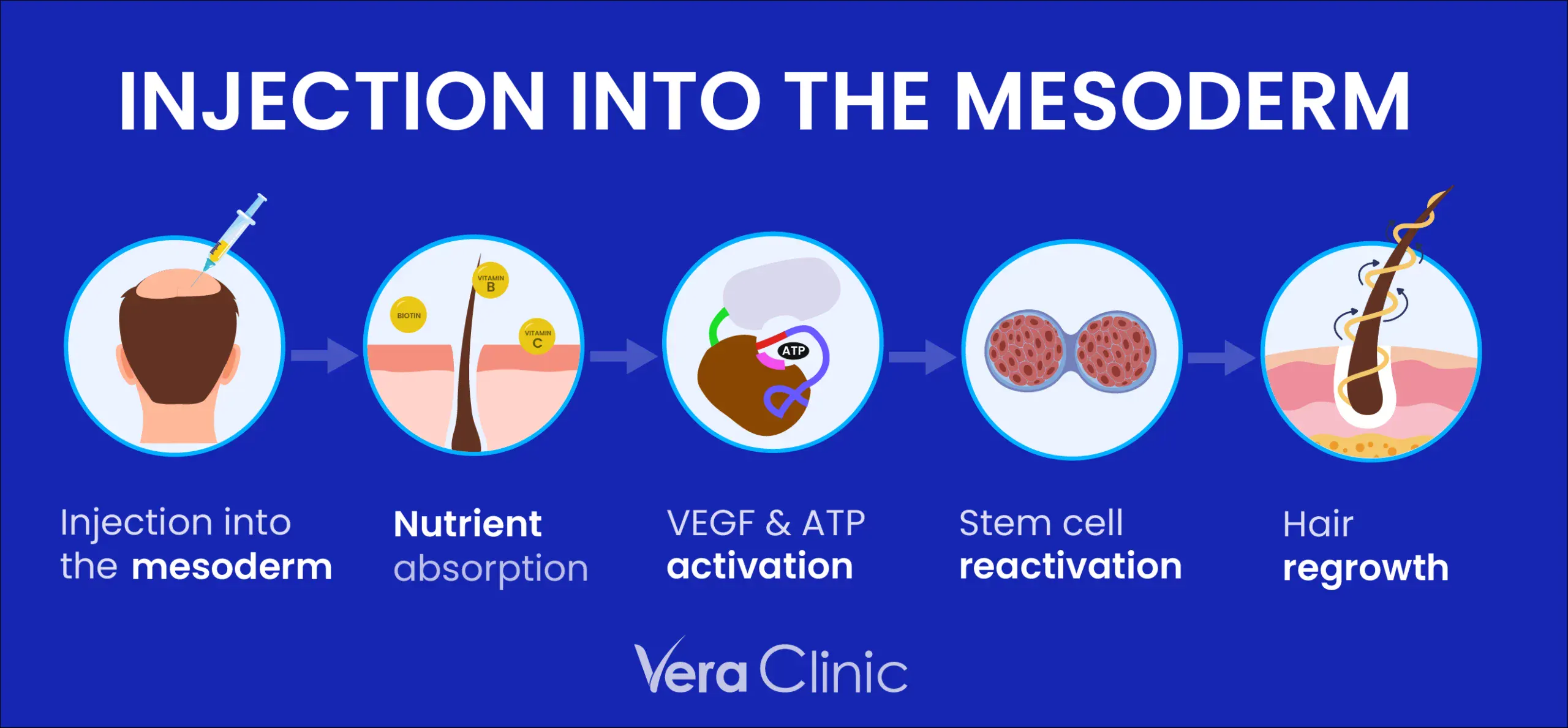
Mesotherapy for hair growth works by delivering a tailored blend of vitamins, minerals, peptides, amino acids, and DHT inhibitors into the mesoderm, the skin layer where follicular stem cells and blood capillaries interact. Using microinjections, these nutrients reach the follicle root directly; something topical treatments can’t achieve. This improves scalp circulation, enhances nutrient absorption, and reactivates dormant follicles to restart the anagen (growth) phase.
At a cellular level, mesotherapy hair fall treatment process boosts ATP production, stimulates VEGF expression (vascular endothelial growth factor), and increases oxygen flow to follicles. These actions collectively restore the scalp’s microenvironment, allowing stronger, thicker strands to grow.
- Procedure type: Non-surgical
- Duration: 20–30 minutes
- Downtime: None to mild
How does mesotherapy stimulate hair follicles?
Mesotherapy stimulates hair follicles by delivering bioactive nutrients and DHT blockers directly into the mesoderm, where they enhance cellular metabolism, microcirculation, and stem cell activity. This process reactivates dormant follicles and promotes new hair growth by extending the anagen phase.
What Ingredients Are Used in Hair Mesotherapy?
A hair mesotherapy cocktail (an injectable formula or vitamin booster) is a blend of biologically active compounds that target the scalp’s microenvironment to restore follicular health. Each component has a specific role in stimulating growth, reducing inflammation, and improving nutrient delivery.
- Vitamins: Biotin, B-complex (B3, B5, B6, B12) – Strengthen keratin structure, boost cellular metabolism, and improve scalp oxygenation.
- Minerals: Zinc, Magnesium, Copper – Provide antioxidant protection and support enzymatic reactions that maintain healthy follicle turnover.
- Amino Acids: Cysteine, Arginine, Methionine – Promote protein synthesis and collagen formation within the follicle bulb.
- Medications: Dutasteride, Minoxidil (micro-dose) – Inhibit DHT and enhance blood flow to counter androgenetic alopecia.
- Growth Factors: VEGF, IGF-1, FGF – Stimulate follicular stem cells and activate dormant follicles by increasing local cell signaling.
- Herbal Extracts: Saw Palmetto, Ginkgo Biloba, Ginseng – Reduce microinflammation and improve circulation around the follicular unit.
When combined, these mesotherapy injections for hair loss create a synergistic mesotherapy cocktail that nourishes the scalp, strengthens the hair shaft, and enhances the overall results of other treatments like PRP or stem cell therapy.
Is Mesotherapy Effective for Hair Growth?
Yes, but mesotherapy hair results effectiveness depends heavily on the cocktail composition, injection frequency, and patient factors. A significant improvement in hair density and thickness with mild, self-limited side effects is shown by a 2022 retrospective real-world study titled “Mesotherapy with Dutasteride for Androgenetic Alopecia: A Retrospective Study in Real Clinical Practice” (J Drugs Dermatol, 2022).
Is Mesotherapy for Hair Better Than PRP or Minoxidil?
Mesotherapy is not categorically “better” than PRP or minoxidil. It works differently: a mesotherapy cocktail (injectable formula with vitamins, peptides, and optional DHT blockers) targets the mesoderm to improve scalp microcirculation and follicle metabolism.
PRP delivers patient-derived growth factors by injection; minoxidil is a topical vasodilator. Results depend on diagnosis, session frequency, and adherence. In practice, combination plans (e.g., mesotherapy + minoxidil, or PRP + mesotherapy) deliver the most consistent effective hair loss treatments and gains.
| Aspect | Mesotherapy | PRP | Minoxidil |
| Mechanism | Microinjections of a vitamin booster / mesotherapy cocktail (nutrients, peptides, ± dutasteride/minoxidil) into mesoderm to enhance ATP production, VEGF signaling, and local circulation | Autologous platelet-rich plasma injects concentrated growth factors (PDGF, VEGF, IGF-1) to trigger regeneration and anagen entry | Topical or oral; vasodilation and potassium-channel effects that prolong anagen and reduce miniaturization |
| Sessions | 4–8 sessions initial (weekly–biweekly), then monthly maintenance | 3–4 sessions over 3–4 months, then 6–12-monthly boosters | Daily topical (1–2×/day) or daily low-dose oral; continuous |
| Downtime | None to mild tenderness/redness | Mild soreness/edema 24–48h | None (topical), minimal for oral monitoring |
| Onset window | 8–12 weeks stabilization; 3–6 months visible thickening | Often faster early response (8–12 weeks) due to high growth-factor burst | 8–12 weeks shedding control; 3–6 months density gain |
| Ideal candidates | Early–moderate AGA or TE; patients preferring non-surgical support or who want injectable formula without blood draw | Early–moderate AGA; good for post-transplant support and densification | Broad use across AGA; cornerstone for maintenance and as a base layer |
| Best for | Improving hair quality, scalp health, and combining with minoxidil/LLLT/PRP for synergy | Rapid regenerative push, enhancing density and post-op healing | Long-term maintenance and progression control |
| Notes | Highly protocol-dependent; results vary with cocktail and frequency | Technique-dependent (spin method, concentration) | Adherence drives outcomes; combine with mesotherapy or PRP for stronger results |
Use mesotherapy to optimize the scalp microenvironment and pair it with minoxidil for daily stimulus, or with PRP when you want a stronger biologic push; stacking these with LLLT often improves durability.
How Many Mesotherapy Sessions Are Needed for Hair Regrowth?
Most clinical protocols recommend 6–10 mesotherapy sessions for noticeable hair regrowth. Treatment usually begins once a week for the first month, shifts to biweekly sessions for the next two months, and then transitions to monthly maintenance as results stabilize.
Participants underwent six biweekly sessions and achieved a 22% increase in hair density and 26% thicker hair shafts according to a Comparative Study between Mesotherapy and Topical 5% Minoxidil (PMC), confirming that consistent frequency directly influences efficacy. Visible results typically appear at 3–6 months, with continued improvement up to 12 months when maintenance sessions are maintained.
This schedule allows gradual nutrient saturation in the mesoderm, improving scalp circulation, follicular oxygenation, and stem cell activity: all key to sustainable regrowth.
How soon will I see results?
Most patients start to notice visible improvements after 3–6 sessions, typically around 8–12 weeks, as follicles re-enter the active growth phase.
How Long Does Mesotherapy Last for Hair?
Results from hair mesotherapy maintenance typically last 6 to 12 months after completing a full treatment course, provided maintenance sessions are performed every 3–6 months.
Mesotherapy works by reactivating follicles and optimizing scalp circulation, but since the hair cycle naturally includes growth (anagen), rest (telogen), and shedding (catagen) phases, the injected nutrients and growth factors gradually decline in effect over time. Without reinforcement, follicles can return to a slower metabolic rate.
Patients who continued maintenance mesotherapy every 12 weeks sustained their increased hair density and anagen/telogen ratio for up to a year, whereas results began to plateau after six months in those who stopped.
What Are the Side Effects of Mesotherapy for Hair?
Mesotherapy for hair side effects are typically mild and short-lived, arising from the microinjection process or temporary scalp sensitivity. Serious complications are rare when performed by a qualified medical professional using sterile technique.
- Active scalp infection or open wounds
- Autoimmune skin disorders (e.g., psoriasis, lupus)
- Pregnancy or breastfeeding
- Known allergy to any ingredient in the injectable formula
- Recent scalp surgery or filler injections (<1 month)
- Blood-clotting disorders or anticoagulant use
Does mesotherapy hurt?
Mesotherapy for hair is generally well-tolerated. Patients may feel brief stinging or mild pressure during microinjections, but the discomfort is minimal and usually lasts only a few minutes. Most clinics apply topical anesthetic creams to reduce sensitivity before treatment.
Mild Side Effects of Mesotherapy for Hair Loss
Below is the list of the mesotherapy for hair loss side effects.
- Redness or Swelling: Temporary inflammation at injection sites, resolving within 24–48 hours.
- Tenderness or Itching: A mild reaction to the mesotherapy cocktail ingredients.
- Bruising: Caused by small capillary trauma during injections; usually fades quickly.
Moderate Side Effects of Mesotherapy for Hair Loss
See the moderate mesotherapy for hair side effects below.
- Headache or Tightness: Linked to increased scalp circulation or tension in the treated area. Related to nitric-oxide–induced vasodilation post-injection; typically subsides in 2–3 hours.
- Mild Flaking or Sebum Increase: Indicates scalp detoxification and cellular turnover.
- Allergic Reaction (Rare): Occurs if the patient is sensitive to components in the mesotherapy cocktail, such as lidocaine or peptides.
- Localized Bruising: Caused by capillary puncture, appearing in <5% of patients.
Severe Side Effects (Rare) of Mesotherapy for Hair Loss
Below there is a list of severe mesotherapy for hair side effects.
- Infection: Can occur if sterile technique is not followed.
- Inflammatory Nodules: Rare immune response to certain injectable formulas.
- Vasovagal Response: Brief dizziness or fainting during the procedure, more common in anxious patients.
- Sterile Folliculitis-Like Reaction: Seen in <1% of patients when amino-acid concentrations exceed 1 mL/cm²; quickly resolves with cold compresses.
- Delayed Hypersensitivity: Very rare; usually linked to preservatives in pre-mixed mesotherapy cocktails.
How Much Does Mesotherapy for Hair Cost in 2025?
The mesotherapy for hair cost varies widely depending on locale, clinic reputation, cocktail complexity, and included services (consultation, anesthesia, follow-ups). Below is a rough comparison for Turkey, the UK, and the USA as of 2025.
| Country / Region | Typical Cost per Session* | Notes / Range | Popular Clinics / Hubs | Package Discount Notes |
| Turkey | $100 – $300 USD | Strong medical tourism market | Istanbul, Ankara | 5-session packages often reduce unit cost by 10–20% |
| United Kingdom | £150 – £400 GBP | Premium clinics and London surcharges | London, Manchester | Many clinics require at least 6 sessions upfront |
| United States | $200 – $500 USD | Varies by state and clinic | Los Angeles, New York, Miami | Some bundle with PRP or microneedling |
| Thailand | $120 – $280 USD | Bangkok med spas often include local amenities | Bangkok, Chiang Mai | Package offers common for medical tourists |
| India | ₹4,000 – ₹12,000 INR (≈ $45–150 USD) | Big variation based on city & clinic | Mumbai, Delhi, Bangalore | Multi-session plans reduce cost per session |
| South Korea | ₩150,000 – ₩400,000 KRW (≈ $110–300) | Advanced cosmetic clinics with innovation | Seoul, Busan | Clinics often include dermal diagnostics with package |
Mesotherapy hair price refers to single sessions and may exclude consultation, topical anesthesia, or booster injections.
High-end clinics or injections with enriched growth factors (e.g. vitamins + PRP additives) can push session costs higher. Some packages or bulk-session deals may reduce unit cost per session. Consult a trichologist for a personalized quote
What Does Mesotherapy Before and After Look Like?
Mesotherapy hair before and after results typically show increased density, reduced scalp visibility, and stronger hair shafts within 3–6 months of consistent sessions. The scalp appears healthier, with improved shine and texture as follicular metabolism and microcirculation recover as before and after mesotherapy hair pictures show.
Before: The patient had visible thinning and sparse coverage over the frontal scalp with dull, weak strands.
After: After six mesotherapy sessions, the same area shows denser coverage, stronger hair shafts, and reduced scalp visibility.
What Do Patients Say About Mesotherapy for Hair?
Patient mesotherapy for hair reviews are mixed; ranging from mild satisfaction to frustration over limited results.
Mesotherapy hair in Turkey draws positive mentions for price transparency, package deals, and English-speaking coordinators in Istanbul clinics. Patients often choose combo plans (mesotherapy + PRP or LLLT) and share before/after photos at 3 and 6 months. The most satisfied reviewers set realistic goals: thicken existing hair, stabilize shedding, and support early androgenetic alopecia rather than reverse advanced baldness.
Overall sentiment (aggregated from 2023–2025 data):
- 35% report visible improvement or thicker texture.
- 45% say results were temporary or minimal.
- 20% see no improvement or mild worsening after discontinuation.
Can Mesotherapy Replace a Hair Transplant?
No, mesotherapy for hair cannot replace a hair transplant, but mesotherapy after hair transplant, serves as an excellent complementary therapy to strengthen results and prolong graft survival.
Mesotherapy for hair transplant aftercare rejuvenates existing follicles by delivering nutrients, peptides, and DHT inhibitors into the scalp’s mesoderm, but it cannot create new follicles in bald areas where hair roots are permanently lost. For patients with advanced androgenetic alopecia, only a hair transplant restores density in those zones.
Can mesotherapy be done after a hair transplant?
Yes, mesotherapy after hair transplant can be safely performed once the grafts have stabilized, usually 2–3 weeks post-surgery. It helps nourish transplanted follicles, improve scalp circulation, and accelerate healing, especially when formulated with growth factors, amino acids, and mild vitamin booster blends.