


Buspirone, commonly sold under the brand name Buspar, is an anxiolytic medication primarily prescribed for the treatment of generalized anxiety disorder (GAD) and sometimes as an adjunct therapy for depression. It is not chemically related to benzodiazepines or SSRIs but works by modulating serotonin (5-HT1A) and dopamine receptors, making it a non-sedative option for long-term anxiety management. Buspirone is often preferred for its low risk of dependence and mild side-effect profile compared to traditional antidepressants.
Although uncommon, buspirone causes hair loss and has been reported in case studies and pharmacovigilance databases. The relationship between buspar and hair loss appears to stem from drug-induced telogen effluvium, where alterations in serotonin and dopamine activity prematurely push hair follicles into the resting (telogen) phase. This results in diffuse shedding typically appearing within 2–3 months of starting the medication.
Multiple cases of hair loss are associated with anxiolytic and antidepressant medications, including buspirone according to a study titled “Psychotropic Drug-Induced Alopecia: A Review of Case Reports” (Annals of Clinical Psychiatry, 2017. While buspirone-induced alopecia is rare, it is reversible upon dose reduction or discontinuation.
Buspar hair loss is considered a type of drug-induced alopecia, often mild and temporary. Hair usually regrows once the medication is adjusted or discontinued, highlighting the importance of early recognition and consultation with a healthcare professional.
How Common is Hair Loss in People Taking Buspirone?
Hair loss from Buspirone (Buspar) is considered rare, but documented. According to pharmacovigilance data and case reviews, fewer than 1% of patients report hair shedding or diffuse thinning while taking the drug. Buspirone was listed among anxiolytics occasionally linked to alopecia in the study “Psychotropic Drug-Induced Alopecia: A Review of Case Reports” (Annals of Clinical Psychiatry, 2017), though at a far lower frequency than SSRIs or mood stabilizers like valproate.
A safety analysis from the FDA Adverse Event Reporting System (FAERS, 2021) identified under 50 reports of alopecia related to Buspirone worldwide, making it one of the less commonly implicated psychotropic medications for drug-induced hair loss.
While the overall hair loss due to medication risk is low, individual susceptibility varies depending on dosage, duration of treatment, genetic predisposition, and coexisting medication use. Most reported cases involve reversible telogen effluvium, where hair regrowth begins within 3–6 months after discontinuation or dose adjustment.
Why Is Hair Loss a Side Effect of Buspirone?
Buspirone side effects hair loss occur due to its indirect influence on the hair growth cycle through neurochemical and hormonal modulation. Buspirone acts as a partial serotonin 5-HT1A receptor agonist, altering serotonin and dopamine balance; neurotransmitters that regulate follicular activity and the anagen (growth) phase of hair.
Disruption in these pathways prematurely shifts follicles into the telogen (resting) phase, leading to diffuse shedding known as telogen effluvium. This process is not due to follicle destruction but rather a temporary growth halt caused by systemic stress or neuroendocrine imbalance.
Buspirone is identified among anxiolytics occasionally associated with alopecia in a pharmacovigilance review titled “Psychotropic Drug-Induced Alopecia: A Review of Case Reports” (Annals of Clinical Psychiatry, 2017). However, the hair loss typically reverses within months once the dosage is reduced or discontinued, suggesting a non-scarring, stress-mediated mechanism rather than permanent follicular damage.
Does Buspirone (Buspar) Make Your Hair Fall Out?
Yes, although rare, Buspirone (Buspar) makes your hair fall out for some people. Reported cases link buspirone-induced alopecia to temporary disruptions in the hair growth cycle, likely due to neurochemical shifts involving serotonin and dopamine receptors. This triggers telogen effluvium, where a higher percentage of hair prematurely enters the resting phase, leading to diffuse shedding.
How Does Buspirone Cause Hair Loss?
Hair loss from Buspirone occurs due to its interference with the hair growth cycle, particularly by disrupting the hormonal and neurochemical balance that maintains follicular activity. The medication’s impact on serotonin and dopamine pathways (key regulators of stress and endocrine function) alter blood flow and nutrient supply to the scalp, pushing more follicles prematurely into the telogen (resting) phase, resulting in diffuse shedding rather than localized baldness.
Buspirone triggers subtle hormonal and cortisol fluctuations, especially in patients sensitive to serotonergic drugs, which heighten stress responses linked to hair miniaturization. Furthermore, since Buspirone acts as a partial 5-HT1A receptor agonist, it indirectly affects thyroid and adrenal hormones, both essential for maintaining healthy hair cycles.
How Long Does it Take for Buspar to Cause Hair Loss?
Hair loss from Buspar usually begins within a few weeks to 3 months after starting the medication, depending on dosage and individual sensitivity.
Why Might Buspirone Trigger Drug-Induced Alopecia?
Drug-induced alopecia refers to temporary or, rarely, permanent hair loss caused by a medication’s interference with the normal hair growth cycle; most often via telogen effluvium. In the case of Buspirone, shedding usually begins within 2–3 months of starting treatment, aligning with the hair cycle’s shift into the telogen (resting) phase.
Buspirone’s modulation of serotonin (5-HT1A) receptors and indirect effects on dopamine transmission influence follicular stem cell activity and keratinocyte proliferation. These neurochemical shifts alter local vascular tone and nutrient delivery to follicles, making them more prone to early shedding. Psychotropic drugs trigger subtle endocrine and stress-response changes, elevating cortisol and oxidative stress that disrupt the hair cycle’s synchronization.
Serotonergic agents like Buspirone induce reversible telogen effluvium, with regrowth typically occurring 3–6 months after discontinuation or dose adjustment according to “Drug-Induced Alopecia: Pathophysiology and Clinical Review” (Dermatologic Therapy, 2020). This supports that Buspirone-related hair loss is generally transient and non-scarring, driven by biochemical rather than structural follicular damage.
How Does Buspirone Cause Telogen Effluvium Hair Loss?
Buspirone triggers telogen effluvium, a temporary form of hair loss, by disturbing the normal balance of the hair growth cycle. The medication’s influence on serotonin and dopamine receptors affects neurohormonal regulation, leading to increased stress signaling and subtle endocrine changes that prematurely push hair follicles from the anagen (growth) phase into the telogen (resting) phase.
The mechanism mirrors other psychotropic-induced telogen effluvium, where neurotransmitter and cortisol fluctuations impair follicular oxygenation and energy metabolism.
How Can Anxiolytic Agents Like Buspirone Lead to Hair Loss?
Anxiolytic agents like Buspirone can lead to drug-induced alopecia through neurohormonal and vascular effects that disturb the hair follicle cycle.
As a 5-HT1A receptor partial agonist, Buspirone alters serotonin and dopamine signaling, which affects the hypothalamic-pituitary-adrenal (HPA) axis and triggers premature transition of follicles into the telogen (resting) phase. This causes diffuse thinning known as telogen effluvium, typically reversible once the drug is stopped or the dose is reduced.
Other anxiolytics (such as benzodiazepines and SSRIs with anxiolytic properties) have shown similar effects, suggesting that the shared disruption of neurotransmitter balance and scalp blood flow is the key mechanism. According to the FDA label, hair loss is listed as an infrequent dermatologic side effect of Buspirone, alongside rash and pruritus.
How Does Buspirone Trigger an Idiosyncratic Reaction Leading to Hair Loss?
An idiosyncratic drug reaction is an unpredictable, non–dose-dependent response that occurs only in susceptible individuals due to genetic or immune factors, and it matters in psychopharmacology because these agents modulate neuro-immune and endocrine pathways that unexpectedly affect skin and hair. Such reactions are rare and variable, so most patients never experience them, and timing, severity, and presentation differ from case to case.
They are hard to replicate in trials because incidence is low, onset is delayed, and standard study designs exclude or dilute single-patient outliers; therefore they are mainly documented in case reports where dechallenge/rechallenge links the drug to the event. In this context, buspirone provokes telogen effluvium via an idiosyncratic neuro-immune shift (e.g., cytokine signaling, microvascular tone changes) that abruptly pushes follicles from anagen to telogen without a clear dose relationship. A representative review outlines idiosyncratic, non–dose-related alopecia across psychotropics and explains why single-case evidence (with regrowth after withdrawal) is the primary proof of causality, according to “Drug-Induced Alopecia: An Overview” (Dermatology Online Journal, 2013).
How Does Buspirone Cause Hair Loss in People with Depression?
Buspirone contributes to hair loss in people with depression by amplifying physiological stress responses and altering neurohormonal balance in ways that affect hair follicle cycling. While buspirone hair loss is uncommon, its serotonergic and dopaminergic effects indirectly trigger telogen effluvium, a condition where stress and neurotransmitter disruption shift follicles prematurely from the growth (anagen) phase into the resting (telogen) phase.
Depressed patients are already more prone to hair shedding due to chronic cortisol elevation and inflammatory cytokine activity, both of which impair scalp blood flow and follicular regeneration. When buspirone modifies serotonin signaling, it momentarily worsens this imbalance, especially during the body’s adaptation period to treatment.
Mood-related neuroendocrine disruption (common in depression) heightens hair follicle sensitivity according to “Stress Hormones and Hair Follicle Biology: Cortisol-Induced Miniaturization and Telogen Shift” (Experimental Dermatology, 2019). When combined with serotonergic medications like Buspirone, this creates a multifactorial environment that triggers transient or diffuse hair loss due to depression during treatment.
Why Does Buspirone Cause Hair Thinning in Depressed Patients?
Buspirone, an anti-anxiety medication, sometimes causes hair thinning in depressed patients, though this reaction is rare and generally linked to telogen effluvium; a temporary condition where stress or medication disrupts the normal hair growth cycle. In individuals with depression, the scalp is already under physiological strain due to elevated cortisol and systemic inflammation, which weakens follicular health and slows regrowth. When Buspirone alters serotonin and dopamine regulation, it compounds these effects, triggering additional shedding or reduced strand density.
Hair thinning usually appears gradually, within 1–3 months of starting treatment, and is typically reversible once the body adapts or the dose is adjusted. Serotonergic medications like Buspirone influence hair cycle dynamics and perifollicular blood flow according to “Psychotropic Drug–Induced Hair Disorders: Clinical Features and Mechanisms” (Clinical Neuropharmacology, 2020), explaining why some depressed patients experience mild, stress-synchronized thinning during therapy.
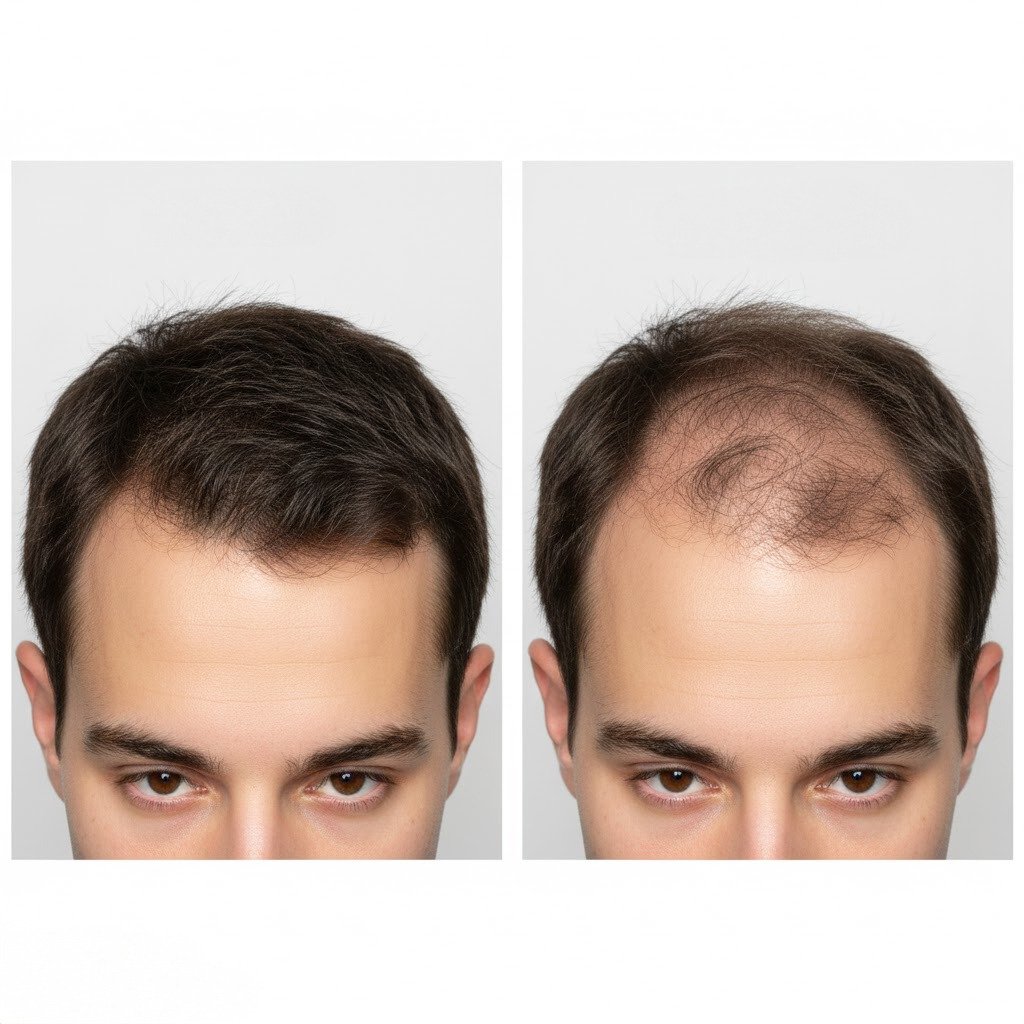
What Does Hair Look Like Before and After Buspirone Hair Loss?
Before Buspirone-induced hair loss, the scalp typically shows normal density with uniform strand thickness, while after the onset of buspirone hair loss, patients often exhibit diffuse thinning and reduced volume due to widespread shedding of telogen hairs.
How to Stop Hair Loss from Buspirone
Managing Buspirone hair loss involves addressing the underlying cause (whether hormonal imbalance, drug-induced telogen effluvium, or nutrient depletion) and supporting follicle recovery through medical and lifestyle interventions.
- Consult a Dermatologist or Hair Transplant Specialist: Schedule a medical evaluation to rule out other causes of hair loss and confirm if Buspirone is the trigger. Adjusting the dose or switching medications stop shedding within weeks.
- Nutritional Support: Supplement with biotin, zinc, iron, and vitamin D, which are essential for follicular strength and regrowth. Studies show that correcting deficiencies improve regrowth in up to 70% of telogen effluvium cases (International Journal of Trichology, 2020).
- Topical and Oral Therapies: Use minoxidil (2–5%) to stimulate anagen phase re-entry and enhance hair density. In drug-induced hair loss, regrowth is often visible within 3–6 months.
- Stress and Cortisol Management: Since Buspirone affects serotonin and cortisol pathways, combining it with relaxation techniques or therapy reduce stress-related shedding and support recovery.
- Monitor and Track Regrowth: Improvement is typically seen after 3–6 months of consistent care, with full recovery possible in 9–12 months depending on follicular health and medication adjustment.
How Effective Is Hair Transplant for Treating Buspirone Permanent Hair Loss?
A hair transplant is an effective long-term solution for permanent hair loss caused by Buspirone, particularly in cases where hair follicles fail to recover after medication withdrawal. Once drug-induced shedding stabilizes and no further active loss is observed (typically after 6–12 months) patients are considered suitable candidates for surgical restoration.
Hair transplantation works by redistributing healthy, DHT-resistant follicles from the donor area to regions affected by thinning or permanent loss. In cases of Buspirone-related alopecia, transplanted follicles are unaffected by neurochemical or hormonal imbalances, allowing them to regrow normally.
Patients with stabilized post-drug alopecia who underwent transplantation achieved 90–95% graft survival rates and high satisfaction scores after one year according to a review titled “Long-Term Outcomes of Hair Restoration in Medication-Induced Alopecia” (Aesthetic Plastic Surgery, 2022).
In Turkey, renowned clinics like Vera Clinic combine medical expertise with advanced techniques such as Sapphire FUE and Oxycure Therapy, ensuring both scalp healing and graft vitality. These procedures are especially valued for their natural aesthetic results, minimal scarring, and cost-effectiveness, making Vera Clinic one of the best hair transplant clinics in Turkey for patients seeking recovery from medication-related hair loss.
What to Expect Before and After a Hair Transplant for Buspirone Hair Loss?
Before the Transplant: Patients undergo scalp evaluation to confirm that Buspirone-induced hair loss has stabilized. Surgeons assess donor density and design a personalized plan targeting thinning or permanently bald areas. Pre-operative bloodwork ensures the body has recovered from medication-related hormonal or nutritional imbalances.
After the Transplant: Mild swelling and redness are common in the first few days, with transplanted follicles entering a brief shedding phase around 2–4 weeks post-surgery. New growth typically begins by 3–4 months, thickening noticeably within 9–12 months. Results are permanent because transplanted follicles are genetically resistant to medication-triggered shedding.
Check the hair transplant before and after results for buspirone hair loss!
When to See a Dermatologist for Hair Loss due to Buspirone
You should see a dermatologist if hair loss persists beyond 3–4 months, worsens rapidly, or involves visible scalp exposure, patchy bald spots, or inflammation and tenderness. Immediate medical attention is advised if there’s scalp pain, redness, or excessive shedding exceeding 100 strands per day.
Persistent hair thinning indicates telogen effluvium or early follicle damage from prolonged drug response. Early evaluation ensures proper management; either dose adjustment, nutritional correction, or referral for a hair transplant consultation if permanent hair loss is confirmed.
How Is Buspirone Hair Loss Diagnosed?
Buspirone hair loss is diagnosed by correlating the timing of hair shedding with the start of medication, ruling out other causes, and confirming improvement after dose reduction or discontinuation.
How Can Switching Antidepressants Help Reverse Hair Thinning?
Switching antidepressants can sometimes reverse hair thinning, particularly when the shedding is linked to the original medication rather than permanent follicle damage. In most cases, hair begins to regrow within 3–6 months after transitioning to a different drug or adjusting the dosage under medical supervision. This recovery occurs because drug-induced telogen effluvium is reversible once the triggering compound clears from the body and normal follicular cycling resumes.
Which Other Types of Anxiolytic Antidepressants Can Cause Hair Loss?
Several anxiolytic antidepressants besides Buspirone have been associated with hair loss, though the mechanisms and severity vary depending on the drug’s pharmacological class and its impact on neurotransmitters.
1. Benzodiazepines (e.g., Diazepam, Lorazepam): Occasionally linked to telogen effluvium due to their sedative impact on the central nervous system, which alters stress hormone balance and slow hair follicle regeneration.
2. SSRIs (e.g., Escitalopram, Sertraline): Cause diffuse hair thinning in rare cases, likely due to serotonin’s influence on the hair growth cycle; hair typically regrows within months of discontinuation.
3. SNRIs (e.g., Venlafaxine, Duloxetine): Affect both serotonin and norepinephrine pathways; excessive norepinephrine stimulation causes vasoconstriction, reducing scalp blood flow and nutrient supply.
4. Tricyclic Antidepressants (e.g., Amitriptyline, Nortriptyline): Reported to cause anagen effluvium and dry, brittle hair due to anticholinergic effects and altered thyroid hormone metabolism.
5. Beta-Blocker Adjuncts (e.g., Propranolol): Used for anxiety-related symptoms rather than depression itself; can contribute to temporary hair shedding through reduced peripheral circulation.
Each class impacts stress response and follicle health differently, meaning that hair loss from these anxiolytics is usually reversible once the drug is adjusted or discontinued under medical supervision.
How to Prevent Hair Loss When Taking Buspirone
While Buspirone hair loss is rare, proactive scalp and lifestyle care help minimize shedding and support recovery if it occurs.
1. Monitor Early Signs: Track shedding during the first 2–3 months of treatment. Early recognition allows your doctor to adjust the dosage before significant loss occurs.
2. Maintain Balanced Nutrition: Ensure adequate intake of iron, zinc, vitamin D, and biotin, which are crucial for hair growth. A 2020 review in Nutrients highlighted that deficiencies in these nutrients are strongly associated with drug-induced telogen effluvium.
3. Manage Stress and Sleep: Since Buspirone targets anxiety pathways, maintaining stable sleep and stress levels supports scalp circulation and hormonal balance.
4. Avoid Harsh Hair Products: Limit sulfates, alcohol-based tonics, and excessive heat styling, which worsen fragility and scalp inflammation.
5. Support Follicle Health with Topical Treatments: Dermatologists recommend minoxidil 2–5% to reactivate dormant follicles and shorten the resting (telogen) phase.
6. Schedule Regular Medical Checkups: Monitor thyroid and hormonal levels; changes in these parameters exacerbate shedding while on Buspirone.
7. Consider a Hair Transplant Consultation:
If shedding persists beyond 6–9 months after dosage adjustment, consult a specialist to evaluate follicular viability and discuss surgical options for permanent restoration.
Consistent monitoring, nutritional support, and medical guidance help prevent long-term Buspirone and hair loss complications while maintaining treatment stability for anxiety management.