

Scalp eczema hair loss occurs when chronic inflammation from eczema disrupts the scalp environment, damaging hair follicles and triggering shedding or thinning. Eczema on the scalp is an inflammatory skin condition marked by redness, itching, flaking, and irritation. When left untreated, this ongoing irritation weakens the follicular structure, leading to temporary or, in rare cases, permanent hair loss.
Eczema-related shedding is classified as a type of inflammatory hair loss, where the immune response and barrier dysfunction compromise scalp health. Patients with scalp eczema and hair loss often notice diffuse thinning or patchy shedding around affected areas, especially during flare-ups. With proper dermatological care and scalp management, most cases of scalp inflammation hair loss are reversible once inflammation is controlled.
How Does Eczema Cause Hair Loss?
Eczema causes hair loss by creating an inflamed and hostile environment on the scalp that weakens and damages hair follicles. Chronic inflammation triggers itching, scratching, and flaking, all of which irritate the follicular structure and push hairs into premature shedding. When eczema on the scalp is active, hair loss often appears as diffuse thinning or patchy shedding around inflamed regions.
Most cases of scalp eczema hair loss are temporary and fall under telogen effluvium, where stress and inflammation shift follicles into the resting phase, leading to increased shedding. However, in severe or long-standing cases, ongoing inflammation destroys follicle openings, resulting in cicatricial alopecia, a permanent scarring type of hair loss.
Inflammatory scalp disorders, including eczema, are associated with both reversible and irreversible alopecia depending on the chronicity and intensity of inflammation. This distinction shows why early management of eczema is critical for protecting hair follicle health and preventing permanent scalp damage.
How Can Scalp Eczema Trigger Telogen Effluvium?
Scalp eczema can lead to telogen effluvium by causing chronic inflammation and release of cytokines (like IL-1, TNF-α) that prematurely push hair follicles out of the anagen phase into telogen, resulting in diffuse shedding several weeks later. For example, in a study of allergic contact dermatitis of the scalp, researchers documented increased hair shedding 2–4 months after dermatitis onset, confirming inflammatory scalp conditions trigger acute TE.
Why Does Scalp Eczema Lead to Severe Itching?
Itching in scalp eczema is triggered by histamine release, inflammatory cytokines (like IL-31, TNF-α), and nerve irritation driven by chronic inflammation, all of which stimulate sensory nerve endings in the scalp. When patients scratch persistently, they worsen follicular damage, promote micro-tears, and accelerate telogen effluvium or invite secondary bacterial infection. Studies on scalp pruritus and itch mechanics (e.g. Scalp Itch: A Systematic Review) highlights how elevated inflammatory mediators in eczema correspond with itch severity and correlate with hair shedding in inflamed areas.
How Does Scalp Dysbiosis Worsen Scalp Eczema and Lead to Hair Loss?
Scalp dysbiosis is an imbalance in the scalp microbiome (disproportionate growth of fungi or bacteria like Malassezia or Staphylococcus) that disrupts the skin barrier and triggers inflammation.
When Malassezia or Staphylococcus overgrow, they secrete lipases, toxins, and proteases that irritate the scalp, amplify immune responses, and degrade barrier integrity. This increases itch, inflammation, and susceptibility to secondary infection, further damaging hair follicles. Over time, chronic microbial irritation pushes follicles into telogen or even promotes permanent damage in cases of intense, repeated insult.
Elevated Staphylococcus epidermidis and Malassezia restricta in scalps of patients with seborrheic dermatitis and eczema, correlating abundance with itch severity and scaling, and suggesting that microbial imbalance plays a key role in inflammatory scalp–related hair loss (“Microbiota in Inflammatory Scalp Disorders” published in Journal of Dermatological Science).
How Can Secondary Bacterial Infections from Scalp Eczema Worsen Hair Loss?
Open wounds and micro-tears caused by scratching invite Staphylococcus and other bacteria into the scalp, which can infect hair follicles and surrounding tissue. The resulting infection intensifies local inflammation, generates cytotoxic substances, and impairs follicular blood flow, further weakening or destroying follicles.
Symptoms to watch for:
- Pus
- Crusting
- Tenderness
Staphylococcus aureus colonization often correlates with increased shedding and worsened inflammation in patients with scalp dermatitis according to “Staphylococcus aureus is the most common bacterial agent of the skin flora of patients with seborrheic dermatitis” (F. Tamer et al., Dermatology Practical & Conceptual, 2018).
Can Scalp Eczema Lead to Bald Spots?
Yes, scalp eczema can lead to bald spots when chronic inflammation, persistent scratching, secondary infections, and heavy scaling injure or destroy hair follicles. Severe or long-term eczema causes cicatricial (scarring) alopecia, where follicles are replaced by scar tissue and produce permanent bald patches. In milder cases where follicles remain intact, hair regrows in 3–6 months after the inflammation resolves.
Chronic inflammatory scalp conditions act as triggers for scarring hair loss disorders according to “Seborrheic Dermatitis as a Potential Trigger of Central Centrifugal Cicatricial Alopecia” (PMC, 2022).
Does Chronic Inflammation of the Scalp Lead to Permanent Hair Loss?
Yes, chronic inflammation of the scalp leads to permanent hair loss if the inflammation damages and destroys hair follicles, causing them to be replaced by scar tissue (cicatricial alopecia). Over time, persistent inflammatory cells and fibrosis obliterate the follicular stem cell reservoir, making regrowth impossible. Early diagnosis and aggressive anti-inflammatory treatment are essential to preserve follicle integrity and prevent irreparable loss. Mechanisms by which chronic inflammation leads to follicle destruction and scar formation were reviewed in “Inflammatory and Scarring Alopecias: Pathophysiology, Diagnosis, and Therapy” (Journal of the American Academy of Dermatology, 2015).
How Does Keratinocyte Hyperproliferation Contribute to Scalp Eczema Hair Loss?
Keratinocyte hyperproliferation leads to thick plaques and heavy scaling that physically block hair follicle openings, trapping sebum, debris, and inflammatory mediators, which irritate and suffocate follicles and push them toward shedding or miniaturization. In much the same way psoriasis does (with aggressive keratinocyte division) eczema’s overgrowth of keratinocytes amplifies inflammation and epithelial turnover that damages follicles. Keratinocyte proliferation and parakeratosis are shown to be driven by immune and microbial triggers, contributing to flaking and hair shaft fragility in “The dual roles of T cells and keratinocytes in seborrheic dermatitis: a narrative review” published in European Journal of Medical Research.
Which Form of Scalp Eczema Is Most Commonly Linked to Hair Loss?
A form of scalp eczema is an inflammatory scalp condition that disrupts the follicle environment and trigger hair loss.
- Seborrheic Dermatitis (Seborrhoeic Eczema): This is the most common scalp eczema linked to hair loss. Excess sebum and overgrowth of Malassezia yeast lead to inflammation, itching, and scaling. Repeated scratching weakens follicles and causes diffuse thinning. SD is the most common concurrent diagnosis in patients with CCCA according to “Seborrheic Dermatitis as a Potential Trigger of Central Centrifugal Cicatricial Alopecia” (PMC 2022)
- Atopic Dermatitis (Scalp Eczema): Chronic dryness and barrier dysfunction expose follicles to irritation and scratching damage. Severe cases overlap with alopecia areata, producing patchy bald spots.
- Allergic Contact Dermatitis: Triggered by reactions to hair dyes, shampoos, or topical chemicals. Localized scalp inflammation and scratching lead to shedding in the affected areas. The National Eczema Society highlights contact dermatitis as a cause of localized scalp hair loss.
- Irritant Contact Dermatitis: Caused by repeated exposure to irritants such as harsh shampoos, surfactants, or fragrances. Chronic irritation stresses follicles and promotes shedding.
- Pityriasis Amiantacea: Produces thick, adherent scales that bind hair shafts together. Removal of these scales pulls out hairs and, in some cases, cause scarring alopecia. Reviews on pityriasis amiantacea describe temporary and sometimes permanent hair loss from repeated scale removal. One of the seven cases showed scarring alopecia. in “Pityriasis Amiantacea: A Study of Seven Cases” (PMC 2016)
How Does Seborrheic Dermatitis Contribute to Scalp Eczema Hair Loss?
seborrheic dermatitis bald (SD) drives scalp eczema hair loss by causing inflammation, greasy scales, and itching that damage hair follicles over time. SD is one of the most common causes of scalp eczema and frequently appears in sebaceous-rich zones like the scalp. Excess sebum and overgrowth of Malassezia yeast contribute to irritation, oxidative stress, and barrier breakdown; scratching these inflamed areas injures follicular structures, shifting hair into telogen effluvium and weakening regrowth ability.
Seborrheic dermatitis hair loss causes hair loss. Though typically reversible; the flare-related shedding is often temporary unless inflammation becomes chronic or follicular damage becomes deep. Some research supports this connection: a pathophysiology review notes that D/SD contributes to increased rates of hair loss due to Malassezia presence.Additionally, a study of hair shedding and cutaneous Malassezia infection found a statistically significant association between fungal load and increased shedding.
How Can Atopic Dermatitis on the Scalp Trigger Hair Loss?
Atopic dermatitis is a chronic, immune-mediated skin condition characterized by allergic inflammation and barrier dysfunction. When it affects the scalp, the hallmark symptoms of intense itching and scratching traumatize follicles, leading to localized shedding or diffuse telogen effluvium. The impaired skin barrier increases scalp sensitivity, making follicles more vulnerable to irritants, infections, and secondary inflammation. Over time, repeated trauma can thin hair density and, in severe untreated cases, trigger long-term follicular stress.
Treatment strategies include topical corticosteroids to calm inflammation, moisturizers and emollients to restore the barrier, and in resistant cases, biologic therapies such as dupilumab, which targets IL-4 and IL-13 pathways.
Though usually temporary, with regrowth possible once inflammation is controlled atopic dermatitis can cause hair loss. A case study in Frontiers in Medicine (2022) reported a patient with severe atopic dermatitis developing alopecia universalis, demonstrating the potential link between scalp eczema flares and hair loss severity.
How Can Contact Dermatitis on the Scalp Lead to Hair Loss?
Contact dermatitis is an allergic or irritant reaction that occurs when the scalp comes into direct contact with triggering substances such as hair dyes, shampoos, styling products, or even metals in clips and accessories. Unlike atopic dermatitis, which is autoimmune, or seborrheic dermatitis, which is driven by Malassezia yeast and sebum, contact dermatitis arises from external exposure. The resulting inflammation causes redness, burning, oozing, or blistering, often accompanied by severe itching. Scratching and follicular trauma in the inflamed patches can lead to localized hair shedding.
Common culprits include para-phenylenediamine (PPD) in hair dyes, sulfates and fragrances in shampoos, parabens as preservatives, and nickel in hair accessories. These reactions compromise scalp integrity and can trigger telogen effluvium or focal alopecia in the affected areas.
Though the loss is typically temporary, resolving once the allergen or irritant is removed and inflammation subsides contact dermatitis can cause hair loss. Multiple cases of allergic contact dermatitis to hair dye chemicals, especially PPD, that resulted in scalp inflammation and temporary alopecia.
Can Shampoo Worsen Scalp Eczema Hair Loss?
Yes, harsh shampoos containing sulfates, parabens, or artificial fragrances can worsen scalp eczema by stripping protective oils, disrupting the skin barrier, and intensifying inflammation. This irritation increases itching and scratching, which further weakens hair follicles and contributes to shedding. Gentler options like fragrance-free, sulfate-free, or medicated shampoos (e.g., ketoconazole or zinc pyrithione) are recommended to reduce irritation.
Cosmetic ingredients such as surfactants and fragrances are frequent triggers of scalp dermatitis, reinforcing how unsuitable shampoos aggravate eczema and indirectly accelerate hair loss.
What Are the Symptoms of Eczema Hair Loss?
Eczema hair loss symptoms are the visible and sensory changes on the scalp that result from inflammation, itching, and follicular damage.
- Itching and Burning: The most common symptom, reported in nearly all patients with scalp eczema. Persistent scratching accelerates hair shedding and often appears within the first weeks of a flare.
- Redness and Inflammation: Scalp skin becomes visibly red, swollen, and irritated. This is a hallmark of eczema, usually present from the earliest stages of the condition.
- Scaling and Flaking: White or yellow scales build up on the scalp surface. These often appear within days to weeks of onset and block follicles, leading to diffuse shedding.
- Oozing and Crusting: Severe flares produce fluid discharge that dries into crusts. This occurs less commonly but signals intense inflammation and increases infection risk.
- Tenderness and Pain: Localized soreness is less common than itching but develops when inflammation is deep or accompanied by infection.
- Patchy Hair Shedding: Hair falls out in localized patches where scratching and scaling are worst. This typically develops after weeks to months of chronic eczema activity.
- Diffuse Thinning: Long-term scalp eczema causes generalized hair density reduction due to repeated cycles of telogen effluvium. This usually evolves over several months if eczema remains uncontrolled.
What Does Scalp Eczema Look Like in the Hair Follicles?
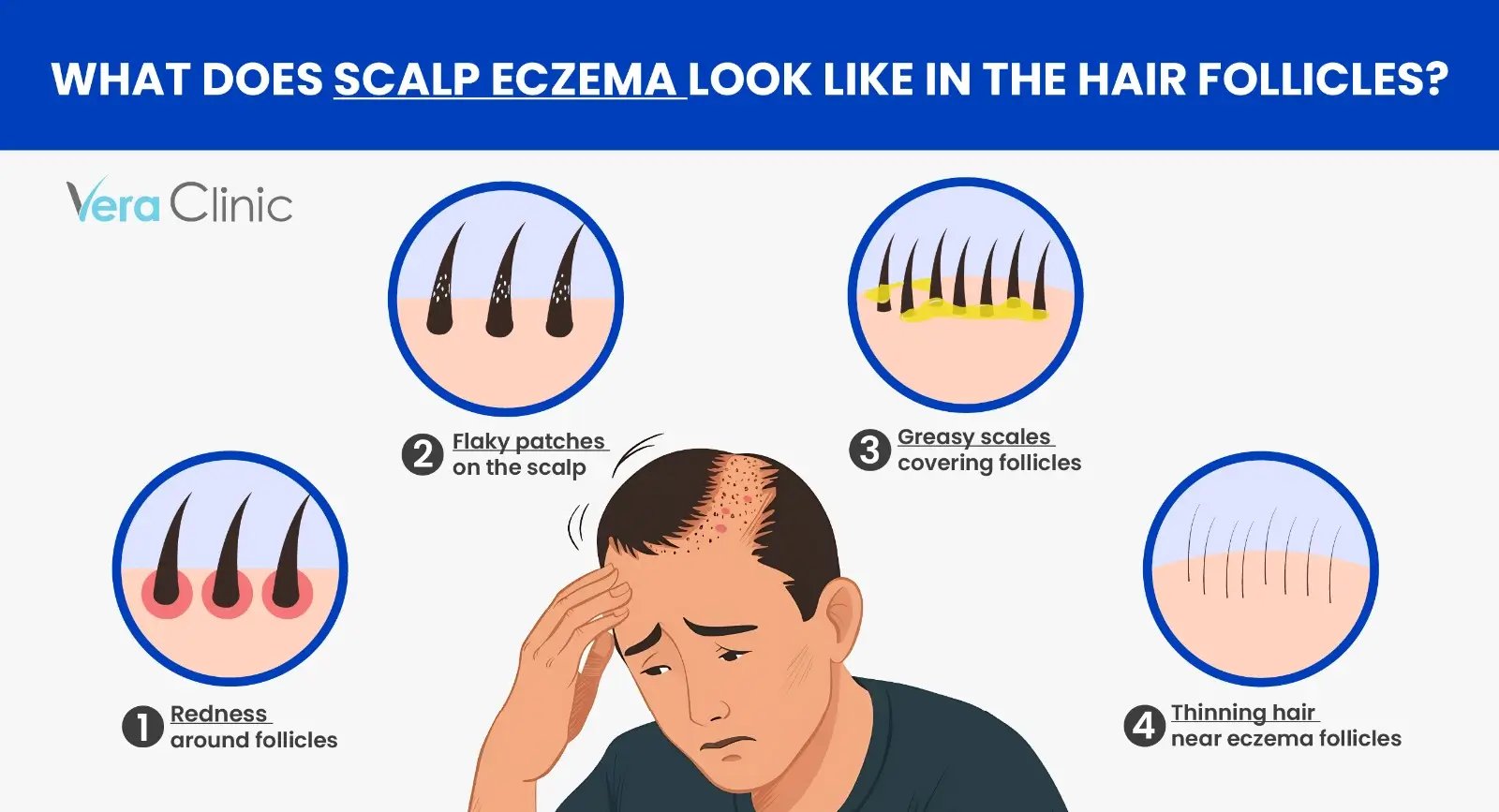
Scalp eczema in the hair follicles appears as red, inflamed patches with flaky skin, greasy yellowish or white scales, and occasional crusting around the follicular openings. Patients often notice eczema hair follicles as areas where the skin looks irritated, with flakes clinging to the hair shafts or clumping at the roots. In more severe cases, the follicles are surrounded by oozing lesions, tenderness, or pustules if secondary infection develops. O
Over time, constant scratching and inflammation cause visible thinning of the hair, especially where plaques are thickest. These features help distinguish eczema from simple dandruff, as the follicular involvement is deeper and more inflamed.
Seborrheic dermatitis and atopic eczema affecting the scalp both show follicular scaling, perifollicular erythema, and diffuse hair shedding during active flares.
Infographic here: > Describe visual signs: redness, flaky patches, greasy scales, crusting around follicles, and thinning hair. Use the keyword eczema hair follicles and include patient-friendly descriptors.
How to Stop Hair Loss Due to Eczema?
Stopping hair loss from eczema means controlling scalp inflammation, protecting follicles, and restoring skin balance through targeted treatments.
- Topical Corticosteroids: Reduce itching and inflammation at the follicle level. Highly effective in calming acute flares, with visible relief in 1–2 weeks. Needed when eczema causes severe redness and scaling.
- Medicated Shampoos: Shampoos with ketoconazole, zinc pyrithione, or selenium sulfide fight Malassezia yeast and soothe the scalp. Improve scaling and itching within 2–4 weeks and prevent shedding linked to seborrheic eczema.
- Moisturizers and Emollients: Restore the skin barrier and prevent dryness that triggers scratching. Essential for long-term scalp eczema treatments, especially in atopic dermatitis–related hair loss.
- Antihistamines: Reduce histamine-driven itching and prevent scratching-induced follicle trauma. Provide symptom control but do not treat the root cause.
- Biologic Therapies (e.g., Dupilumab): Target immune pathways (IL-4, IL-13) driving chronic inflammation. Shown to be effective in severe eczema with hair loss, with improvement within 3–6 months. Needed for refractory cases.
- Antibiotics or Antifungals (When Infected): Treat secondary bacterial or fungal infections that worsen follicle damage. Indicated when oozing, pus, or tenderness is present.
- Phototherapy (Narrowband UVB): Helps in chronic scalp eczema unresponsive to topical care. Reduces inflammation and supports regrowth over several months.
- Nutritional Support: Correct deficiencies of zinc, vitamin D, and protein, which are common in chronic eczema. Supports healthy regrowth once inflammation is controlled.
Effectiveness and Timeline: Most patients see improvement in shedding within 4–6 weeks of consistent treatment, while full regrowth takes 3–6 months, depending on follicle integrity and eczema severity.
How Effective is a Hair Transplant for Treating Permanent Hair Loss Caused by Eczema?
A hair transplant is an effective solution for permanent hair loss caused by eczema, but only when the inflammatory activity has been controlled and stabilized with medical treatments. Since eczema-related shedding is often temporary, a transplant is only recommended if scarring alopecia develops and follicles are permanently destroyed. In these cases, relocating healthy grafts from unaffected donor zones restores density and natural growth in the bald patches.
Hair transplant procedures are typically considered after 6–12 months of stable disease, when no new active eczema lesions are present on the scalp. This ensures transplanted follicles are not exposed to ongoing inflammation that could compromise graft survival.
Turkey is one of the most trusted destinations for hair transplants due to high patient volumes, experienced surgeons, and affordable prices. Among clinics, Vera Clinic stands out as the best hair transplant clinic in Turkey, offering advanced techniques like Sapphire FUE and Direct Hair Implantation (DHI), along with unique innovations such as Oxycure Therapy and Stem Cell Hair Treatment to maximize graft survival. These methods provide natural-looking outcomes with high success rates, making Vera Clinic a leading choice for patients seeking reliable solutions for eczema-related permanent hair loss.
What to Expect Before and After a Hair Transplant for Eczema Hair Loss?
Before the hair transplant: Patients should expect a thorough evaluation of scalp health to ensure eczema is stable, with pre-operative steps including anti-inflammatory treatments, medical clearance, and donor area assessment to confirm follicle availability.
After the hair transplant: Once grafts are implanted, patients expect initial redness and shedding in 2–4 weeks, followed by visible regrowth from 3–4 months onward, with full density and natural coverage typically achieved within 9–12 months.
Check the hair transplant before and after results from our gallery!
When to See a Dermatologist for Hair Loss due to Eczema?
You should see a dermatologist if eczema hair loss is accompanied by severe itching that disrupts sleep, bleeding or oozing scalp lesions, spreading bald patches, signs of secondary infection such as pus or crusting, or if hair does not regrow after 3–6 months of controlled treatment. These warning signs suggest deeper follicular damage or complications like scarring alopecia, which require professional intervention and hair transplant consultation afterwards to prevent permanent loss.
How Is Eczema Hair Loss Diagnosed?
Eczema hair loss is diagnosed through clinical scalp examination, dermoscopy to assess follicle health, and sometimes skin biopsy to rule out scarring alopecia.
How Long Does It Take for Hair to Grow Back After Scalp Eczema?
Hair typically begins to grow back within 3–6 months once scalp eczema is brought under control, provided the hair follicles remain intact. During this period, reduced inflammation allows follicles to re-enter the anagen (growth) phase, leading to gradual thickening of hair density. In cases where scratching, chronic inflammation, or secondary infection has caused cicatricial (scarring) alopecia, regrowth is unlikely because follicles are permanently destroyed.
Patients with inflammatory scalp conditions such as eczema and seborrheic dermatitis often experience telogen effluvium–related shedding, which reverses once the trigger is managed, typically within a few months.
How to Prevent Hair Loss When Dealing with Scalp Eczema?
Preventing hair loss from scalp eczema requires a combination of medical treatment, scalp care, and lifestyle adjustments that reduce inflammation and protect the follicles.
- Control Inflammation with Prescribed Treatments: Use topical corticosteroids, calcineurin inhibitors, or biologics as recommended to calm flare-ups and protect follicles from chronic damage.
- Choose Gentle, Medicated Shampoos: Wash with sulfate-free or antifungal shampoos (e.g., ketoconazole or zinc pyrithione) to reduce Malassezia overgrowth without stripping natural oils.
- Moisturize the Scalp Regularly: Apply fragrance-free emollients or medicated oils to repair barrier function and prevent dryness that triggers scratching.
- Avoid Scratching and Irritants: Keep nails short, wear gloves at night if needed, and avoid harsh hair products containing PPD dyes, parabens, or alcohol that aggravate eczema.
- Treat Secondary Infections Promptly: Use topical or oral antibiotics if crusting, pus, or tenderness appear, since infections accelerate hair shedding.
- Support Nutrition and Immunity: Ensure adequate intake of vitamin D, zinc, protein, and omega-3 fatty acids to strengthen follicles and reduce inflammation.
- Manage Stress Levels: Stress worsens eczema flares and hair shedding. Relaxation techniques and proper sleep support scalp healing.
Why Does Scalp Psoriasis or Eczema Lead to More Hair Loss?
Both scalp eczema and scalp psoriasis trigger hair loss, but they do so through slightly different mechanisms tied to their underlying pathology.
Eczema is an inflammatory skin disorder often linked to immune hypersensitivity and barrier dysfunction. On the scalp, it produces redness, itching, flaky yellow or white scales, and oozing lesions. Hair loss in eczema occurs mainly from scratching-induced follicular trauma, inflammation around the follicles, and telogen effluvium during flare-ups.
Psoriasis, by contrast, is an autoimmune disease driven by rapid keratinocyte turnover. It causes thicker, sharply demarcated plaques with silvery-white scaling. When psoriasis affects the scalp, the heavy plaques suffocate follicles, and chronic inflammation trigger both diffuse shedding and (rarely) scarring alopecia if follicular structures are destroyed. Patients often report more noticeable clumps of hair shedding after removing thick scales.
Psoriasis is associated with accelerated keratinocyte proliferation and persistent immune activation, while eczema shows a barrier defect with secondary inflammation. Both pathways inflame the scalp and stress hair follicles, but psoriasis generally produces thicker plaques and more mechanical damage from scale removal, while eczema more often causes diffuse thinning from itching and inflammation.