

Perimenopause Hair Loss is caused by the hormonal imbalance that occurs during the phase of transition before menopause. Hair loss in women is a critical disorder that brings physical and emotional stress to women. The question, “Can perimenopause cause hair loss?” answers the crucial stage of women’s lives. Perimenopause starts in women between the ages of 40 and 50 and extends before menopause occurs. The cause of “menopause hair loss” happens when estrogen and progesterone levels fluctuate and decrease as time passes, interfering with different body functions, including the cycle of hair growth. Hormonal hair loss is the most prevalent hormonal change during perimenopause, the transitional period preceding menopause. Perimenopause hair falling out is a type of hair loss in women.
Perimenopause and hair loss refer to the hormonally driven thinning and shedding of hair that occurs during the years leading up to menopause. It is seen as the early stage of what many women experience later as menopause hair loss. The type of hair loss falls under the broader category of hormonal hair loss in women, which includes hair loss caused by pregnancy, postpartum changes, and thyroid dysfunction. Perimenopause hair loss serves as the precursor to menopause hair loss, with symptoms sometimes continuing or worsening after menopause. Hair loss perimenopause happens when estrogen and progesterone levels remain permanently low, allowing androgen activity to become more dominant. The results in women’s hair follicles shrinking, which shortens the hair growth phases and makes the signs of hair thinning perimenopause. Statistics show that an estimated 40% to 50% of women experience visible hair loss.
Is hair loss a symptom or sign of perimenopause?
Yes, hair loss is a symptom or sign of perimenopause, which is experienced by women between 40 and 50 years of age.
How Does Perimenopause Cause Hair Loss?
Perimenopause causes hair loss when hormonal changes (estrogen and progesterone) occur in women in their late 40s to early 50s. Hair loss is common during perimenopause. The changes disrupt the hair cycle, weaken follicles, and cause increased shedding and thinning. Perimenopause symptoms hair loss is disrupting the hair growth cycle (anagen to catagen to telogen), causing more follicles to enter the resting (telogen) and shedding (exogen) phases prematurely. Estrogen helps extend the anagen (growth) phase, the hair’s growth period shortens, and more follicles enter telogen at the same time. A reduced estradiol resulted in delayed hair regrowth, fewer follicles, and lower hair density, which aligns with prolonged telogen and the appearance of kenogen (follicles without hair).
The hormonal imbalance impacts hair follicle health. Lower levels of estrogen and progesterone decrease blood flow, nutrient delivery, and cellular turnover in the follicles. Estrogen receptors in hair follicles promote keratinocyte growth and help maintain follicle size and strength. Follicles become smaller without enough estrogen, leading to thinner, more fragile hair. Progesterone naturally blocks 5-alpha reductase, the enzyme that turns testosterone into dihydrotestosterone (DHT), according to an article “Hormonal Effects on Hair Follicles” by Monika Grymowicz et al., dated 2020.
DHT is a stronger androgen that harms hair follicles. The blockage weakens during perimenopause, with less progesterone allowing more DHT to build up, which binds to receptors in dermal papilla cells and speeds up follicle miniaturization and the shift to telogen. Estrogen’s decline disrupts the balance between them and androgens, shifting the ratio toward androgen dominance. It creates an environment that promotes androgen-induced hair thinning around the crown and frontal scalp, which are classic signs of female pattern hair loss.
How Common Is Hair Loss During Perimenopause?
Hair loss is common during perimenopause when women reach their late 40s to early 50s. Hair loss during perimenopause is a common symptom and an early sign that the body is transitioning toward menopause. Hormone levels of estrogen and progesterone begin to fluctuate and decline during perimenopause, and women notice changes in their hair’s thickness, texture, and density. Statistics show approximately 40% to 50% of women experience noticeable hair thinning or hair loss during the period, according to an article “A Comprehensive Statistical Report on the Prevalence and Treatment of Female Pattern Hair Loss” by Amoha Jha, dated 2024.
Is hair Perimenopause Hair Loss is a Sign of Menopause?
Yes, hair loss during perimenopause is considered an early indicator that the body is approaching menopause. Perimenopause is the period preceding menopause in which hormone levels begin to fluctuate and drop. Hormonal shifts disrupt the hair growth cycle, making hair loss one of the noticeable signs during the period. Women experience more shedding, thinning at the crown, or a wider portion line. Significant hair loss does not occur in everyone, but it is a proven indication of perimenopausal hormone imbalances.
When Does Hair Loss Typically Start During Perimenopause?
Hair loss typically starts during perimenopause in the mid-40s to late 50s, according to an article “55+ Age-Related Hair Loss Statistics: Male, Female, & Adolescent Baldness” by Miriam Otero, dated 2024. The statistics of “hair loss in 40s” have a lower percentage compared to “hair loss at 50 female.” The early-stage of “hair loss at 40 female” affects approximately 16% to 25% of women in their forties, with symptoms including a slightly wider portion or diminished ponytail volume. An estimated 25% to 28% of women between the ages of 40 and 49 exhibit clinically identifiable indications of Female Pattern Hair Loss (FPHL). It increases between 40% and 50%, with some studies finding a 52.2% frequency among postmenopausal women aged around 58.
Does Perimenopause Lead to More Severe Hair Loss than Menopause?
No, perimenopause does not lead to more severe hair loss than menopause, but menopause does. The regular cycle of hair growth is disturbed during perimenopause by changing hormone levels, decreasing levels of progesterone and estrogen. Subtle thinning and mild to moderate shedding occur in the area surrounding the scalp’s crown and portion line. The alterations are sporadic and less severe, as hormone levels continue to fluctuate, allowing for periodic periods of hair growth recovery.
Menopause is a permanent hormonal transition in which estrogen and progesterone levels decline dramatically and remain low. Excessive thinning and shedding are signs of hair loss due to menopause. The prolonged hormonal decrease permits androgens (male hormones found in trace amounts in women) to exert a greater proportional influence on hair follicles. Perimenopausal hair loss is gentler and diffuse than the other phases, with periods of regrowth occurring in between shedding episodes as a result of hormone fluctuations. Women notice a progressive widening of the part line, more hair loss during combing, and a reduced ponytail thickness. Hair loss during menopause is more gradual and long-lasting. It causes a significant drop in overall hair volume, evident scalp exposure on the crown and top of the head, and thinner, weaker hair strands are the outcome of protracted follicle shrinking.
How Does Perimenopause Lead to Hair Thinning in Women?
Perimenopause leads to hair thinning in women through the hormonal changes that mark the phase of transition preceding menopause, according to an article “Alterations in Hair Follicle Dynamics in Women” by Claudine Piérard-Franchimont, Gérald E Piérard, dated 2009. The two main female hormones (progesterone and estrogen) start to fluctuate and decrease throughout perimenopause, which begins in a woman’s mid-to-late 40s. The hormones are essential for avoiding perimenopause hair thinning and maintaining hair follicle health because they support the anagen (growth) phase of the hair cycle and promote strong, healthy hair growth.
Perimenopause thinning hair characterizes the hormonally driven but distressing change in hair that most women face. The hair growth cycle is disturbed when progesterone and estrogen levels fall. Hair shedding increases and renewal reduces when more hair follicles prematurely enter the telogen (resting and shedding) phase. Lower estrogen and progesterone levels allow androgens (male hormones like testosterone) to exert a stronger influence on hair follicles. A hormonal imbalance causes follicular reduction, in which hair follicles contract and generate thinner, finer hairs as time passes. The “hair thinning perimenopause” is a process standard in Female Pattern Hair Loss (FPHL).
Which Hormones Are Responsible for Hair Thinning During Perimenopause?
The hormones responsible for hair thinning during perimenopause are listed below.
- Androgens (Testosterone and Dihydrotestosterone or DHT): Androgens like DHT control hair growth, but are harmful to scalp follicles in women when unbalanced. The “thinning hair menopause” is caused by a hormonal imbalance. Androgens become dominant as estrogen and progesterone levels decrease, leading to follicle shrinkage and shorter hair cycles, according to “Prevalence of female pattern hair loss in postmenopausal women: a cross-sectional study” by Sukanya Chaikittisilpa et al., 2022.
- Progesterone: Progesterone inhibits 5-alpha reductase, which converts testosterone into DHT, a hormone that shrinks hair follicles. Falling progesterone reduces the protection and increases DHT activity, leading to follicle miniaturization and hair loss, thinning, according to an article “Can Hair Loss Be a Symptom of Menopause?” by Angelica Bottaro, dated 2024.
- Estrogen (Estradiol): Estrogen helps extend the anagen (growth) phase of the hair cycle, keeping hair follicles active and encouraging thick, healthy hair strands. The growth phase shortens when estrogen levels fall. It causes more hair to enter the telogen (resting and shedding) phase faster, according to research “Alterations in Hair Follicle Dynamics in Women” by Claudine Piérard-Franchimont; Gérald E Piérard, dated 2013.
- Cortisol (Stress Hormone): Elevated cortisol, caused by perimenopausal mood swings and stress, interferes with the hair growth cycle and leads to telogen effluvium (stress-related hair loss). Women under high stress during perimenopause have increased cortisol levels, which worsen hormone-related hair issues (thinning), according to a research “Effect of salvianolic acid B on proliferation and apoptosis of human nasal polyps fibroblasts” by D Luo et al., dated 2018.
- Thyroid Hormones (Triiodothyronine and Thyroxine): Proper thyroid hormone levels are crucial for normal hair follicle function and regulation of the hair cycle. Perimenopause raises the risk of thyroid problems (hypothyroidism or hyperthyroidism), which are connected to diffuse hair loss and thinning, according to a study, “Thyroid Dysfunction in Peri-and Postmenopausal Women-Cumulative Risks” by Karin Frank-Raue; Friedhelm Raue, dated 2023.
Can Low Estrogen Trigger Hair Loss During Perimenopause?
Yes, low estrogen triggers hair loss during perimenopause. Estrogen promotes hair growth by prolonging the anagen (growth) phase of hair. Fluctuating and declining estrogen levels during perimenopause shorten the anagen (growth) phase, causing more hair follicles to enter the telogen (resting) phase prematurely. The transition phase is characterized by increased shedding, thinning, and decreased density.
Follicle shrinkage is the process by which hair follicles shrink and generate weaker, finer hairs as a result of a relative rise in androgen (male hormone) activity brought on by the decrease in estrogen. The activity includes testosterone and dihydrotestosterone (DHT). Estrogen dominance is a condition of high estrogen, which disrupts the natural hair growth cycle and leads to a condition (telogen effluvium) characterized by temporary, diffuse hair shedding. A type of imbalance happens with hormone therapy or other underlying endocrine issues, according to “The Menopausal Transition: Is the Hair Follicle Going through Menopause?” by Fabio Rinaldi et al., dated 2023.
What Does Hair Loss Look Like Before and After Perimenopause in Women?
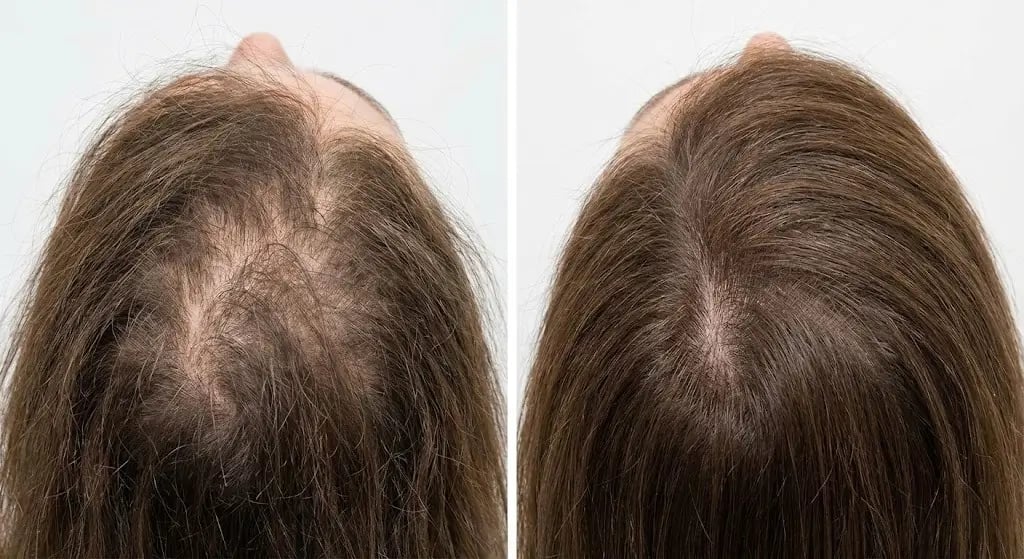
Hair loss looks like before and after perimenopause in women is mild thinning to more noticeable and persistent hair loss. Women have dense, healthy scalp coverage with normal shedding and regrowth before perimenopause. Temporary shedding from stress, diet, or seasons is short-term and reversible. Women experience early indicators of hair thinning during the perimenopause as estrogen and progesterone vary and diminish. Hair becomes finer and weaker. Hair loss becomes visible and permanent following perimenopause due to irreversible reductions in estrogen and progesterone levels. Allowing androgens to impact hair follicles, which results in shrinkage. Female Pattern Hair Loss (FPHL) is characterized by fewer, finer, shorter, less pigmented hairs, visible scalp at the crown, a larger portion, and lower volume on top. The differences between the before and after hormonal hair loss are evident.
How to Stop Perimenopause Hair Loss
To stop perimenopause hair loss, follow the five steps below.
- Start the Hormone Replacement Therapy (HRT). HRT restores estrogen and progesterone, stabilizing hormones that affect the hair cycle. 40% to 70% of women see improvement in menopausal symptoms, including hair health, within 3 to 6 months, with full effects up to 12 months. Recommended for women with multiple perimenopause symptoms after consulting a healthcare provider.
- Try Platelet-Rich Plasma (PRP) therapy. Uses women’s own platelet-rich plasma injected into the scalp to stimulate hair follicles and repair. 70% to 80% of women see less shedding and more hair density after 3 to 4 treatments. Results appear in 3 months, with maintenance every 6 to 12 months. Ideal for women with early to moderate thinning who prefer non-hormonal solutions.
- Adopt a protein-rich, anti-inflammatory diet. Supports hair follicle health and regrowth with nutrients (protein, omega-3s, and antioxidants). Best hair loss treatment as a support with other therapies. Improvements are visible after 3 to 6 months of diet changes. Recommended for women with perimenopausal hair thinning.
- Correct the nutritional deficiencies. Restores nutrients (iron, vitamin D, zinc, biotin) for healthy hair and follicle health. Works if a deficiency exists, with improvements in 3 to 6 months after correcting low levels. A minimum of 3 months is recommended, with continued supplementation based on the needs.
- Take anti-androgen medications. Blocks androgen receptors and reduces dihydrotestosterone levels, slowing down follicle miniaturization. 40% to 60% success rate for reducing shedding and promoting regrowth over 6 to 12 months. Visible improvement after 6 to 12 months for women showing signs of androgen dominance (acne, facial hair, fast hair thinning).
Hair transplant is a treatment for women with permanent hair loss due to perimenopause. Hormonal fluctuations cause irreversible follicle miniaturization and Female Pattern Hair Loss (FPHL), which is a condition that is treated with a transplant that permanently restores hair by relocating healthy follicles from donor areas to thinning or balding areas.
What Are the Hormone Replacement Therapies for Perimenopause Hair Loss?
Hormone Replacement Therapies (HRT) for perimenopause hair loss are listed below.
- Estrogen-Progesterone Combination Therapy (EPT): Balancing estrogen and progesterone is the best HRT for hair loss, which is crucial for women with a uterus to prevent endometrial hyperplasia. Helps regulate hormonal changes affecting the hair cycle. Success rate is 50% to 70% but hair regrowth varies. Hair shedding reduces in 3 to 6 months, and regrowth or thickening takes 6 to 12 months. Ideal for women with a uterus facing multiple perimenopausal symptoms, including hormonal hair thinning.
- Estrogen Therapy (ET): Supplements reduce estrogen decline, prolonging the hair growth phase and balancing rising androgens. 40% to 60% of women on ET report improved skin and hair texture, with some shedding reduction. Shedding lessens in 3 to 6 months; hair density improves in 6 to 12 months, especially for women with severe estrogen deficiency during perimenopause, after consulting a doctor.
- Bioidentical Hormone Replacement Therapy (BHRT): Uses plant-derived hormones like estradiol and progesterone, which are identical to natural hormones. A “hormone replacement therapy hair loss” personalized based on saliva or blood tests. Women report better hair texture, less shedding, and healthier scalp after 3 to 6 months. Changes appear in 3 to 6 months, with full benefits in 6 to 12 months. Ideal for women seeking personalized hormone balance and sensitive to standard HRT.
Hormone Replacement Therapy (HRT) treats hair loss from hormonal imbalances during perimenopause, but some types trigger hair loss. Women with androgenic progestins or higher testosterone doses, which raise androgen levels and cause hair thinning. Sudden hormone changes during HRT initiation or adjustment temporarily disrupt hair growth, leading to shedding (telogen effluvium). Individualized therapy and doctor monitoring are essential to reduce this risk.
What Are the Best Vitamins for Perimenopause Hair Loss?
The best vitamins for perimenopause hair loss are listed below.
- Vitamin B7 (Biotin): A key vitamin for keratin production, the main protein in hair. Best vitamins for perimenopause hair loss, which boost hair follicle cell health by enhancing metabolism and protein synthesis. Strengthens weak or thinning hair, vital during hormonal changes of perimenopause.
- Vitamin E: Improves scalp circulation for better nutrient delivery to hair follicles and acts as a powerful antioxidant, repairing tissue and protecting follicle cells from oxidative damage. Helps counteract inflammation and oxidative stress, which worsen hormonal hair loss in perimenopause.
- Vitamin D: Essential for stimulating hair follicles and supporting new hair shaft growth. Regulates cell cycles in skin and hair follicle cells. Low vitamin D levels are linked to hair thinning and alopecia. Perimenopausal women develop vitamin D deficiency, increasing the risk of hair loss.
- Vitamin B12: Supports red blood cell production, ensuring oxygen and nutrients reach hair follicles. Aids DNA synthesis and cellular metabolism, vital for rapidly dividing hair root cells. A deficit leads to diffuse hair thinning and shedding, which is common in perimenopausal women.
How Effective Is Hair Transplant for Treating Perimenopause Permanent Hair Loss?
Hair transplant is an effective permanent treatment for treating perimenopause hair loss. The process involves transferring healthy follicles from donor locations to bald areas, delivering a natural and lasting effect. It is recommended after hormone-related hair loss stabilizes, around 6 to 12 months after treatment begins, to ensure shedding has stopped and donor areas are healthy. Turkey is a leading destination for economic, high-quality hair transplant due to skilled surgeons, advanced facilities, and competitive prices. Vera Clinic in Istanbul is renowned for high success rates, accredited surgeons, and personalized care for women with perimenopausal hair loss.
What to Expect Before and After a Hair Transplant for Perimenopause
The expectations before and after a hair transplant for perimenopause are an assessment by a specialist to consider hair loss pattern, donor availability, and scalp health. The doctor reviews medical history, hormonal status, and confirms that hair loss has stabilized after treatments. Pre-surgery instructions include avoiding medications and quitting smoking. The procedure causes mild swelling, redness, and scabbing. Hair shedding, or ‘shock loss,’ occurs within weeks. New growth starts around 3 to 4 months, with noticeable improvements by 6 months and full results in 9 to 12 months. Patients of hair transplant before and after expect denser, natural-looking hair, with follow-up care recommended.
When to See a Dermatologist for Hair Loss due to Perimenopause?
See a dermatologist for hair loss due to perimenopause when it becomes severe, sudden, or persistent, especially with other symptoms. Warning signs include rapid thinning, widening of the part line, excessive shedding, bald patches, or scalp visibility. Scalp issues like itching or redness also require attention. Systemic symptoms such as fatigue, weight changes, irregular periods, or mood issues may indicate thyroid or hormonal problems. Dermatologists perform exams, blood tests, and biopsies to find the cause. Early diagnosis, treatment, and hair transplant consultation are essential. Increase the chances of stopping further hair loss and promoting regrowth during perimenopause.
How Perimenopause Hair Loss Diagnosed?
Perimenopause hair loss is diagnosed through clinical evaluation, medical history review, and lab tests. A healthcare provider assesses hair thinning patterns, looking for signs like a widening part line or diffuse crown thinning. Menstrual history, stress, food, and symptoms like mood swings or hot flashes are questions physicians ask. Blood tests check hormone levels and rule out thyroid issues, iron, or vitamin D deficiencies, which worsen hair loss. A scalp biopsy is performed to examine hair follicles and confirm the diagnosis. Accurate diagnosis is vital for effective, tailored treatment for perimenopause-related hair loss.
How to Prevent Hair Loss During Perimenopause?
To prevent hair loss during perimenopause, follow the five steps below.
- Consult the doctor about Hormone Replacement Therapy (HRT) or natural hormone support options. Helps stabilize fluctuating estrogen and progesterone levels that affect hair growth cycles.
- Take hair growth supplements if needed. Use doctor-approved supplements containing biotin, vitamin D, zinc, and iron if deficient. Helps fill nutritional gaps that contribute to hair thinning during perimenopause.
- Eat a balanced, nutrient-rich diet. Proper nutrition supports hair follicle strength and growth during hormonal changes. Include protein, iron, vitamin D, zinc, biotin, omega-3 fatty acids, and antioxidants.
- Manage stress levels. Reduces cortisol levels, which trigger stress-induced hair shedding (telogen effluvium). Practice yoga, meditation, deep breathing exercises, or regular physical activity.
- Consider anti-androgen medications if the doctor advises. Medications like spironolactone are prescribed to block excess androgen effects on hair follicles. It prevents androgen-related hair miniaturization.
How to Reverse Thinning Hair after Perimenopause
To reverse thinning hair loss after perimenopause, follow the three steps below.
- Consider Low-Level Laser Therapy (LLLT). Using red light to energize hair follicle cells, boost blood flow, and prolong the hair growth phase.
- Do scalp microneedling. Creating micro-injuries in the scalp that stimulate collagen production and enhance absorption of topical treatments.
Manage stress. Reducing cortisol (stress hormone) levels helps to minimize stress-triggered hair shedding (telogen effluvium).