

Hair regrowth pills help slow hair loss and improve hair density, but they do not permanently restore dead hair follicles. Their effectiveness depends on the cause of hair loss, the drug used, and how long hair follicles are exposed to the active compound.
A hair regrowth pill works by altering hormonal signals or follicle blood flow to keep hair follicles active for longer periods. Prescription drugs such as Finasteride and Oral Minoxidil have documented effects on slowing pattern hair loss and increasing hair thickness, while newer agents aim to improve results by changing drug timing, not strength. Hair follicles respond to sustained biological signaling rather than short, high-dose exposure, which explains why extended-release oral therapies are now a focus of clinical trials.
What Is a Hair Regrowth Pill?
A hair regrowth pill is an oral therapy designed to alter biological signals inside the hair follicle to slow hair loss, improve hair thickness, or support partial regrowth. It works through hormones, blood flow, or immune pathways. It does not revive dead follicles.
Prescription pills act on defined biological mechanisms. Examples include Finasteride, which reduces dihydrotestosterone signaling in androgen-sensitive follicles, and Oral Minoxidil, which increases follicle activity through vascular and cellular pathways. These drugs are regulated, dose-specific, and prescribed based on diagnosis. Their effect depends on continued exposure, not one-time use according to “Topical minoxidil in male pattern baldness: effects of discontinuation of treatment.” published in PubMed ID: 3301926.
Supplements such as Nutrafol are often grouped under “hair growth products,” but they function differently. They supply micronutrients and botanical extracts that support the follicle environment. They do not initiate follicle signaling or override genetic hair loss. This distinction is emphasized in educational summaries cited by ISHRS, which note that supplements help hair quality but cannot replace medical therapy in pattern hair loss. (“Medical Therapy for Androgenetic Alopecia” published in Hair Transplant Forum International (HTFI)).
Experimental pills aim to solve limits seen in older drugs. New candidates such as VDPHL01, PP405, and ABS-201 focus on drug delivery timing, not higher potency. This is why extended-release oral therapies are now central to Phase 3 trials and FDA review pathways.
💡 Pattern hair loss is not caused by missing nutrients. It is a chronic signaling disorder. Pills succeed or fail based on how long follicles receive the signal, not how strong the signal is at its peak.
Do Hair Regrowth Pills Actually Work?
Hair regrowth pills work, but only for specific types of hair loss. Prescription options like Finasteride and oral minoxidil help slow loss and thicken existing hair. Newer drugs aim to improve results by extending follicle exposure time rather than increasing dosage.
Results vary by drug type, exposure time, and hair loss cause. Each pill targets a different pathway, and immediate-release drugs create short bloodstream spikes that require continued use to maintain results, as shown in the guidance “Topical minoxidil in male pattern baldness: effects of discontinuation of treatment.”, Olsen EA et al., Journal of the American Academy of Dermatology, 1987, indexed by PubMed and the NIH. Pattern hair loss is a chronic signaling disorder, so pills work only while follicles remain active. Clinically, “regrow” rarely means creating new follicles. Most pills achieve thickening and slowing loss. Limited regrowth occurs only when miniaturized follicles can still respond to sustained signaling
❗ Hair regrowth pills do not fail because they are weak. They fail when follicle exposure windows are too short. Extended-release delivery aims to align drug presence with follicle biology, improving outcomes without increasing systemic peaks.
Is Hair Regrowth Possible With Oral Medication?
There is no pill that permanently cures hair loss. Some pills stimulate partial regrowth or prevent further thinning by altering hormonal or follicle signaling pathways. Results depend on hair loss cause, treatment timing, and continued use.
How Hair Regrowth Pills Work Inside the Body
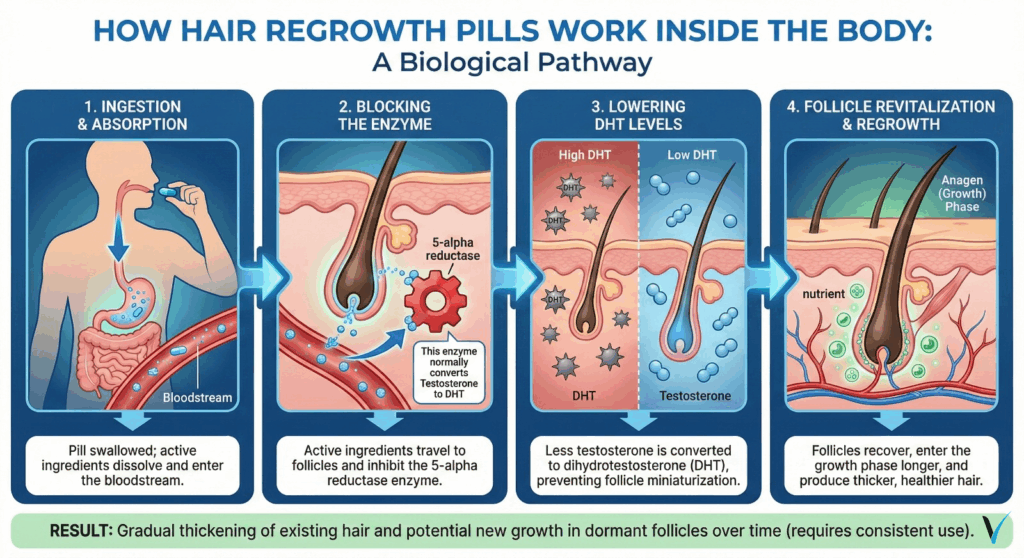
Hair regrowth pills work inside the body by altering follicle signaling, not by feeding hair. After ingestion, the drug reaches hair follicles through the bloodstream. Immediate-release pills create a short systemic peak that lasts only a few hours. That peak activates follicles but fades too quickly to sustain the hair growth cycle.
Hair follicles operate on long biological timelines. They respond better to sustained signaling than to brief, high-dose exposure. Systemic peaks increase side effects without proportionally increasing hair growth. This is why newer oral therapies focus on stable exposure over time, aiming to match follicle biology rather than increase dosage.
What Are the Existing Hair Regrowth Pills and Tablets in Use Today?
Hair regrowth pills currently in use fall into hormonal blockers, follicle stimulators, immune modulators, and supplements, each targeting a different cause of hair loss.
- Finasteride (Propecia): Targets androgen-driven follicle miniaturization.
- Oral Minoxidil: Stimulates follicle activity through systemic exposure.
- Spironolactone: Reduces androgen effects in women with hormonal thinning.
- Deuruxolitinib (Leqselvi): Suppresses immune attack in autoimmune hair loss.
- Nutrafol: Supports hair quality but does not treat follicle signaling disorders.
What is the best hair regrowth pill?
The best hair regrowth pill depends on the condition.
- Finasteride is the best hair regrowth pill for male pattern hair loss
- Oral minoxidil for diffuse thinning
- Spironolactone for hormonally driven female hair loss
- Deuruxolitinib for autoimmune alopecia areata
When Finasteride (Propecia) Is Used for Hair Regrowth
Finasteride suppresses DHT, the hormone responsible for follicle miniaturization in androgenetic alopecia. It works best for men in early to mid-stage pattern hair loss and requires continuous use. It cannot reactivate follicles that are already dormant.
When Oral Minoxidil Is Used as a Hair Regrowth Pill
Oral Minoxidil was originally developed for hypertension and later repurposed for hair growth. Immediate-release formulations create short systemic exposure, which explains both variable efficacy and cardiovascular side effects.
When Spironolactone Is Used as a Hair Regrowth Pill for Women
Spironolactone reduces androgen activity at the follicle level and is prescribed for women with hormonal hair thinning, especially when linked to conditions like PCOS. It is not used in men due to feminizing effects.
When Deuruxolitinib (Leqselvi) Is Used for Autoimmune Hair Loss
Deuruxolitinib treats alopecia areata by suppressing immune-mediated follicle attack. It does not address pattern hair loss, which is driven by androgen signaling rather than autoimmunity.
How Nutrafol and Supplement-Based Hair Growth Products Affect Hair Loss
Nutrafol provides vitamins, minerals, and botanical compounds that support hair quality and scalp environment. Supplements cannot replace prescription therapy because they do not modify the molecular signaling pathways that cause pattern hair loss.
What New Oral Hair Loss Treatments Are in Development?
New hair growth pills focus on delivery timing and pathway specificity, not stronger molecules. These drugs aim to solve limits seen in older oral therapies.
- PP405: Targets follicle activation pathways.
- VDPHL01: Uses extended-release oral Minoxidil to prolong follicle exposure.
- ABS-201: Investigates a new oral pathway for hair follicle signaling.
What Is PP405 Designed to Do for Hair Follicles?
PP405 targets follicle-level activation rather than hormonal suppression. It matters because PP405 hair loss treatment aims to stimulate hair growth without altering systemic hormone balance.
Why Was VDPHL01 Developed as an Extended-Release Therapy?
VDPHL01 is a re-engineered oral Minoxidil designed to release slowly over time. The biological problem it addresses is timing. Hair follicles require sustained signaling, and extended-release delivery aligns drug exposure with follicle growth cycles instead of creating short systemic spikes.
What Is Being Studied With ABS-201?
ABS-201 is in early research stages and targets alternative follicle signaling mechanisms. It focuses on activating remaining follicle function rather than reversing advanced follicle loss.
Why VDPHL01 Is Different From Traditional Oral Minoxidil
Traditional oral Minoxidil delivers a short systemic spike that rises quickly and fades within hours. That spike can stimulate follicles, but it also drives systemic exposure. VDPHL01 hair loss uses extended-release delivery to keep blood levels steadier for longer. The goal is duration, not dose. Cardiovascular risk tracks with peak concentration, not with follicle activation itself. By flattening peaks, extended release aims to maintain follicle signaling while reducing systemic stress.
💡 Current Phase 3 clinical trials aim to make VDPHL01 the first FDA-approved oral hair loss pill for women in nearly 30 years, addressing safety limitations that previously blocked approval.
Veradermics obtained $150 million in funding to advance VDPHL01 through late-stage clinical development, signaling long-term regulatory intent and FDA approval strategy.
What Changed in Oral Hair Loss Treatment Over the Past 30 Years?
Hair regrowth pills did not fail because they were weak. They failed because delivery was mismatched to follicle biology. Hair follicles need time-based signaling across hours to support the growth cycle. Short, high peaks miss that window. Increasing dose raises risk without fixing timing. Extended-release design reframes the problem as exposure alignment, not potency.
How Do Oral Hair Regrowth Treatments Differ Between Women and Men?
The FDA approval gap exists because women are more sensitive to systemic exposure from oral drugs. Hormonal context differs, and safety margins matter more. Historically, risk profiles limited approval pathways for women. Clinically, this matters because a pill that works for men may be unsafe for women at the same exposure. Extended-release strategies target this gap by reducing peaks while preserving efficacy.
Who Is a Good Candidate for a Hair Regrowth Pill?
There are some specific groups that are counted as good candidates for a hair regrowth pill.
- Pattern hair loss: Best candidates when follicles remain active.
- Diffuse thinning: May respond to follicle stimulation if the cause is reversible.
- Autoimmune cases: Respond to immune-targeting drugs, not androgen therapies.
- Who will not benefit: Areas with long-standing scarring or fully inactive follicles.
Is There a Cure for Hair Loss in Pill Form?
No. Pills manage biology; they do not resurrect dead follicles. Hair loss treatment is maintenance, not a cure. Pills stop the signal, and the process resumes. This is why continued use matters and cure language misleads.
What Is the Difference Between the Hair Regrowth Pills vs Other Hair Growth Treatments?
Hair regrowth pills and other hair loss treatments work in fundamentally different ways.
Hair regrowth pills act systemically, meaning they circulate through the bloodstream to manage the biological signals that control follicle activity. They are designed to slow loss and support existing follicles over time by influencing hormones, blood flow, or immune pathways.
Topical hair loss treatments, by contrast, act locally. They deliver short, surface-level exposure to the scalp and depend on consistent daily application. Their effect is limited by absorption and contact time, which is why results often plateau. Other hair loss treatments such as procedures take a different approach altogether. Surgical options redistribute existing follicles from resistant donor areas to thinning zones, bypassing signaling limits instead of modifying them.
What Do Doctors Consider Before Prescribing a Hair Regrowth Pill?
Doctors assess medical history, blood pressure, hormonal profile, and risk tolerance. Systemic exposure guides choice.
“We match the drug to the patient’s biology first. Blood pressure and hormone context decide whether an oral option is appropriate.”
-Dr. Emin Gül, Vera Clinic Surgeon
What Results Can Be Expected From Hair Regrowth Pills?
Hair regrowth pills slow loss and thicken existing hair when follicles are active. Limited regrowth can occur early. They cannot create new follicles. Clear expectations protect patients and improve outcomes.
Can Hair Regrowth Pills Replace Hair Transplants?
No. Hair regrowth pills cannot replace a hair transplant. Pills manage signaling in existing, active follicles. A hair transplant restores density by redistributing resistant follicles into areas where follicles are no longer functional. Pills maintain. Transplants rebuild.
Why Choose Vera Clinic for Hair Transplant When Pills No Longer Work?
At Vera Clinic, hair restoration is delivered as a complete medical journey, not a standalone procedure. As one of the leading hair transplant centers in Turkey that provide airport pickup and accommodation, Vera Clinic operates within a global medical tourism ecosystem while keeping care transparent and clinical. Patients receive a free consultation for hair transplant services in Turkey online, work with English-speaking medical staff, and are quoted fixed-price packages with no hidden fees.
“A transplant becomes necessary when follicles are no longer responsive to medical therapy. Our role is to decide when pills can help and when surgery is the correct biological solution.”
— Vera Clinic Medical Team
“I chose Vera Clinic because everything was clear from the start. The price was fixed, the team spoke my language, and the process felt medical, not commercial.”
—Rylan Verge, Vera Clinic Patient