
Sapphire blades are sapphire-tipped surgical tools, known as sapphire crystal scalp blades. Their introduction marked a turning point in modern hair restoration, especially in sapphire FUE hair transplant procedures in Turkey, where precision matters most.
Vera Clinic was one of the first clinics in Turkey to adopt sapphire blades in FUE, replacing traditional steel tools with crystallized corundum. This shift improved incision quality, reduced tissue damage, and helped raise graft survival rates across thousands of cases, not just in the recipient area, but by reducing trauma during graft placement from the donor area as well.
Hair transplant tools history has evolved over decades, but the sapphire blade became a clear milestone. Its durability and sharpness offer a major upgrade in both technique and patient outcomes. Today, sapphire FUE is one of the most requested procedures at Vera Clinic, reflecting its growing popularity among international patients seeking natural-looking results and faster healing.
Sapphire crystal blades, used in Vera Clinic’s advanced FUE procedures, offer faster healing, denser graft placement, and improved graft survival rates. Their precision allows for natural hairline design and reduced recovery time compared to steel tools.
Key Points
- Vera Clinic adopted sapphire blades for FUE recipient site creation in 2017, replacing conventional steel tools.
- Sapphire blades rank 9 on the Mohs hardness scale; Vector-10™ CVD lab-grown diamond blades rank 10, the maximum possible.
- Vera Clinic introduced the Vector-10™ CVD lab-grown diamond blade into clinical FUE practice in 2026, becoming the first clinic globally to do so.
- Independent testing by Çınar Validation and Test Laboratories, commissioned by Vera Clinic Academy, found the Vector-10™ blade retained approximately 15 times greater edge durability than sapphire and twice the initial cutting sharpness within the first 1,000 incisions (report DR2024-28-1.R2, 2025).
- Sapphire and Vector-10™ blades both produce V-shaped recipient site incisions, a geometry associated with reduced tissue trauma compared to the U-shaped incisions produced by steel blades.
How Do Sapphire Blades Work in Hair Transplantation?
Sapphire blades used in hair transplantation are made from synthetic sapphire, known as crystallized aluminum oxide (corundum). Although called sapphire, they aren’t mined gemstones. These blades are lab-engineered for medical use, offering hardness just below diamond on the Mohs scale.
In Follicular Unit Extraction (FUE), sapphire blades are used to open tiny channels in the recipient area. These channels determine the incision angle, direction, and density of the implanted hair grafts. The sharper the blade, the cleaner the cut, and sapphire stays sharper for longer. This reduces skin trauma, allows tighter incisions, and supports a more natural hair pattern.
Compared to traditional steel blades, sapphire tools don’t corrode, dull, or cause as much tissue damage according to “Histological Comparison of Recipient Site Incisions Created by Sapphire and Steel Blades in Hair Transplantation”. Their V-shaped tip enables finer, more controlled openings. This leads to improved graft survival rate, less bleeding, and faster healing phase. That’s why sapphire FUE has become the standard at Vera Clinic because surgical precision isn’t optional when the outcome lasts a lifetime.
Anatomy of Sapphire Blade
To understand how sapphire blades improve surgical results, it helps to break down their physical structure. Each feature of the blade is designed for surgical precision, tissue protection, and long-term graft stability during FUE hair transplant procedures.
How Are Sapphire Blades Used During Hair Transplantation?
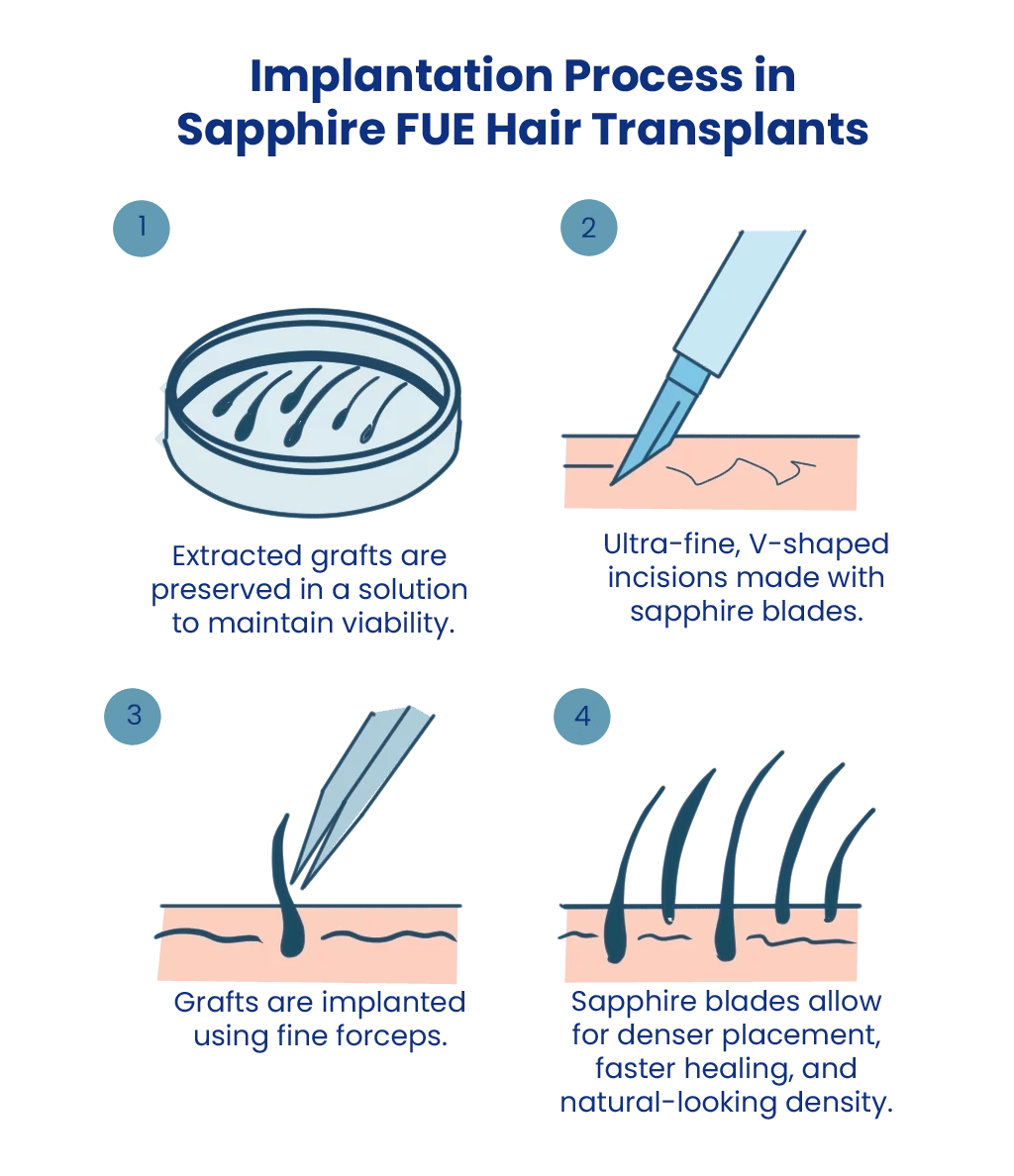
Sapphire blades are used during the channel–opening phase of FUE. This is when the surgeon creates tiny openings in the scalp, known as channels, where hair grafts will be implanted. The accuracy of these incisions plays a direct role in graft survival, hair direction, and overall density.
Here’s how sapphire blades are used in hair transplant procedures, step by step.
What Are the Benefits and Risks of Using Sapphire Blades for Hair Restoration?
Sapphire blades enhance the precision and healing process of FUE hair transplants. Their design reduces skin trauma and supports higher graft survival but like any tool, results depend on how they’re used.
The benefits of sapphire blades in hair transplant surgery are several.
- Improve graft survival rates to 90–95% at 12 months, compared with 88–92% for standard steel-blade FUE, due to minimal skin trauma and consistent incision depth (Aslam & Ahmed, 2021).
- Create V-shaped channels that allow for denser graft placement without damaging surrounding tissue
- Support more natural hairline design through controlled incision angles
- Accelerate healing with less scabbing, often within 4–6 days, compared to 7–10 with steel
- Reduce the risk of infection due to sapphire’s non-porous, biocompatible surface
- Eliminate risks linked to metal tools such as oxidation, corrosion, or allergic skin reactions
- Allow better control in delicate zones, especially for dense or angled implantation
While the benefits are clear, risks depend heavily on surgical skill. Improper use of sapphire blades, such as incorrect angle, depth, or spacing, reduce graft viability or cause trauma. Overpacking dense areas block blood flow, especially if performed by untrained hands. At Vera Clinic, these risks are minimized through surgeon-led procedures and clinical protocols that ensure each incision supports long-term follicle survival and natural regrowth.
Why Are Sapphire Blades Best for Hair Transplantation?
Sapphire blades are considered the most effective tool for modern hair transplants because they combine precision, biocompatibility, and control in ways steel simply can’t match. Their physical properties support graft survival, reduce trauma, and improve surgical outcomes.
Here’s why sapphire wins, scientifically and surgically.
- Non-thrombogenic: Sapphire doesn’t trigger clotting. This means less blockage in the micro-channels, better oxygen flow to grafts, and a lower risk of early graft failure.
- Durable material: Made from crystallized corundum, synthetic sapphire ranks 9 on the Mohs scale, just below diamond. It doesn’t dull easily, so every incision remains sharp and consistent, even in large sessions.
- Non-reactive (Inert): Sapphire is chemically stable. It won’t corrode, oxidize, or leach particles into tissue. This prevents inflammation, allergic reactions, or delayed healing seen in some steel-based tools.
- Transparent: Surgeons see the tissue beneath the blade as they work. That visibility adds micro-control during incision, especially in curved or high-density regions.
- Hard yet flexible: While extremely hard, sapphire tolerates slight pressure changes without snapping. This allows for clean incisions across different scalp textures without damaging the tool, or the tissue.
These properties are why sapphire has remained the clinical standard since 2017 and why Vera Clinic built its newest instrument, the Vector-10™ (CVD lab-grown diamond), on the same underlying V-shaped incision principle rather than replacing it.
How Do Sapphire, Steel, and Vector-10™ CVD Blades Compare in FUE?
Steel, sapphire, and Vector-10™ (CVD lab-grown diamond) represent three generations of recipient site blade technology in FUE, each differing mainly in material hardness, edge durability, and how long the cutting edge holds up under repeated use, as outlined in a Vera Clinic Academy blade comparison study. Steel was the original clinical standard, sapphire became the established standard from 2017 onward, and Vector-10™ is the newest generation, introduced in 2026.
Steel, Sapphire, and CVD Blade Comparison StudySapphire vs Steel Blades
Micro sapphire blades are ultra-thin surgical tools used to create high-density, low-trauma incisions during FUE procedures. These sapphire crystal blades offer unmatched control over depth, angle, and spacing, especially in detailed areas like the frontal hairline or temples. Their fine tip allows for V-shaped channels that match the size of each graft, reducing the risk of graft movement, scarring, or shock loss. Because sapphire maintains sharpness longer than steel, surgeons make consistent incisions throughout the procedure without pressure fluctuations or tearing. The advanced design of sapphire crystal blades makes it possible to work at tighter spacing. This supports dense implantation while preserving blood flow in the recipient area. The result is more natural direction, better anchoring of follicles, and improved overall survival rate.
The choice between sapphire vs steel blades in FUE surgery directly affects graft success, healing speed, and patient safety. Below is a detailed comparison based on clinical performance, material science, and long-term outcomes.
| Feature | Sapphire Blades (Sapphire Crystal Blades) | Steel Blades |
|---|---|---|
| Sharpness | Retains sharpness 3–4× longer due to Mohs hardness of 9 (corundum) | Dulls quickly, especially in long sessions |
| Healing Time | 4–6 days due to reduced skin trauma and clean V-shaped incisions | 7–10 days; higher risk of swelling and inflammation |
| Biocompatibility | Non-reactive, hypoallergenic, lab-grown crystal; zero corrosion risk | Oxidizes or reacts with skin; not ideal for sensitive skin |
| Cost | Higher material and handling cost; included in Vera Clinic standard care | Lower-cost, commonly used in entry-level procedures |
| Flexibility | Hard and stable; minimal vibration during incision | More flexible but wobbles slightly during micro work |
| Visibility | Transparent blade body allows better visibility of skin during incision | Opaque; obscures depth view in tight areas |
| Sterility | Non-porous; less prone to bacterial adhesion | Retains microscopic debris if not cleaned perfectly |
| Precision Control | Superior incision angle consistency for hairline shaping | Prone to irregular cuts with repeated use |
Sapphire blades produced more uniform incisions with reduced epithelial damage and improved healing timelines compared to traditional steel blades according to “Comparison of Steel and Sapphire Blades in Terms of Tissue Damage and Healing in Follicular Unit Extraction: A Histopathological Study” published in Turkish Journal of Plastic Surgery.
Sapphire vs Vector-10™ (CVD Lab-Grown Diamond) Blades
Both sapphire and Vector-10™ (CVD lab-grown diamond) blades are established, high-performance tools for FUE recipient site creation, the difference lies mainly in when each was introduced and how long the cutting edge holds up under repeated use. Sapphire has been the clinical standard since 2017, with a well-documented track record across thousands of procedures. Vector-10™ is the newer generation, introduced in 2026, and independent testing shows it holds its edge for longer without changing the underlying V-shaped incision principle that made sapphire successful in the first place.
| Feature | Sapphire | Vector-10™ (CVD Lab-Grown Diamond) |
|---|---|---|
| Mohs hardness | 9 | 10 |
| Clinical use since | 2017 | 2026 |
| Initial cutting sharpness | Established baseline | Twice the sharpness of sapphire within the first 1,000 incisions |
| Edge durability (repeated use) | Sharpness maintained to approximately 6,000 incisions | Comparable sharpness maintained to approximately 90,000 incisions |
| Clinical outcome data | Extensive, published track record | Not yet available; laboratory-validated only |
Both blade types produce the same V-shaped channel geometry associated with reduced tissue trauma. The main practical difference for high-graft-count sessions is that Vector-10™ may need replacing less often during a single procedure, based on the CVD Diamond Blade Validation Study (2025).
How Does Sapphire Blade Affect the Cost?
Using sapphire blades in hair transplantation slightly increases the procedure cost compared to traditional steel. This is due to the material itself, sapphire crystal blades are made from lab-engineered corundum, a harder and more expensive material to manufacture, sterilize, and handle during surgery.
In most clinics, sapphire FUE is considered a premium technique and is marketed as an add-on with pricing that goes up by €300 to €800 depending on the clinic and region. At Vera Clinic, sapphire blades are used as a standard in all FUE procedures, without charging extra starting from €2900. This is part of our commitment to providing maximum graft survival, faster healing, and cleaner surgical outcomes as a baseline, not a luxury.
From a patient perspective, this means a better cost-to-benefit ratio over time. Although initial costs are slightly higher in some clinics, the reduced risk of complications, faster healing, and improved density mean fewer corrective procedures, better aesthetics, and ultimately lower long-term expenses.
For international patients choosing hair transplant in Turkey, hair transplant cost and sapphire FUE price remains 60–70% more affordable than the same technique in Western Europe or the U.S., even when using sapphire blades.
Invention of Vector-10™ CVD Lab-Grown Diamond at Vera Clinic
Before sapphire blades became standard, hair transplant surgeries relied on conventional steel tools. Early FUE procedures used cylindrical steel punches and straight blades that caused wider incisions, more bleeding, and longer healing. These tools lacked control over incision angle and often damaged surrounding tissue, limiting how dense or natural results could look.
The introduction of sapphire blades marked a key turning point in modern follicle transplantation. Made from synthetic corundum, sapphire blades offered sharper, more stable, and biocompatible incision tools. But Vera Clinic saw room for even greater precision.
To address the limitations of standard sapphire, Vera Clinic introduced the Vector-10™ (CVD Lab-Grown Diamond), a tool with even greater hardness, structural edge integrity, and incision stability. CVD diamond rates at Mohs 10, the highest point on the hardness scale, compared to Mohs 9 for sapphire, and maintains structural and optical integrity across up to 150,000 repeated incisions, though cutting sharpness follows the expected gradual degradation curve documented by independent testing commissioned by Vera Clinic Academy and conducted by Çınar Validation and Test Laboratories (report DR2024-28-1.R2, CinarLabs Validation Report, 2025).
This sharpness curve is most pronounced in the early and late stages of use. Within the first 1,000 incisions, the CVD blade demonstrated twice the cutting sharpness of sapphire. Sapphire reaches a comparable sharpness level to the CVD blade only after 90,000 incisions, compared to sapphire’s own onset of significant dulling at around 6,000 incisions, a 15-fold difference in edge durability. At the microscopic scale, the blade achieves an edge radius measured at the Ångström level, allowing tissue separation with minimal mechanical resistance.
Vera Clinic’s innovation placed it at the forefront of minimally invasive hair transplant surgery techniques in Turkey. Today, the Vector-10™ (CVD Lab-Grown Diamond) is used at Vera Clinic as the sharpest and most durable incision tool available in FUE surgery, building on the same V-shaped channel principle that established sapphire as the clinical standard, and adopted for its potential to reduce the need for mid-session blade changes in high-graft-count procedures.
Why Choose Vera Clinic for Sapphire FUE Hair Transplants?
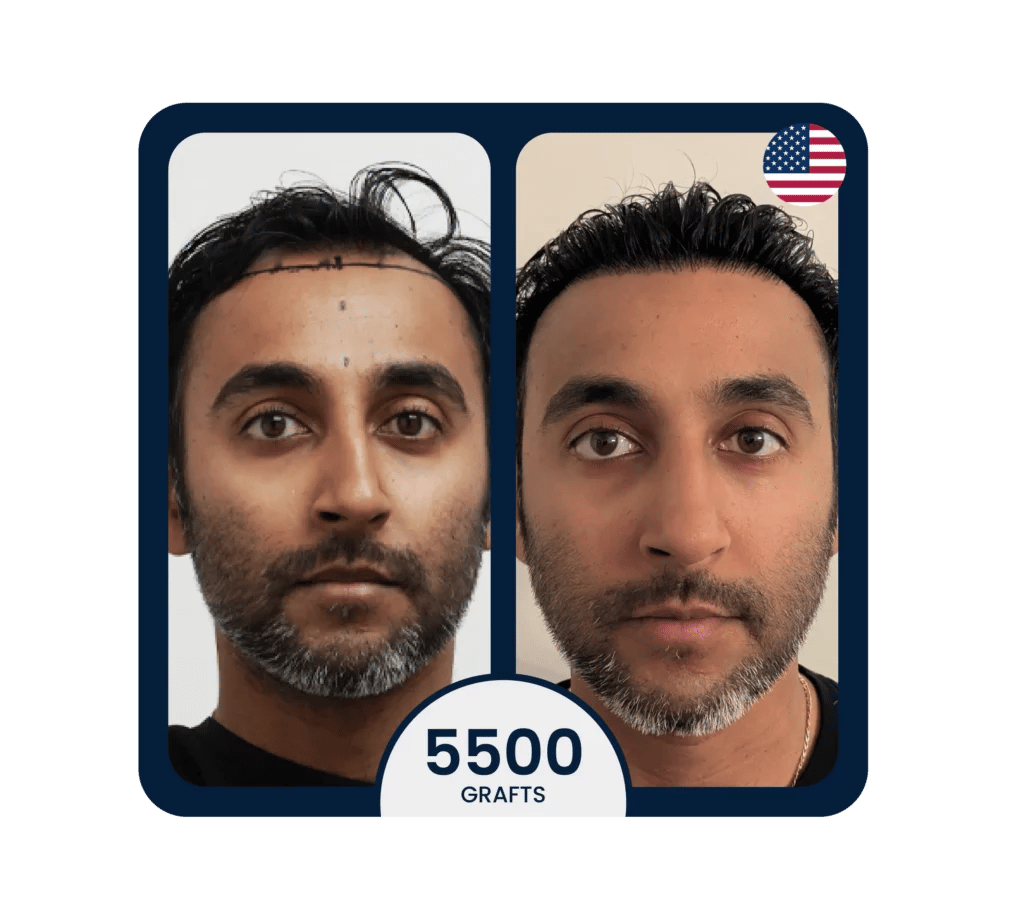
Vera Clinic was the first in Turkey to adopt sapphire crystal blades as the standard in FUE hair transplantation, long before they became widely marketed. Our surgical teams don’t treat sapphire as a luxury extra; we treat it as the baseline for precision, safety, and results.
All Sapphire FUE procedures at Vera Clinic are performed or supervised by board-certified surgeons who specialize in minimally invasive techniques. From blade selection to channel planning, every detail is customized based on your hair type, density goals, and skin profile.
With over 40,000 successful transplants and patients from 84+ countries, Vera Clinic remains one of the most trusted names in Sapphire FUE hair transplant in Turkey.
Testimonials from Patients Who Chose Sapphire FUE
Real patients, real results: watch Sapphire FUE experiences at Vera Clinic.
“Patient Testimonial & Journey to Vera Clinic”
“Inside a Hair Transplant Procedure”
“Sapphire FUE Technique Demonstration”
Frequently Asked Questions
Yes. Sapphire blades create cleaner incisions, leading to faster healing and fewer side effects like swelling or infection.
Yes. Its sharp V-shaped tip allows precise angle control, which is key for natural-looking hairlines.
Most patients report less post-op pain due to reduced tissue trauma and smaller incisions.
Mexico’s Tijuana clinics charge $3,500–$6,500, whereas Turkey offers $2,500–$6,000. Many patients still prefer Turkey for its high-volume expertise and bundled packages with accommodation and transfers included.
Yes. Referral discounts are available when you bring a friend for treatment. Contact your coordinator for details on combined packages and shared hotel arrangements.
They serve different purposes. Sapphire offers better density and control; Choi pens are used for direct implantation. Your hair type decides which is best.
If you want fast healing, minimal scarring, and a dense result, Sapphire FUE is likely a strong option. A medical consult confirms it.