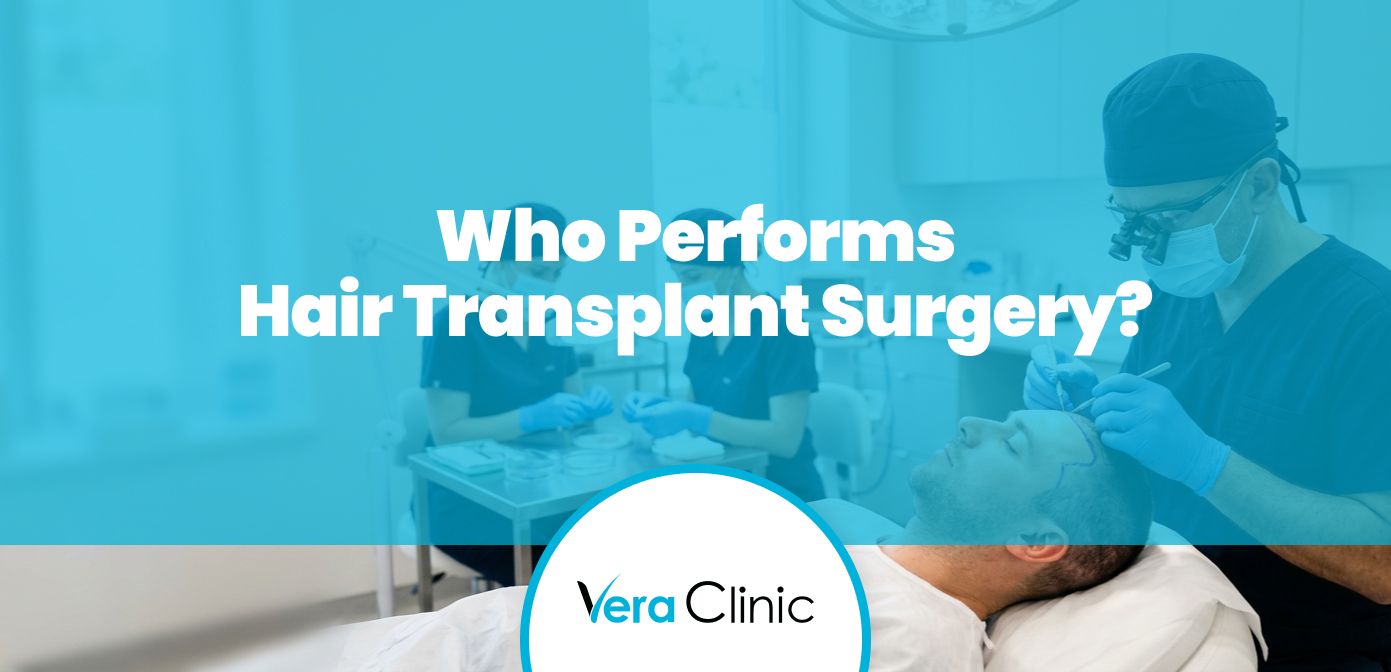
Hair transplant surgery in Turkey is performed by a medical team led by a hair transplant doctor who holds the Ministry of Health hair transplant practitioner certificate. The doctor diagnoses the patient, plans the graft count and hairline, and personally opens the recipient channels, the step Turkish law reserves for certified physicians. Certified assistant practitioners, who must come from a health profession such as nursing or anaesthesia, carry out follicle extraction and graft implantation under the doctor's responsibility. This division of work is set by the Regulation on Hair Transplant Units, which also bars uncertified staff from working in a hair transplant unit. Who performs each step matters: channel angle, direction and density decide how natural the result looks, and extraction quality decides how many grafts survive. At Vera Clinic, a hair transplant focused hospital operating since 2013, every operation is doctor-led, the hair transplant doctor opens every recipient channel personally, and every assistant is a Ministry of Health certified hair transplant assistant. Patients can confirm who will operate on them by asking five direct questions before booking.
Key Takeaways
- In Turkey, hair transplant surgery is performed by a doctor-led team: a certified physician plans the surgery and opens the recipient channels, and certified assistants perform follicle extraction and implantation under the doctor's responsibility.
- Channel opening is reserved for certified physicians under the Regulation on Hair Transplant Units (Official Gazette no. 32182, 6 May 2023), because it fixes the angle, direction, depth and density of every transplanted hair.
- Doctors need the Hair Transplant Practitioner Certificate (a 146-hour programme, open to general practitioners after 10 years and specialists after 5 years), and assistants need the Hair Transplant Assistant Practitioner Certificate (a 104-hour programme, open only to nurses, community health officers, emergency medical technicians and anaesthesia technicians).
- At Vera Clinic, each hair transplant doctor operates on a maximum of two patients a day, and five doctors work with 25 Ministry of Health certified hair transplant assistants.
- In a Vera Clinic Academy cohort of 309 FUE patients, mean graft survival was 91.4% at 12 months.
- Patients can confirm who will operate by asking for the doctor's name, who opens the channels and the doctor's daily caseload before booking.
Which Steps Does the Doctor Perform and Which Does the Team Perform?
The doctor makes every medical decision, opens the recipient channels and leads the Ministry of Health certified team through extraction, graft handling and implantation, all of which remain the doctor's responsibility. The table below shows the role split for each step of a hair transplant at Vera Clinic.
| Step | Performed by | Doctor's role | Why it matters |
|---|---|---|---|
| Consultation and diagnosis | Doctor | Performs personally | Confirms whether surgery is the right treatment |
| Hairline design and graft planning | Doctor | Performs personally | Sets graft count, density and donor budget |
| Local anaesthesia | Anaesthesiologist and certified nurses | Remains responsible for the patient throughout | Patient comfort and safety for the whole operation |
| Follicle extraction | Doctor and doctor-led certified team | Sets the extraction pattern and checks graft quality | Affects transection rate and donor appearance |
| Graft sorting and storage | Doctor and doctor-led certified team | Confirms the graft count against the plan | Out-of-body handling affects graft survival |
| Channel opening | Doctor | Performs personally (legal requirement) | Sets the angle, direction, depth and density of every hair |
| Implantation | Doctor and doctor-led certified team | Opens every channel and checks final density | Places grafts into the channels the doctor opened |
| Post-operative check and aftercare plan | Doctor | Performs personally the day after surgery | Early detection of complications |
Role allocation is fixed before the first incision, so every stage of the hair transplant process has a named person responsible for it from the start.
What Does Turkish Law Say About Who Can Perform a Hair Transplant?
Turkish law requires every person working in a hair transplant unit to hold a Ministry of Health certificate and allows only certified physicians to open recipient channels. The rules come from the Regulation on Hair Transplant Units, published in the Official Gazette on 6 May 2023 (no. 32182) and amended on 3 November 2023 (no. 32358) and 12 September 2025 (no. 33015).
Official sources
- Four defined phases: The regulation defines a hair transplant as anaesthesia, follicle collection, channel opening and placement of follicles into the channels.
- Practitioner certificate: The Hair Transplant Practitioner Certificate is open only to physicians (doctors), and general practitioners need at least 10 years since diploma registration while specialists need at least 5 years since specialty registration.
- Assistant practitioner certificate: The Hair Transplant Assistant Practitioner Certificate is open only to nurses, community health officers, emergency medical technicians and anaesthesia technicians.
- Channel opening: Only doctors who hold the practitioner certificate may perform the channel opening phase.
- Registered staff only: Only staff whose certificates are registered with the Ministry may work in a hair transplant unit.
- Authorised training: Certificate programmes are delivered only by training centres the Ministry has authorised.
- Training length: The practitioner programme lasts 146 hours over 18 working days and the assistant programme lasts 104 hours over 13 working days, and both include 80 hours of practical training.
- Exams: Both certificates require a theory exam and a practical exam, each passed with at least 70 out of 100, and neither certificate expires.
These rules apply to every hair transplant performed in a licensed unit in Turkey, whatever technique is used.
What Does the Doctor Decide Before the First Incision?
Before surgery begins, the doctor makes the decisions that set the limits of the whole operation: whether to operate, how many grafts to move and where to place them.
- Diagnosis: The doctor confirms the type and pattern of hair loss and whether surgery, medication or both is the right treatment.
- Candidacy: The doctor declines or redirects patients whose donor area cannot support the procedure, whose hair loss is still progressing or whose health makes surgery unsafe, and according to Vera Clinic's internal case data, 24% of evaluations involving an existing health condition, such as diabetes, hypertension or an autoimmune condition, end in a decline.
- Donor capacity: The doctor estimates how many grafts the donor area can supply over a lifetime, so that one operation does not use up grafts a future session may need.
- Graft count by Norwood stage: The doctor sets the graft count by Norwood stage, and a Vera Clinic Academy retrospective analysis of 412 male patients found mean requirements rising from 1,850 grafts at Norwood II to 3,650 at Norwood IV and 4,850 at Norwood VII.
- Hairline design: The doctor draws the hairline according to facial proportions, age and expected future hair loss.
- Technique choice: The doctor chooses between a type of FUE (Sapphire blade or Vector-10™ lab-grown diamond blade) and DHI after assessing the donor and recipient areas.
These decisions put a fixed ceiling on extraction, because the hair transplant donor area does not regrow the follicles removed from it.
Why Is Channel Opening Reserved for the Doctor?
Channel opening is reserved for the doctor because it means making incisions in the recipient area, and Turkish law allows only certified practitioner doctors to make these incisions. These incisions fix the angle, direction, depth and density of every transplanted hair, so a graft that survives in a poorly opened channel still grows in the wrong direction for the rest of the patient's life.
Why Does Doctor-Led Channel Opening Matter for a Natural Result?
Doctor-led channel opening matters because five features of every channel decide whether the transplanted hair looks natural.
- Angle: The incision angle decides whether new hair lies flat like native hair or stands up unnaturally.
- Direction: Each channel follows the natural growth direction of the zone it sits in, which changes across the hairline, mid-scalp and crown.
- Depth: Channels that are too deep cause pitting, and channels that are too shallow push grafts out.
- Density: Channel spacing sets the final density and protects the blood supply that new grafts need.
- Size match: Each channel is cut to the size of the graft it will receive, which limits tissue trauma.
Blade selection is part of the doctor's plan. Vera Clinic introduced sapphire blades for channel opening in 2017 and launched the Vector-10™ CVD lab-grown diamond blade in March 2026. A Vera Clinic Academy review of 11 published studies found that sapphire V-shaped incisions were associated with about 25% faster healing than steel U-shaped incisions, and the Academy's laboratory validation found the Vector-10™ blade about twice as sharp as sapphire across the first 1,000 test incisions.
What Do Certified Hair Transplant Assistants Do?
Certified hair transplant assistants extract follicles, prepare and store grafts, and implant them into the channels the doctor has opened, all under the doctor's responsibility and within the scope Turkish regulation permits.
- Extraction: Assistants can remove follicular units from the donor area with motorised rotary punches, following the extraction pattern the doctor has set.
- Graft preparation: Assistants sort grafts by hair count, keep them hydrated and store them under controlled conditions until implantation.
- Implantation: Assistants can place grafts into the channels opened by the doctor with classic forceps or blunt implanters, at the density defined in the surgical plan.
In Turkey, the regulated title for assistants is hair transplant assistant practitioner, and the certificate is open only to nurses, community health officers, emergency medical technicians and anaesthesia technicians. Training is delivered only by Ministry-authorised centres, and the certificate must be registered with the Ministry before its holder can work in a hair transplant unit. At Vera Clinic, every assistant holds this Ministry-issued certificate, not an in-house credential.
How Is the Doctor Involved During the Rest of the Operation?
The doctor remains responsible for the patient for the entire operation, checks the team's work at fixed points between phases and intervenes whenever it departs from the plan. Doctor-led means these checkpoints, not the number of hours the doctor holds an instrument.
- Presence: Each operating room at Vera Clinic has its own hair transplant doctor, who is responsible for the patient in that room from the first step to the last.
- Extraction check: The doctor reviews the donor pattern and graft quality during extraction to keep transection low and the donor area even.
- Graft count check: The doctor confirms the extracted graft count against the plan before opening channels.
- Implantation check: The doctor reviews placement and density before the operation ends.
- Caseload: At Vera Clinic, each hair transplant doctor operates on a maximum of two patients a day.
- Team size: Vera Clinic currently has five hair transplant doctors working with a team of 25 Ministry of Health certified hair transplant assistants.
These checkpoints take place inside the operating room, because each room at Vera Clinic has its own hair transplant doctor. Anaesthesia follows the same doctor-led principle, since a physician anaesthesiologist administers the pain-free anesthesia protocol.
Does Who Performs the Surgery Affect the Result?
Yes. Extraction technique decides how many follicles survive removal, and channel opening decides how natural and dense the result looks, so untrained or unsupervised hands raise the risk of a poor outcome.
- Transection: Poor punch control cuts through follicles during extraction and lowers the number of usable grafts.
- Donor overharvesting: Extraction without a doctor-set pattern can leave the donor area visibly thin.
- Unnatural angles: Channels opened at the wrong angle or direction produce hair that grows in a way no styling can hide.
- Lower graft survival: Long out-of-body time and rough handling reduce the share of grafts that grow.
The International Society of Hair Restoration Surgery (ISHRS) classifies FUE graft incisions and recipient site creation as surgical procedures that should be performed by a trained, licensed physician. The ISHRS also recognises that in some countries accredited health professional groups, such as Physician Assistants in the US and Physician Associates in the UK, may perform delegated aspects of the procedure within the scope of their licence and under a licensed physician's supervision.
Outcome data is the practical test of any delegation model. In a Vera Clinic Academy retrospective cohort of 309 consecutive FUE patients treated between January 2022 and December 2024, mean graft survival was 91.4% at 12 months. A separate Academy study that followed 187 patients for five years found that 76.5% rated their satisfaction 7 or higher out of 10 at year 5.
Patchy density, visible donor thinning and unnatural hair direction are among the signs of hair transplant failure that trace back to these steps.
How to Check Who Will Perform Your Hair Transplant
Ask the clinic five direct questions before booking, and expect a specific answer to each one.
- Doctor's name: Ask for the full name of the doctor who will plan and operate on you, and check their certificate.
- Meeting the doctor: Ask whether the doctor will examine you in person on the day of surgery, before any incision is made.
- Channel opening: Ask who opens the channels, and expect the answer to be the named doctor.
- Team certificates: Ask whether every team member holds a Ministry of Health certificate and whether the unit is licensed.
- Daily caseload: Ask how many operations the doctor performs on the same day as yours.
A clinic that cannot name the operating doctor or explain its role split shows one of the clearest warning signs of a hair mill.
Who Performs Hair Transplant Surgery at Vera Clinic?
At Vera Clinic, every hair transplant is planned and led by a named, certified hair transplant doctor, and every assistant on the team is a Ministry of Health certified hair transplant assistant, as set out in the Vera Clinic Standard of Care.
Vera Clinic operates as a hospital focused on hair transplantation, and its doctors and medical team include Dr. Salim Öz Aysu, Dr. Emin Gül, Dr. Tolga Varol, Dr. Ahmet Azak and Dr. Aidin Chadordouz Jeddi.
Vera Clinic doctors also teach: they serve as instructors in the Ministry of Health's physician training course for hair transplant surgery, and Vera Clinic Academy is approved by both the Ministry of Health and the Ministry of National Education. The doctors who train other surgeons in channel opening are the same doctors who open the channels for Vera Clinic patients. The Academy admits licensed physicians only and concludes with the Ministry-issued Hair Transplant Practitioner Certificate.
"My team is certified and highly trained, but the channels are mine to open. Each incision decides how natural a hairline will look, and that decision should rest with the doctor who designed it," says Dr. Emin Gül, Hair Transplant Doctor at Vera Clinic.
Surgical training and clinical research at Vera Clinic both run through Vera Clinic Academy.
Frequently Asked Questions
No, not on their own. In Turkey, only staff who hold the Hair Transplant Assistant Practitioner Certificate may perform follicle extraction and implantation, and only under a certified doctor's responsibility. Opening recipient channels is reserved for the doctor, and uncertified staff may not work in a hair transplant unit at all.
Not on their own. A nurse can take part in a hair transplant after earning the assistant practitioner certificate, and can then perform extraction and implantation under a doctor's responsibility. A nurse cannot open channels.
Yes. At Vera Clinic, a hair transplant doctor reviews your photographs before any quote or surgery date is given. At the hospital, before surgery, the doctor reviews your medical history, assesses your donor and recipient areas with AI-assisted trichoscopy and draws your hairline by hand until you approve it.
Each operating room at Vera Clinic has its own hair transplant doctor, who is responsible for the whole operation. The doctor's hands-on work is concentrated in diagnosis, hairline design and channel opening, and the team's work is checked between phases.
Not through a dedicated national certificate like Turkey's; rules differ by country and, in the US, by state. The ISHRS accepts delegation to accredited groups such as Physician Assistants in the US and Physician Associates in the UK when they work within their licence under a licensed physician's supervision, and holds that other unlicensed staff should not perform surgical steps such as FUE incisions.
A medical licence, and in Turkey a Ministry of Health certificate as well. Many countries have no formally recognised specialty board for hair transplant surgery, so any licensed physician may offer it. Turkey requires a government-issued certificate for every role: doctors need the Hair Transplant Practitioner Certificate, and assistants need the Hair Transplant Assistant Practitioner Certificate.