

An ice graft hair transplant is a graft-preservation protocol, not a separate surgical technique. A protocol in which extracted follicles are held in a chilled solution to slow their metabolism and limit ischemic damage during the time they spend outside the body. It is layered onto a standard extraction method such as FUE or DHI, not used in place of one. The clinical question that matters is whether chilling grafts protects survival, and the answer from Vera Clinic Academy’s own cohort of 309 patients is that a purpose-built hypothermic solution at 4°C, paired with a controlled out-of-body window, supports graft survival of 91.4% at 12 months and 89.8% at 24 months.
At Vera Clinic, this preservation runs on every procedure alongside specialised operative lighting, so cold storage is a built-in standard rather than an upgrade.
Key Points
- An ice graft hair transplant is a graft-preservation protocol, not a separate extraction method: follicles are held in a chilled solution and the surgery is still FUE, Sapphire FUE, or DHI.
- At Vera Clinic, cold preservation is standard on every procedure, using HypoThermosol solution at 4°C with a target maximum out-of-body time of six hours.
- In Vera Clinic Academy’s retrospective cohort of 309 patients (January 2022 to December 2024), mean graft survival was 91.4% at 12 months and 89.8% at 24 months, a decline of only 1.6 percentage points.
- Once grafts are kept cold within a controlled time window, survival is driven mainly by patient anatomy: higher Norwood-Hamilton grade, lower donor density, and older age each independently predicted lower survival, while out-of-body time did not (p = 0.211).
- Colder is not automatically better; a purpose-built hypothermic solution outperforms plain cold saline, so the preservation solution matters more than temperature alone.
- There is no separate “ice graft” price at Vera Clinic because preservation is built into every package; full packages range from €3,200 to €5,990.
- Patient satisfaction reached 90.4% at 24 months, and temporary shock loss affected 16.5% of patients, resolving within 12 weeks in every case.
What Is an Ice Graft Hair Transplant?
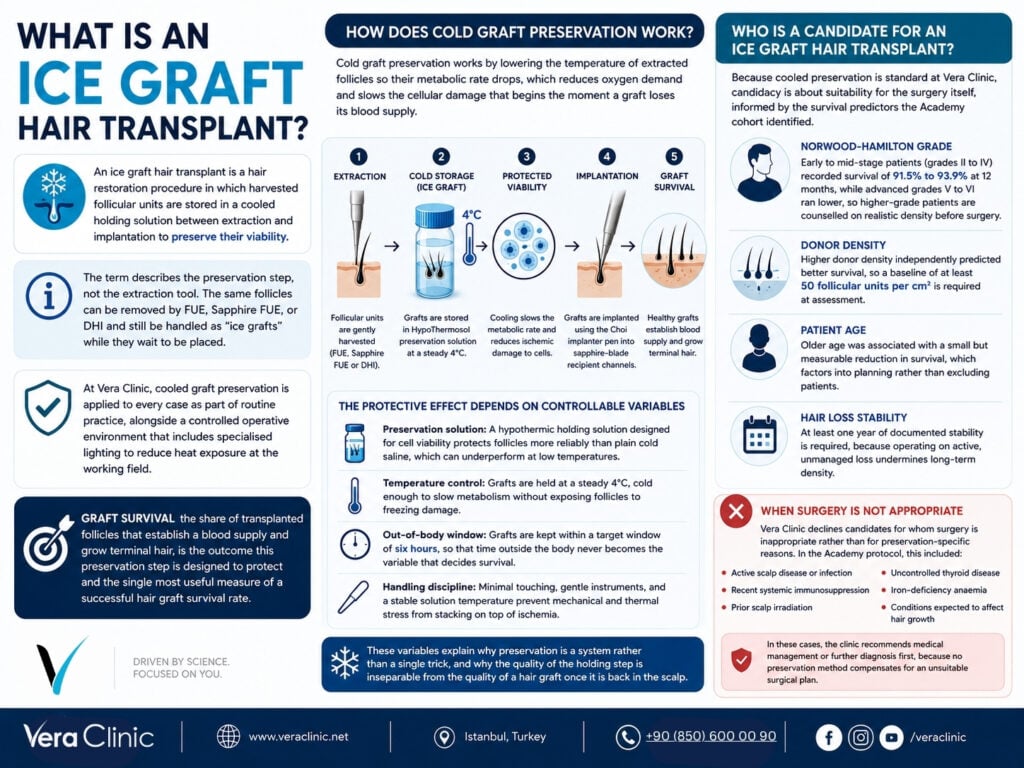
An ice graft hair transplant is a hair restoration procedure in which harvested follicular units are stored in a cooled holding solution between extraction and implantation to preserve their viability. The term describes the preservation step, not the extraction tool, so the same follicles can be removed by FUE, Sapphire FUE, or DHI and still be handled as “ice grafts” while they wait to be placed.
The distinction matters because marketing often presents “ice graft” as though it were a distinct operation that competes with FUE or DHI. It is not. Extraction defines how grafts leave the donor area, while preservation defines how they are protected once out. Confusing the two leads patients to compare things that sit at different stages of the same procedure.
At Vera Clinic, cooled graft preservation is applied to every case as part of routine practice, alongside a controlled operative environment that includes specialised lighting to reduce heat exposure at the working field. Graft survival, the share of transplanted follicles that establish a blood supply and grow terminal hair, is the outcome this preservation step is designed to protect, and it remains the single most useful measure of a successful hair graft survival rate.
How Does Cold Graft Preservation Work?
Cold graft preservation works by lowering the temperature of extracted follicles so their metabolic rate drops, which reduces oxygen demand and slows the cellular damage that begins the moment a graft loses its blood supply. A follicle outside the body is in a state of ischemia, and controlled cooling in a purpose-built solution delays the point at which that ischemia causes irreversible harm.
At Vera Clinic the protocol is specific rather than generic. In the Academy cohort, follicular units were held in chilled HypoThermosol preservation solution at 4°C, with a target maximum out-of-body time of six hours, while grafts were harvested with a 0.8 mm motorised punch and placed using the Choi implanter pen into sapphire-blade recipient channels. The protective effect depends on a few controllable variables working together:
- Preservation solution: A hypothermic holding solution designed for cell viability protects follicles more reliably than plain cold saline, which can underperform at low temperatures.
- Temperature control: Grafts are held at a steady 4°C, cold enough to slow metabolism without exposing follicles to freezing damage.
- Out-of-body window: Grafts are kept within a target window of six hours, so that time outside the body never becomes the variable that decides survival.
- Handling discipline: Minimal touching, gentle instruments, and a stable solution temperature prevent mechanical and thermal stress from stacking on top of ischemia.
These variables explain why preservation is a system rather than a single trick, and why the quality of the holding step is inseparable from the quality of a hair graft once it is back in the scalp.
Does Colder Storage Actually Improve Graft Survival?
Colder is not automatically better, and this is where the “ice graft” label can mislead. Plain cold storage can lag behind milder conditions when a basic solution is used, which is why a purpose-built hypothermic preservation solution matters more than temperature alone. What the evidence points to is that once grafts are held in a proper cold solution within a controlled time window, survival is governed mainly by patient anatomy rather than by handling. Vera Clinic Academy’s retrospective cohort makes this concrete: survival by Norwood-Hamilton (NH) grade is set out below.
| Norwood-Hamilton grade | 12-month survival | 24-month survival |
|---|---|---|
| Grade II | 93.9% | 92.5% |
| Grade III | 92.7% | 91.4% |
| Grade III vertex | 92.2% | 91.1% |
| Grade IV | 91.5% | 89.9% |
| Grade V | 89.3% | 87.4% |
| Grade VI | 86.5% | 84.7% |
| Overall cohort | 91.4% | 89.8% |
Across 309 consecutive FUE patients treated between January 2022 and December 2024, mean graft survival was 91.4% (SD 4.1%) at 12 months (n = 309) and 89.8% (SD 5.0%) at 24 months (n = 249), an absolute decline of only 1.6 percentage points over the second year (95% CI 2.0 to 1.2, p less than 0.001), according to Graft Survival Rates Following Follicular Unit Extraction at 12 and 24 Months (Vera Clinic Academy, retrospective cohort; Yalcin and Filima). In that analysis, higher NH grade (p less than 0.001), lower donor density (p = 0.004), and older age (p = 0.028) independently predicted lower survival, while out-of-body time was not a significant predictor after adjustment (p = 0.211). Vera Clinic’s position follows directly from this: cold preservation and a disciplined time window remove handling as a source of variation, so counselling should focus on the patient factors that actually move the outcome. A separate Vera Clinic Academy prospective cohort of 789 patients recorded mean survival of 92%, range 90% to 96%, at month 12, which corroborates the stability of results under the same standard.
“After ten years in hair restoration, I have seen that graft preservation is where clinics quietly differ the most. The extraction technique gets the attention, but once a case is underway, how the graft is protected while it is out of the body is what decides whether the result holds. It is the one variable fully in our hands. Everything else, a patient’s Norwood grade, their donor density, their age, varies from person to person, so preservation is the strongest lever a clinic actually controls.” said Emin Gül, Vera Clinic doctor.
Who Is a Candidate for an Ice Graft Hair Transplant?
Because cooled preservation is standard at Vera Clinic, candidacy is about suitability for the surgery itself, informed by the survival predictors the Academy cohort identified. The following factors shape the clinical picture:
- Norwood-Hamilton grade: Early to mid-stage patients (grades II to IV) recorded survival of 91.5% to 93.9% at 12 months, while advanced grades V to VI ran lower, so higher-grade patients are counselled on realistic density before surgery.
- Donor density: Higher donor density independently predicted better survival, so a baseline of at least 50 follicular units per square centimetre is required at assessment.
- Patient age: Older age was associated with a small but measurable reduction in survival, which factors into planning rather than excluding patients.
- Hair loss stability: At least one year of documented stability is required, because operating on active, unmanaged loss undermines long-term density.
Vera Clinic declines candidates for whom surgery is inappropriate rather than for preservation-specific reasons. In the Academy protocol, this included active scalp disease or infection, recent systemic immunosuppression, prior scalp irradiation, and conditions expected to affect hair growth such as uncontrolled thyroid disease or iron-deficiency anaemia. In these cases the clinic recommends medical management or further diagnosis first, because no preservation method compensates for an unsuitable surgical plan.
Ice Graft Preservation vs Standard Graft Handling
The difference between controlled cold-chain preservation and basic graft handling is not the surgery but the environment grafts experience while they wait. The comparison below sets out the dimensions that affect outcomes.
| Dimension | Controlled cold-chain preservation | Basic graft handling |
|---|---|---|
| Holding environment | Hypothermic solution at a controlled 4°C | Ambient or plain-saline storage, variable temperature |
| Out-of-body-time control | Target window of six hours | Undefined, sensitive to delay |
| Hydration control | Continuous, monitored | Inconsistent, depends on workflow |
| Best suited to | Large, long, or revision cases | Short, small sessions |
| Status at Vera Clinic | Standard on every procedure | Not used |
Vera Clinic’s preferred protocol is controlled cold-chain preservation for every case because it removes handling quality as a source of variation between short and long procedures. Standardising the preservation step is one of the elements that separates predictable outcomes from inconsistent ones across the wider range of hair transplant techniques.
How Much Does an Ice Graft Hair Transplant Cost in Turkey?
At Vera Clinic there is no separate price for cooled graft preservation, because it is part of the standard operation applied to every patient rather than an optional add-on. Full hair transplant packages range from €3,200 to €5,990, and cooled preservation, specialised operative lighting, and the holding-solution protocol are already included at no extra charge.
| Package element | Included at Vera Clinic |
|---|---|
| Controlled cold-chain graft preservation | Yes, standard |
| Specialised operative lighting | Yes, standard |
| Holding-solution protocol | Yes, standard |
| Surgery, aftercare, and follow-up | Yes |
| Full package price range | €3,200 to €5,990 |
Because preservation is built into the standard package, patients at Vera Clinic do not pay an “ice graft” premium. Where prices differ between providers, one input is whether a clinic invests in dedicated preservation infrastructure at all, alongside graft count, surgeon involvement, and facility standards.
What Results Can You Expect After an Ice Graft Hair Transplant?
Results after an ice graft hair transplant follow the same biological timeline as any well-handled FUE or DHI procedure, with preservation quality showing up as consistency rather than a different growth pattern. The phases below map what happens over the first two years.
- Weeks 2 to 6, shedding phase: Transplanted hairs shed as follicles recover from the stress of transfer; in the Academy cohort temporary shock loss affected 16.5% of patients and resolved within 12 weeks in every case.
- Months 3 to 6, early regrowth: New hairs begin to emerge as follicles re-enter the growth cycle.
- Months 6 to 12, coverage builds: Density and texture develop toward the near-final result, with survival stabilising at 91.4% around the 12-month mark.
- Months 12 to 24, maturation and confirmation: Survival settled at 89.8%, a decline of only 1.6 percentage points, confirming that results hold over the second year rather than eroding.
At 24 months, 90.4% of patients in the Academy cohort reported being satisfied or very satisfied with their outcome.
“I came to Vera Clinic for a hair transplant revision. My first surgery, at another clinic, was done with FUE, and I never reached the result I expected or that had been promised to me. When I chose Vera Clinic, they explained their graft-preservation approach up front. My revision used the same FUE technique, and yet this time the outcome genuinely satisfied me, only seven months after the procedure.” says E. Rodriguez, revision patient at Vera Clinic, 7 months post-procedure.
Why Choose Vera Clinic for Ice Graft Hair Transplant?
Vera Clinic treats graft preservation as a measured standard, not a marketing badge, and backs its handling protocol with its own published survival data. Every procedure runs on the same controlled cold-chain preservation, specialised operative lighting, and coordinated workflow that keeps out-of-body time short.
- Academy-backed outcomes: Survival is tracked and published through Vera Clinic Academy at 12 and 24 months, at 91.4% and 89.8% across 309 patients, giving patients real data rather than promises.
- Consistent protocol: The same preservation standard applies to every case, from compact sessions to large revision work.
- JCI-accredited care: Surgery is delivered under international accreditation with structured follow-up through the first 12 months.
- Honest positioning: Vera Clinic tells patients that preservation protects survival, while patient factors such as Norwood-Hamilton grade and donor density do the most to shape the final result.
Frequently Asked Questions
Ice graft preservation does not eliminate shock loss, which is a normal shedding phase before regrowth, but protecting follicle viability during handling supports a stronger return of hair after that phase. In the Academy cohort shock loss affected 16.5% of patients and resolved within 12 weeks in every case.
Yes, cooled preservation is combined with the extraction method rather than replacing it, so it applies equally to DHI, Sapphire FUE, and standard FUE. At Vera Clinic the preservation step is standard whichever extraction technique a case calls for.
At Vera Clinic there is nothing extra to pay, because cooled preservation is included in the standard package rather than charged as an upgrade. The value lies in consistent graft handling, not in a separate premium service.
Vera Clinic targets a maximum out-of-body time of six hours, and within that window out-of-body time was not a significant predictor of survival in the Academy cohort. Coordinated extraction and implantation keep grafts inside that window.