
An unshaven hair transplant is a hair restoration procedure performed without shaving the recipient area, delivered at Vera Clinic exclusively through DHI (Direct Hair Implantation) with the Choi implanter pen for most hair types, and through unshaven FUE for curly or Afro-textured hair, where the C-shaped follicle cannot pass through the Choi pen’s straight cannula. Because DHI places each graft directly without pre-made channel incisions, the surrounding long hair is never cut, which preserves a patient’s existing style and keeps early healing discreet. This makes it the leading choice for women and for people in public-facing roles who cannot show visible signs of surgery.
A no-shave session at Vera Clinic restores 2,000 to 3,500 grafts and reports a graft survival rate of up to 95% at 12-month follow-up across 433 patients treated between 2023 and 2025 (Vera Clinic Academy Database). One point is worth stating directly: unshaven is a cosmetic and discretion choice, not a medical improvement over shaven surgery, where greater field visibility can aid precision. Most unshaven cases at Vera Clinic follow its DHI hair transplant protocol, built around Choi-pen implantation and trichoscopy-based planning; curly and Afro-textured cases follow unshaven FUE instead, since the Choi pen cannot hold a curved follicle.
What Is an Unshaven Hair Transplant?
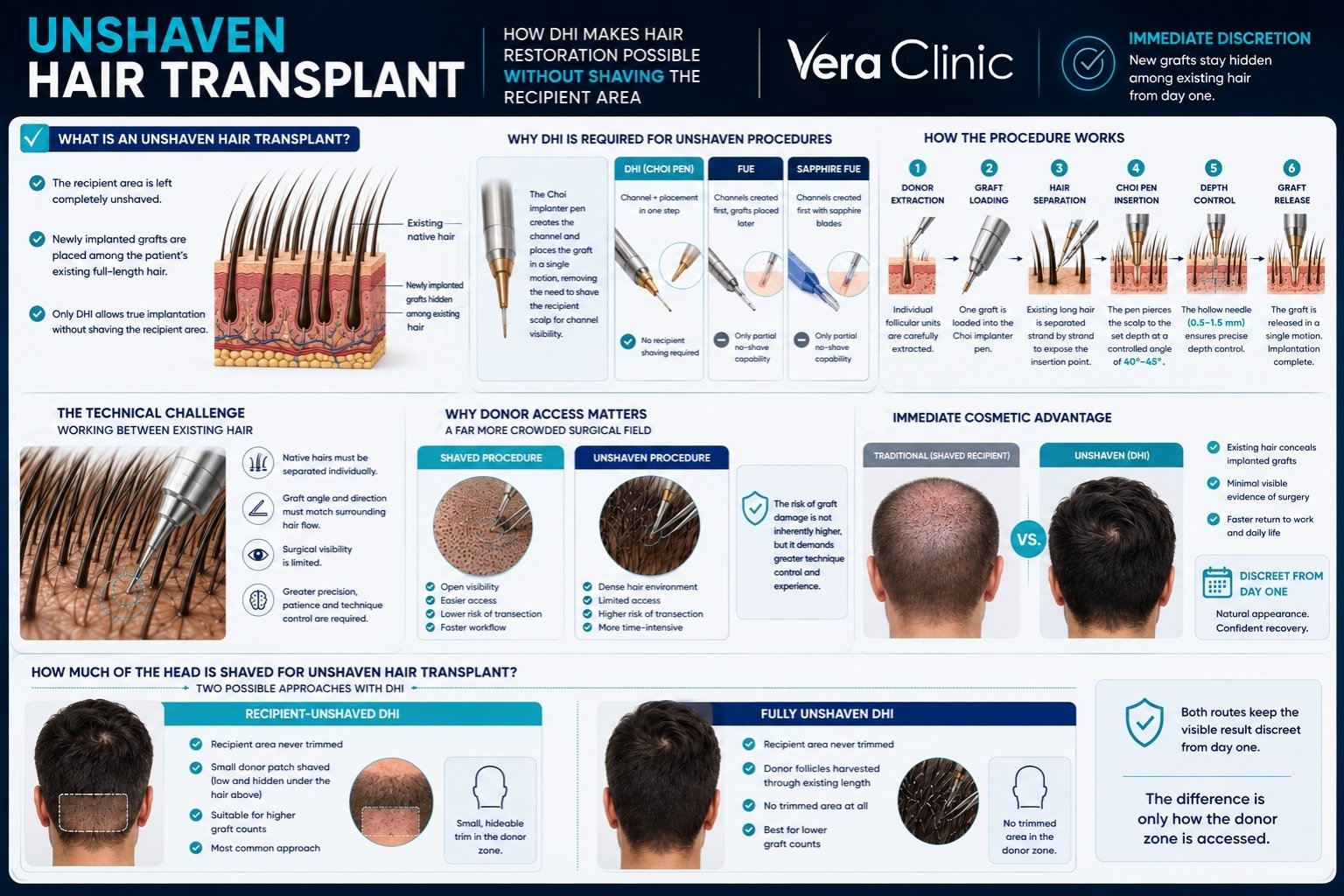
An unshaven hair transplant is a transplant in which the recipient area is left completely untouched by clippers, so newly implanted grafts sit among the patient’s existing full-length hair. Vera Clinic performs this with DHI for most hair types, because the Choi implanter pen creates the channel and places the graft in a single motion, removing the need to shave the scalp for channel visibility. Curly and Afro-textured follicles are unshaven through FUE instead, since their C-shaped structure cannot pass through the pen’s straight cannula.
For most hair types, standard FUE and Sapphire FUE offer only partial no-shave work, since both cut a full field of recipient channels before placement (ISHRS 2025 Practice Census). The donor zone is handled separately and receives a small, hideable trim rather than a full shave. The DHI hair transplant in Turkey procedure uses this same Choi-pen method as its foundation. The exception is curly or Afro-textured hair, where Vera Clinic performs unshaven FUE without pre-cutting a full recipient channel field, since grafts are placed by following each follicle’s natural curve rather than through a straight-line channel pattern.
How Does an Unshaven Hair Transplant Work?
An unshaven hair transplant works by extracting and implanting individual follicular units through the patient’s existing hair, using the Choi implanter pen to set each graft at a controlled angle of 40 to 45 degrees without pre-cutting the scalp. The pen holds a hollow needle 0.5 to 1.5 mm wide, and the surgeon loads one graft, pierces the scalp to a set depth, and releases the follicle in a single action (Vera Clinic Academy Database, 2023 to 2025).
Working between native hairs is the defining challenge. At Vera Clinic, the surgical team led by Dr. Emin Gül separates the existing long hair strand by strand to expose each insertion point, then matches the angle and direction of every graft to the surrounding flow so the difference stays invisible once the hair grows out. During extraction, the donor area must remain clearly visible to avoid transecting neighbouring follicles, which is why an unshaven case is described as operating in a far more crowded field than a shaved one. The risk of graft damage is not inherently higher, but it demands greater technique control and patience.
How Much of the Head Is Shaved for Unshaven Hair Transplant?
Three routes are possible, and the choice depends on graft volume, how visible the donor area is, and follicle shape:
- Recipient-unshaved DHI: The implantation area is never trimmed and a small donor patch is shaved low enough to sit hidden under the hair above it.
- Fully unshaven DHI: The donor follicles are harvested through existing length as well, leaving no trimmed area at all, which suits lower graft counts.
- Unshaven FUE for curly or Afro-textured hair: For C-shaped follicles that cannot be loaded into the Choi pen, extraction and implantation are performed as FUE instead of DHI, following the natural curve of each graft while the recipient area stays untouched.
All three routes keep the visible result discreet from day one; the difference is in which tool reaches the follicle and how the donor zone is accessed.
What Happens During the Procedure Step by Step?
The unshaven procedure follows the same single day structure as standard DHI, adjusted for working through existing hair.
- Consultation and trichoscopy: A FotoFinder Trichoscale AI scan maps donor density and the thinning pattern before any plan is set.
- Planning and graft estimate: The surgeon agrees the graft number, the design, and which donor sections to access through the long hair.
- Local anaesthesia: The scalp is numbed under local anaesthesia, often with needle-free pre-numbing.
- Unshaved extraction: Follicular units are harvested one by one while the surrounding hair stays in place.
- Graft preparation: Extracted units are sorted and kept in a controlled solution to limit out-of-body time.
- Direct Choi-pen implantation: Each graft is loaded into the pen and placed between existing hairs at the planned angle and depth.
- Same-day completion: A session of 2,000 to 3,500 grafts takes 7 to 8 hours and finishes in one day.
Each phase is timed to keep grafts out of the body for as short a window as possible, which protects survival.
Who Is a Good Candidate for an Unshaven Hair Transplant?
A good candidate for an unshaven hair transplant has a stable, DHT-resistant donor area, a moderate graft requirement, and a personal or professional reason to avoid visible shaving. The underlying condition for both men and women is androgenetic alopecia, which keeps the donor area at the back and sides reliable for harvesting.
- Women with diffuse thinning: Part-line and frontal density can be rebuilt without removing existing length, which is why most female cases are assessed under Vera Clinic’s hair transplant for women pathway.
- Women with a Hamilton-Norwood pattern: A less common, male-pattern-like hairline recession, measured on the Hamilton-Norwood scale, can also be rebuilt with recipient-unshaved DHI, without removing existing length.
- Public-facing professionals: People who cannot show a shaved scalp at work return to view without an obvious change.
- Patients keeping a defined hairstyle: Existing length is preserved for styling immediately after surgery.
- Moderate graft needs: Cases up to roughly 4,000 grafts fit a single no-shave session.
Vera Clinic does not recommend the unshaven route for every patient. Cases needing 5,000 or more grafts in one session are directed to shaved Sapphire FUE, because DHI’s single-follicle implantation cannot cover very large areas efficiently in one sitting (Vera Clinic Academy Database, 2023 to 2025).
The shift toward no-shave work has driven measurable growth: female patients made up 15.3% of hair restoration surgery worldwide in 2024, up from 12.7% in 2021, a change the ISHRS links directly to no-shave DHI access (ISHRS 2025 Practice Census).
Is Unshaven DHI Suitable for Curly or Afro-Textured Hair?
No, Unshaven DHI is not suitable for curly or Afro-textured hair, because the C-shaped follicle resists the straight cannula inside the Choi implanter pen. Loading a curved follicle into a straight channel applies force along the follicle’s full length, and a graft that breaks during loading is destroyed rather than delayed, removing it from the result entirely rather than simply slowing the session down. This limitation is specific to follicle geometry, not to skin type, so any patient with a tightly coiled natural curl pattern faces the same constraint regardless of the reason they want an unshaven result.
For patients with this hair type who still want a discreet, no-shave outcome, Vera Clinic performs unshaven FUE instead of unshaven DHI, extracting and implanting each graft along its natural curve rather than forcing it through a straight pen. This is the same clinical position the clinic applies across its Afro hair transplant protocol, where curl-adapted extraction replaces straight-line tools for this follicle type.
What Are the Benefits of an Unshaven Hair Transplant?
The main benefit of an unshaven hair transplant is discretion, because no recipient hair is removed and the visible signs of surgery stay hidden under existing length. The advantages below all follow from keeping the surrounding hair intact.
- No visible shaving: The recipient area is never trimmed, so there is no shaved patch to explain or cover.
- Faster social return: Normal daily activity resumes in 5 to 7 days, and surrounding hair partly hides early redness (Vera Clinic Academy Database, 2023 to 2025).
- Less dramatic shedding phase: The temporary shedding of transplanted hairs in the first weeks is less noticeable because native hair is still present.
- Style continuity: Patients keep their length and part line throughout recovery.
These benefits are practical and cosmetic; they do not change the clinical success of the graft itself.
What Are the Risks and Limitations of an Unshaven Hair Transplant?
An unshaven hair transplant carries the same surgical risks as any transplant and adds technique-specific limitations rather than new medical dangers. The points below separate genuine risks from the trade-offs of working through hair.
- Greater technical demand: Placing grafts between native hairs requires precise angulation and careful handling to avoid damaging existing follicles.
- Longer, more exacting work: Separating and protecting the surrounding hair adds time compared with a shaved field.
- Graft-count ceiling: Very large coverage is harder to achieve in one unshaven session, which limits suitability for advanced loss.
- Standard surgical risks: Bleeding, infection, and reaction to local anaesthesia are possible, and long hair itself does not raise infection risk when post-operative hygiene is followed.
Vera Clinic does not present unshaven surgery as medically superior. Shaving improves field visibility and speed, and the success of a transplant depends on technique, graft handling, and planning rather than on whether the hair was shaved (clinical position, Dr. Emin Gül). Clinics that market no-shave as a better clinical outcome, rather than a discretion option, overstate its role. An industry repair rate of 6.9% across all techniques in 2024 underlines why operator experience matters more than the shaving choice (ISHRS 2025 Practice Census).
How Much Does an Unshaven Hair Transplant Cost in Turkey?
An unshaven DHI hair transplant at Vera Clinic currently costs €3,990 to €5,190 as an all-inclusive package, lower than equivalent DHI pricing in the UK or US. The table below compares the current Vera Clinic figure with the wider market.
| Location | All-inclusive price | What it includes | Approx. cost per graft |
|---|---|---|---|
| Vera Clinic (Turkey), unshaven DHI | €3,990 to €5,190 | Surgery, anaesthesia, hotel, VIP transfers, medications, aftercare, follow-up | €1.10 to €1.70 |
| Turkey market, DHI | €3,000 to €6,000 | All-inclusive package | €0.90 to €1.60 |
| United Kingdom, DHI | €7,000 to €14,000 | Procedure, limited extras | €2.80 to €5.50 |
| United States, DHI | €9,000 to €17,000 | Procedure, limited extras | €4.00 to €6.50 |
Figures for Vera Clinic and Turkey are drawn from the Vera Clinic Academy Database (2025); international comparisons are from Bookimed (2026). The Vera Clinic package combines surgery, accommodation, and transfers into one fixed price, so the quoted figure is the figure paid. These prices sit within the broader hair transplant cost structure for treatment in Turkey. Turkey’s all-inclusive model keeps the hair transplant turkey cost 60 to 80% below UK and US figures.
Is an Unshaven or Shaven Hair Transplant Better?
Neither option is medically better, and the right choice depends on graft volume and the need for discretion. The comparison below sets the two side by side on the points that affect a decision.
| Factor | Unshaven DHI | Shaven FUE / Sapphire FUE |
|---|---|---|
| Recipient area shaved | No | Yes |
| Donor area shaved | Partial or hidden | Yes |
| Max grafts per session | Up to about 4,000 | 4,000 or more |
| Field visibility for surgeon | Reduced (works through hair) | Full |
| Visible signs after surgery | Largely hidden | More noticeable until regrowth |
| Return to social activity | 5 to 7 days | Longer while shaved area regrows |
| Best fit | Discretion, smaller cases, part-line work | Large coverage, advanced loss |
| Cost at Vera Clinic | €3,990 to €5,190 | Varies by graft count |
| Recipient-site density (grafts/cm²) | 35–45 | Higher, unrestricted by native-hair spacing |
For coverage above roughly 4,000 grafts, Vera Clinic routes patients to a shaved FUE hair transplant, where parallel channel creation places high volumes more efficiently. For smaller, discretion-sensitive cases, no-shave DHI is the preferred protocol, applying a lower recipient-site density of 35 to 45 grafts/cm² to limit friction against surrounding native hair, per a donor zone extraction thresholds and multi-session strategy study conducted by Vera Clinic Academy. For curly or Afro-textured hair, the deciding factor is not graft volume but follicle shape: unshaven FUE replaces unshaven DHI because the Choi pen cannot hold a C-shaped graft, regardless of session size.
What Results Can You Expect After an Unshaven Hair Transplant?
After an unshaven hair transplant, transplanted hairs shed within the first few weeks, then regrow over the following year, with full density visible at 12 to 18 months. The phases below set the realistic timeline.
- Weeks 1 to 2: Care focuses on graft stabilization; washing begins within a few days under medical guidance, while heat styling and tight styles wait several weeks.
- Weeks 2 to 4: A shock-loss shedding phase occurs, which is less visible here because native hair remains in place.
- Months 3 to 4: First visible regrowth appears.
- Months 12 to 18: Final density and the mature result are reached.
At 12-month follow-up, Vera Clinic reports a 98% patient satisfaction rate and DHI graft survival of up to 95%, with graft wastage held under 2.5% against an industry average of 7% (Vera Clinic Academy Database, 2023 to 2025). Documented outcomes for no-shave cases can be viewed in the hair transplant before and after gallery.
Self-esteem outcomes have also been measured for a specific subgroup: women with a Hamilton-Norwood pattern. In a Vera Clinic Academy retrospective cohort of 68 such patients treated with recipient-unshaved DHI between January and December 2023, self-esteem scores rose by five points on average over 12 months, with the largest gains among women who started with the most advanced hair loss, according to the Vera Clinic Academy Self-Esteem After Unshaven DHI Hair Transplant in Women Study (Vera Clinic Academy, 2026).
Why Choose Vera Clinic for an Unshaven Hair Transplant?
Vera Clinic is an Istanbul-based, JCI-accredited hair transplant centre that treats no-shave DHI as a precision discipline rather than a marketing label. For patients who want a discreet result without compromise, the clinic brings together specialist surgeons, advanced diagnostics, and structured recovery support.
- No-shave DHI specialisation: Unshaven cases are a core focus, with protocols refined for working between existing hairs.
- Named surgical team: Procedures are performed or supervised by Dr. Emin Gül and the specialist team.
- Advanced diagnostics: FotoFinder Trichoscale AI maps the donor area and a UHL Scanner evaluates grafts, supporting the high-density Hyper DHI protocol.
- Recovery support: OxyCure hyperbaric oxygen therapy and Smart Aftercare monitoring during the first 10 days support healing and graft stability.
- All-inclusive packages: A fixed price covers surgery, accommodation, VIP transfers, medications, and follow-up, with no hidden fees.
Book a consultation with Vera Clinic to find out whether an unshaven DHI plan fits your hair, your goals, and your graft requirement.
In most cases the result is discreet, because the surrounding hair stays in place and hides early redness. Patients return to social activity within 5 to 7 days, sooner than after a shaved procedure.
Longer hair helps, because existing length is used to cover both the donor and recipient zones during early healing. The surgical team confirms the length needed at consultation based on the donor plan.
Both men and women can have unshaven DHI. The difference between male and female cases lies in candidacy and surgical planning, not the technique, so men with moderate, well-defined needs are also suitable.
A single no-shave DHI session at Vera Clinic places 2,000 to 3,500 grafts, reaching up to 4,000 when donor density allows. Cases needing 5,000 or more grafts are planned as shaved FUE instead.
Normal daily activity resumes within 5 to 7 days, and the discreet result means a public-facing return is easier than after a shaved procedure. The first 10 to 14 days stay focused on graft stabilization.