


Die Überlebensrate der transplantierten Haarfollikel ist entscheidend für den langfristigen Erfolg einer Haartransplantation. Sie bezeichnet den Prozentsatz der verpflanzten Follikel, die sich erfolgreich einwurzeln und im Laufe der Zeit weiterhin natürliches Haar wachsen lassen. Zwar bieten Techniken wie FUE (Follicular Unit Extraction) und DHI (Direct Hair Implantation) Überlebensraten der Transplantate von über 90 %, doch hängen die tatsächlichen Ergebnisse von mehr als nur der Operationsmethode ab, wie in „Review of Factors Affecting the Growth and Survival of Follicular Grafts“ von William M. Parsley et al. (2010) dargelegt.
Faktoren wie die sorgfältige Handhabung der Transplantate, die präzise Platzierung, der allgemeine Gesundheitszustand des Patienten sowie die konsequente postoperative Versorgung entscheiden maßgeblich darüber, ob die Transplantate anwachsen oder ausfallen. Für Patientinnen und Patienten, die eine Haarwiederherstellung in Betracht ziehen, ist es unerlässlich zu verstehen, was die Vitalität der Transplantate beeinflusst, um dichte, natürlich aussehende Ergebnisse zu erzielen und weitere Eingriffe zu vermeiden. In diesem Leitfaden erläutern wir, was das Überleben der Transplantate tatsächlich beeinflusst – vor, während und nach Ihrer Haartransplantation.
Wichtige Punkte
- Das Überleben der Transplantate wird 12 Monate nach der Transplantation gemessen, sobald der Haarausfall (Schockverlust) abgeklungen ist und das Haar in Textur und Dicke ausgereift ist.
- Eine Lagerung der Transplantate bei Raumtemperatur (21 °C) ging bei einer mehrstündigen Verzögerung des Eingriffs mit einer höheren Überlebensrate (90,9 %) einher als die Lagerung bei 4 °C (80,3 %) (Beehner, 2021).
- In einer Analyse der Vera Clinic Academy mit 386 männlichen FUE-Patienten sank die durchschnittliche Transplantatüberlebensrate von 94,3 % im Norwood-Hamilton-Stadium III auf 88,4 % im Stadium VII, wobei das Alter ebenfalls mit dem Stadium zunimmt und nicht als eigener Faktor herausgerechnet wurde.
- In einer separaten Kohorte der Vera Clinic Academy mit 612 Patienten nach einer Transplantation war die kombinierte Anwendung von Minoxidil und Finasterid mit dem stärksten unabhängigen Anstieg der Transplantatüberlebensrate nach 12 Monaten aller untersuchten Nachsorgefaktoren verbunden, noch vor der Einhaltung der Diät.
- Eine retrospektive Studie an 158 FUE-Patienten berichtete von einer Gesamtüberlebensrate der Follikel von über 90 %, wobei mehr als 85 % der Patienten nach 12 Monaten eine Überlebensrate von über 95 % aufwiesen (Wang et al., 2024).
- Das Transplantatüberleben in Narbengewebe verhält sich anders: Eine systematische Übersicht zur primären narbigen Alopezie ergab ein durchschnittliches Überleben von 82,7 % nach 7 bis 12 Monaten, das bis zum vierten Jahr auf etwa 55 % zurückging (Yii et al., 2025).
Was ist die Überlebensrate von Haartransplantaten?
Die Überlebensrate von Haartransplantaten bezeichnet den Prozentsatz der transplantierten Follikeleinheiten, die sich erfolgreich einwurzeln und nach einer Haartransplantation weiterhin gesundes, wachsendes Haar produzieren. Eine hohe Überlebensrate der Transplantate ist entscheidend für eine natürlich aussehende Dichte, langfristige Ergebnisse und die Minimierung der Notwendigkeit von Wiederholungsoperationen.
In modernen klinischen Einrichtungen erzielen Techniken wie FUE und DHI Überlebensraten zwischen 85 % und 95 %, abhängig von verschiedenen Faktoren wie der Handhabung der Transplantate, der Hydratation, der Einpflanzgeschwindigkeit und dem allgemeinen Gesundheitszustand des Patienten. Diese Rate wird über einen Zeitraum von 3 bis 12 Monaten gemessen, in dem die transplantierten Haare eine vorübergehende Ausfallphase (bekannt als „Schockausfall“) durchlaufen, bevor sie wieder in den Anagenzyklus (Wachstumszyklus) zurückkehren. Eine abschließende Bewertung der Überlebensrate erfolgt in der Regel 12 Monate nach der Transplantation, wenn das transplantierte Haar vollständig nachgewachsen ist und in Textur und Dicke ausgereift ist.
Bei sachgemäßer Handhabung und Implantation können Transplantate unter idealen Bedingungen Überlebensraten von bis zu 95 % erreichen, was mit der allgemeinen Fachliteratur zur Transplantatüberlebensrate übereinstimmt (Parsley & Perez-Meza, 2010).
Warum ist das Überleben der Transplantate bei Haartransplantationen wichtig?
Das Transplantatüberleben spielt eine zentrale Rolle bei der Bestimmung der Gesamterfolgsrate einer Haartransplantation, da es die optische Dichte und die natürlich aussehenden Ergebnisse prägt, die sich Patienten erhoffen. Unabhängig davon, ob ein Patient sich einer FUE-, DHI- oder FUT-Behandlung unterzieht, bestimmt die Anzahl der Transplantate, die überleben und zu gesunden Follikeln heranwachsen, wie effektiv der Eingriff den Haaransatz oder den Scheitelbereich wiederherstellt.
Eine hohe Überlebensrate der Transplantate ist entscheidend für die Ästhetik sowie für das emotionale und finanzielle Wohlbefinden der Patientinnen und Patienten. Diese investieren sowohl Hoffnung als auch finanzielle Mittel in den Eingriff; bei einer niedrigen Überlebensrate der Follikel resultiert dies in lückenhaftem Haarwuchs, der Notwendigkeit einer Revision und langfristiger Unzufriedenheit. Im Gegensatz dazu führt eine hohe Überlebensrate zu einer dichteren Bedeckung, einer verbesserten Transplantatdichte und gesteigertem Selbstvertrauen.
Technisch gesehen muss zwischen vitalen und nicht vitalen Transplantaten unterschieden werden. Nur vitale Follikel treten nach der Operation wieder in die Anagenphase (Wachstumsphase) ein. Chirurgen streben danach, das Überleben der Follikeleinheiten zu maximieren, indem sie präzise Techniken anwenden und Trauma, Dehydrierung und Ischämie während der Operation minimieren.
Vergleicht man beispielsweise das Überleben der Transplantate bei FUT und FUE, so bewahrt die FUT-Methode die Transplantate tendenziell besser, da die Streifenentnahme die Durchtrennung von Follikeln begrenzt. Allerdings sind die Überlebensraten bei der modernen FUE-Methode durch die Einführung von Saphirklingen und die gekühlte Lagerung der Transplantate deutlich gestiegen. Ebenso hat das Überleben der Transplantate nach der DHI-Methode vielversprechende Ergebnisse gezeigt, dank der Fähigkeit des Choi-Implanters, die Handhabung zu reduzieren und die Winkelkontrolle zu verbessern.
Letztendlich gewährleistet die Maximierung der Überlebensrate der Haartransplantatfollikel, dass Patienten die von ihnen erhofften Ergebnisse der Haartransplantation erhalten; dies macht sie zum entscheidenden Maßstab sowohl für medizinische Fachkräfte als auch für ihre Patienten.
Welche Faktoren beeinflussen das Überleben der Haartransplantate maßgeblich?
Das Erreichen einer hohen Überlebensrate der Haarfollikel ist entscheidend für natürlich aussehende Ergebnisse und den langfristigen Erfolg einer Haartransplantation. Mehrere miteinander verbundene Faktoren spielen eine entscheidende Rolle dabei, wie viele der transplantierten Follikel anwachsen. Hier sind die wichtigsten Faktoren, die die Lebensfähigkeit der Transplantate und die Ergebnisse der Haartransplantation beeinflussen.
- Qualität des Spenderhaars: Dickeres, dichteres Spenderhaar mit starken Wurzeln gewährleistet eine höhere Überlebensrate und besseres Wachstum.
- Alter und Genetik: Jüngere Patientinnen und Patienten weisen in der Regel eine schnellere Wundheilung auf, während fortschreitender Haarausfall ohne medikamentöse Therapie die Haardichte langfristig reduziert.
- Entnahmemethode: DHI bietet dank der präzisen Platzierung des Implanter-Stifts eine Überlebensrate von bis zu 97 %. FUE erreicht bei sorgfältiger Durchführung eine Überlebensrate von 90–95 % bei minimaler Narbenbildung. FUT bietet eine Überlebensrate von 85–95 %, verursacht jedoch lineare Narben und ein höheres Traumarisiko.
- Manuell vs. motorisiert: Die manuelle FUE weist eine höhere Überlebensrate und geringere Transektionsraten auf als motorisierte Werkzeuge.
- Handhabung und Lagerung der Transplantate: Ausreichende Hydratation, minimale Ischämie und korrekte Temperaturkontrolle sind entscheidend für das Überleben der Follikel.
- Implantationstechnik: Implantationsstifte reduzieren das Trauma und die Zeit außerhalb der Kopfhaut und verbessern so die Gesamtüberlebensrate der Transplantate.
- Erfahrung des Chirurgen und Klinikstandards: Erfahrene Chirurgen und akkreditierte Kliniken gewährleisten eine höhere Konsistenz, Sicherheit und natürlich aussehende Ergebnisse.
- Gesundheitszustand des Patienten und Zustand der Kopfhaut: Diabetes mellitus, Nikotinabusus und eine gestörte Kopfhautintegrität beeinträchtigen die Transplantatannahme sowie die Wundheilungskapazität.
- Einhaltung der Nachsorgeanweisungen: Die konsequente Befolgung der postoperativen Anweisungen zu Waschen, Schlafen und Schutz ist entscheidend für das Überleben der Transplantate.
Qualität der Spenderhaare
Die Grundlage jeder Transplantation liegt in der Qualität der Spenderhaare. Haardurchmesser, Wurzelstärke und Follikeldichte tragen alle zu einer höheren Überlebenswahrscheinlichkeit bei. Patienten mit dickerem, dichterem Spenderhaar erzielen eine bessere Wachstumsrate nach der Haartransplantation.
Alter und Genetik beeinflussen das Überleben der Follikeleinheiten. Jüngere Patientinnen und Patienten heilen in der Regel schneller, doch befinden sie sich in frühen Stadien eines fortschreitenden Haarausfalls und erhalten keine medikamentöse Therapie (wie Finasterid), kann die langfristige Haardichte dennoch beeinträchtigt sein.
Entnahmemethode (FUE, DHI, FUT)
Die zur Entnahme der Haarfollikel verwendete Methode spielt eine wesentliche Rolle bei der Bestimmung der Überlebensrate der transplantierten Follikel. Unter den drei wichtigsten Techniken wird DHI (Direct Hair Implantation) häufig mit der höchsten Transplantatüberlebensrate (bis zu 97 %) in Verbindung gebracht, was auf den präzisen, verzögerungsfreien Implantationsansatz mit Implantationsstiften zurückzuführen ist, die das Trauma der Follikel reduzieren, wie in der Studie „Direct Hair Transplantation: A Modified Follicular Unit Extraction Technique“ von Pradeep Sethi et al. (2013) dargelegt.
Die FUE (Follicular Unit Extraction) bietet ein ausgewogenes Verhältnis zwischen minimaler Narbenbildung und guter Transplantatlebensfähigkeit, was zu einer Überlebensrate von etwa 90–95 % führt, insbesondere wenn sie unter Verwendung fortschrittlicher Instrumente und sorgfältiger Handhabung durchgeführt wird, wie in „Review of Factors Affecting the Growth and Survival of Follicular Grafts“ von William M. Parsley et al. (2010) dargelegt.
Die FUT-Haartransplantation (Follicular Unit Transplantation) erzielt zwar ebenfalls hohe Überlebensraten von 85–95 %, geht jedoch mit linearer Narbenbildung und einem leicht erhöhten Traumarisiko während der Streifenentnahme einher – ein Befund, der auch in einer kleinen Vergleichsstudie zur Überlebensrate von FUE und FUT bestätigt wurde (Beehner, 2015). In der Vera Clinic wird die FUT-Methode nicht angewendet, da die linearen Narben und das höhere Verletzungsrisiko bei der Entnahme des Hautstreifens den Standards der Klinik für eine minimalinvasive, patientenorientierte Haarwiederherstellung widersprechen.
Sowohl bei der FUE als auch bei der DHI beeinflussen die eingesetzten mechanischen Instrumente das Ergebnis, doch sind die Fähigkeiten des Chirurgen und seine Handhabungstechnik oft die entscheidenden Faktoren für das Überleben der Follikeleinheiten. In einer 2015 veröffentlichten klinischen Studie wurden manuelle und motorisierte Methoden der Follikeleinheit-Extraktion (FUE) verglichen. Die Ergebnisse zeigten, dass die manuelle FUE eine etwas höhere Überlebensrate der Follikel und niedrigere Transsektionsraten aufwies.
Motorisierte Stanzwerkzeuge bieten zwar Geschwindigkeit und Effizienz, verursachen jedoch ein übermäßiges Drehmoment und Vibrationen, die empfindliche Transplantate schädigen – insbesondere in den Händen weniger erfahrener Anwender. Die manuelle Entnahme eignet sich besser für Patienten mit einer empfindlicheren Kopfhaut oder feinerem Haar, bei denen Präzision entscheidend ist, um eine hohe Lebensfähigkeit der Transplantate zu erhalten und natürlich aussehende Ergebnisse zu gewährleisten
Handhabung und Lagerung der Transplantate
Die Art und Weise, wie die Transplantate zwischen Entnahme und Implantation gehandhabt und gelagert werden, beeinflusst ihre Überlebensrate bei FUE- und DHI-Verfahren maßgeblich. Temperaturkontrolle, Feuchtigkeitsversorgung und eine begrenzte Ischämiezeit sind entscheidend für die Erhaltung der Lebensfähigkeit der Follikel. Eine wegweisende Studie im „Hair Transplant Forum International“ ergab, dass Transplantate, die bei Raumtemperatur (21 °C) aufbewahrt wurden, bei einer mehrstündigen Verzögerung des Eingriffs tatsächlich eine höhere Überlebensrate (90,9 %) aufwiesen als solche, die bei 4 °C (80,3 %) gelagert wurden, wie in „A Study Comparing Survival of Hair Follicles Stored Cold and at Room Temperature“ belegt wird, Michael L. Beehner, „Hair Transplant Forum International“, (2021).
Trotz der weit verbreiteten Annahme, dass kälter besser sei, zeigen andere Untersuchungen, dass sowohl bei 0 °C als auch bei 4 °C die Lebensfähigkeit erhalten bleibt – mit einer Lebensfähigkeit der Zellen der äußeren Wurzelscheide in Zellkultur von 96 % (0 °C) und 92 % (4 °C) sowie einer Überlebensrate in vivo von 85 % (0 °C) und 79 % (4 °C) nach 24 Stunden, gemäß der Studie „How long hair follicle units be preserved at 0 and 4 degrees C for delayed transplant?“, Qian Jiange et al., (2005).
Eine minimierte Ischämie, eine angemessene Hydratation und die Wahl der Aufbewahrungslösung sind von entscheidender Bedeutung, um eine hohe Überlebensrate der transplantierten Haarfollikel zu erreichen und natürlich aussehende Ergebnisse zu erzielen.
Implantationstechnik
Die Methode zur Implantation der entnommenen Transplantate spielt eine entscheidende Rolle für die Gesamteinschleifungsrate der Haartransplantate und die Qualität der Ergebnisse der Haartransplantation. In der modernen Haarwiederherstellung sind zwei Hauptimplantationstechniken weit verbreitet: die Pinzettenimplantation (üblich bei FUE) und Techniken mit einem Implantationsstift, wie sie bei DHI zum Einsatz kommen.
Bei der FUE werden die entnommenenFUE-Haartransplantation Follikel manuell mit einer feinspitzigen Pinzette in vorab angelegte Einschnittstellen eingesetzt. Diese Technik ist zwar effektiv, erfordert jedoch außergewöhnliche chirurgische Präzision, um ein Trauma der Transplantate, falsche Einwinkelungen oder übermäßige Manipulation zu vermeiden – allesamt Faktoren, die das Überleben der follikulären Einheiten beeinträchtigen.
DHI hingegen nutzt einen Choi-Implantationsstift, der es dem Chirurgen ermöglicht, das Transplantat in einer einzigen Bewegung zu laden, einzuschneiden und zu implantieren. Dadurch verkürzt sich die Zeit, in der die Transplantate außerhalb der Kopfhaut verbleiben, und die Handhabung wird minimiert, was das Überleben der Transplantate nach dem Eingriff potenziell erhöhtDHI-Haartransplantation. Der Einsatz von Implantationsstiften verbessert laut der klinischen Studie „Does the use of implanters affect the quality of FUE grafts?“ von Conradin von Albertini et al. (2017) die Überlebensrate von 1- und 2-Haar-Follikeleinheiten im Vergleich zur Pinzetten-basierten Implantation.
Robotersysteme basieren nach wie vor auf manueller Implantation, das heißt, dass der Chirurg oder Techniker jedes Transplantat von Hand platziert. Das Überleben dieser Transplantate hängt davon ab, wie sorgfältig sie während der Lagerung und Implantation behandelt werden – insbesondere hinsichtlich ihrer Hydratation, der Temperatur und der Zeit außerhalb des Körpers. Zwar verbessert die Präzision der Entnahme durch den Roboter die Transplantaternte, doch macht diese Technik eine fachkundige Implantation nicht überflüssig.
Letztendlich bieten zwar alle Techniken eine hohe Erfolgsquote bei Haartransplantationen, doch DHI bietet Vorteile bei der Verringerung von Gewebeverletzungen und der Verbesserung der ästhetischen Konsistenz – insbesondere in Fällen, in denen eine hohe Transplantatüberlebensrate und eine feine Richtungssteuerung erforderlich sind.
Erfahrung des Chirurgen und Klinikstandards
Die Kompetenz des Chirurgen spielt eine entscheidende Rolle für die Überlebensrate der Transplantate, da sie die Schädigung der Follikel während der Entnahme und Implantation minimiert. Kliniken mit erfahrenen Teams und strengen Verfahrensprotokollen erzielen mit größerer Wahrscheinlichkeit höhere Überlebensraten der Transplantate sowie konsistente, natürlich aussehende Ergebnisse.
Seriöse Kliniken verfügen häufig über internationale Akkreditierungen, befolgen strenge Hygieneprotokolle und setzen standardisierte Abläufe um: Jeder Schritt von der Entnahme der Transplantate bis zur Implantation wird streng kontrolliert. Darüber hinaus reduziert ein gut geschultes Team die Ischämiezeit und das Trauma – beides entscheidende Faktoren für die Optimierung des Überlebens der Follikeleinheiten.
Die Überlebensrate Erfolgsquote bei Haartransplantationenist in der Regel höher in Kliniken, in denen die Eingriffe von staatlich geprüften Chirurgen durchgeführt und von geschulten Technikern unterstützt werden, die nach strengen operativen Richtlinien arbeiten, da die Fachkompetenz des Chirurgen Einfluss darauf hat, wie stark die Transplantate bei der Entnahme und Einsetzung traumatisiert werden. Diese Faktoren erhöhen gemeinsam die Wahrscheinlichkeit konsistenter Ergebnisse bei Haartransplantationen, insbesondere bei fortschrittlichen Techniken wie FUE oder DHI, bei denen Präzision entscheidend für die Erhaltung der Haardichte ist.
In der Vera Clinic wird jede Phase des Eingriffs – von der Spenderbereichsermittlung bis zur Transplantatverpflanzung – von einem engagierten Operationsteam überwacht, das standardisierte Entnahme- und Implantationsprotokolle befolgt. Bei unseren präoperativen Untersuchungen werden die Spenderdichte und die Elastizität der Kopfhaut individuell bewertet, um für jeden Patienten den optimalen Entnahmeansatz zu ermitteln.
Gesundheitszustand des Patienten und Zustand der Kopfhaut
Die Gesundheit des Patienten spielt eine entscheidende Rolle für den Erfolg des Anwachsens der Haartransplantate. Erkrankungen wie Diabetes mellitus, Autoimmunerkrankungen und Gefäßerkrankungen beeinträchtigen die Wundheilung, verringern die Durchblutung der Follikel und erhöhen das Risiko eines Transplantatversagens.
Ebenso beeinträchtigt das Rauchen die Mikrozirkulation und die Sauerstoffversorgung, die für das Überleben der Follikeleinheiten entscheidend sind. Chronische Entzündungen der Kopfhaut oder ein schlechter Allgemeinzustand der Kopfhaut (aufgrund von Dermatitis oder Infektionen) beeinträchtigen die Transplantatannahme und führen zu ungleichmäßigen Ergebnissen, wie in der Studie „Is Every Patient of Hair Loss a Candidate for Hair Transplant?: Deciding Surgical Candidacy in Pattern Hair Loss“ von Robert H. True (2021) dargelegt. Für eine optimale Wachstumsrate nach der Haartransplantation sollten Patienten zugrunde liegende medizinische Probleme behandeln lassen und die Anweisungen vor und nach der Operation genau befolgen.
Einhaltung der postoperativen Nachsorge
Die konsequente Einhaltung der postoperativen Pflege ist entscheidend für die Aufrechterhaltung einer hohen Überlebensrate der Haartransplantate. In den ersten Tagen nach dem Eingriff verringert das Vermeiden von Schweiß, übermäßiger körperlicher Aktivität, direkter Sonneneinstrahlung und potenzieller Verletzung das Risiko von Infektionen und der Ablösung von Follikeln. Die richtige Technik beim Haarewaschen (mit sanften, tupfenden Bewegungen statt Reiben) hilft, den Bereich sauber zu halten, ohne die neu implantierten Transplantate zu stören. Das Schlafen mit erhöhtem Kopf minimiert zudem Schwellungen und verhindert Druck auf den Transplantationsbereich. Wer die Nachsorge vernachlässigt, riskiert eine verringerte Überlebensrate der transplantierten Haarfollikel und suboptimale Ergebnisse („Selbstmanagement in der Erholungsphase nach einer Haartransplantation bei Patienten mit androgenetischer Alopezie: Eine qualitative Studie“, Liu Shichang et al., 2024). In einer separaten Studie mitStudie zur Überlebensrate von Transplantaten unter Berücksichtigung der Einhaltung von Ernährungs-, medizinischen und Haarpflegeempfehlungen 612 Patienten nach einer Transplantation standen die Einhaltung der Diät sowie die kombinierte Anwendung von Minoxidil und Finasterid jeweils unabhängig voneinander in Zusammenhang mit einer höheren Transplantatüberlebensrate nach 12 Monaten, wobei die medikamentöse Behandlung der stärkste untersuchte Nachsorgefaktor in dieser Kohorte war.
Beeinflusst der Schweregrad des Haarausfalls (Norwood-Hamilton-Stadium) die Transplantatüberlebensrate?
Ja, die Transplantatüberlebensrate sinkt tendenziell mit steigendem Norwood-Hamilton (NH)-Stadium. Patienten mit fortgeschrittenerem Haarausfall weisen eine größere zu behandelnde Fläche und mehr betroffene Follikel auf, was die Überlebensrate im Vergleich zu früheren Stadien offenbar leicht senkt. In einer Analyse der Vera Clinic Academy an 386 männlichen FUE-Patienten, die zwischen 2020 und 2025 in der Vera Clinic behandelt wurden, wurde die Überlebensrate nach 12 Monaten mittels kalibrierter Trichoskopie gemessen. Die mittlere Transplantatüberlebensrate sank dabei von 94,3 % im Stadium III auf 88,4 % im Stadium VII.
| NH-Stadium | Patienten (n) | Durchschnittliche Transplantatüberlebensrate (12 Monate) |
|---|---|---|
| III | 98 | 94,3 % |
| III Scheitel | 76 | 92,8 % |
| IV | 88 | 91,5 % |
| V | 64 | 90,3 % |
| VI | 38 | 89,2 % |
| VII | 22 | 88,4 % |
Dieser Rückgang war statistisch signifikant, obwohl die Gesamtdifferenz in einem relativ engen Bereich zwischen 88 % und 94 % blieb. Auch das Alter der Patienten nimmt in dieser Gruppe tendenziell mit dem NH-Stadium zu, und die Analyse hat den eigenständigen Einfluss des Alters nicht separat berücksichtigt. Ein höheres Stadium sollte daher nicht als alleiniger Grund für die geringere Überlebensrate gewertet werden. Die von İsmail Işık, M.Sc., Sait Demirci, M.Sc., und İbrahim Alişan, Doç. Dr., geleitete Studie weist darauf hinÜberlebensrate der Transplantate gemäß einer Studie nach dem Norwood-Hamilton-Stadium, dass das Stadium neben der Spenderdichte und der Gesamtzahl der benötigten Transplantate einer von mehreren Einflussfaktoren ist.
Beeinflusst die Technik das Überleben der Haartransplantate?
Die Überlebensrate von Haartransplantaten hängt maßgeblich von der eingesetzten Transplantationstechnik ab, wobei jede Methode spezifische Vorteile und Einschränkungen aufweist. Die folgende übersichtliche Tabelle vergleicht systematisch, wie verschiedene Haartransplantationstechniken die Überlebensrate von Haartransplantaten beeinflussen, und fasst die wichtigsten Vor- und Nachteile zusammen.
| Technik | Durchschnittliche Überlebensrate (%) | Vorteile | Nachteile |
| FUE (Follicular Unit Extraction) | 85–90 % | Minimalinvasiv, punktförmige Narben, schnellere Genesung | Etwas geringere Überlebensrate, wenn Transplantate unsachgemäß behandelt werden oder austrocknen |
| DHI (Direct Hair Implantation) | 90–95 % | Höchste Präzision bei Winkel und Richtung, reduzierte Transplantatmanipulation | Längere Behandlungsdauer, erfordert hochqualifiziertes Personal |
| FUT (Follicular Unit Transplantation) | 85–90 % | Hohe Transplantatausbeute, ideal für umfangreiche Eingriffe | Lineare Narbenbildung, längere Heilungsdauer |
In der Vera Clinic werden Sapphire-FUE und DHI als primäre Techniken der Haartransplantation eingesetzt. Diese Präferenz beruht auf dem ausgewogenen Verhältnis von Transplantatüberlebensrate, minimaler Narbenbildung und der Präzision, die mit Saphirklingen und dem Choi Implanter Pen in erfahrenen Händen erreicht wird.
So steigern Sie die Transplantatüberlebensrate nach einer Haartransplantation
Die Steigerung der Überlebensrate Ihrer Haartransplantate hängt nicht von einem einzigen Faktor ab. Es ist die Kombination aus Nachsorge, dem Können des Chirurgen und dem Lebensstil des Patienten, die den langfristigen Erfolg bestimmt.
- Waschen Sie den Empfängerbereich gemäß den Empfehlungen behutsam, vermeiden Sie Kratzen oder Zupfen und schützen Sie die transplantierten Areale während der initialen Heilungsphase vor direkter Sonneneinstrahlung, Schweiß und Druck.
- Die Therapie mit plättchenreichem Plasma (PRP) und Exosomenbehandlungen beschleunigen die Heilung, verbessern die Versorgung der Haarfollikel und können das Haarwachstum sowie die Überlebensrate der Transplantate steigern.
- Rauchen und Alkohol beeinträchtigen die Durchblutung und die Sauerstoffversorgung der Kopfhaut. Es wird daher dringend empfohlen, den Konsum in dieser Phase vollständig einzustellen oder zumindest deutlich zu reduzieren.
- Ein erfahrenes Team sorgt für ein minimales Trauma bei der Entnahme und Implantation, was den Transplantatverlust reduziert und die langfristigen Ergebnisse verbessert.
- Achten Sie darauf, dass Sie wichtige Vitamine und Mineralstoffe wie Biotin, Eisen, Zink und Omega-3-Fettsäuren zu sich nehmen, die alle eine Rolle bei der Haarregeneration und der Stärkung der Haarwurzeln spielen.
Diese frühen, scheinbar kleinen Maßnahmen beeinflussen maßgeblich die Gesamterfolgsrate Ihrer Haartransplantation und tragen dazu bei, dichtere, natürlicher aussehende Ergebnisse zu erzielen. Ernährung, Waschtechnik und der Zeitpunkt der Aktivitäten fallen alle unter denselben Nachsorge bei HaartransplantationenDachbegriff, der die langfristige Genesung prägt.
Was sind die Anzeichen für eine schlechte Transplantatüberlebensrate?
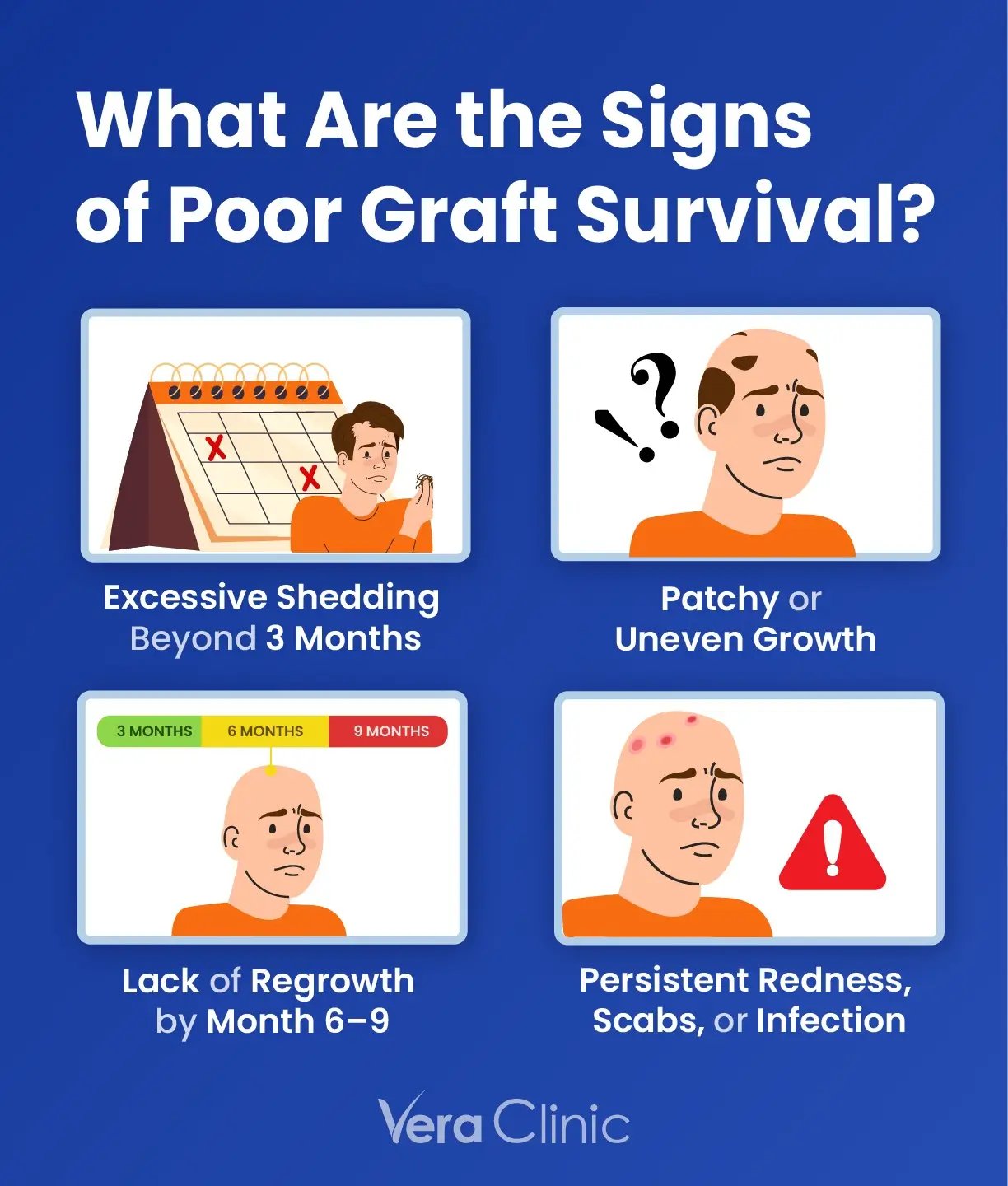
Das frühzeitige Erkennen der Anzeichen für ein schlechtes Anwachsen der Transplantate hilft Patienten, rechtzeitig ärztlichen Rat einzuholen und möglicherweise ein dauerhaftes Versagen der Transplantate zu verhindern. Während ein gewisser Haarausfall nach einer Haartransplantation normal ist, insbesondere in den ersten Wochen (bekannt als „Schockausfall“), deuten anhaltende oder ungewöhnliche Ausfallmuster auf ein Problem hin. Nachfolgend finden Sie eine Liste der Anzeichen für ein schlechtes Anwachsen der Transplantate.
- Übermäßiger Haarausfall nach mehr als drei Monaten: Während der Haarausfall normalerweise innerhalb von 8–12 Wochen abklingt, deuten anhaltende Ausdünnung oder Haarausfall nach 4–5 Monaten auf eine geringe Überlebensrate der Haarfollikel oder eine fehlgeschlagene Transplantation hin.
- Fleckweises oder ungleichmäßiges Wachstum: Unregelmäßige Wachstumsmuster, kahle Stellen oder Lücken zwischen den transplantierten Haaren deuten auf eine geringe Überlebensrate der transplantierten Haarfollikel oder eine mangelhafte Implantationstechnik hin.
- Ausbleiben des Nachwachsens im 6.–9. Monat: Bei den meisten Patienten setzt das neue Haarwachstum zwischen dem 3. und 6. Monat ein, wobei die volle Dichte nach 12 Monaten erreicht wird. Bleibt bis zum 6. Monat ein sichtbares Nachwachsen aus, kann dies auf fehlgeschlagene Follikel oder ischämische Schäden hinweisen.
- Persistierende Rötungen, Krusten oder Infektionen über mehr als zwei Wochen: Anhaltende Entzündungen oder Infektionen beeinträchtigen das Überleben der Haarfollikel. Es ist unerlässlich, die Nachsorgeanweisungen strikt zu befolgen, um Follikulitis oder Nekrose zu verhindern.
Nach einer Haartransplantation ist es normal, dass es in den ersten Wochen zu einem gewissen Haarausfall kommt. Wenn Sie jedoch über den dritten Monat hinaus übermäßigen Haarausfall oder sichtbare kahle Stellen bemerken, ist dies ein Anzeichen für eine schlechte Transplantatüberlebensrate. Wenden Sie sich umgehend an Ihre behandelnde Ärztin oder Ihren behandelnden Arzt, wenn das Ergebnis ungleichmäßig, asymmetrisch oder unnatürlich spärlich wirkt, da dies auf eine fehlerhafte Platzierung der Transplantate oder Probleme mit deren Überleben hindeuten kann. Persistierende Schmerzen, Schwellungen oder Anzeichen einer Infektion Wochen nach dem Eingriff sind Warnsignale, die eine unverzügliche medizinische Abklärung erfordern.
Wissenschaftliche Forschung zum Überleben von Haartransplantaten
Aktuelle klinische Studien belegen, dass die Wahl der Technik, der individuelle Patientenstatus sowie begleitende supportive Maßnahmen maßgeblich über das Überleben der Transplantate und den langfristigen Erfolg der Transplantation entscheiden.
1. FUE bei androgenetischer Alopezie – Xi’an-Studie
Eine retrospektive Studie mit 158 männlichen Patienten, die an androgenetischer Alopezie litten, berichtete, dass über 90 % der transplantierten Follikel nach der FUE-Methode überlebten, wobei mehr als 85 % der Patienten 12 Monate nach der Operation eine Überlebensrate von über 95 % erreichten. Die Patientenzufriedenheit lag bei über 98 %, bei einer Komplikationsrate von unter 6 %, wie in „Using the follicular unit extraction technique in treatment of male androgenetic alopecia“ von Fang Wang et al. (2024) angegeben.
2. Überleben bei narbiger (cicatrizialer) Alopezie
Bei Fällen von primärer narbiger Alopezie wurde eine systematische Übersichtsarbeit mit insgesamt 123 Patienten durchgeführt, um Studien zu identifizieren, die die Behandlung der PCA bei Erwachsenen mittels FUE oder FUT untersuchten. Der primäre Endpunkt war die Überlebensrate der transplantierten Follikeleinheiten (FU). Insgesamt betrug die gewichtete Überlebensrate der transplantierten FU nach der Haartransplantation 82,7 % im Zeitraum von 7 bis 12 Monaten und sank dann bis zum vierten Jahr allmählich auf etwa 55 %. Dies unterstreicht die Herausforderung, die das Überleben der Haarfollikel in Narbengewebe im Laufe der Zeit darstellt, wie in „Systematic Review of Follicular Unit Graft Survival Rates After Hair Transplantation in Primary Cicatricial Alopecia“ von Valerie Yii et al. (2025) belegt wird.
3. PRP als Konservierungslösung fördert das Wachstum
In einer randomisierten kontrollierten Studie wurden 20 Fälle von AGA in zwei Gruppen (PRP und Nicht-PRP) eingeteilt. Die aus der PRP-Gruppe entnommenen Follikeltransplantate wurden in PRP gelagert und anschließend in den Haaransatz transplantiert. Sechs Monate nach der Operation wiesen die Patienten, deren Transplantate in PRP gelagert worden waren, eine signifikant höhere Follikeldichte und längere Haarschäfte auf als diejenigen, deren Transplantate lediglich in Kochsalzlösung aufbewahrt worden waren. Dies deutet auf eine verbesserte Wachstumsrate der Transplantate und eine höhere Lebensfähigkeit der Follikel hin, wie in „Randomized control trial to study the efficacy and safety of platelet-rich plasma as intraoperative holding solution in hair restoration surgery: A pilot study“, Vikas Pathania et al. (2023), belegt wird.
Warum sind Planung und Nachsorge entscheidend für den langfristigen Erfolg einer Haartransplantation?
Das Erreichen hoher Überlebensraten der Haartransplantate geht weit über den chirurgischen Eingriff hinaus – es ist das Ergebnis sorgfältiger Planung, fachkundiger Technik und kontinuierlicher postoperativer Betreuung. Während moderne Methoden wie Sapphire FUE und DHI eine solide Grundlage bieten, hängen Ihre langfristigen Ergebnisse ebenso sehr von Ihrem persönlichen Engagement bei der Nachsorge ab wie von der Fachkompetenz Ihrer Klinik.
Bei Vera Clinic verbindet unser Team medizinische Exzellenz mit individueller Patientenbetreuung, um eine hohe Transplantatüberlebensrate, natürlich aussehende Ergebnisse und langanhaltende Zufriedenheit zu gewährleisten. Mit über 40.000 Eingriffen, modernsten Protokollen zum Schutz der Transplantate und einem umfassenden Nachsorgekonzept helfen wir Patienten dabei, ihre Ziele bei der Haarwiederherstellung zu verwirklichen.
Häufig gestellte Fragen
FUE erzielt heute eine höhere Überlebensrate, vor allem weil Saphirklingen, gekühlte Lagerung und Implantationsstifte das Trauma der Transplantate und die Zeit außerhalb des Körpers reduzieren. FUT kann immer noch gute Ergebnisse erzielen, erfordert jedoch mehr Handhabung pro Transplantat und hinterlässt eine bleibende lineare Narbe an der Entnahmestelle, was bei FUE vermieden wird.
Ein Touch-up-Verfahren kann spärliche Bereiche korrigieren, jedoch erst, nachdem die ursprünglichen Transplantate volle 12 Monate Zeit hatten, um zu reifen. Eine geringe Überlebensrate führt in der Regel zu einer Überprüfung der Spenderqualität, der Technik und der Nachsorge, bevor eine Wiederholungsoperation durchgeführt wird.
Ja, beide Faktoren verschlechtern die Durchblutung und die Sauerstoffversorgung der Kopfhaut, die die frisch transplantierten Follikel dringend benötigen, um sich zu etablieren. Die meisten Kliniken empfehlen daher, beides zumindest in den ersten Wochen nach dem Eingriff vollständig einzustellen oder zumindest deutlich zu reduzieren.
Nur in geringem Maße und meist indirekt: Ältere Patienten weisen tendenziell ein fortgeschritteneres Norwood-Hamilton-Stadium auf, was mit einer etwas geringeren Überlebensrate verbunden ist. Das Alter allein hat sich nicht als starker Prädiktor erwiesen.
Ohne klinische Hilfsmittel wie die Trichoskopie lässt sich dies nicht exakt messen. Das monatliche Anfertigen von Vergleichsfotos aus einheitlichen Blickwinkeln ist die praktischste Methode, um einen plötzlichen, fleckigen Verlust an Haardichte zu erkennen, der einem Chirurgen gemeldet werden sollte.
Ja, 90 % liegen im Bereich, den die meisten modernen Techniken bei angemessener Einhaltung der Nachsorgeanweisungen erreichen. Bei Raten unter 85 % lohnt es sich, die Technik oder Heilungsfaktoren genauer unter die Lupe zu nehmen.
Quellen
- Beehner, M. (2015). Eine vergleichende Studie zur Überlebensrate von FUE- und FUT-Transplantaten bei vier Patienten. 23. Jahrestagung der ISHRS, Chicago.
- Beehner, M. (2021). Eine Studie zum Vergleich der Überlebensrate von Haarfollikeln bei Kühllagerung und Lagerung bei Raumtemperatur. Hair Transplant Forum International, 31(5), 165–173.
- Liu, S., Zhang, J., Yang, X., Wu, Y. & Ning, L. (2024). Selbstmanagement in der Erholungsphase nach einer Haartransplantation bei Patienten mit androgenetischer Alopezie: Eine qualitative Studie. International Journal of Nursing Studies Advances, 7, 100234.
- Parsley, W. M., & Perez-Meza, D. (2010). Überblick über Faktoren, die das Wachstum und das Überleben von Follikeltransplantaten beeinflussen. Journal of Cutaneous and Aesthetic Surgery, 3(2), 69–75.
- Pathania, V., Sood, A., Beniwal, N., Baveja, S., Shankar, P., & Patrikar, S. (2023). Randomisierte kontrollierte Studie zur Untersuchung der Wirksamkeit und Sicherheit von thrombozytenreichem Plasma als intraoperative Aufbewahrungslösung in der Haarwiederherstellungschirurgie: Eine Pilotstudie. Medical Journal Armed Forces India.
- Qian, J., Li, W., Zhang, G., Yan, L. & Sun, W. (2005). Wie lange können Haarfollikeleinheiten bei 0 und 4 °C für eine spätere Transplantation konserviert werden? Dermatologic Surgery, 31(1), 23–26.
- Sethi, P., & Bansal, A. (2013). Direkte Haartransplantation: Eine modifizierte Technik der Follikulären Einheitsextraktion. Journal of Cutaneous and Aesthetic Surgery, 6(2), 100–105.
- True, R. H. (2021). Ist jeder Patient mit Haarausfall ein Kandidat für eine Haartransplantation? – Entscheidung über die Eignung für einen chirurgischen Eingriff bei erblich bedingtem Haarausfall. Indian Journal of Plastic Surgery, 54(4), 435–440.
- Vera Clinic Academy. (2026). Einhaltung von Ernährungs-, medizinischen und Haarpflegeempfehlungen im Zusammenhang mit dem Transplantatüberleben nach der Follicular Unit Extraction: Eine prospektive Kohortenstudie an der Vera Clinic. https://www.veraclinic.net/wp-content/uploads/2026/07/Dietary-Medical-and-Hair-Care-Adherence-in-Relation-to-Graft-Survival-After-Follicular-Unit-Extraction-A-Prospective-Cohort-Study-at-Vera-Clinic.pdf
- Vera Clinic Academy. (2026). Transplantatüberleben nach Norwood-Hamilton-Stadium: Eine stratifizierte Ergebnisanalyse von Patienten mit follikulärer Einheitsextraktion an der Vera Clinic (2020–2025). Vera Academy, Vera Clinic, Istanbul, Türkei. https://www.veraclinic.net/wp-content/uploads/2026/06/Graft-Survival-by-Norwood-Hamilton-Stage-A-Stratified-Outcome-Analysis.pdf
- von Albertini, C., & von Albertini, M. (2017). Beeinflusst der Einsatz von Implantiergeräten die Qualität von FUE-Transplantaten? Hair Transplant Forum International, 96–99.
- Wang, F., et al. (2024). Einsatz der Follicular-Unit-Extraction-Technik bei der Behandlung der androgenetischen Alopezie beim Mann. BMC Surgery.
- Yii, V., Moussa, A., Triwongwaranat, D., Smith, B. R. C., & Bhoyrul, B. (2025). Eine systematische Übersichtsarbeit zu den Überlebensraten von Follikeleinheitstransplantaten nach Haartransplantation bei primärer narbiger Alopezie.