


Cymbalta, the brand name for duloxetine, is a serotonin–norepinephrine reuptake inhibitor (SNRI) used to treat major depressive disorder (MDD), generalized anxiety disorder (GAD), fibromyalgia, and neuropathic pain. It works by increasing serotonin and norepinephrine levels in the brain, helping to stabilize mood and reduce pain perception.
As an antidepressant, duloxetine is considered highly effective for both emotional and physical symptoms of depression, particularly in patients with stress-related somatic complaints. However, a small number of patients have reported duloxetine hair loss, a potential but rare side effect that typically presents as diffuse thinning or telogen effluvium; a form of hair shedding triggered when follicles prematurely enter the resting phase of the growth cycle.
The relationship between duloxetine and hair loss is still being studied. Most available data come from post-marketing surveillance reports and case studies, which indicate that the condition is uncommon and usually reversible. Hair typically begins to regrow within 3–6 months after dose adjustment or discontinuation.
Duloxetine accounted for fewer than 3% of all reported antidepressant-related alopecia cases according to a study titled “Antidepressant-Induced Alopecia: A Review of Individual Case Reports from the WHO Global Database” (Drug Safety, 2022) , suggesting a low incidence compared to SSRIs.
While cymbalta hair loss occurs, it is rare and often temporary, resolving once treatment is stabilized or the medication is changed under medical supervision.
How Common Is Hair Loss in People Taking Cymbalta?
Hair loss in people taking Cymbalta (duloxetine) is very uncommon, primarily documented via individual case reports rather than large-scale studies. Clinical sources and side effect databases note occasional reports, but it is not listed among the frequent adverse events.
In a broader context, bupropion had a significantly higher association with hair loss than SSRIs or SNRIs like duloxetine according to a comparative cohort study “Risk of hair loss with different antidepressants”, suggesting duloxetine’s risk is relatively low.
No hair loss due to medication was found at 6 months of duloxetine treatment in a case report titled “Alleviation of Alopecia after Switching from Escitalopram to Duloxetine”, indicating that switching to duloxetine poses less risk for alopecia than some SSRIs.
When Does Hair Loss Typically Start After Taking Cymbalta?
Hair loss in some patients taking Cymbalta (duloxetine) usually begins within 1 to 3 months after treatment initiation, aligning with the latency period typical of drug-induced telogen effluvium.
Medication-induced hair shedding often appears 1 to 6 months after the inciting drug is introduced or its dose is changed, as follicles prematurely enter the resting (telogen) phase before visibly shedding.
Could Idiosyncratic Drug Reactions be Responsible for Hair Loss in Cymbalta Users?
Yes. Drug-induced telogen effluvium follows an idiosyncratic pattern. The body reacts in a non-predictable way to medication. The reaction is not strictly dose-dependent. It appears after a latency period, then resolves when the trigger is removed.
Reviews of telogen effluvium describe this pattern with many drugs, including psychotropics. The shed usually starts 1 to 6 months after the trigger.
For SNRIs and SSRIs, evidence comes from pharmacovigilance reports and cohort data. Case literature shows antidepressant-related alopecia that improves after switching agents. One example: hair loss on escitalopram that eased after moving to duloxetine, which supports a patient-specific (idiosyncratic) mechanism rather than a class effect according to Alleviation of Alopecia after Switching from Escitalopram to Duloxetine: a Case Report.
Risk signals vary by molecule. A large cohort study tied bupropion to a higher alopecia risk than SSRIs and SNRIs, while duloxetine’s signal was low. Low signal does not mean zero risk; it supports the view that when shedding happens on duloxetine, an idiosyncratic response is plausible according to “Risk of hair loss with different antidepressants: a comparative retrospective cohort study”.
Mechanistically, experts propose neurotransmitter-driven shifts in the hair cycle and scalp microcirculation that push follicles into telogen. StatPearls and dermatology reviews outline this telogen pathway and its timing, which matches many patient reports.
Cymbalta-related shedding is uncommon. When it occurs, the pattern often fits an idiosyncratic telogen effluvium that is reversible after dose change or discontinuation under medical guidance.
Why Is Hair Loss a Side Effect of Duloxetine?
Hair loss occurs with duloxetine, though it’s uncommon. Duloxetine affects two key neurotransmitters (serotonin and norepinephrine) which regulate not only mood but also influence peripheral systems such as blood flow, inflammation, and follicle cycling. When these neurochemical levels shift, hair follicles prematurely enter the telogen (resting) phase, leading to diffuse shedding, known as telogen effluvium.
Research supports this mechanism. A 2022 review in Drug Safety analyzing global case reports on antidepressant-induced alopecia found duloxetine side effects hair loss among the least frequently implicated drugs, accounting for under 3% of reported cases. However, those few cases showed a clear temporal relationship between the start of treatment and hair shedding, strengthening the association.
This cymbalta side effects hair loss pattern matches how medications alter hormonal or neurochemical signals that regulate the hair growth cycle. Once duloxetine is discontinued or the dosage adjusted, follicle activity typically normalizes within three to six months, and regrowth follows naturally.
Is Hair Loss a Permanent Side Effect of Long-Term Duloxetine Treatment?
No. Hair loss linked to long-term duloxetine use is not permanent and is generally reversible once the medication is adjusted or discontinued. The shedding pattern aligns with telogen effluvium, a temporary form of hair loss where follicles prematurely enter a resting state. Once the underlying trigger (in this case, duloxetine) is removed or stabilized, hair regrowth usually begins within three to six months.
Long-term studies and post-marketing analyses of duloxetine safety profiles do not list permanent alopecia among chronic adverse effects. A 2020 review published in Current Drug Safety assessing long-term SNRI use (including duloxetine) reported no evidence of irreversible hair loss, though it noted occasional, self-limited episodes of shedding.
Furthermore, duloxetine’s long-term side effects typically center around liver enzyme elevation, mild weight changes, or sexual dysfunction, rather than dermatologic outcomes. Clinical data from over 8,000 patients treated for extended periods showed no persistent dermatological toxicity, supporting the conclusion that hair loss, when it occurs, is temporary and reversible.
Long-term duloxetine treatment does not cause permanent hair loss. The rare shedding observed is a transient reaction that resolves once treatment is optimized under medical supervision.
How Does Duloxetine Cause Hair Loss?
Duloxetine causes hair loss by disrupting the normal hair growth cycle through neurochemical and hormonal changes.
Cymbalta (duloxetine) works by increasing serotonin and norepinephrine levels in the brain. While this helps regulate mood, these neurotransmitters also influence peripheral blood flow, hormonal balance, and stress responses, all of which are connected to hair follicle health. When the body adapts to a new balance of these chemicals, hair follicles prematurely shift from the anagen (growth) phase to the telogen (resting) phase, leading to temporary diffuse shedding, medically known as telogen effluvium.
In simple terms, duloxetine doesn’t “kill” hair follicles; it alters their timing. The scalp’s microcirculation and follicular environment change slightly under the influence of these neurotransmitters. This causes a temporary shedding period in some cases similar to stress-induced hair loss.
Duloxetine was linked to fewer than 3% of all antidepressant-related hair loss cases according to a study published in Drug Safety (2022) reviewing global pharmacovigilance data on antidepressant-induced alopecia reported that, suggesting that while it triggers this reaction, it does so rarely.
In addition, elevated stress hormones and inflammatory markers observed in some duloxetine users amplify this effect. The medication’s early adjustment phase mimics the body’s stress response, which temporarily raises cortisol and shortens the hair growth phase.
Why Do SNRIs Like Cymbalta Influence Neurochemical Balance?
SNRIs like Cymbalta (duloxetine) influence neurochemical balance by blocking the reuptake of serotonin and norepinephrine, increasing their levels in the synaptic cleft and enhancing communication between neurons. This helps stabilize mood and reduce pain sensitivity.
Duloxetine strongly inhibits both serotonin (SERT) and norepinephrine (NET) transporters, leading to improved neurotransmission in mood-regulating areas of the brain according to “Duloxetine, an antidepressant with analgesic properties – a preliminary analysis” published in National Library of Medicine.
Can Cymbalta Alter Serotonin and Norepinephrine Levels in the Body?
Yes. Cymbalta (duloxetine) directly alters serotonin and norepinephrine levels by inhibiting their reuptake into nerve cells. This action increases their concentration in the synaptic cleft, allowing stronger and longer neurotransmission.
Why Are Hair Follicles Sensitive to Neurotransmitter Imbalances?
Hair follicles are sensitive to neurotransmitter imbalances because they are neuroendocrine mini-organs intricately connected to the nervous system. They contain receptors for key neurotransmitters like serotonin, norepinephrine, and dopamine, which regulate their growth cycle, pigmentation, and local immune activity.
When neurotransmitter levels are disrupted (such as by stress or medication) this communication network becomes unbalanced, potentially leading to hair growth disturbances, premature shedding, or pigment changes.
Hair follicles both produce and respond to neurotransmitters, confirming their direct interaction with the peripheral nervous system and their dependence on neurochemical stability for normal function.
How Can SNRIs Like Cymbalta Cause Drug-Induced Alopecia?
SNRIs like Cymbalta (duloxetine) cause drug-induced alopecia by interfering with the normal hair growth cycle. They trigger telogen effluvium, a condition where a large number of hair follicles prematurely shift from the growth (anagen) phase to the resting (telogen) phase, leading to excessive shedding.
This disruption occurs because SNRIs alter neurochemical signaling that indirectly affects scalp blood flow and follicle metabolism. When serotonin and norepinephrine levels change, the local environment around hair follicles becomes unstable, impacting their growth rhythm.
Several antidepressants, including SNRIs, were associated with an increased risk of telogen effluvium according to a research in Psychosomatics (Etminan et al., 2018), which typically resolves after discontinuation or adjustment of the medication.
Can Cymbalta Trigger Anagen Effluvium?
No. Cymbalta is not known to directly cause anagen effluvium, which involves abrupt loss of actively growing hair due to direct follicle toxicity (as seen with chemotherapy).
Instead, Cymbalta causes telogen effluvium in some cases, where follicles prematurely enter the resting phase, leading to diffuse shedding. This process is stress- or metabolism-mediated, not cytotoxic.
Antidepressant-related hair loss typically presents as telogen effluvium, not anagen effluvium according to « A systematic review and meta-analysis of alopecia associated with antidepressant use. » published in Clinical Therapeutics.
Is Cymbalta-Induced Telogen Effluvium Reversible or Permanent?
Yes, it is reversible. Cymbalta-induced telogen effluvium is a temporary, non-scarring type of hair loss. Once the medication is discontinued or adjusted, hair follicles gradually re-enter the growth (anagen) phase, and regrowth is usually seen within 3–6 months.
Drug-induced telogen effluvium generally resolves once the trigger is removed according to “Telogen Effluvium: A Review.” published in Journal of Clinical and Diagnostic Research, confirming its reversible nature.
Why Does Cymbalta Cause Hair Loss in People with Depression?
Cymbalta (duloxetine) contributes to drug-induced telogen effluvium while depression itself alters stress-neuroendocrine signaling that sensitizes hair follicles; together increasing shedding risk.
SNRIs raise synaptic serotonin/norepinephrine, which disturb hair-cycle timing and push follicles from anagen to telogen (shedding). Hair follicles are neuroendocrine mini-organs that respond to neuromediators and stress signals, so depressed patients (already under HPA-axis/stress load) is more vulnerable to this hair loss due to depression shift according to “Neuroendocrinology of the hair follicle: principles and clinical perspectives” published in PubMed. Population data show alopecia occurs with antidepressants (duloxetine risk is low but present). TE is typically non-scarring and reversible after removing the trigger.
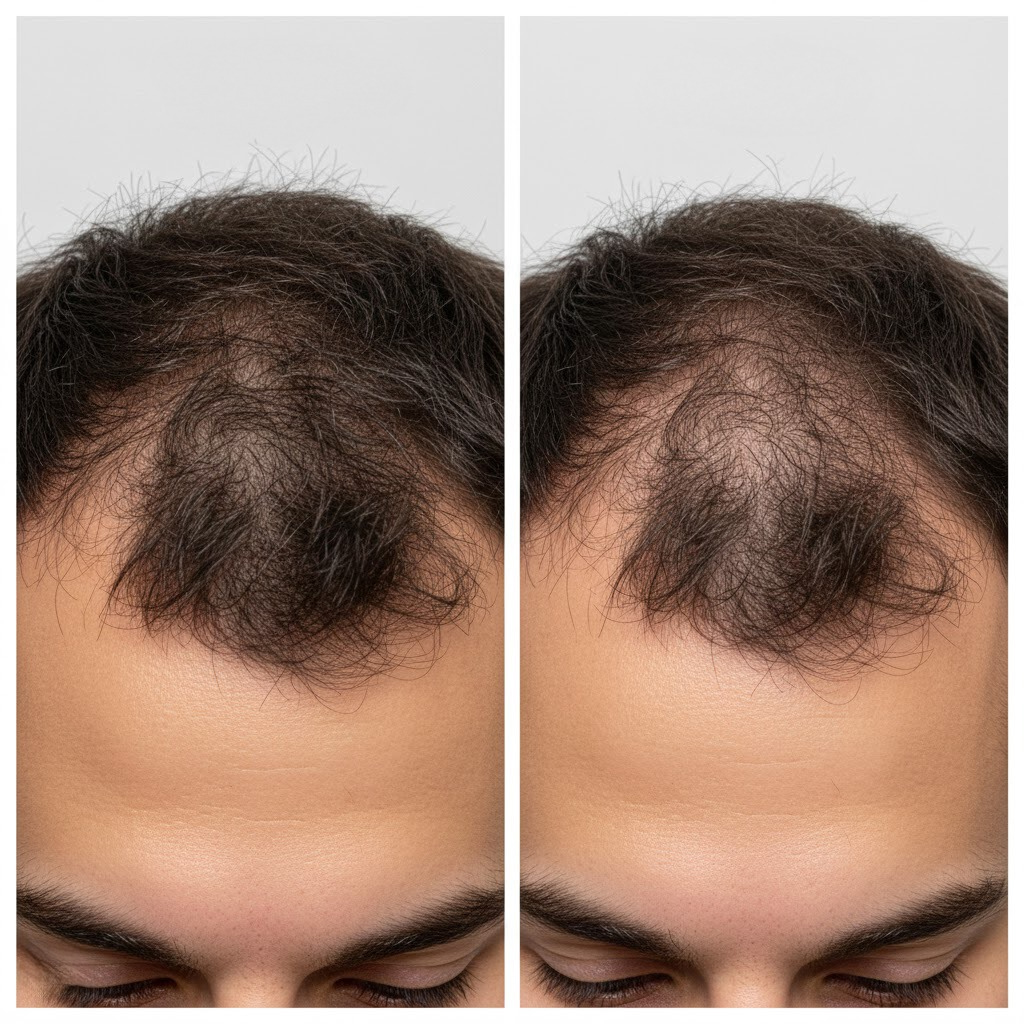
What Does Hair Look Like Before and After Cymbalta Hair Loss?
Before Cymbalta-induced hair loss, the hair typically appears normal in density and texture, reflecting each individual’s natural growth pattern. After hair loss begins, patients often notice diffuse thinning, wider part lines, and increased shedding, especially around the crown and temples. This condition aligns with telogen effluvium, where many follicles prematurely enter the resting phase due to medication-related neurochemical shifts.
How to Stop Hair Loss from Duloxetine?
Treating Duloxetine (Cymbalta)-induced hair loss involves addressing both the medication-related trigger and supporting the hair’s natural regrowth cycle. Below are key approaches explained in the context of drug-induced telogen effluvium.
- Medication Adjustment: If hair loss starts after beginning Duloxetine, consult your doctor about dose reduction or switching antidepressants. Effectiveness is high; regrowth usually begins within 3–6 months once the trigger is removed. It is needed when hair shedding is persistent and coincides with starting Duloxetine.
- Topical Minoxidil Therapy: Topical Minoxidil (2%–5%) helps restart the anagen (growth) phase in affected follicles. Effectiveness is moderate; visible regrowth in 3–4 months. It increases blood flow and prolongs the growth phase of follicles disrupted by neurotransmitter imbalance. It is needed when shedding continues despite medication adjustment.
- Nutritional and Hormonal Support: Deficiencies in iron, zinc, biotin, and vitamin D worsen telogen effluvium. Effectiveness is high if deficiency-related; improvement seen in 8–12 weeks. It restores nutrient levels critical for keratin and follicle metabolism. It is needed when blood tests show micronutrient deficiencies or fatigue.
- Low-Level Laser Therapy (LLLT): LLLT devices (caps or combs) use red light to stimulate cell metabolism and increase oxygen supply to follicles. Its effectiveness is clinically proven for diffuse shedding; results in 12–16 weeks. It reactivates dormant follicles and improves scalp circulation. It is needed as supportive treatment during recovery from Cymbalta-related hair loss.
- Stem Cell or PRP Therapy: In resistant cases, Platelet-Rich Plasma (PRP) or Stem Cell Therapy accelerate regrowth. Its effectiveness has a strong clinical success rate (70–80%) in medication-induced hair loss. Injected growth factors enhance follicular repair and restart anagen activity. It is needed for prolonged telogen effluvium (lasting more than 6 months).
Most patients recover hair density within 3–9 months after stopping Duloxetine or starting supportive treatments. In rare cases, regrowth takes up to one year, depending on follicle recovery and systemic balance.
How Effective is Hair Transplant for Treating Duloxetine Permanent Hair Loss?
Hair transplant is an effective and permanent solution for people who experience irreversible hair loss after taking Duloxetine.
Once the medication-related shedding (telogen effluvium) has stabilized, procedures such as FUE or DHI restore natural hair density using the patient’s own donor follicles. These transplanted hairs are resistant to the hormonal and neurochemical factors that triggered the original loss, offering long-term regrowth with a 90–95% success rate according to clinical outcomes.
Hair transplant is recommended 6–12 months after hair shedding stops, ensuring the scalp and follicles have fully recovered from Duloxetine-related effects.
Getting a hair transplant in Turkey is a popular choice due to its advanced techniques, high graft survival rates, and cost efficiency. Vera Clinic, known for its innovative Sapphire FUE and Stem Cell Hair Transplant methods, is recognized as the best hair transplant clinic in Turkey, offering scientifically supported results and faster post-surgery healing.
What to Expect Before and After a Hair Transplant for Duloxetine Hair Loss?
Before: your doctor confirms shedding is stable (typically 6–12 months), coordinates any medication changes, documents baseline photos, and assesses donor capacity to set realistic graft targets.
After: day 0–7: tiny scabs and redness; weeks 2–8: “shock loss” of transplanted hairs; months 3–4: stubble becomes new growth; month 6+: thicker coverage; month 12+: texture/pigment fully mature.
Check the hair transplant before and after photos here!
When to See a Dermatologist for Hair Loss due to Duloxetine?
You should see a dermatologist if hair loss continues beyond 3–6 months after starting or stopping Duloxetine, or if the shedding becomes sudden, patchy, or severe.
While mild diffuse shedding is common with Duloxetine-related telogen effluvium, persistent or aggressive loss signal follicular inflammation, autoimmune reactions, or secondary causes that require medical evaluation. Dermatologists perform trichoscopy, pull tests, and sometimes biopsies to confirm whether the cause is drug-related or another scalp disorder.
Severe symptoms needing medical attention:
- Rapid or patchy bald spots (possible alopecia areata)
- Shedding that exceeds 100–150 hairs per day for weeks
- Accompanying symptoms such as itching, burning, or scalp tenderness
- No visible regrowth after 6–9 months
- Hair loss accompanied by other systemic symptoms (fatigue, hormonal imbalance, thyroid dysfunction)
How is Duloxetine Hair Loss Diagnosed?
Duloxetine hair loss is diagnosed by linking the onset of shedding to the start of the medication and excluding other causes like hormonal or nutritional deficiencies. A dermatologist or hair transplant consultation confirms it through scalp examination, trichoscopy, or a pull test.
How can Trichoscopy help Diagnose SSRI-Induced Hair Loss?
Trichoscopy helps confirm drug-induced telogen effluvium from SSRIs by showing diffuse empty follicular openings, numerous short “upright regrowing” hairs, and largely uniform shaft diameter, matching a shedding pattern rather than follicle miniaturization.
Expansion: It also rules out other causes (e.g., androgenetic alopecia shows >20% hair-shaft diameter variability, miniaturized hairs, and perifollicular discoloration) thereby linking the timing of shedding to SSRI exposure and guiding treatment.
Which Other Types of SNRI Antidepressants Can Cause Hair Loss?
Several SNRIs besides Duloxetine have been linked to temporary or diffuse hair shedding, usually presenting as telogen effluvium; a reversible, non-scarring form of hair loss caused by neurotransmitter or hormonal imbalance.
1. Venlafaxine (Effexor)
Venlafaxine alters serotonin and norepinephrine levels in a way that disrupts the normal hair growth cycle. Hair loss reports are uncommon but documented in pharmacovigilance data.
2. Desvenlafaxine (Pristiq)
A metabolite of venlafaxine, Desvenlafaxine causes mild telogen effluvium within the first 3–6 months of use. Regrowth generally occurs after discontinuation or dose adjustment.
3. Levomilnacipran (Fetzima)
Levomilnacipran-related hair loss is rare, but case reports describe temporary shedding possibly linked to excessive noradrenergic activity affecting follicular signaling.
4. Milnacipran (Savella)
Primarily prescribed for fibromyalgia, Milnacipran leads to transient hair thinning. Its mechanism is thought to mirror other SNRIs by shortening the anagen phase through stress-hormone modulation.
What Antidepressants Don’t Cause Hair Loss?
While the List of Antidepressants that Cause Hair Loss are mild, temporary shedding, some are less likely to trigger telogen effluvium or have only minimal reports of hair loss. These options are better tolerated in individuals sensitive to drug-induced alopecia.
1. Bupropion (Wellbutrin): An NDRI (norepinephrine-dopamine reuptake inhibitor) that rarely affects serotonin pathways linked to hair growth disruption. Often chosen when patients experience hair loss with SSRIs or SNRIs.
2. Mirtazapine (Remeron): Acts as a noradrenergic and specific serotonergic antidepressant (NaSSA), enhancing mood through receptor modulation rather than reuptake inhibition; reducing the risk of follicle cycle interference.
3. Vortioxetine (Trintellix): A serotonin modulator and stimulator that fine-tunes receptor activity instead of drastically increasing serotonin levels, which helps maintain hair cycle stability.
4. Agomelatine (Valdoxan): Works via melatonergic and serotonergic receptor regulation rather than neurotransmitter reuptake; has minimal evidence of hair loss and even supports hair growth through circadian regulation.
5. Duloxetine Alternatives (Lower Risk SNRIs): Among SNRIs, Desvenlafaxine and Milnacipran are reported to have fewer hair loss cases compared to Venlafaxine or Duloxetine, possibly due to different serotonin-to-norepinephrine potency ratios.
Hair loss caused by depression itself stems from chronic stress and hormonal imbalance, leading to telogen effluvium through cortisol and cytokine changes; not drug metabolism. In contrast, antidepressant-induced hair loss occurs due to neurochemical alterations from medication, which are typically reversible once the drug is stopped or switched.
How Can Patients Prevent Hair Loss while Taking Cymbalta?
Preventing hair loss while taking Cymbalta (duloxetine) focuses on supporting follicle health, minimizing stress on the hair growth cycle, and monitoring medication effects early. While some shedding occurs as a temporary side effect, these evidence-based strategies can help reduce its severity and promote regrowth.
1. Monitor Hair Changes Regularly: Check for unusual shedding during the first few months of Cymbalta use. Early detection allows dose adjustments before hair loss worsens. (Etminan et al., Clinical Therapeutics, 2018)
2. Support Hair Growth with Nutrition: Maintain adequate iron, zinc, vitamin D, and biotin levels. These nutrients are essential for follicle strength and reduce telogen effluvium risk.
3. Use Topical Minoxidil: Applying 2–5% Minoxidil stimulates follicle activity and promote regrowth while continuing Cymbalta treatment.
4. Manage Stress Levels: Practice yoga, meditation, or scalp massage to lower cortisol, which controls shedding during antidepressant therapy.
5. Avoid Aggressive Hair Practices: Limit chemical treatments, heat styling, and tight hairstyles that strain already sensitive follicles.
6. Consider Medical Hair Therapies: Ask your dermatologist about PRP (Platelet-Rich Plasma) or Low-Level Laser Therapy (LLLT) to enhance recovery and circulation.
7. Consult a Dermatologist Early: If shedding persists for longer than 3–6 months, seek medical advice to confirm whether it’s medication-related or due to another cause.